
Tax Strategy
Apparel tariffs are in legal limbo: how to model landed cost and chase refunds in 2026
As of mid-2026 the durable US duty on Chinese apparel is roughly base plus 7.5% Section 301, around 24% on a cotton tee, not the 60% the old stack assumed. The big IEEPA layers were struck down and may be refundable, so rebuild your landed-cost model on what survives and check your refund window.
Key Takeaways
- The Supreme Court struck down the IEEPA reciprocal and fentanyl tariffs on Feb 20, 2026, so the layers that pushed China apparel toward 60% no longer apply going forward.
- Chinese apparel carries Section 301 at 7.5% (List 4A), not 25%. The 25% lists cover strategic goods, not consumer clothing.
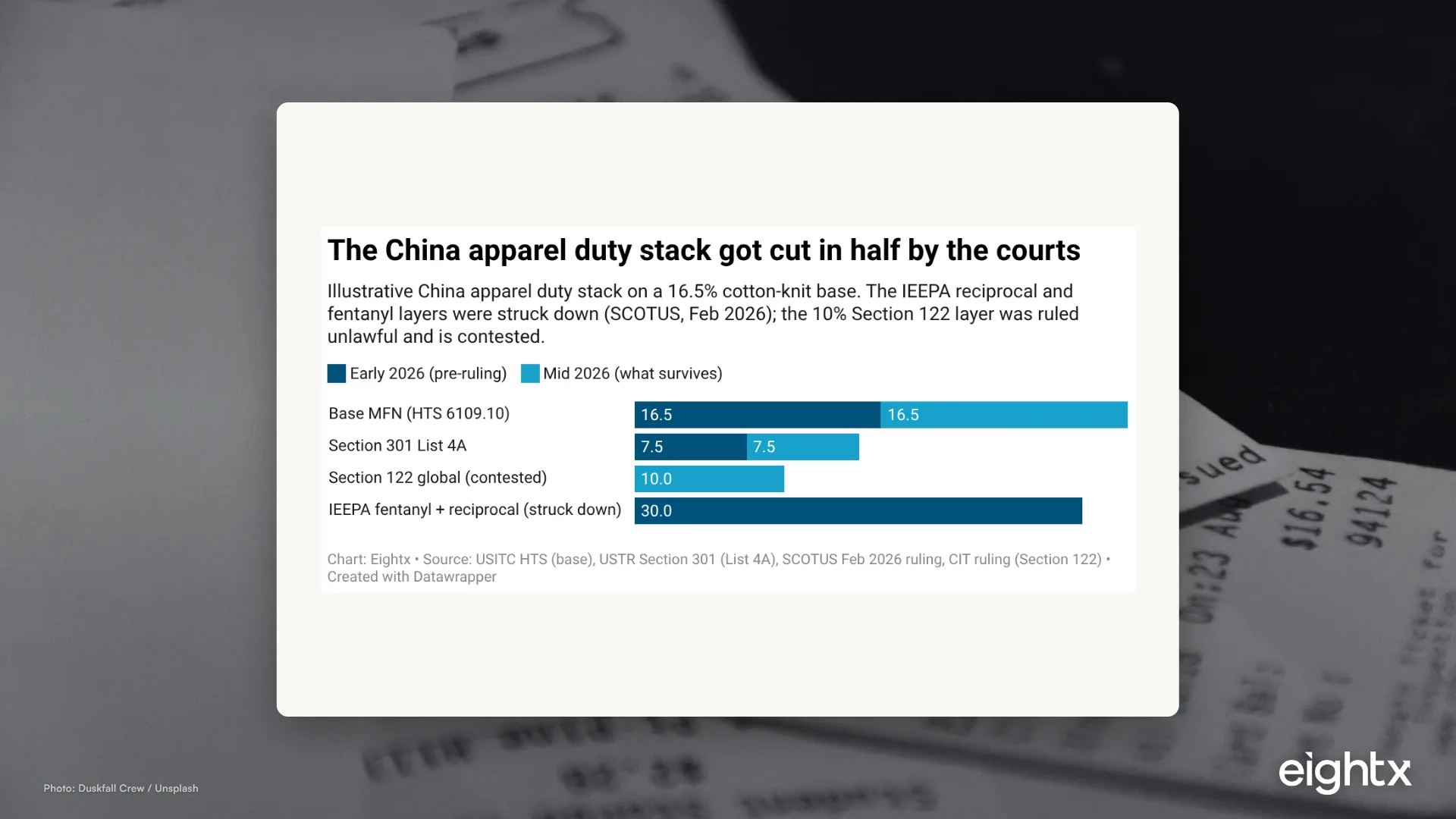
- The durable China apparel stack is now about 16.5% base plus 7.5% Section 301, near 24% all-in, plus a contested 10% Section 122 layer that a court has already ruled unlawful.
- There is a live tariff-refund window for IEEPA duties paid roughly April 2025 to February 2026, and it runs on liquidation deadlines, not press cycles.
- Vietnam now leads both knit (21.4%) and woven (20.7%) US apparel imports while China imports fell about 35.6% in value in 2025.
For 18 months the planning assumption for apparel brands was simple and grim. China landed cost was stacked toward 60%, and the only move on the board was to diversify sourcing toward Vietnam. As of June 2026 that picture has broken apart, and if your duty model still runs on last year's numbers you are planning off a rate that no longer exists in law.
Here is what actually happened. The Supreme Court struck down the IEEPA reciprocal and fentanyl tariffs in February. A replacement 10% Section 122 global tariff was itself ruled unlawful by the Court of International Trade. What durably survives on Chinese apparel is the long-standing Section 301 List 4A rate of 7.5% on top of the normal duty. So the operator decision is no longer "China or Vietnam" in the abstract. It is two concrete things: rebuild the landed-cost model on what survives in law, and figure out whether you are owed refunds on duties you already paid.
When I talk to founders running an apparel brand at this size, the thing they keep saying is that the tariff line landed before they had a model for it. They knew duty went up, they could feel it in the bank account, but nobody could tell them the real number per unit by origin. With the rules now changing by court ruling, planning off a stale stack is how you either overprice yourself out of the market or leave refund money on the table.
What actually changed: the apparel tariff stack after the 2026 rulings
Start with the number a founder cares about. The durable, surviving duty on Chinese apparel is roughly the base most-favored-nation (MFN) rate plus 7.5% Section 301, which lands a cotton tee near 24% all-in, not the ~60% the old stack assumed. That is a structural change, not a rounding tweak.
Three things drove it. First, the base MFN duty on a cotton knit T-shirt (HTS 6109.10.00) is 16.5% in the 2026 schedule, and that floor has not moved. Second, Chinese apparel carries Section 301 at 7.5% on List 4A, in place since the Phase One reduction in February 2020. The 25% Section 301 rates that people quote apply to strategic goods like EVs, batteries and magnets, not consumer clothing. Third, the layers that used to push the stack toward 60%, the IEEPA fentanyl and reciprocal tariffs, were struck down by the Supreme Court on February 20, 2026, and no longer apply going forward.
There is one live caveat. A 10% Section 122 global tariff imposed in late February sits on the entry summary today, but the Court of International Trade ruled it unlawful, with refund relief initially limited to named plaintiffs and appeals pending. So treat the 10% as real-on-paper but contested. The honest planning baseline is "base + 7.5% Section 301, plus a contested 10%."
The takeaway for your model is blunt. Apparel always sat at the high end because the base duty is already in the teens, but the IEEPA layers that made it look like a 60% problem are gone. Do not quote yourself last year's rate.
Rebuild your landed-cost model on what survives, not the headlines
A tariff is not a line item you note and move on from. It hits the same place as cost of goods, so it eats contribution margin before you have spent a dollar on ads. The model that matters is fully landed cost per origin, per SKU, with the duty line set to what actually survives in law.
Build it the same way for each candidate origin: FOB product cost, plus base MFN duty for the HS line, plus the surviving Section 301 layer (China only), plus the contested Section 122 layer if you choose to carry it, plus freight, insurance and customs brokerage. Divide by units for landed cost per unit, then subtract from price to see contribution margin. Customs itself is really two or three components: the duty, the brokerage fee, and processing. Book freight on its own line so your gross margin in the P&L and your inventory in the cash-flow statement stay honest.
The single most useful habit here came from an operator who imports from both Switzerland and Asia. He told me the biggest tariff impact "has been the volatility in it," the moving target, not any single rate. That is the through-line for this whole post: model the band, not the point. Run your stack at base + 301 alone, then again with the contested 10% on top, and price against the range.
| Origin | Base MFN | Section 301 | Section 122 (contested) | Illustrative all-in |
|---|---|---|---|---|
| China | 16.5% | 7.5% | 10% | ~34% (or ~24% without 122) |
| Vietnam | 16.5% | none | 10% | ~26.5% (or 16.5% without 122) |
| Bangladesh | 16.5% | none | 10% | ~26.5% (or 16.5% without 122) |
| Cambodia | 16.5% | none | 10% | ~26.5% (or 16.5% without 122) |
| India | 16.5% | none | 10% | ~26.5% (or 16.5% without 122) |
| Indonesia | 16.5% | none | 10% | ~26.5% (or 16.5% without 122) |
Are you owed a refund? The 2026 tariff-refund window
This is the most actionable section, so treat it as a "what to do this week" item. Importers who paid the IEEPA layers, roughly from April 2025 to February 2026, may be able to recover them now that those layers were struck down. The catch is that the claim window runs on your entry liquidation deadlines, not the news cycle.
The mechanics, as trade-law firms describe them in mid-2026, work in tiers. Unliquidated entries and entries liquidated within roughly the last 80 days can be pursued through CBP's process in ACE. Entries outside that window generally need a protective protest or a filing at the Court of International Trade to preserve the claim. The open question still being litigated is whether refunds flow automatically to all importers or only to those who filed. That uncertainty is exactly why you act now: preserving a claim is cheap, and missing a liquidation deadline is permanent.
What to do this week: pull your 2025 entry summaries, identify every line where an IEEPA layer was charged, and total the dollars. Then take that list to your customs broker or a trade attorney and ask which entries are still inside the window and which need a protest filed to stay alive. Do not wait for a CBP notice that tells everyone the refunds are automatic, because the deadlines do not pause while the litigation runs.
Where the goods actually come from now
The good news is that the industry already did most of the diversifying, so you are not pioneering anything. In full-year 2025, Vietnam was the single largest source of both knit and woven US apparel, while China slipped to roughly 14% of each. Vietnam led knit at 21.4% and woven at 20.7%. China sat at 14.1% of knit and 14.0% of woven. Bangladesh is the woven story, second only to Vietnam at 15.1% of that chapter. China apparel imports fell about 35.6% in value across 2025, the steepest drop since the pandemic.
| Origin | Knit (HS 61) share | Knit value | Woven (HS 62) share | Woven value |
|---|---|---|---|---|
| Vietnam | 21.4% | $9.65B | 20.7% | $7.12B |
| China | 14.1% | $6.36B | 14.0% | $4.81B |
| Bangladesh | 6.2% | $2.79B | 15.1% | $5.17B |
| Cambodia | 7.9% | $3.58B | 4.0% | $1.39B |
| India | 5.4% | $2.42B | 7.7% | $2.64B |
| Indonesia | 5.6% | $2.52B | 6.4% | $2.21B |
| Total all countries | 100% | $45.14B | 100% | $34.36B |
What this means for your sourcing plan: the supplier base in Vietnam, Bangladesh, India and Cambodia is deep and proven, so diversifying is a capacity decision you can execute, not a theory. Match the alternative to your fabric. Vietnam plus Cambodia is a credible knit pair; Vietnam plus Bangladesh is the woven pair. And do not try to route Chinese goods through a third country to dodge duty. The pattern we see again and again is the transshipment trap: ship China-made product through Canada or Mexico and you still pay, because the product still says made in China.
Absorb, pass through, or re-engineer COGS
Once your model reflects the surviving stack, you have three levers, and you should size all three rather than reaching for the first one.
The first is pricing. Model the contribution-margin hit if you absorb the duty, then the demand hit if you pass it through, using your own price elasticity rather than a guess. What works is building two small models side by side, one for the COGS effect and one for the demand effect, then deciding from the numbers. Watch the herd assumption too. As one founder put it, most companies sourcing from China "are all going to be having this conversation right now and they're all increasing their prices," which can give you room to hold, or punish you for moving alone.
The second lever is COGS engineering, and apparel needs it because the margins are thin. The honest band is roughly 50% to 65% gross, and as one operator framed it, "with beauty you can pull off 80-to-85% gross margin, and apparel, by the time you do wholesale, you're at 50% at least, or at best." When the margin is that tight, the fastest cash often comes from the SKU long tail, not the duty line. One brand carrying around 100 styles found it could cut roughly $500k of inventory in a year because half the catalog was not really contributing.
The third lever is working capital, and it is the one that quietly kills diversification. Switching factories front-loads inventory while you qualify the new supplier and hold a buffer in two countries at once. One brand I worked with was sitting on roughly 250 days of inventory; getting that toward the three-to-four-month range we usually recommend freed real liquidity. Fund the dual-country buffer out of the duty savings itself: hold the old origin for replenishment, qualify the new one on next season's buy, and let the recovered margin pay for the overlap.
The headline rate is not the number that moves your margin. After the 2026 rulings the durable China apparel duty is near 24%, not 60%, and the real China-versus-Vietnam gap is the 7.5% Section 301 line. Rebuild your model on what survives in law, run it as a band that includes the contested 10%, and pull your 2025 entry summaries to see if you are owed a refund. That turns a headline anxiety into a line you actually control.
What is next to watch
The legal picture is still moving, so build the model to flex. Three things are worth watching. The Section 122 appeal could either vacate the 10% for everyone, which collapses your stack to base + 301, or reinstate it broadly. The refund litigation will resolve whether IEEPA refunds are automatic or litigated-only. And a proposed Section 301 forced-labor overlay of 10% to 12.5% on countries including Bangladesh, Cambodia, India, Vietnam and China is on the table but not yet in force, the next real cost catalyst to watch.
The discipline that survives all of this is scenario bands, not point estimates. As I tell founders planning into uncertainty, you build a couple of models, one where the cost holds and one where it moves, and reality is somewhere between the two. Set your duty line to a range, re-run it every quarter against the latest ruling, and you stay decision-ready no matter which way the courts go.
Sources and methodology
Base duty figures are general column 1 (MFN) rates from the USITC Harmonized Tariff Schedule for apparel under HS chapters 61 and 62. We use 16.5% as a representative cotton knit T-shirt rate (HTS 6109.10.00); actual apparel rates range from free to over 32% by fiber and garment, with woven cotton lines often a few points higher than their knit equivalents. Classify each SKU to its own 10-digit line rather than assuming one rate across the catalog.
The Section 301 figure is the List 4A rate of 7.5% on China apparel and consumer goods, in place since the Phase One reduction from 15% in February 2020, per USTR Section 301 tariff actions. The 25% Section 301 rates apply to Lists 1 through 3 and strategic goods, not apparel. Roughly 70% of US textile and apparel imports from China are covered by at least one 301 list.
Tariff legal status is time-sensitive and was triangulated from trade-law coverage in May and June 2026. The IEEPA reciprocal and fentanyl tariffs were struck down by the Supreme Court on February 20, 2026. A 10% Section 122 global tariff imposed in late February was later ruled unlawful by the Court of International Trade, with refund relief initially limited to named plaintiffs and appeals pending. We present the surviving layers, base plus Section 301 plus the contested Section 122, as the planning baseline and treat the vacated country-specific reciprocal figures as historical, not current cost. This is a genuine live dispute: some sources still report the country-specific reciprocal layers as in effect under Executive Order 14257, and the refund litigation is precisely the fight over which reading holds. Re-verify the exact status with a customs broker or trade attorney before you ship a PO.
The refund mechanics, the roughly 80-day liquidation guidance and the protective-protest and Court of International Trade routes, come from trade-law firm guidance rather than a single primary CBP notice. Treat the specific deadlines as directional and confirm your own entry dates with a broker before relying on them.
Origin shares and values are US Census Bureau imports for consumption, full-year 2025, for HS chapters 61 and 62, pulled live this session (HS 61 total $45.14B; HS 62 total $34.36B). Shares are origin value divided by chapter total, accurate to roughly 0.1 point; the 14.0% and 14.1% China figures are chapter-level Census values, not the blended annual apparel share (which other reviews put nearer 13.7%). Full-year Census trade data may be revised after initial release. These figures are planning aids, not a substitute for a line-by-line HTS lookup with your customs broker.
This is the kind of structural margin work a fractional CFO for apparel brands should own, because it ties sourcing, working capital and pricing into one number.
Frequently asked questions
what is the actual tariff on apparel from china right now in 2026?
There is no single rate, but the durable stack is smaller than the headlines. On a cotton tee the base MFN duty is about 16.5% and Section 301 List 4A adds 7.5%, so roughly 24% all-in. A separate 10% Section 122 layer sits on the entry summary today but a court has already ruled it unlawful, so treat it as contested. The 50-to-60% numbers from 2025 included IEEPA layers the Supreme Court struck down.
wait, did the supreme court really cancel the reciprocal tariffs?
Yes. On February 20, 2026 the Supreme Court struck down the IEEPA reciprocal and fentanyl tariffs, which were the layers pushing China apparel toward 60% and adding 30-to-49 points on countries like Vietnam and Cambodia. Those layers no longer apply going forward. Re-verify the exact status before you ship a PO, because the refund mechanics are still being litigated.
can i get a refund on the tariffs i already paid in 2025?
Possibly. Importers who paid the IEEPA layers from roughly April 2025 to February 2026 may be able to recover them, but whether refunds are automatic for everyone or limited to importers who sued is still being fought out in court. The claim window runs on your entry liquidation dates, not the news cycle, so pull your entry summaries now rather than waiting for clarity.
how do i file a tariff refund claim and what's the deadline?
For unliquidated entries and entries liquidated within roughly the last 80 days, refunds run through CBP's portal in ACE. Outside that window you generally need a protective protest or a filing at the Court of International Trade. The specific deadlines come from trade-law guidance rather than one clean CBP notice, so get a customs broker or trade attorney to confirm your dates before you rely on them.
what is section 301 and does it apply to my clothing?
Section 301 is the China-specific tariff program. Apparel and consumer goods sit on List 4A at 7.5%, not the 25% you may have heard. The 25% lists cover strategic goods like EVs, batteries and magnets. Roughly 70% of US textile and apparel imports from China are covered by at least one 301 list, so most clothing lines carry the 7.5%.
is it still worth moving production out of china?
The math is different now. The durable China-versus-Vietnam gap is mostly the 7.5% Section 301 line, roughly 7 to 8 points, not the old 25-point chasm. That can still be worth chasing on high-volume lines, but only after freight, lead time and factory qualification are priced in. Most of the industry already moved, so the supplier base in Vietnam and Bangladesh is deep enough to execute against.
should i raise prices to cover tariffs or eat the cost?
Model both before you decide. Work out the contribution-margin hit if you absorb the duty, then the demand hit if you pass it through using your own price elasticity. The trap is assuming everyone holds prices while you raise yours, or the reverse. With duty in legal flux, model a band of outcomes rather than a single point estimate.
what's a normal gross margin for an apparel brand?
Apparel runs lean compared with categories like beauty. By the time you account for wholesale, a typical apparel brand is at roughly 50% gross margin at best, often 50% to 65% on the direct-to-consumer side. That thin band is exactly why the duty line matters so much: a few points of tariff lands straight on contribution margin.