
Financial Strategy
AU CFO salary vs fractional 2026: A$420k-A$1m all-in for full-time, A$3k-A$15k/month for fractional
A full-time Australian CFO costs A$420k to A$1m all-in for year one once 12% super, payroll tax, STI at target, and a 25 to 35% retained-search fee stack onto base. A fractional CFO runs A$3k to A$6k/month under A$10M revenue, A$6k to A$12k at A$10 to 30M, and A$12k to A$20k+ above that.
Key Takeaways
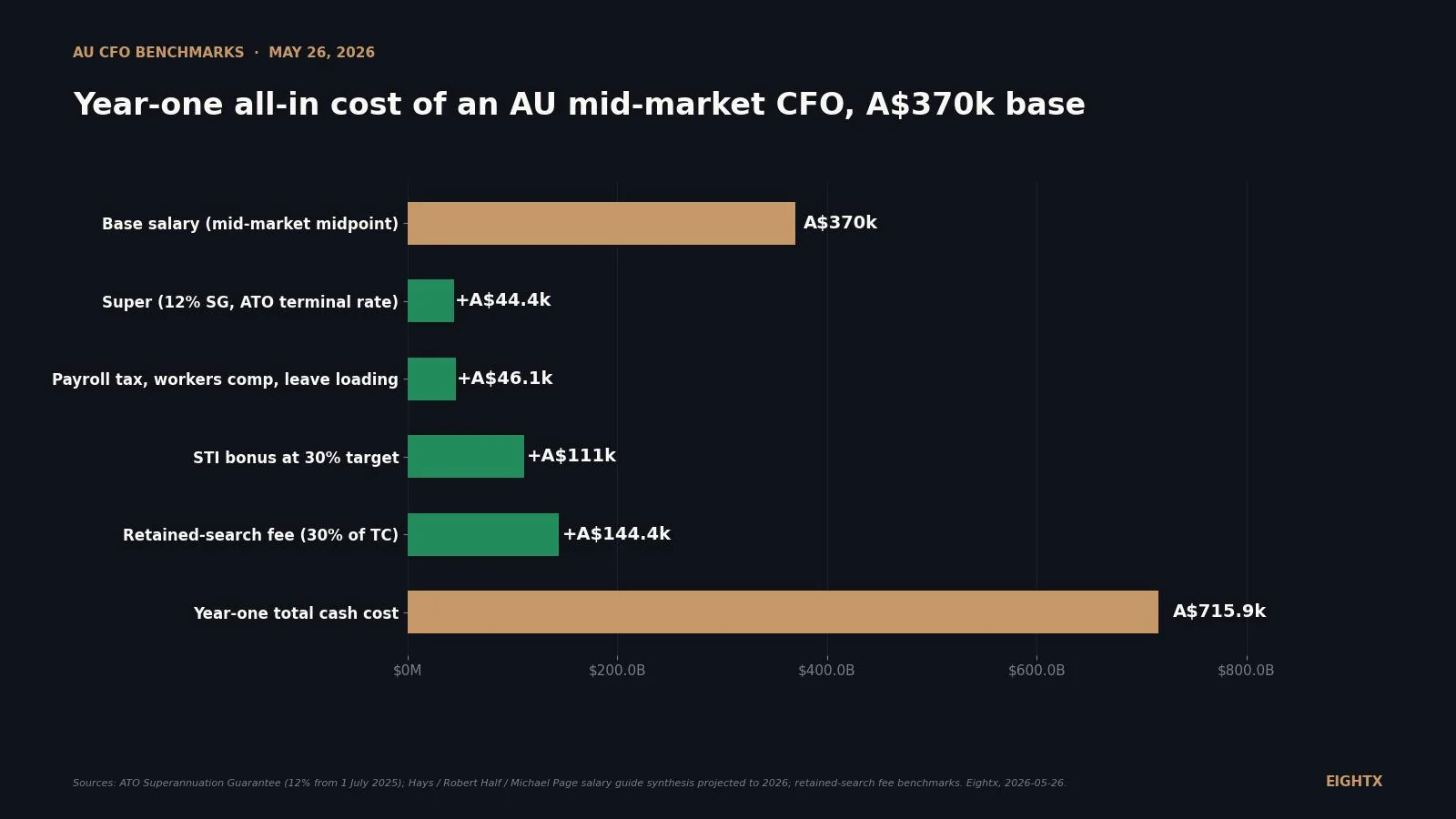
- The number on the offer letter is roughly half the year-one cost. A mid-market AU CFO at A$370k base lands at about A$715k year one once 12% super, payroll tax and leave loading, STI at target, and a 30% retained-search fee are stacked on top.
- The ATO Superannuation Guarantee is 12% from 1 July 2025, and the ATO confirms this is the final scheduled increase. That adds A$36k to a A$300k base and A$48k to a A$400k base before any other on-costs.
- Indicative 2026 base bands by company size: small (under A$50M revenue) A$240k-A$340k, mid (A$50-200M) A$310k-A$430k, large (A$200M-1B) A$370k-A$600k. Sydney sits at the top of band, Brisbane and Perth roughly 10% behind.
- Fractional CFO engagements in Australia run A$3k-A$15k per month per the Scale Suite and Eagle Rock CFO industry reports, with senior practitioners at A$300-A$450/hr. Scope covers strategic finance (forecasting, fundraising, board reporting) but not bookkeeping or BAS.
- Under A$30M revenue the math rarely clears for full-time unless a capital raise is on the table in the next 12 months. The cost of a mis-hire within 18 months sits at 100-200% of total annual comp per SHRM and AU HR benchmarks.
If you're an Australian ecommerce or consumer-products founder running A$10M to A$200M in revenue, a version of the same question is sitting on your desk: do I need a full-time chief financial officer (CFO), or can a fractional engagement do the job for the next 18 months? The recruiter salary guides quote big numbers, your accountant quotes their own number, and nobody puts the all-in math in one place.
This post does. We pull the public salary-guide bands, the ATO Superannuation Guarantee (SG) rate, the typical short-term incentive (STI) targets, and the published Australian fractional CFO industry rates into one comparable view. We won't publish our own pricing here, because the goal is for you to do the math on your situation, not ours.
The number on the offer letter is half the actual cost
Take the simple case: a mid-market AU CFO offer letter shows A$370,000 base salary. That's the recruiter-guide midpoint for a A$50-200M revenue business in 2026.
Now stack the year-one costs that the offer letter doesn't show. The ATO Superannuation Guarantee is 12.0% from 1 July 2025, the legislated terminal rate, which adds A$44,400. Payroll tax (state-dependent, 4.75-5.5% above the threshold), workers compensation (about 2%), and leave loading and other on-costs add roughly A$46,000 in cash terms. STI at a 30% mid-market target adds A$111,000 if the plan pays at target. A retained executive search at 30% of total cash compensation adds another A$144,420 as a one-off year-one cost.
That puts the year-one all-in cost at about A$716,000 for a CFO whose base salary is A$370,000. Year-two recurring (no recruitment fee) sits at A$571,000.
The pattern holds at every company size. A small-company CFO at A$290k base lands at roughly A$525k year one. A large-company CFO at A$485k base lands above A$1 million.
The recruiter-guide salary band is the input, not the answer. By the time you've layered 12% super, on-costs, STI at target, and a one-off retained-search fee, the year-one all-in cost is roughly 1.8x to 2.1x the base number on the offer letter. Plan the budget against the all-in figure, not the headline.
What the recruiter guides actually say about AU CFO base salary
The three primary sources for Australian CFO base salary are Hays, Robert Half, and Michael Page. All three publish annual salary guides. As of May 2026 the current editions (Hays FY25/26, Robert Half 2026, Michael Page 2026) are registration-gated behind a contact form on the publisher's website.
The bands below are an Eightx synthesis of the prior published editions (2023-24) with a 7-10% compound uplift applied to project 2026 levels. Public lower-bound sources like PayScale Australia (median A$172,068 base, n=352, updated May 2026) and Indeed Australia (average A$169,662, n=120) run materially below the recruiter-guide bands because they're self-reported and skew toward smaller-company Head of Finance titles labelled CFO. The recruiter guides skew enterprise. The truth sits between, weighted by company size.
City Small (under A$50M) Mid (A$50-200M) Large (A$200M-1B) Sydney A$260k-A$340k A$320k-A$430k A$420k-A$600k Melbourne A$240k-A$320k A$310k-A$410k A$400k-A$560k Brisbane A$220k-A$300k A$290k-A$380k A$370k-A$520k Perth A$220k-A$300k A$290k-A$380k A$370k-A$520k
Two things to note. First, the Sydney-Melbourne premium is real but smaller than founders expect (roughly 5%). The bigger gap is between the eastern-seaboard cities and Brisbane / Perth, which trail by 10% in commercial roles. Perth runs at or above Sydney for resources-sector CFOs, which is a separate market.
Second, the small-company band overlaps materially with the senior Financial Controller and Head of Finance band. If your business is under A$30M revenue and you don't have an obvious capital-raise or M&A calendar, a strong Head of Finance plus a fractional CFO often covers the same scope at half the cost.
The 12% super, STI and recruitment fee math
The three line items founders underestimate when they look at the salary guide and start budgeting.
Superannuation Guarantee at 12%. The ATO confirmed in its small-business newsroom that 12.0% effective 1 July 2025 is the final scheduled SG rate increase. No further rises are legislated. For salary planning that means the rate is settled for the foreseeable future. It also means the gap between gross salary and total compensation packaged is now larger than founders who last hired in the 9.5% era expect.
STI bonus targets. A typical mid-market CFO STI plan targets 25-40% of base salary, with 50-60% in the upper quartile. ASX-listed companies push the target higher (35-60%) and add long-term incentive (LTI) grants on top, typically 50-100% of base in grant-date value. At the smaller end, private companies under A$50M often run 15-30% target STIs and many have no formal STI plan at all (the bonus is discretionary, declared after year-end).
Recruitment fees. Two models dominate. Contingent search (pay only if the hire is made) runs 15-25% of first-year base salary, more common at the small-company end. Retained search (paid in tranches whether the hire is made or not, with longer guarantees and dedicated researcher time) runs 25-35% of first-year total cash compensation, which is base plus STI at target. For a CFO at A$300k base plus A$60k STI target (A$360k total), a 30% retained search is A$108k. For a A$400k base plus A$120k STI (A$520k total), it's A$156k.
The worked example below pulls all of this together for the mid-market case.
Cost component Amount (AUD) Note Base salary A$370,000 Mid-market midpoint, 2026 projection Super (12% SG) A$44,400 ATO FY26 rate, legislated terminal Payroll tax (5.45% NSW above threshold) A$20,165 State-dependent; NSW rate shown Workers compensation (about 2%) A$7,400 Industry-rate dependent Leave loading and on-costs (about 5% cash) A$18,500 Excludes accrual-only items STI bonus at target (30% of base) A$111,000 Target; actual depends on plan outcome Recruitment fee (30% retained search of TC) A$144,420 One-off year-one cost Year-one total cash cost A$715,885 Excludes onboarding ramp productivity loss Year-two recurring cost (no recruitment fee) A$571,465 Cash-out basis
What an AU fractional CFO actually covers (and what it doesn't)
The Australian fractional and virtual CFO market is fragmented, and most providers don't publish rate cards. The two that do (Scale Suite and Eagle Rock CFO via their 2026 industry report) give us a defensible band.
Hourly rates run A$150-A$400 for general practice, A$300-A$450 for senior practitioners with 10+ years of CFO-level experience, and A$450-A$600 for specialists with 20+ years and a defined niche (M&A, capital raise, turnaround).
Monthly retainers structure the relationship around scope rather than hours. The published bands cluster like this:
- Under A$10M revenue: A$3,000-A$6,000 per month. Light-touch advisory, monthly board pack, quarterly forecast refresh, one strategic call a week.
- A$10-30M revenue: A$6,000-A$12,000 per month. Embedded fractional, weekly cadence, full board pack ownership, rolling 13-week cash forecast, capital planning.
- A$30-100M revenue: A$12,000-A$20,000+ per month. Senior partner plus an analyst or controller pairing, multiple weekly touchpoints, deep involvement in capital raise or M&A workstreams.
Scope is where the comparison with full-time gets honest. A fractional CFO engagement (per the industry-published descriptions) typically covers strategic finance leadership: forecasting, scenario planning, KPI dashboards, fundraising support, board reporting, capital-stack design, and senior advice on hiring the rest of the finance team. It generally does not cover bookkeeping, payroll, BAS lodgement, tax returns, or day-to-day accounts payable. Those sit with an external accountant, an internal controller or finance manager, or both.
A full-time CFO at A$370k base does the strategic work too, but you're also paying for availability (40+ hours a week vs typically 5-10 in a fractional retainer) and for the bandwidth to build and manage the rest of the finance team in-house. The fractional cost gap is real because the scope and availability gap is real.
Note the gap. At sub-A$10M revenue, full-time runs roughly 10x the cost of a fractional engagement. At A$100-200M, it's still 3-4x. The differential narrows but never closes, because availability and direct team management never become free.
The break-even math: when does a full-time CFO clear its A$500k+ all-in cost?
The decision frame for an Australian ecommerce or consumer-products operator running A$10M to A$200M:
Under A$30M revenue. The math rarely clears for full-time unless you have a defined capital raise or transaction calendar in the next 12 months that needs a dedicated in-house finance leader for due diligence. A strong Head of Finance (A$180-A$240k all-in) plus a senior fractional CFO at A$6-12k per month covers the same scope at less than half the cost.
A$30M-A$100M revenue. This is the awkward middle. The full-time call depends on operational complexity: multi-entity, multi-currency, inventory finance, debt covenants, and how active your capital plan is. Many businesses at this size run a part-time CFO plus a full-time Financial Controller for 2-3 years before the full-time CFO hire becomes obvious.
A$100M+ revenue with an M&A or IPO calendar. Full-time usually wins. The bandwidth to build a finance team, sit on the executive committee, and own investor or board relationships justifies the A$700k-A$1m+ all-in cost.
The risk founders underestimate is the cost of getting the hire wrong. SHRM and Australian HR research benchmarks put senior executive replacement cost at 100-200% of total annual compensation. For a mid-market CFO at A$350k all-in, the midpoint is roughly A$525k in direct costs (recruitment redo, signing bonus, severance) plus a 3-6 month productivity loss valued at A$44-88k. That cost effectively doubles your year-one CFO budget if the hire leaves inside 18 months.
The practical implication: a 6-12 month fractional engagement before the full-time hire (covering scope, candidate calibration, and team build) often pays for itself by reducing the probability of a mis-hire. That's not a recommendation specific to any provider, it's the structure most of the published industry reports recommend independently.
Sources and methodology
Primary public sources used. ATO, The final SG rate increase is coming on 1 July, confirming 12.0% effective from 1 July 2025 as the final scheduled SG rate. PayScale Australia CFO salary page (accessed 2026-05-25, n=352). Indeed Australia CFO salary page (n=120, May 2026). Scale Suite, Virtual CFO Australia Complete Guide 2026. Scale Suite, Cost to Hire Finance Manager Australia 2026. Eagle Rock CFO, Fractional CFO Industry Report 2026. Robert Half Australia CFO recruitment page. APB Strategy, Retained vs Contingent Executive Search (Australia). HelloLedger, True Cost of Hiring a New Employee (Australia).
Salary-guide projection method. The Hays Salary Guide FY25/26 Australia, Robert Half Salary Guide 2026 Australia, and Michael Page Australia Salary Benchmark 2026 are all registration-gated as of May 2026. The bands cited here are an Eightx synthesis of the prior published editions (Hays 2023-24, Robert Half 2024, Michael Page 2023-24) with a 7-10% compound uplift applied to project 2026 levels. This is disclosed transparently because the projection is defensible (CFO comp inflation has run mid-single-digits annually across all three sources for the past five years) but it is not a direct quote from the 2026 editions.
On-cost calculations. Super at 12.0% per the ATO terminal rate. Payroll tax shown at NSW 5.45% above the A$1.2M annual wages threshold; other states differ (VIC 4.85%, QLD 4.75%, WA 5.5%, SA 4.95%). Workers compensation modelled at 2%, which is a rough mid-point across industries (lower for office-based finance roles, higher in manufacturing or warehousing). Leave loading and other on-costs at 5% of base in cash terms (this excludes annual-leave and long-service-leave accruals, which are real liabilities but don't show up as year-one cash outflow).
STI and recruitment-fee benchmarks. STI prevalence and target percentages synthesized from Australian Institute of Company Directors (AICD) executive compensation reporting plus the Robert Half AU CFO commentary. Recruitment-fee bands cross-referenced between Hunter Recruiting (US benchmark) and APB Strategy (Australia-specific). Australian retained-search practice is consistent with US for top-tier searches; contingent search is more competitive in Australia (15-20% more common than the 25% upper bound).
Fractional CFO band sources. Scale Suite and Eagle Rock CFO are two of a small number of providers that publish their rate cards or industry-survey data. The bands cited are the midpoints of the published ranges. Most Australian fractional CFO providers don't publish pricing, so these benchmarks should be treated as the well-documented end of the market rather than the only end.
Mis-hire cost benchmark. SHRM (Society for Human Resource Management) and Australian HR research consistently put senior executive replacement cost at 100-200% of total annual compensation. The figure includes direct recruitment costs, severance and signing-bonus losses, vacancy productivity loss, and onboarding ramp on the replacement. We've used the midpoint (150%) in worked examples.
Update cadence. This benchmark is refreshed every 12 months, in July, when Hays, Robert Half, and Michael Page release their new editions at the start of the Australian financial year. Next update target: July 2026.
For the wider Australian ecommerce finance context, see our Australian ecommerce finance benchmarks and interim CFO services overview.
Frequently asked questions
what does a full-time cfo actually cost in australia in 2026, not just base salary?
Add roughly 35-45% to the base salary you see in a Hays or Robert Half guide. For a A$300k base small-company CFO, year-one all-in lands around A$420-A$525k once 12% super, payroll tax, workers comp, leave loading, STI at target, and a retained-search fee are included. For a A$400k base mid-market CFO it lands at A$560-A$725k.
what's the super guarantee rate for cfo salaries in fy26?
12.0%. The ATO confirms 12% is the final scheduled SG rate, effective from 1 July 2025, with no further increases legislated. That adds A$36k to a A$300k base CFO and A$48k to a A$400k base before any other on-costs.
how much do recruiters charge to find a cfo in australia?
Contingent executive search runs 15-25% of first-year base salary. Retained executive search runs 25-35% of first-year total cash compensation (base plus STI). For a A$300k base plus A$60k STI = A$360k total, a 30% retained search costs about A$108k one-off in year one.
how much does a fractional cfo cost per month in australia?
Published industry bands sit at A$3-6k per month for businesses under A$10M revenue (light-touch advisory), A$6-12k per month for A$10-30M revenue (embedded weekly cadence), and A$12-20k+ per month for A$30-100M revenue with more complex finance ops. Senior practitioners bill A$300-A$450 per hour outside retainers.
at what revenue should i hire a full-time cfo vs stay with a fractional?
Under A$30M in revenue, the full-time math rarely clears unless a capital raise or transaction is on the table in the next 12 months. A$30-100M is the awkward middle where the call depends on complexity (multi-entity, multi-currency, inventory finance). Above A$100M and with a real M&A or IPO calendar, a full-time CFO usually wins on availability and team-building bandwidth.
what's the typical sti bonus for a cfo in a mid-market australian company?
25-40% of base salary at target, with 50-60% in the upper quartile. Small private companies under A$50M often run 15-30% targets or no formal STI plan at all (discretionary bonus only). ASX-listed and PE-owned businesses are at the top of the range with formal scorecards and LTI grants stacked on top.
what's actually included in a fractional cfo retainer at a$6k to a$12k per month?
Per the Scale Suite and Eagle Rock industry reports, a typical embedded fractional CFO covers strategic finance leadership: rolling 13-week cash forecast, monthly board pack with KPI commentary, fundraising and capital-stack planning, scenario and budget modelling, and senior partner attendance at one weekly leadership meeting. It generally excludes bookkeeping, payroll runs, BAS lodgement, and tax returns, which sit with an accountant or controller.
how much does it cost if i hire a cfo and they leave within 18 months?
SHRM and Australian HR research benchmarks put replacement cost at 100-200% of total annual compensation for senior executive roles. For a A$350k all-in CFO, the midpoint is roughly A$525k in direct costs plus A$44-88k of vacancy productivity loss across a 3-6 month gap. That's the case for taking the hire-vs-fractional decision slowly.