
eCommerce
The Australian Shopify landscape 2026: 152,323 stores, 3,653 on Plus, and the most Afterpay-saturated market on Earth
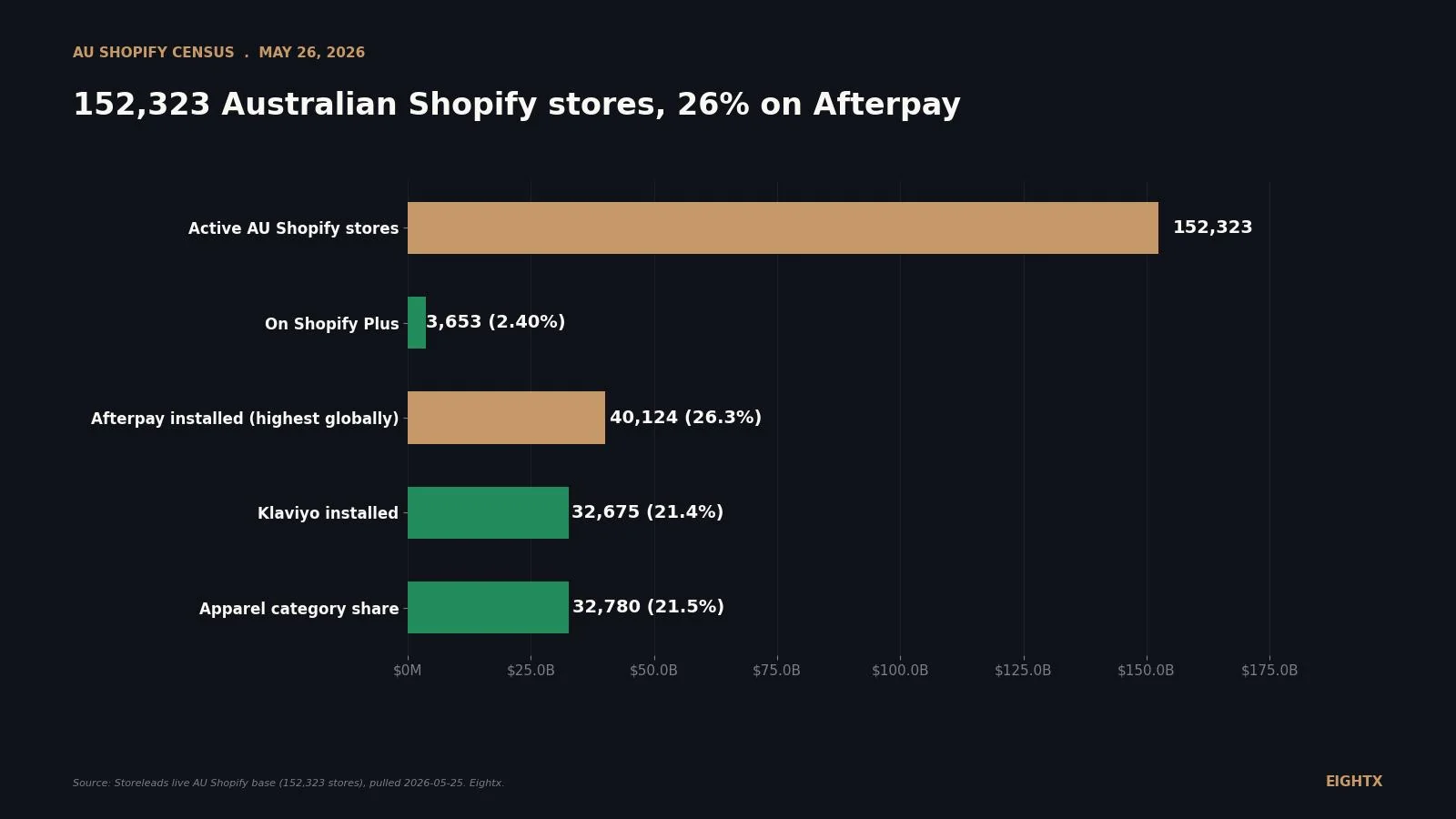
Key Takeaways
- Australia has 152,323 active Shopify stores. 3,653 of them (2.40%) are on Shopify Plus, slightly above the global Plus density of 2.10%. AU is a Shopify-dominant market: Shopify out-counts WooCommerce by 1.82 to 1.
- Afterpay sits on 26.3% of AU Shopify stores (40,124 installs). That is the highest BNPL penetration of any Shopify market on Earth. If your AU brand does not have Afterpay at checkout, you are an outlier and your conversion rate is showing it.
- Klaviyo runs marketing on 21.4% of AU Shopify (32,675 stores). Mailchimp is on 7.6%. Klaviyo's penetration in AU is 2.8 times its nearest paid competitor; treat it as the default, not a brave choice.
- Apparel is 21.5% of the base (32,780 stores). Only six top-level categories crack 4%. Long tail is heavy: if you are not in Apparel, Home and Garden, Beauty, or Food and Drink, you are in a small category in absolute terms.
- Dawn is on 12.5% of AU Shopify stores (19,095 installs). On Plus specifically, ~79% of brands run custom or unidentifiable themes. Free Dawn wins the long tail; custom builds win the named-brand layer.
If you sell on Shopify in Australia, the question "where do I sit versus the rest of the market" has never had a clean answer. ABS retail trade data is useful for the macro but does not tell you anything about plan mix, theme choice, or whether your tech stack is normal. Storeleads, the paid stack-detection service, will tell you, but the data is locked behind paid seats. This post pulls the whole AU Shopify landscape from Storeleads' live API on 2026-05-25 and makes it free to reference. Every number that follows comes from the same pull.
The short version: Australia has 152,323 active Shopify stores. 3,653 of those are on Shopify Plus (2.40% of the AU base, a touch above the global 2.10% Plus share). Apparel is the dominant category at 21.5% of stores. Klaviyo is the default marketing tool at 21.4% penetration. And Afterpay sits on 26.3% of AU Shopify stores, which makes Australia the most BNPL-saturated Shopify country market on the planet.
How big is the Australian Shopify base, really?
Storeleads counts 152,323 active AU Shopify stores as of 2026-05-25. "Active" here means the domain is currently responding to a HEAD request and Storeleads' fingerprinter can confirm Shopify on the backend. BuiltWith, which detects Shopify code at any point during its crawl history, reports 171,387 AU Shopify stores. The gap (about 19,000 stores) is parked or dead domains that still carry Shopify code on cached pages.
For benchmarking, Storeleads is the right number. It is the live competitor set. BuiltWith is the right number when you want a ceiling on how many AU brands have ever touched the platform. Both numbers move a few thousand week to week.
Australia is also a Shopify-dominant market: WooCommerce has 83,784 live AU stores by the same Storeleads pull. Shopify out-counts WooCommerce in AU by 1.82 to 1, which is roughly twice the global Shopify-to-WooCommerce ratio. If a competitor in your category is on WooCommerce in AU, they are unusual.
3,653 of those 152,323 AU Shopify stores sit on Shopify Plus. That works out to 2.40% of the AU base, just above the 2.10% global Plus share. AU over-indexes on Plus by roughly 14%, which lines up with the country's concentrated brand layer: more than two dozen named AU DTC brands (The Oodie, JB Hi-Fi, Aje, BlackMilk, Tony Bianco, Bydee, DISSH, MCoBeauty, Ally Fashion, Peppermayo and others) all sit on Plus.
One honest caveat: Storeleads does not distinguish the three non-Plus tiers (Basic, Shopify Standard, Advanced Shopify) reliably. Plus is the only plan it can confirm via TLS and back-end fingerprinting. That is why the chart above shows a two-bucket split. We treat 148,670 as the combined non-Plus universe.
What Australians sell on Shopify
Apparel is the dominant vertical at 21.5% of AU Shopify stores (32,780 stores). That is roughly 1 in 5 stores selling clothes. Home and Garden is second at 12.9% (19,650 stores), followed by Beauty and Fitness at 10.0% (15,283), Food and Drink at 8.1% (12,299), Sports at 4.7%, and Health at 4.7%. Everything else sits below 4%.
The long tail matters. Only six top-level categories crack the 4% threshold. If you sell pet products, autos, business and industrial goods, books, or consumer electronics, you are in a small category in absolute terms (between 1,000 and 5,000 stores each). That has two implications. Your competitor set is small enough that you can probably name them. And your category-specific app ecosystem is shallower than it would be in Apparel or Beauty, so you carry more "we built it ourselves" tech than the larger verticals.
A note on the taxonomy: Storeleads uses Google's product category schema and a store can appear in more than one category. The shares above sum to less than 100% because many stores have no category assigned. This is a taxonomy breakdown, not a revenue breakdown; Apparel's 21.5% store share probably understates Apparel's revenue share of AU Shopify GMV, because the named Plus brands skew Apparel.
The Australian Shopify tech stack: what is actually installed
This is the chart most operators want to see. Penetration of named apps and technologies across the 152,323-store AU Shopify base.
Three things stand out.
Apple Pay (67.3%), Shop Pay (66.6%), Google Pay (65.7%) and PayPal Express (57.2%) are each on more than half of AU Shopify stores. If your AU checkout does not have all four wallets enabled, you are giving away conversion to competitors who do. Wallet penetration this high means AU shoppers expect to see them and the friction of typing card details has effectively become an opt-in behaviour.
Afterpay sits on 26.3% of AU Shopify (40,124 installs). This is the highest BNPL penetration of any Shopify country market on Earth. Klarna is a distant 1.3% (2,054 installs) and Affirm is essentially absent on AU Shopify. The home-court effect is real: Afterpay is an Australian company, AU shoppers were trained on the product first, and the AU merchant base has built around it. If you are an AU brand without Afterpay at checkout, you are a quarter-of-the-market outlier. Re-check your unit economics and put it back on.
Klaviyo runs marketing on 21.4% of AU Shopify (32,675 stores). Mailchimp is on 7.6%. Omnisend is on 2.4%. Klaviyo's AU penetration is 2.8 times its nearest paid competitor. Treat it as the default, not a brave choice. Same story with Judge.me at 17.2% on reviews and Microsoft Clarity at 11.3% on heatmap analytics; Clarity has displaced paid tools like Hotjar and Triple Whale (1.6%) as the AU default in the last 18 months, almost entirely because it is free.
One known gap: we could not confirm A2X, Cin7, Unleashed or DEAR penetration via Storeleads on this pull. The Storeleads app tokens for those specific accounting and inventory apps either returned zero or returned the full 152,323-store base (silently no-op). We've flagged that in the methodology section below and we'll backfill it in a follow-up post when we cross-reference the Shopify App Store install counts directly.
Themes: free Dawn wins the long tail, custom builds win Plus
Theme detection is less reliable than tech detection because most Plus brands rename their theme file to disguise the lineage, but for the broader AU base the signal is clean.
Dawn (Shopify's current free default) sits on 12.5% of AU Shopify stores. The legacy free themes (Debut, Brooklyn, Narrative, Supply, Minimal, Venture) collectively still appear on more stores than every paid theme combined, and that pool is mostly older stores that have not migrated to the Online Store 2.0 architecture Dawn requires. If you are still on Debut or Brooklyn in 2026, that is legacy debt and you are leaving page-speed and check-out features on the table.
Paid themes (Impulse at 2.3%, Prestige at 2.3%, Symmetry at 0.7%, Empire at 0.6%, Broadcast at 0.8%, Warehouse at 0.9%) carry far less of the AU base than they do of the AU GMV. On Shopify Plus specifically, the picture flips: only about 21% of AU Plus stores run a detectable theme (Dawn 9.7%, Prestige 4.0%, Impulse 3.4%, Broadcast 1.9%, Symmetry 1.3%, Empire 0.9%). The remaining ~79% of AU Plus stores run a custom theme or have renamed an Impulse/Prestige starter so the lineage is no longer detectable. That custom-theme share is the cleanest signal Storeleads gives us that a store is a serious AU DTC brand.
The named flagship AU Shopify Plus brands
Working from the Storeleads global rank sorted within AU Plus, the named brand layer is dominated by Apparel, Beauty and Consumer Electronics. The table below captures the top 26 by rank as of the 2026-05-25 pull. Employee counts are LinkedIn-derived and accurate to within ~10%.
Brand Domain Vertical Employees Simify (Travel SIMs) simify.com.au Consumer Electronics n/a Threadheads (Graphic Tees) n/a Apparel / Casual 25 The Oodie theoodie.com Apparel 70 JB Hi-Fi jbhifi.com.au Consumer Electronics 3,586 BlackMilk Clothing blackmilkclothing.com Apparel / Women's 51 Aje International aje.com.au Apparel 328 Tony Bianco tonybianco.com Apparel / Footwear 58 Bydee AU bydee.com Apparel / Swimwear 40 Sukin (Organic Skin Care) n/a Beauty / Skincare 52 Ally Fashion allyfashion.com Apparel 220 Billy J billyj.com.au Apparel / Women's 43 MCoBeauty mcobeauty.com Beauty / Cosmetics 93 HTC VIVE Australia n/a Consumer Electronics 453 Kat The Label n/a Apparel / Lingerie 15 Peppermayo peppermayo.com Apparel / Women's 85 KitchenAid AU n/a Home and Garden 48 Happy Mammoth happymammoth.com Beauty / Wellness 96 DISSH dissh.com.au Apparel 226 ALDI Mobile aldimobile.com.au Consumer Electronics n/a BRONZE SNAKE n/a Apparel 12 Hismile hismileteeth.com Health / Oral 109 Thrills Co. thrillsco.com Apparel 61 Lioness Fashion n/a Apparel 51 Levi's Australia levis.com.au Apparel n/a 2XU 2xu.com Athletic Apparel 180 FRANKIE4 frankie4.com.au Footwear 103
Apparel dominates this list (16 of 26 brands), which lines up with Apparel being 21.5% of the AU Shopify base but a much larger share of AU GMV. Consumer Electronics shows up disproportionately because of two large omnichannel retailers (JB Hi-Fi, ALDI Mobile) and one global brand running its AU storefront on Plus (HTC VIVE).
How AU compares to other Shopify country markets
To put 152,323 in context, here is the AU base alongside the four largest Shopify country markets globally, with Plus shares where Storeleads will confirm.
Market Active Shopify stores Shopify Plus Plus share Global 3,593,277 75,592 2.10% United States 1,267,098 28,566 2.25% United Kingdom 250,920 n/a n/a Canada 170,089 n/a n/a Australia 152,323 3,653 2.40%
AU has a higher Plus density (2.40%) than the United States (2.25%) or the global average (2.10%). That fits the pattern: AU has a smaller long tail (152K stores vs the US's 1.27M) and a relatively concentrated named-brand layer, so a higher share of total stores sit at the enterprise tier.
What this means for benchmarking your AU brand
Three useful tests you can run on your own stack against these numbers.
One: is your checkout normal? If you are missing any of Apple Pay, Shop Pay, Google Pay, PayPal or Afterpay, you are an outlier among AU Shopify stores. Each of those four wallets sits on more than half of AU stores, and Afterpay is on a quarter. The fastest win in AUD-denominated conversion this year is probably enabling whichever of those five you are missing.
Two: is your marketing stack the default? Klaviyo on 21.4% means "default" in the sense that almost no other paid tool comes close. If you are on Mailchimp or a generic email service provider, your competitors are running more sophisticated flows. That gap shows up in repeat-purchase rate and LTV more than in any single campaign, which is why it is easy to miss.
Three: is your theme carrying debt? If you are on Debut, Brooklyn, Narrative, Supply, Minimal or Venture (each between 0.4 and 4.9% of AU Shopify) you are on a Shopify-deprecated theme. Migration to Dawn or a current paid theme is not optional much longer; the legacy themes block Online Store 2.0 features (app blocks, metafield-driven templates, the latest checkout extensions) that show up in your site speed and merchandising flexibility. Plan the migration before Shopify forces it.
Australia is Shopify's most Afterpay-saturated market on Earth. 26.3% of AU Shopify stores have Afterpay installed, against 1.3% Klarna and ~0% Affirm. If you sell to AU consumers without Afterpay, you are leaving conversion on the table at scale; if your unit economics make Afterpay's merchant fee uncomfortable, your unit economics are the thing to fix, not Afterpay.
If you want to see how the AU Shopify stack interacts with the macro, this post is the denominator for our Australian online retail spend tracker, the AU vs US ecommerce finance comparison and the upcoming ASX-listed DTC benchmark series. For the cost-of-capital and pricing-power view of the AU market, see the RBA cash rate trend.
Sources and methodology
Primary source. All figures in this post come from Storeleads' API (storeleads.app), accessed on 2026-05-25 via the Storeleads MCP. The AU Shopify base uses the filter platform=shopify, country=AU. Plus counts apply the additional filter plan="Shopify Plus". Tech and app penetration uses Storeleads' technology-detection layer, which fingerprints both front-end script tags and back-end signals.
The Plus-vs-non-Plus split is two buckets, not four. Storeleads will reliably confirm Shopify Plus via TLS and backend fingerprinting, but it does not surface the three lower-tier distinctions (Basic Shopify, Shopify Standard, Advanced Shopify) on the AU country pull. So our "non-Plus" universe is one combined 148,670 number. Industry-cited global tier mix (Backlinko, Wisepops, Shopify earnings deck commentary) puts the global non-Plus split at roughly 44% Basic, 31% Shopify Standard, 14% Advanced, but applying that split to AU specifically would be a guess and we have not done so.
Cross-reference with BuiltWith. BuiltWith reports 171,387 AU Shopify stores. Storeleads' 152,323 captures roughly 89% of the BuiltWith universe. The gap is parked or dead domains that still carry Shopify code in BuiltWith's crawl history but that Storeleads' live-response check excludes. We treat Storeleads as the more useful number for benchmarking against live competitors.
Category taxonomy. Storeleads uses Google's product category schema. A store can appear in multiple top-level categories, and a meaningful share of stores have no category assigned at all, which is why the category shares above sum to less than 100%. We've used top-level categories only; the category tree has dozens of sub-categories that are too thin to chart at the AU country level.
Known data gaps in this pull. Five filters on the Storeleads MCP silently no-op'd against the AU base on this pull: creation_date (no store-age histogram), state_province (no NSW vs VIC vs QLD breakdown), previous_platform (no Magento-to-Shopify migration count), min_employee_count and min_monthly_visits. The Storeleads city filter does narrow but most stores have no city set, so the city distribution is sparse and we have not charted it. Several AU-relevant apps (A2X, Cin7, Unleashed, DEAR) returned either zero or the full base, suggesting the Storeleads app tokens for those slugs are mis-mapped on this pull. We have flagged that for a follow-up.
Sort behaviour. Storeleads' default sort is by rank ascending; reverse sorts work but most other sort orders (by estimated visits, employee count or creation date) appear to be silently ignored. All ranked tables in this post use rank ascending.
Update cadence. This census is a point-in-time snapshot. We expect to refresh quarterly. The AU Shopify base moves a few thousand stores week to week as new domains are detected and dead domains drop out; the percentages quoted here are stable to within roughly +/- 0.5 percentage points across a quarter.
Frequently asked questions
how many shopify stores are there in australia in 2026?
About 152,000. The Storeleads live count on 2026-05-25 was 152,323 active Australian Shopify stores. BuiltWith's broader code-detection count is 171,387 (Storeleads captures roughly 89% of that universe; the gap is dead or parked domains BuiltWith still detects from older crawl data). Both numbers move week to week, but 150K-170K is the right range to quote.
how many shopify plus merchants are there in australia?
3,653 as of 2026-05-25, or 2.40% of the AU Shopify base. That is slightly above the global Plus share of 2.10%, which is consistent with AU having a smaller long tail and a more concentrated named-brand layer (The Oodie, JB Hi-Fi, Aje, Tony Bianco, DISSH, MCoBeauty, Peppermayo and dozens of others all sit on Plus).
is shopify bigger than woocommerce in australia?
Yes, by 1.82 to 1. Storeleads counts 152,323 AU Shopify stores against 83,784 AU WooCommerce stores. That is roughly twice the global Shopify-to-WooCommerce ratio, which makes AU one of the most Shopify-dominant ecommerce markets globally.
what payment and bnpl providers have the highest penetration on australian shopify?
Apple Pay (67.3%), Shop Pay (66.6%), Google Pay (65.7%) and PayPal Express (57.2%) are each on more than half of stores. Afterpay leads BNPL at 26.3% (40,124 installs), the highest BNPL penetration of any Shopify country market on Earth. Klarna is a distant second at 1.3%.
is klaviyo or mailchimp more popular on australian shopify?
Klaviyo by almost 3 to 1. Klaviyo runs on 21.4% of AU Shopify stores (32,675 installs). Mailchimp is on 7.6% (11,605 installs) and Omnisend on 2.4%. Treat Klaviyo as the default AU Shopify email-and-SMS stack rather than a contested choice.
what's the most common theme on australian shopify stores?
Dawn, the current Shopify free default. It sits on 12.5% of AU Shopify stores (19,095 installs). Legacy free themes (Debut, Brooklyn, Narrative, Supply, Minimal, Venture) collectively still appear on more stores than every paid theme combined. On Plus specifically, about 79% of brands run custom or unidentifiable themes.
what's the difference between storeleads' count and builtwith's count for shopify australia?
Storeleads only counts currently responding domains. BuiltWith counts any domain it has ever detected Shopify code on. So BuiltWith (171,387) is higher than Storeleads (152,323) by about 19,000. The gap is dead or parked domains. Storeleads is the better number when you want to benchmark against live competitors; BuiltWith is the better number when you want a ceiling on the AU Shopify universe.
how do i benchmark my au shopify stack against the market?
Five quick checks. One, do you have Afterpay at checkout? If not you are in the bottom three-quarters of AU stores by BNPL coverage. Two, are you on Klaviyo? If you are on Mailchimp or generic email you are an outlier on the AU Shopify market. Three, are you on Shop Pay, Apple Pay, Google Pay and PayPal? Anything less is a meaningful conversion-rate gap. Four, are you on a free Shopify theme older than Dawn? That is legacy debt. Five, if you are doing $5M-plus, are you on Plus? Only 2.4% of AU stores are; the named-brand layer is mostly there.