
Insights
Average ecommerce engineering headcount by revenue band, 2026
Most DTC brands at $5M to $7M do not yet employ a full-time engineer, relying instead on agency retainers and Shopify Plus native tooling. The typical first in-house hire lands between $5M and $7M revenue. By $25M a lean operator runs 1 to 2 engineers; by $100M the median sits at 4 to 8, with tech-heavy outliers doubling that. Build-vs-buy discipline, not headcount, drives the outcome.
Key Takeaways
- Zero of six public DTC 10-Ks break engineering out separately (BIRD, WRBY, YETI, FIGS, RVLV, SFIX). Engineering hides inside corporate (Allbirds: 22% of 927 employees). YETI is the only one with a discrete R&D line: $25.2M in FY2025 (1.35% of revenue), and even that is product engineering, not software.
- The first in-house engineer typically lands between $5M and $7M revenue, not at $1M and not at $10M. Below that you rent (agency, freelancer, Shopify Expert). The first hire is almost always a hybrid Shopify generalist plus ecom manager, not a senior backend engineer.
- A median Shopify-native DTC brand runs 1 to 2 engineers per $10M of revenue across the $5M to $100M band, easing toward 1 per $10M at $250M+. A 250-person SaaS company is ~38% technical (Index Ventures TeamPlan). A 250-person DTC brand is ~15% to 25% technical because Shopify already absorbed the platform layer.
- Revenue per engineer should sit at $5M to $15M for a Shopify-native DTC brand. If yours is below $2M per engineer and you are not a software company, you are over-built. Freeze hiring and audit the build vs buy mix before you fund the next role.
- Hire your first data person before your second engineer. The CAC, LTV, and contribution-margin view is what unblocks the next $10M of revenue, not faster site speed. This is the single most common $10M-to-$25M hiring mistake we see on CFO calls.
The number to anchor on is 1 to 2 engineers per $10M of revenue for a direct-to-consumer (DTC) brand running on Shopify with off-the-shelf apps and one agency relationship. That ratio holds from $5M to $100M revenue and eases to roughly 1 per $10M at $250M+ as the storefront work stops scaling linearly. This is a modelled planning baseline, not a published industry statistic, because no published statistic exists (see methodology). The first full-time engineer typically lands between $5M and $7M in revenue, not at $1M and not at $10M. Below that you rent (agency, freelancer, Shopify Expert). Above $25M the question shifts from "do we have an engineer" to "do we have a team that owns the storefront, data, and integrations as three separate disciplines."
We pulled the public DTC 10-K filings for Allbirds, Warby Parker, YETI, FIGS, Revolve, and Stitch Fix, cross-referenced the Index Ventures TeamPlan org-design benchmark, the Constant Hire 2026 Shopify Developer Salary Report, and the Robert Half 2026 Technology Salary Guide, and then triangulated against the Eightx CFO call library across 50+ DTC brands at $1M to $150M revenue. The result below is a planning baseline, not a published industry statistic, because no published industry statistic exists. We will refresh it quarterly when the next batch of 10-Ks lands.
What the public DTC 10-Ks won't tell you
Zero of the six public DTC 10-Ks we reviewed break out engineering or technology headcount separately. That is the first finding, and it matters before any of the bands below make sense.
Warby Parker (WRBY) discloses 3,780 total employees in its FY2024 10-K and explicitly names "highly skilled software engineers" as a key talent dependency in the risk factors. Zero engineering headcount number. Stitch Fix (SFIX) discloses 4,570 total employees in its FY2024 10-K including 2,002 stylists. No engineering line. Allbirds (BIRD) last disclosed a total of 927 employees in the FY2023 10-K and has restructured significantly since: revenue fell from $298M in 2022 to $152M in 2025, a 49% decline. The pattern matters for operators planning the down case: engineering is sticky on the way down because the storefront still has to work. Retail and CX shrink with the topline. Engineering and the corporate functions shrink slower, which is why a $150M post-restructuring brand can still look engineering-heavy as a share of total. YETI Holdings is the only company in this cohort with a discrete R&D line: $25.2M in FY2025 (1.35% of $1.87B revenue), up from $15.5M in FY2023. That R&D is product and industrial engineering for hard goods (coolers, drinkware), not software engineering.
Company Ticker FY2025 revenue Total employees R&D disclosed Engineering count YETI Holdings YETI $1.87B ~8,000 (est.) $25.2M (1.35% rev) No Stitch Fix SFIX $1.27B 4,570 (incl. 2,002 stylists) No No Revolve Group RVLV $1.23B ~2,000 (est.) No No Warby Parker WRBY $872M 3,780 No No FIGS FIGS $631M ~500 (est.) No No Allbirds BIRD $152M 927 (FY2023 disclosure) No No
The pattern: at $50M to $1B revenue, engineering is small enough to disappear inside "corporate functions" and big enough to make or break the brand. The decision point for any operator under $50M is not "how many engineers." It is "what are we actually building in-house, versus buying or renting."
The staffing curve: engineers per revenue band
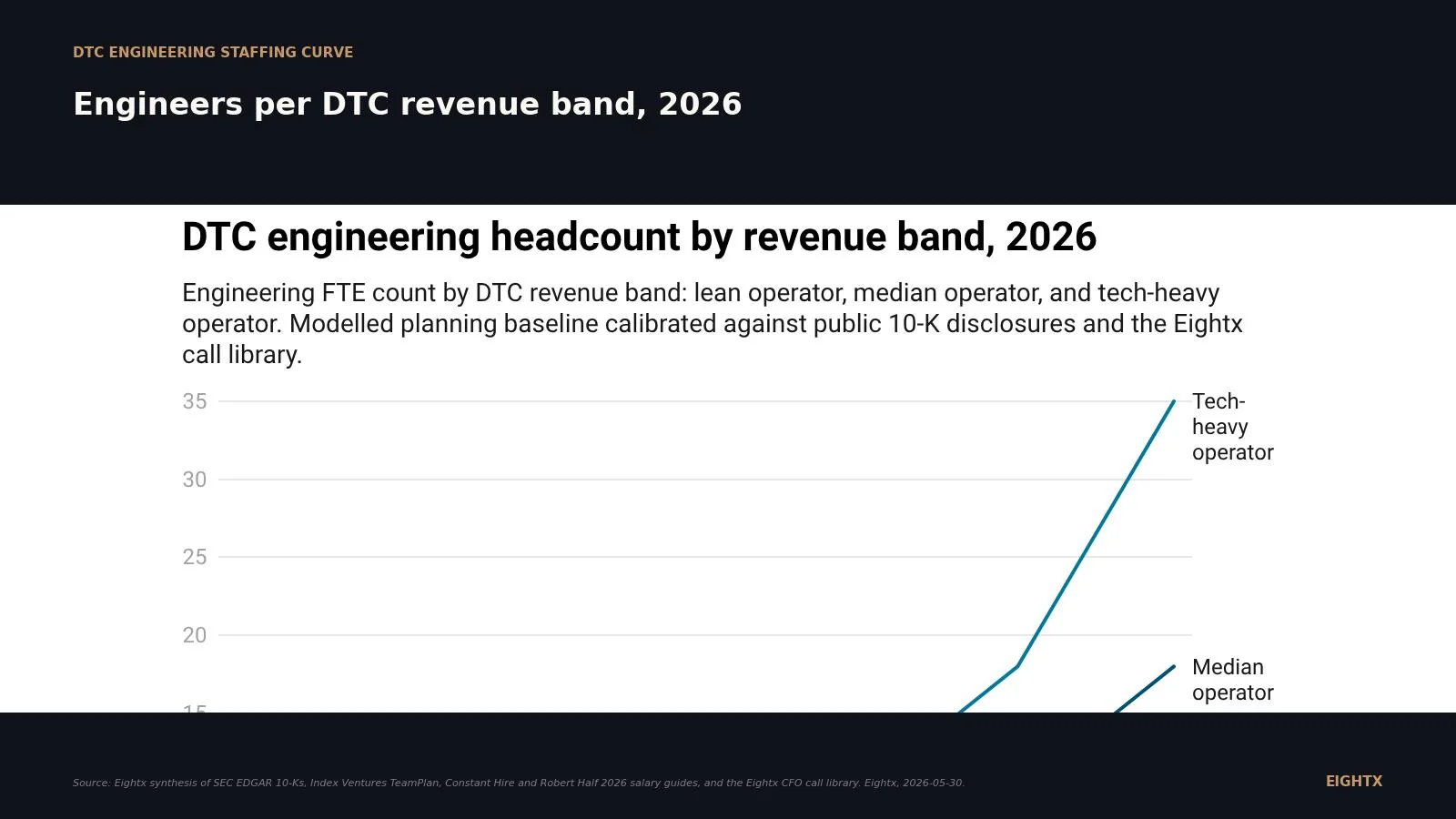
Here is the number you came for. Three operator profiles at each revenue band, from $1M to $250M+.
The lean operator runs on Shopify with off-the-shelf apps and an agency for spikes. The median operator runs the same stack with one to two in-house engineers handling integration and conversion work. The tech-heavy operator is either a headless rebuild (Hydrogen, Next.js, custom front-end) or a platform-driven brand where the storefront is genuinely a competitive moat, not a commodity layer. Most brands sit in the median band; very few should be in the tech-heavy band before $50M revenue.
The first in-house engineer typically lands between $5M and $7M, and is almost always a hybrid Shopify generalist plus ecom manager, not a senior backend engineer. The Eightx CFO call library has this pattern dozens of times. Sam Dillon (Eightx) on a 2024 call: "I know a guy who was a dual ecom manager and dev." That hybrid hire pattern is the default, because at $5M to $10M a brand does not have enough discrete engineering work to justify a full-time senior developer.
Revenue band Total headcount Lean eng. FTE Median eng. FTE Tech-heavy eng. FTE Eng. % of total (median) $1M 3-6 0 0 0-1 0% $5M 10-25 0-1 1 1-2 5% $10M 20-40 1 2 3-4 7% $25M 40-80 2-3 3-4 5-6 6% $50M 75-150 3-4 5-7 10-12 7% $100M 120-250 5-7 10-12 18-22 8% $250M+ 250-600 10-15 18-25 35-50 9%
Salary anchors for 2026, per Constant Hire: $120K to $140K base for a Liquid-focused mid-level Shopify developer, $150K to $185K for a headless or Hydrogen developer, $220K to $280K for a Shopify architect. Add roughly 25% on top for fully-loaded cost (benefits, taxes, equipment). A $50M brand running five engineers at the median bands is spending roughly $750K to $1.0M per year in engineering payroll alone, before agency and tooling.
Why DTC runs leaner than SaaS at the same revenue
The Index Ventures TeamPlan benchmark says SaaS startups at 250 employees are roughly 38% technical. A DTC brand at the same 250 employees runs roughly 15% to 25% technical. That math implies a 250-person DTC brand has 30 to 50 in engineering, data, and product combined, not 75 to 95. The gap is Shopify.
A SaaS company's product is its codebase. Engineering is a direct revenue input, every feature ships through the engineering team, and the org chart reflects that. A DTC brand's product is physical goods plus a Shopify storefront. The storefront is bounded by what Shopify (and the app ecosystem) already does, which is most of it. The engineering work that remains is integration, conversion, marketing tech, and data, not building a commerce platform from scratch.
Revenue per engineer at scale clusters around $5M to $15M for a Shopify-native DTC brand versus $1M to $5M for SaaS-like commerce companies (Stitch Fix, Warby Parker, headless rebuilds). The cleanest test: if your revenue-per-engineer is below $2M and you are not a software company, you are over-built. Freeze hiring and audit the build vs buy mix before you fund the next role.
The build vs buy vs agency mix at each stage
The headcount number is the wrong number to optimize. The right number is the build, buy, and agency split at each stage.
Under $10M revenue: buy almost everything, agency for spikes. Shopify, Klaviyo, Triple Whale, a 3PL, a CRO agency on a monthly retainer for site work and launches. The only in-house role is the ecom manager or the founder doing it themselves. Trying to in-source the storefront at $5M revenue is the single most expensive build-vs-buy mistake we see on CFO calls.
$10M to $25M revenue: in-source data, start owning the storefront. One in-house Shopify generalist plus the agency still on retainer. First data hire (analyst, not engineer) drops in around $15M to $20M when the CAC, LTV, and contribution-margin questions get hard. Klaviyo and server-side tracking become an in-house specialty rather than an agency deliverable.
$25M to $50M revenue: build what differentiates, buy everything else. Three to five in-house FTEs covering storefront, marketing tech, and data. Agency drops to project-based work. First data engineer hire if the brand has multi-channel complexity (DTC plus wholesale plus Amazon plus a private-label arm). This is the band where most brands need to make a deliberate decision about whether they are an ops-driven brand (lean engineering forever) or a platform-driven brand (headless rebuild, larger engineering org). The "default to ops-driven" answer is correct for ~80% of brands at this stage.
$50M+ revenue: the storefront, data, and integrations are three separate disciplines. Five to ten in-house engineers plus a dedicated agency or contractor for spikes. A small data team (engineer plus analyst plus optional senior architect). Saras Analytics found the all-in cost of a three-person internal data team at $20M+ revenue runs $400K to $600K in year one. At $50M that is justifiable. At $20M it usually is not.
What this means for your business if you're between $5M and $50M
Three concrete moves.
Resist the "we need a CTO" urge before $25M. What you actually need is one strong Shopify generalist plus a marketing-tech contractor. A real CTO hire at $15M typically means $250K to $350K all-in for someone who is under-utilized inside six months, which then triggers a hire-down-stream cascade of three more engineers to give them something to manage. The CTO conversation is for $50M+. Before that, the conversation is "senior Shopify developer who owns the storefront."
Hire your first data person before your second engineer. The CAC, LTV, and contribution-margin view is what unblocks the next $10M of revenue, not faster site speed. The data analyst typically pays for themselves inside 90 days by surfacing one or two misallocated ad-spend decisions or one inventory turn improvement. The second engineer rarely does. This is the single most common $10M-to-$25M hiring mistake we see on CFO calls.
Track revenue per engineer monthly. If it drops below $2M per FTE without a deliberate platform bet (a headless rebuild, a custom integration layer, a real moat that justifies the spend), freeze hiring and audit the build vs buy mix. Most over-hired DTC brands hit that threshold quietly because the engineering work expanded to fill the engineers, not the other way around.
The number to anchor on is 1 to 2 engineers per $10M of revenue, with the first FTE landing between $5M and $7M as a hybrid Shopify generalist. If your ratio is below $2M revenue per engineer and you are not a software company, you are over-built. Freeze the next hire and audit the agency-vs-FTE split before you fund another role.
Sources and methodology
SEC EDGAR, 10-K filings, fiscal year 2025. Pulled the FY2025 income statements and human capital sections for Allbirds (BIRD, CIK 1653909), Warby Parker (WRBY, CIK 1504776), YETI Holdings (YETI, CIK 1670592), FIGS (FIGS, CIK 1846576), Revolve Group (RVLV, CIK 1746618), and Stitch Fix (SFIX, CIK 1576942). Revenue and R&D line items are from incomeStatement.revenue and incomeStatement.researchAndDevelopment. Only YETI returned a non-empty R&D array ($25.2M FY2025, $21.1M FY2024, $15.5M FY2023). All other companies report R&D as zero or absent, meaning they aggregate it into selling, general, and administrative expenses. None of the six 10-Ks break out engineering headcount as a discrete line in the Item 1 Human Capital section.
Index Ventures TeamPlan. Org-design benchmark for venture-backed startups: ~50% technical at 50 employees, ~41% at 125 employees, ~38% at 250 employees, and roughly 1 designer per 8 engineers. TeamPlan is SaaS-skewed by design. The DTC bands in this post discount these SaaS percentages by roughly 50% to reflect Shopify absorbing the platform layer. See https://www.indexventures.com/index-press/teamplan-an-org-design-benchmarking-tool-for-rapidly-scaling-startups/.
Constant Hire 2026 Shopify Developer Salary Report. Used for in-house salary bands. Liquid-only mid-level $120K to $140K, headless or Hydrogen $150K to $185K, architect $220K to $280K. Stores under $5M GMV "generally get better economics from project-based work." Source: https://www.constanthire.com/posts/shopify-developer-salary.
Robert Half 2026 Technology Salary Guide. Cross-check on engineering salary bands at the mid-market. Source: https://www.roberthalf.com/us/en/insights/research/data-reveals-which-technology-roles-are-in-highest-demand.
Saras Analytics, "Why most $20M+ DTC brands regret building data infra in-house." Used for the data-team cost reference: $400K to $600K all-in for a three-person internal data team in year one. Source: https://www.sarasanalytics.com/blog/why-most-20m-dtc-brands-regret-building-data-infrastructure-in-house.
Eightx CFO call library. 5,400+ transcripts of senior-partner calls with DTC operators at $1M to $150M revenue. Used as supporting voice and the "hybrid Shopify dev plus ecom manager" first-hire pattern. Not used as the source of headcount numbers. The sample biases toward CFO-engaged DTC brands and would over-represent operators who are already thinking about engineering as a finance decision rather than a tech decision.
Limitations. No public dataset directly answers this question. The bands above are a modelled synthesis calibrated against the public 10-K data plus the Eightx call library, explicitly framed as a planning baseline. Sample bias toward Shopify-native digitally-native DTC: brands on WooCommerce, BigCommerce, custom, or Salesforce Commerce Cloud will have different engineering shapes, typically higher headcount earlier. "Engineer" definition is fuzzy and includes marketing-tech, analytics, integrations, and data engineers in the bands. A pure-play application software engineer (full-time-employee writing application code) is a subset that lands closer to the lean column. Engineering hiring at DTC brands has tightened since 2023 (see our DTC layoff and hiring tracker for the cuts cadence), so the median operator row is calibrated to 2026 reality, not 2021 hiring patterns. We refresh this page quarterly when the next batch of 10-Ks lands. Next update target: August 2026 after Q2 earnings season closes.
For more on how engineering hiring intersects with the rest of the labor market right now, see our DTC layoff and hiring tracker and our interim CFO services page for how we work with operators on these calls.
Frequently asked questions
when should a dtc brand hire its first in-house software engineer?
Between $5M and $7M revenue, almost always as a hybrid Shopify generalist plus ecom manager rather than a senior backend engineer. Below $5M you get better economics from project-based work with a Shopify Expert agency or freelancer. The pattern we see on CFO calls: founders try to make the hire at $3M because they want control, regret it at $4M because the engineer is under-utilized, and finally hit the right cadence around $6M when the queue of integrations and conversion work justifies an FTE.
how many engineers does a $10m dtc brand actually need?
One in-house engineer plus an agency relationship is the modal answer. Lean operators run zero in-house and lean entirely on agency. Tech-heavy operators (typically headless rebuilds or platform-driven brands) run three to four in-house. The median is one Shopify generalist plus an optional marketing-tech contractor handling Klaviyo and server-side tracking. If you are at $10M with four in-house engineers and you are not a software company, you are over-built for your revenue.
is it better to hire an in-house shopify dev or use an agency at $5m to $10m revenue?
Use the agency for the platform work and hire in-house for the integration and conversion work. A senior Shopify Liquid developer costs $120K to $140K all-in (Constant Hire 2026). An agency on a $5K to $8K monthly retainer gets you a team for less than half that cost but pays back slower on changes. The split that works: agency owns the storefront and major launches, in-house owns Klaviyo, Triple Whale, server-side tracking, and the 3PL integration. That keeps the in-house person on revenue-adjacent work, not pixel-pushing.
what is the average shopify developer salary at a dtc brand in 2026?
$120K to $140K for a Liquid-focused mid-level developer, $150K to $185K for a headless or Hydrogen developer, and $220K to $280K for a Shopify architect, per the Constant Hire 2026 salary report. Robert Half's 2026 Technology Salary Guide gives similar bands for software engineering at the mid-market level. Add 20% to 30% on top for fully-loaded cost (benefits, taxes, equipment) when modelling the actual P&L impact.
how do public dtc brands like warby parker and stitch fix structure their engineering teams?
We do not know precisely, because zero of the six public DTC 10-Ks we reviewed break out engineering headcount separately. Warby Parker has 3,780 total employees as of FY2024 and explicitly calls out 'highly skilled software engineers' as a key talent dependency in its 10-K risk factors. Stitch Fix has 4,570 total including 2,002 stylists. Both companies treat engineering as material to the business but do not number it. That gap is the operator-relevant finding: at $1B revenue, engineering is large enough to make or break the brand and small enough to disappear inside corporate functions.
when do you hire a data engineer vs a data analyst at a dtc brand?
Hire the analyst first, almost always. Between $5M and $25M the constraint is getting clean answers to questions about CAC, LTV, and contribution margin, not the pipeline that produces them. An analyst with strong SQL and Shopify, Klaviyo, and ad-platform familiarity covers that. The data engineer comes later, around $25M to $50M, when you start needing actual transformation pipelines (typically when Triple Whale or Northbeam stops being enough). Saras Analytics found that the all-in cost of a three-person internal data team at $20M+ runs $400K to $600K in year one. Most brands at that revenue do not need it.
what is the typical engineering share of total headcount at a dtc brand?
5% to 9% at the median Shopify-native brand, rising slowly with revenue. A $5M brand with one engineer in 15 employees is ~7%. A $50M brand with five engineers in 100 employees is 5%. A $250M brand with 18 engineers in 400 employees is ~5%. Tech-heavy operators run 12% to 20%. Compare to a SaaS company at the same headcount, which Index Ventures TeamPlan benchmarks at ~38% technical at 250 employees. The gap is Shopify, which absorbs the platform engineering load that a SaaS company has to staff itself.
how does dtc engineering hiring change when you go headless?
Roughly double. A median Shopify-native brand at $25M to $50M runs 3 to 7 in-house engineers. The same brand on a headless rebuild (Hydrogen, Next.js, custom front-end on the Shopify Storefront API) typically runs 6 to 12. You absorb the front-end framework, the build pipeline, the rendering layer, and the storefront performance work that Shopify was doing for you. The CFO test before a headless decision: does the rebuild deliver a real moat (a content engine, a personalization layer, a checkout you cannot ship on Shopify) or just a faster site? If the answer is the second one, the math on the extra engineering hires almost never works at sub-$100M revenue.