
CPG
Retail Distribution Economics: Margin After the Middlemen
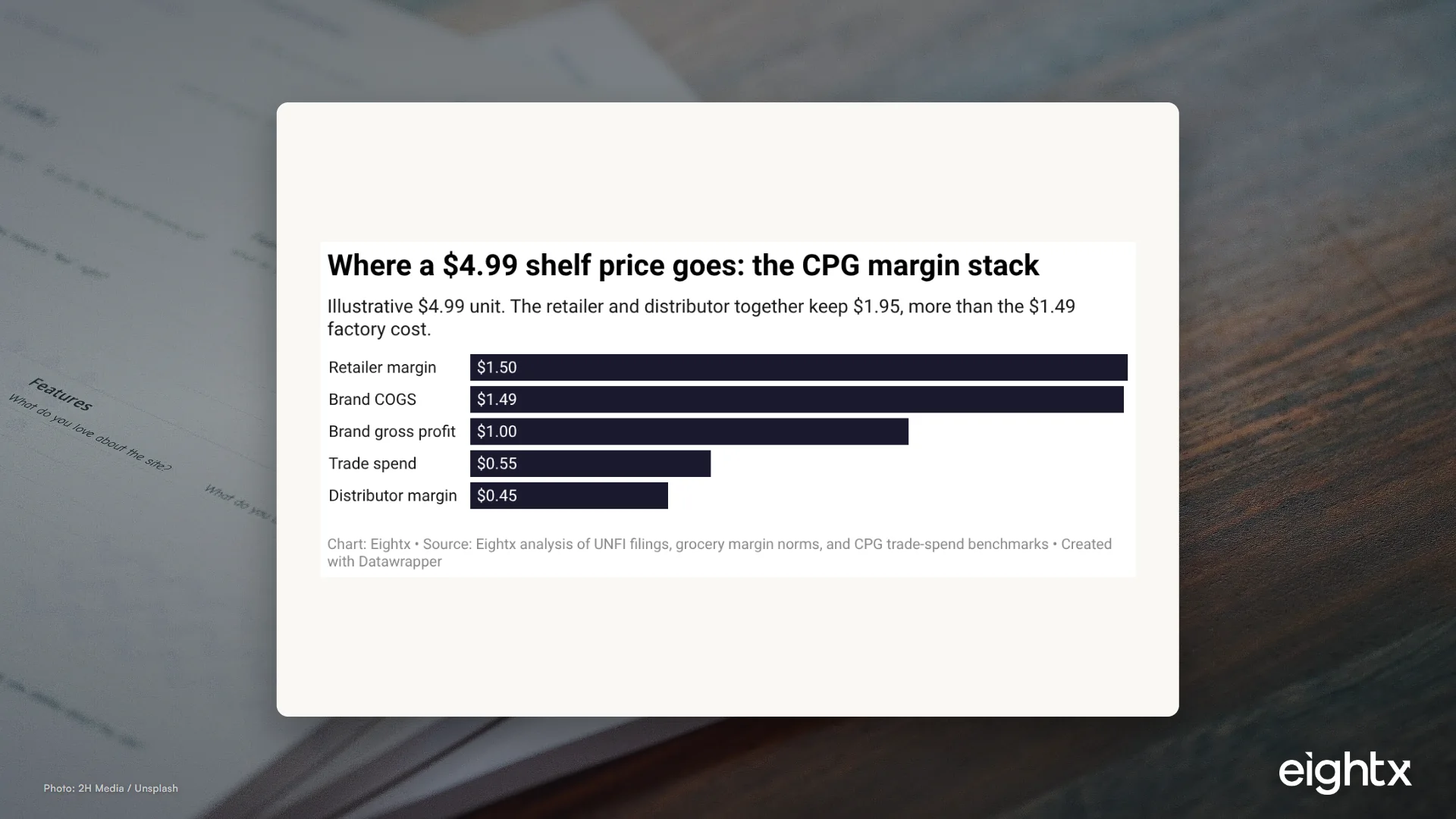
On a $4.99 packaged food unit, the retailer keeps about $1.50 (the high end of a 22% to 30% band), the distributor about $0.45, and trade spend pulls another $0.55. After roughly $1.49 of COGS, the brand's true gross profit is about $1.00, near 20% of shelf price. The middlemen take more than the factory does.
Key Takeaways
- Retailers take roughly 25% to 30% of shelf price (Walmart's implied product margin is about 24%); distributors like UNFI run only about 13% gross margin on what they resell, the opposite of what most founders assume.
- Trade spend consumes 15% to 25% of gross wholesale revenue, often the single most underestimated line in a CPG model.
- On a $4.99 unit, the brand's true take after all middlemen and COGS is about $1.00, near 20% of shelf price.
- Wholesale-channel COGS prints 58% to 67% of revenue in public 10-Ks, versus 26% to 31% for DTC, a 30-to-40-point swing driven by who takes a cut.
- Gross margin does not predict winners: Celsius posts a 50.4% gross margin but only 5.6% operating margin. Judge channels on contribution margin, where good wholesale is 30%.
You priced your product at $4.99 on the shelf and your factory cost is $1.49. That feels like a 70% margin business. It is not. By the time the unit travels from your co-packer to the grocery shelf, the distributor has taken a cut, the retailer has taken a bigger one, and trade spend has quietly eaten a chunk of what you booked as revenue. What lands in your pocket is closer to a dollar.
This is the single most expensive misunderstanding I see at $5M to $50M food and beverage brands. Founders model their margin off the shelf price, sign the distributor agreement, win the grocery account, and then wonder why the P&L does not move. The shelf price was never yours. Let me walk the price build down, line by line, and show you the brand's true take.
The price build, factory to shelf
Start at the top, with the price the consumer pays, and work backwards through everyone who touches the unit before it reaches them.
| Step | Who keeps it | Amount | Running balance |
|---|---|---|---|
| Shelf price | Consumer pays | $4.99 | $4.99 |
| Retailer margin (~30%) | Grocer | $1.50 | $3.49 paid to distributor |
| Distributor margin (~13%) | UNFI / KeHE | $0.45 | $3.04 paid to brand |
| Trade spend (~18% of wholesale rev) | Retailer programs | $0.55 | $2.49 net brand revenue |
| Brand COGS | Factory | $1.49 | $1.00 gross profit |
The brand's true gross profit on a $4.99 unit is about $1.00, roughly 20% of shelf price. Read that again: the retailer and distributor together keep $1.95, more than your $1.49 factory cost and nearly double your $1.00 of gross profit. The middlemen take more than the factory does.
When I talk to founders running a brand this size, the number that stops them is not the retailer cut, which they half expect. It is the trade-spend line, because it comes off revenue they already counted as theirs.
The distributor's cut is smaller than you think
The distributor is the least expensive middleman in the chain, and founders consistently overestimate them. UNFI, the largest broadline natural and specialty distributor, reported a 13.2% gross profit rate on net sales in its Q2 fiscal 2026 results, and its full-year rate has barely moved, holding between 13.3% and 13.6% since fiscal 2023. Model the distributor at about 13% and you will be close. KeHE, its main rival, is privately held and does not publish the same detail, but it operates in the same low-teens band.
On the $3.49 the retailer pays the distributor, a 13% margin is about $0.45. That is real money, but it is the smallest slice in the stack. The distributor's job is logistics and access: getting your case onto the truck and into the retailer's warehouse. They are not the reason your margin disappears.
The pattern we see again and again is founders blaming the distributor for thin retail margins. The distributor is the cheapest hop in the journey. The retailer and the trade spend are where the money actually goes.
The retailer takes the biggest slice
A center-store national-brand packaged food item typically carries a 22% to 30% retailer gross margin. Walmart, the lowest-margin mass retailer, reported a cost of revenue of 75.8% in its fiscal 2026 10-K, which implies a product margin near 24% and a markup of about 32% on cost. Conventional and specialty grocery sit higher, which is why 30% is a fair planning number even though 24% to 25% is the central case. On a $4.99 shelf price, 30% is $1.50, the single largest piece of the pie before COGS.
Here is the part operators miss: the retailer's cut sits on top of the distributor's, not instead of it. When your wholesale-channel gross margin looks like 35%, the retailer is taking another 24 points before the consumer ever sees the price. Two separate margins stack between your invoice and the shelf, and the consumer pays for both.
And the retailer keeps almost none of it. Supermarket net profit was only about 1.7% in 2024 per FMI Food Industry Facts. That fat-looking 24% to 30% gross margin funds labor, occupancy, and shrink, not a pile of grocer profit. It is the cost of access to the shelf, and it is non-negotiable.
Trade spend and slotting: the lines nobody budgets correctly
Trade spend is where good models go to die. It covers promotions, off-invoice discounts, scan-downs, and the deductions retailers take whether you agreed to them or not. Industry benchmarks put it at 15% to 25% of gross sales, clustering at 18% to 20% for established grocery-heavy brands. On $3.04 of gross wholesale revenue, 18% is $0.55. That comes straight off the top of the revenue you booked, before COGS. It is the difference between gross-to-gross and gross-to-net, and the brands that ignore it post a paper margin they never actually collect.
Slotting fees are a separate beast, and they are lumpy launch capital, not an ongoing line. There are two valid ways to size them: roughly $250 to $1,000 per item per store per NielsenIQ, which aggregates up to $5,000 to $20,000 or more per SKU once you span a full chain or region. Both framings are correct; they just count at different levels.
When we work with grocery brands, this is the conversation that lands hardest, founder to founder: there is a whole category of spend you have to pay these people called trade spend. One piece is the listing fee, where they make you pay something like 10 grand per SKU just to get on shelf at a chain. Then there are the promos, where you drop the price and cost-share that markdown with the retailer. In live client P&Ls we have seen trade spend run 22% to 24% when a brand leans hard into a high-volume club channel. If you do nothing else after reading this, build a gross-to-net line in your model and treat trade spend as the COGS it functionally is.
So what is left, and is it worth it?
After the retailer ($1.50), the distributor ($0.45), and trade spend ($0.55), the brand books $2.49 of net revenue on a $4.99 unit. Subtract $1.49 of COGS and you are left with $1.00 of gross profit, near 20% of shelf price and about 40% of net revenue.
That is not automatically a bad business. Gross margin alone is a vanity number. What matters is contribution margin after you back out variable costs, and the contribution margins through retail are better than most people think. When I talk to founders running a good product through grocery, the line I give them is this: you can pull off 30%, even 40%, contribution through retail once you account for the fact that you are paying zero CAC per order. A good contribution margin in DTC is 20%. In wholesale, 30% is the lower bound I work from. Wholesale strips your gross margin, but it skips all the acquisition cost, so it is usually better for your net margin, not worse.
The trap is comparing your wholesale gross margin to your DTC gross margin and concluding retail is a loser. They are different unit-economics machines. Gross margin does not predict winners either. Across the public food and beverage set, Celsius posts a 50.4% gross margin but only a 5.6% operating margin, while Vital Farms posts a 37.6% gross margin and gets to 11.6% operating margin. The gross-to-operating gap is the game, not the headline gross number.
| Company | Role | Gross margin | Operating margin |
|---|---|---|---|
| Celsius | Branded beverage | 50.4% | 5.6% |
| Simply Good Foods | Branded food | 36.2% | 10.8% |
| Vital Farms | Branded food | 37.6% | 11.6% |
| UNFI | Distributor | 13.3% | -0.1% |
The contribution margin through retail beats perception. Most founders look at the gross-margin haircut, assume DTC is the only way, and miss that in wholesale you skip the acquisition cost entirely. Judge the channel on contribution, not gross, and a 30% wholesale floor regularly beats a 20% DTC ceiling.
One more thing before you chase the shelf: if you enter retail without awareness, it does not work. If shoppers do not know you, they do not pick your package, and if they do not pick it, you lose the slot to the next brand on sell-through. Plenty of sub-$10M brands win in retail, but they go in with a reason for the shopper to reach for them.
What to do about it
- Build the price-build waterfall for your real SKUs before you sign any distributor or retailer agreement. Start at shelf price and subtract every cut down to your true take. If you do not know your number, you are negotiating blind.
- Add a gross-to-net line to your model. Book gross wholesale revenue, then subtract trade spend explicitly. Never report the gross number as if it were yours.
- Judge channels on contribution margin, not gross margin. Use a 30% contribution floor for wholesale and a 20% floor for DTC. Below the floor, the channel is not scalable no matter how good the product is.
- Negotiate trade spend like it is COGS, because it functions like COGS. Cap promotional frequency, audit deductions monthly, and claw back unauthorized ones. A 3-point reduction in trade spend on our example unit adds about $0.09 of profit, a 9% lift to your take.
- Model the payment lag, not just the margin. Distributors and big-box retailers commonly pay net 30 to net 60, and one operator we worked with was stuck at 60 days with no room to negotiate down. Your margin can improve while your cash gets worse, so sequence DTC and retail rather than chasing both at full tilt.
Sources and methodology
The price build models a $4.99 packaged food unit with planning benchmarks for $5M to $150M brands, not a single company's actuals. Distributor margin is set at 13%, matching UNFI's reported 13.2% gross profit rate on net sales. UNFI (CIK 1020859) reported gross profit of $1,046M on net sales of $7,947M for the 13 weeks ended January 31, 2026, a 13.16% rate that the company rounds to 13.2%; its full-year rate held at 13.3% in fiscal 2025 and 13.6% in fiscal 2024 and 2023, and the distributor was roughly operating-margin breakeven across that span.
Retailer margin is modeled at 30% of shelf price as the high end of a 22% to 30% band. Walmart (CIK 104169) reported cost of revenue of $535,395M on revenue of $706,413M for the fiscal year ended January 31, 2026, a 75.8% cost ratio that implies a product margin near 24% and an operating margin of 4.2%. Walmart does not report a gross-profit XBRL tag, so the margin is computed as one minus the cost ratio. Center-store national-brand grocery margins run wider in conventional and specialty stores, and supermarket net profit was about 1.7% in 2024 per FMI, which is why the gross cut funds operations rather than store profit.
Trade spend is set at 18% of gross wholesale revenue, the midpoint of a 15% to 25% benchmark band synthesized from McKinsey trade-promotion analytics and corroborated against live client P&Ls running 22% to 24% in club-heavy channels. Slotting fees are cited at both the per-store level ($250 to $1,000 per item, NielsenIQ) and the per-chain level ($5,000 to $20,000 or more per SKU), since both framings appear in the data and aggregate to each other.
The CPG comparison set uses SEC EDGAR FY2025 10-K filings, with gross and operating margins computed from reported revenue, cost of revenue, and operating income: Celsius (CIK 1341766) at 50.4% gross and 5.6% operating, Simply Good Foods (CIK 1702744) at 36.2% and 10.8%, and Vital Farms (CIK 1579733) at 37.6% and 11.6%. COGS is held at $1.49, consistent with the 58% to 67% wholesale-channel COGS range observed across public CPG 10-Ks, versus 26% to 31% for DTC; both are Eightx benchmarks drawn from filings and client P&Ls rather than a single public dataset.
Operator-voice observations are drawn from anonymized founder calls in the Eightx corpus. Figures quoted from those calls (trade spend bands, payment terms, contribution floors) are retained; client identities are not. Your numbers will shift with category, retailer, and promotional intensity, so treat every figure here as a planning band, not a forecast.
If you run a food or beverage brand and want this modeled on your actuals, our fractional CFO team for food and beverage brands does exactly this.
Frequently Asked Questions
how much margin does a cpg brand keep after distribution and retail?
On a typical $4.99 packaged food unit, after the retailer's ~30% margin, the distributor's ~13%, trade spend near 18% of wholesale revenue, and about $1.49 of COGS, the brand keeps roughly $1.00 of gross profit, near 20% of shelf price.
what is the typical distributor margin for unfi or kehe?
UNFI reported a 13.2% gross profit rate on net sales in its Q2 fiscal 2026 results, and its full-year rate has held 13.3% to 13.6% since 2023. KeHE is private and does not publish the same detail, but industry commentary places it in a similar low-teens range.
what is a normal grocery retailer margin on packaged food?
Center-store national-brand packaged food typically runs a 22% to 30% retailer gross margin, with Walmart's implied product margin at about 24%. Perimeter and specialty items run higher. Net profit for the store is only about 1.7% after operating costs.
how much is trade spend as a percent of revenue for cpg brands?
Trade spend usually runs 15% to 25% of gross revenue, clustering at 18% to 20% for established grocery-heavy brands. Launch-intensive or heavily promoted brands can exceed that, and slotting fees sit on top of it as separate launch capital.
how much are slotting fees to get on a grocery shelf?
Two valid framings: roughly $250 to $1,000 per item per store, which aggregates up to $5,000 to $20,000 or more per SKU across a full chain or region. Treat slotting as lumpy launch capital, separate from your ongoing trade spend.
is wholesale or dtc better for cpg margin?
DTC keeps more gross margin (COGS near 26% to 31%) but pays high CAC. Wholesale gives up gross margin (COGS 58% to 67%) but carries no per-order acquisition cost, so wholesale contribution margin of 30% often beats DTC's 20%. Judge it on contribution, not gross.
why is my wholesale gross margin so much lower than dtc?
Because the distributor and retailer each take a cut before you book revenue, and trade spend reduces it further. The same SKU that prints 70% gross margin on Shopify can print 33% through grocery, a roughly 35-point swing driven entirely by channel.
what payment terms should i expect from grocery retailers and distributors?
Net 30 to net 60 is standard, and big-box accounts often sit at the slow end. Your margin can be better in wholesale while your cash is worse, so model the payment lag, not just the margin, before you scale a retail channel.