
eCommerce
Shopify Payments vs Stripe fees 2026: the 200bp gap that decides who you process with
Stripe charges 2.9% plus $0.30 per transaction regardless of Shopify plan, while Shopify Payments charges 2.15% to 2.9% plus $0.30 depending on plan tier, and using Stripe on Shopify adds a 0.2% to 2.0% third-party gateway surcharge on top. On Shopify Basic, that surcharge closes the gap entirely, meaning Shopify Payments always wins on cost for merchants processing primarily through Shopify.
Key Takeaways
- Stripe's US online card rate is 2.9% + $0.30, unchanged since 2014. Shopify Payments runs 2.9% (Basic), 2.7% (Grow), 2.5% (Advanced) and approximately 2.15% (Plus, negotiated).
- Shopify layers a third-party gateway surcharge on top of any non-Shopify-Payments processor: 2.0% (Basic), 1.0% (Grow), 0.6% (Advanced), 0.2% (Plus). On Basic, routing to Stripe costs an effective 4.9% + $0.30 per US card transaction.
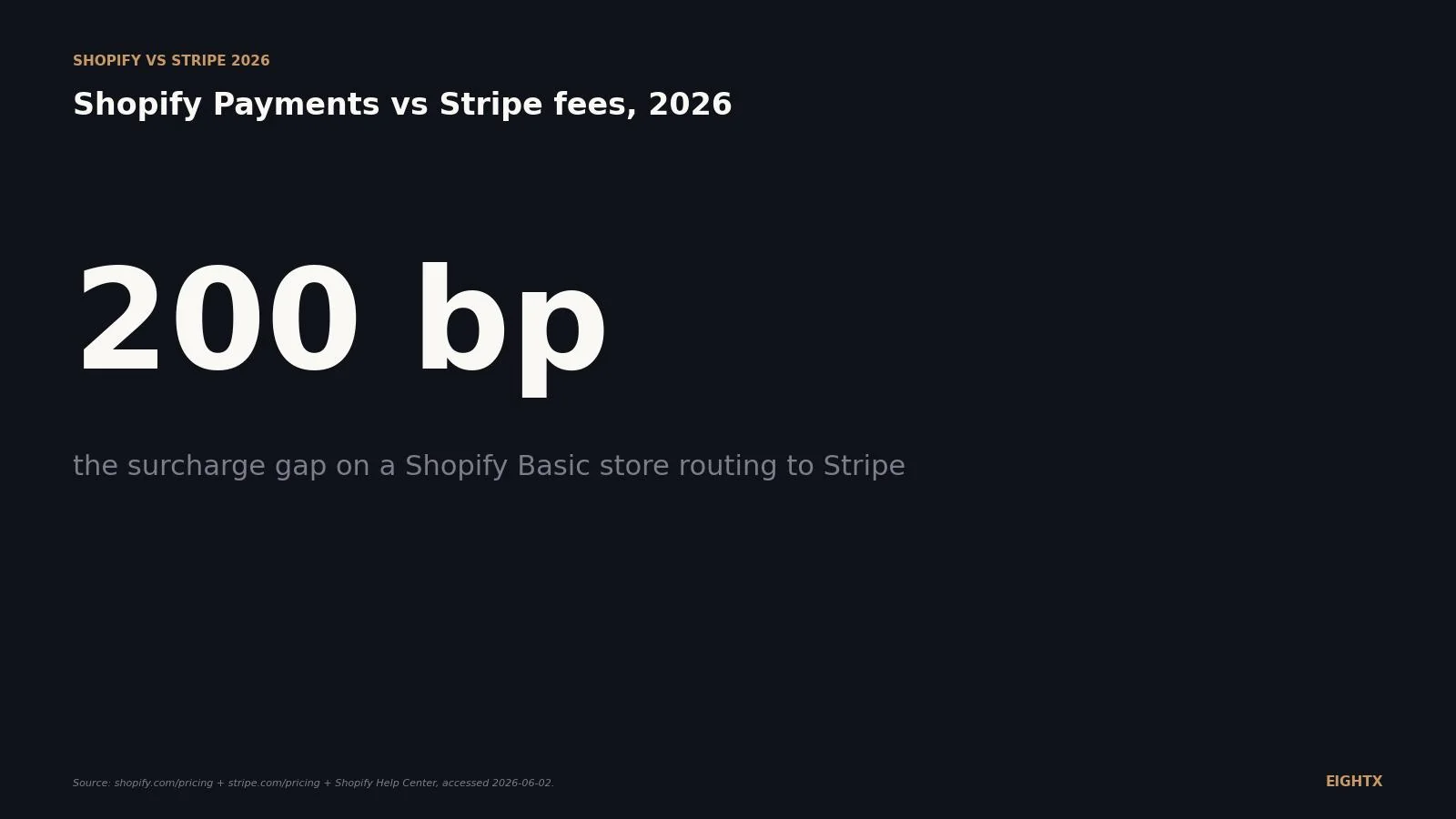
- The all-in gap is 200 basis points on Basic and roughly 95 basis points on Plus at rack. On $10M of card volume, that is $200,000 a year on Basic and $95,000 on Plus.
- Stripe-on-Shopify only wins on a narrow set of cases: ACH at 0.8% capped at $5, B2B invoicing, high-risk categories, or international card acceptance in countries Shopify Payments does not support.
- The biggest lever is negotiating Shopify Payments down with a competing Stripe quote in hand. Eightx founder calls in 2025 logged a Plus account at approximately 1.15% + $0.15, roughly 100bp under default Plus rack.
If you sell on Shopify, the choice between Shopify Payments and Stripe in 2026 is not a "rate versus rate" comparison. It is a "rate versus rate plus Shopify's third-party gateway surcharge" comparison. Stripe's US online card rate has been 2.9% + $0.30 for a decade and remains there in 2026. Shopify Payments charges 2.9% on Basic, 2.7% on Grow, 2.5% on Advanced and roughly 2.15% on Plus. But routing to Stripe (or any third-party gateway) triggers an additional 2.0% / 1.0% / 0.6% / 0.2% surcharge by plan. That means a Basic-plan store routing card payments through Stripe pays an effective 4.9% + $0.30, a 200 basis point penalty versus Shopify Payments.
For the median $1M-$10M DTC operator on Basic, Grow or Advanced, Shopify Payments wins on pure processing cost. The real lever, proven across founder calls, is negotiating Shopify Payments down from rack once you cross enough volume to put a competing Stripe quote in front of Shopify's finance team.
The 2026 published rates side by side
Here is what each processor publishes in 2026, by Shopify plan tier, for US online card transactions.
Plan Shopify Payments rate Stripe rate Shopify gateway surcharge Total Stripe-on-Shopify Spread vs Shopify Payments Basic 2.9% + $0.30 2.9% + $0.30 2.0% 4.9% + $0.30 +200 bp Grow 2.7% + $0.30 2.9% + $0.30 1.0% 3.9% + $0.30 +120 bp Advanced 2.5% + $0.30 2.9% + $0.30 0.6% 3.5% + $0.30 +100 bp Plus ~2.15% + $0.30 (negotiated) 2.9% + $0.30 (rack) 0.2% 3.1% + $0.30 (rack) +95 bp (rack vs rack)
The math is mechanical. Stripe's 2.9% does not move. Shopify Payments steps down as you climb the plan tiers. The gateway surcharge does the same, but the spread is what matters: even with both falling in parallel, Stripe-on-Shopify never crosses below Shopify Payments at rack rates.
The reason Plus is the only realistic break-even zone is that the surcharge collapses to 0.2% and Stripe's enterprise pricing team will negotiate below 2.9% rack for the right merchant. Below Plus, the surcharge is structurally too large to overcome. For the wider platform-economics picture (where processor fees sit inside total cost of ownership), see our Shopify Plus vs BigCommerce finance comparison.
The math on $100, $1M and $10M
Per-transaction cost is the cleanest way to see this. The chart below shows all-in cost per $100 card transaction, by plan, for both routes.
Translate that to annual processing cost on $1M and $10M of card volume and the gap shows up as cash.
Plan $1M GMV: Shopify Payments $1M GMV: Stripe-on-Shopify $1M delta $10M GMV: Shopify Payments $10M GMV: Stripe-on-Shopify $10M delta Basic $29,000 $49,000 $20,000 $290,000 $490,000 $200,000 Grow $27,000 $39,000 $12,000 $270,000 $390,000 $120,000 Advanced $25,000 $35,000 $10,000 $250,000 $350,000 $100,000 Plus (rack) $21,500 $31,000 $9,500 $215,000 $310,000 $95,000
Two things to flag in that table. First, on Basic the annual delta scales linearly with volume because the spread is fixed at 200 basis points. Second, on Grow and Advanced the surcharge step-down (1.0% to 0.6%) is what makes upgrading plans pay back. If you are on Basic doing $200,000 a month in card volume, the math on moving to Grow is straightforward: you save $8,000 in spread per $1M of GMV, which more than covers the higher plan cost.
Why Shopify's surcharge structure exists
Shopify's third-party gateway surcharge looks like a fee. It is functionally a moat. Shopify Payments processed 64% of Shopify GMV in FY2025, up from 60% in FY2024, on $378.4 billion of total platform GMV. Merchant solutions revenue (Shopify Payments plus Shop Pay Installments plus Shopify Capital plus FX) hit $8.8 billion for the year, a blended 2.33% take-rate. That take-rate is the business model.
The surcharge step-down by plan is deliberate. On Basic, the 2.0% surcharge makes it economically irrational to use anything but Shopify Payments. On Plus, the 0.2% surcharge is small enough that a sophisticated enterprise merchant with a tailored Stripe relationship can model around it. That tiering protects Shopify Payments attach on the long tail (where churn risk is lowest) while letting Plus merchants choose without losing them as platform customers.
For an operator, the read is that the surcharge is not negotiable on the gateway side. The negotiable lever is your Shopify Payments rate itself.
When Stripe-on-Shopify actually wins
Three cases where running Stripe alongside Shopify makes financial sense, even with the surcharge layered on top.
Case one: ACH for high-AOV B2B. Stripe ACH Direct Debit is 0.8% capped at $5 per transaction in the US. On a $50,000 invoice it caps at $5 instead of a $1,450 card fee. Shopify Payments does not have an equivalent ACH rate at this writing. If you sell B2B with average orders above $5,000, Stripe ACH wins outright on every plan tier even after the gateway surcharge.
Case two: Plus tier with a sub-rack Stripe quote. On Plus, Stripe will negotiate below 2.9% for enterprise volume. If your Stripe rep can get you to 1.95% all-in plus the 0.2% surcharge, you land at 2.15% + $0.30, matching Shopify Payments at default Plus rack. The number to beat is whatever you have negotiated Shopify Payments down to. If you have Shopify Payments at 1.4% (which we have observed), Stripe cannot get there.
Case three: international acceptance in unsupported countries. Shopify Payments is not available in every Shopify market. If you process cards in a country Shopify Payments does not serve, Stripe-on-Shopify is the only option and the surcharge is the cost of doing business there.
Outside those three, the math points to Shopify Payments. Stripe wins narrowly inside them.
What Shopify Payments gives you that Stripe does not
Shop Pay processed more than $100 billion of GMV across Shopify in 2025 and is only available natively on Shopify Payments. The published Shopify research shows Shop Pay buyers convert at materially higher rates than non-Shop-Pay buyers, and Shop Pay Installments via the Affirm partnership lands at approximately 5% per BNPL transaction, well below Stripe's 5.99% Klarna pass-through layered with the gateway surcharge.
Other Shopify-Payments-only features that matter: native dispute handling inside Shopify Admin, no third-party gateway surcharge of course, fraud protection that ties into Shopify's risk model, and eligibility for Shopify Capital based on your transaction history. None of those line items show up in a rate comparison, but they show up in your operations and your cost of capital.
For a Shopify operator, those features are part of the all-in cost picture. Stripe is the better neutral payment processor across the wider web. On a Shopify store specifically, the platform features compound in Shopify Payments' favour.
The negotiation play
This is the part most operators never run. Shopify Payments at rack is the published rate. Shopify Payments negotiated is what large stores actually pay. Eightx founder calls in 2025 logged a Plus account at approximately 1.15% + $0.15 per transaction, secured by presenting a competing Stripe quote to Shopify's finance team. The default Plus rate is approximately 2.15% + $0.30. That is roughly 100 basis points of GMV unlocked through one conversation.
The mechanic is straightforward. One, audit your current effective rate by dividing your monthly merchant fees by your Shopify net revenue. Compare to your plan rack rate. If you are paying rack, you have spread to recapture. Two, get a Stripe Sales quote in writing, even if you do not plan to switch. The quote is the lever. Three, request a rate review with your Shopify rep with the Stripe quote attached. Shopify's finance team will not open a rate review without a competing offer on the table, so this step is non-negotiable.
A Shopify rep we interviewed put it directly: "Our finance team will not do a rate review unless there's a competing offer." Operators routinely miss this because nobody walks them through it. The competing quote unlocks the conversation. The conversation unlocks the spread.
If you are on Plus and paying rack rate, you are leaving roughly 100 basis points of GMV on the table. On $20M of card volume, that is $200,000 a year. The recovery mechanic is a Stripe quote, a meeting and a willingness to ask. Operators routinely skip the ask.
What an operator does this quarter
Three plays, in order of payback.
Audit your effective rate. Pull your last twelve months of Shopify Payments fees from the merchant statements. Divide by your card-paid net revenue. That is your real blended rate. Compare to your plan rack: 2.9% Basic, 2.7% Grow, 2.5% Advanced, approximately 2.15% Plus. If you are above rack, you have a reconciliation problem. If you are at rack and on Plus, you have a negotiation opportunity.
Model the plan upgrade if you are on Basic or Grow. The surcharge step-down from Basic to Grow is 100 basis points. If you are processing $200,000+ a month, you save $2,000 a month in surcharge just by moving to Grow. The Grow plan delta over Basic is roughly $80 a month at current US pricing. That is a 25x payback if you are already routing through a third-party gateway. Even if you are on Shopify Payments, the card rate steps down 20 basis points from 2.9% to 2.7%, saving $400 a month on $200,000 of volume. Plan upgrades on growing stores are nearly always the right move.
If you are on Plus, get a Stripe quote and ask for a rate review. The mechanic is in the section above. The downside is one meeting and one written quote. The upside is approximately 100 basis points of GMV. That is the highest-ROI 60 minutes you will spend this quarter.
What we're watching next
Shopify's FY2026 10-K will land in February 2027. The two numbers to watch: Shopify Payments attach rate (64% in FY2025, up from 60% in FY2024) and merchant solutions take-rate (2.33% blended). If attach climbs past 70% the surcharge structure is doing exactly what it was designed to do. If take-rate compresses, Shopify is conceding ground to merchants like you in negotiated rates, which is good news for the negotiation play.
On the Stripe side, the 2.9% rack has held since 2014. The watch is for any signal of a US rate cut in response to competitive pressure from Adyen and the ACH-first stack. None visible as of June 2026.
For more on how processor economics interact with the rest of your DTC P&L, see our interim CFO services overview and the fractional CFO services for ecommerce page.
Sources and methodology
Stripe published pricing. Stripe's US online card rate of 2.9% + $0.30, international card surcharge of 1.5%, currency conversion surcharge of 1.0%, manually keyed card surcharge of 0.5%, and ACH Direct Debit rate of 0.8% capped at $5 are pulled from stripe.com/pricing, accessed 2026-06-02. Klarna pass-through rate of 5.99% + $0.30 is also from stripe.com/pricing. Affirm and Afterpay are not publicly listed on Stripe's pricing page and are negotiated per merchant.
Shopify published pricing. Basic 2.9% + $0.30, Grow 2.7% + $0.30, and Advanced 2.5% + $0.30 online card rates are pulled from shopify.com/pricing, accessed 2026-06-02. The Plus rate of approximately 2.15% + $0.30 is not published on the public pricing page; it is sourced from third-party 2026 fee analyses (ToolTester, Taxomate, Rigby) which cluster in the 2.10% to 2.30% range. The post uses "approximately 2.15%" rather than a verbatim figure because Plus rates vary by country and Amex mix.
Shopify third-party gateway surcharge. Basic 2.0%, Grow 1.0%, Advanced 0.6%, and Plus 0.2% are pulled from the Shopify Help Center entry "Cost of Shopify Payments" and cross-referenced against 2026 third-party fee guides (Taxomate, Rigby, ToolTester) which cluster on 0.6% for Advanced. A minority of guides quote 0.5%; we use 0.6% as the conservative current value and recommend operators verify the live rate in their Shopify Admin on review day.
Shopify Inc. Form 10-K for fiscal year ended December 31, 2025, accession 0001594805-26-000007, filed 2026-02-11. FY2025 GMV of $378.4 billion, merchant solutions revenue of $8.8 billion, and Shopify Payments attach rate of 64% of GMV are pulled from the MD&A and KPI sections. Shop Pay GMV of more than $100 billion in 2025 is disclosed in the same filing.
Stripe TPV estimate. Stripe is privately held and does not publish a blended take-rate. The $1.4 trillion FY2025 TPV figure is from third-party analyst notes (Forbes, FactSet, 2026 commentary) and is directional rather than audited.
Methodology notes. The "Stripe-on-Shopify" total cost equals Stripe's published rack rate plus Shopify's third-party gateway surcharge plus $0.30 fixed fee. This assumes US online card, no FX, no Amex premium. The break-even analysis assumes Stripe at 2.9% rack; large merchants routinely negotiate below rack, which is why Plus is the realistic break-even zone if Stripe undercuts rack by 95 basis points or more. Operator-voice quotes are anonymized from Eightx founder calls in 2025.
Update cadence. This page is refreshed quarterly when Stripe or Shopify changes published pricing, when a new Shopify 10-K lands, or when our operator dataset adds materially to the negotiation observations.
Frequently asked questions
is shopify payments cheaper than stripe in 2026?
On a Shopify store, yes, on every plan tier. The reason is not the headline card rate (Stripe and Shopify Payments are identical on Basic at 2.9% + $0.30) but Shopify's third-party gateway surcharge, which layers 0.2% to 2.0% on top of any non-Shopify-Payments processor. On Basic, Stripe-on-Shopify costs 4.9% + $0.30 all-in. On Plus, the gap closes to about 95 basis points.
how much does shopify charge if i use stripe instead of shopify payments?
Shopify adds a third-party gateway surcharge on top of Stripe's rate: 2.0% on Basic, 1.0% on Grow, 0.6% on Advanced, and 0.2% on Plus. Stack that on Stripe's 2.9% + $0.30 and you get 4.9% + $0.30 on Basic, all the way down to 3.1% + $0.30 on Plus at rack rates.
can i use stripe on shopify without paying the extra fee?
No. The third-party gateway surcharge applies to any non-Shopify-Payments processor including Stripe, Adyen, Authorize.net and PayPal. The only way to avoid the surcharge is to use Shopify Payments as your primary card processor.
when does stripe make sense over shopify payments on a shopify store?
Three legit cases. One, you need ACH at 0.8% capped at $5 (Shopify Payments does not match this for high-AOV B2B). Two, you operate in a country where Shopify Payments is not available. Three, you are on Plus with a negotiated Stripe rate at least 95 basis points under Stripe's 2.9% rack, which is rare without enterprise volume.
can i negotiate my shopify payments rate down to match stripe?
On Plus, yes, with a competing Stripe quote in hand. The default Plus rate is approximately 2.15% + $0.30 and we have logged negotiated floors near 1.15% + $0.15 on large Plus accounts. Shopify's finance team will not open a rate review without a competing offer on the table, so the Stripe quote is the lever even if you do not plan to switch.
what's the real all-in cost difference on a $100 sale?
On Basic, $3.20 with Shopify Payments versus $5.20 with Stripe-on-Shopify, a $2.00 gap. On Plus at rack, $2.45 with Shopify Payments versus $3.40 with Stripe-on-Shopify, a $0.95 gap. The fixed $0.30 per transaction applies to both routes.
does shopify payments support bnpl like klarna and afterpay?
Yes, through Shop Pay Installments via the Affirm partnership, with merchant economics typically near 5% per BNPL transaction. Going via Stripe-Klarna on a Shopify Basic store stacks Stripe's 5.99% Klarna pass-through plus the 2.0% gateway surcharge, putting BNPL at 7.99% per transaction. Shop Pay Installments wins for native Shopify stores.
which has lower ach rates, stripe or shopify payments?
Stripe. Stripe's ACH Direct Debit is 0.8% capped at $5 per transaction in the US. For a B2B Shopify store doing $50,000 average orders, that is $5 per transaction versus 2.9% + $0.30 on cards, which is the single case where Stripe-on-Shopify wins outright even with the gateway surcharge layered on Plus.