
Financial Strategy
What is amortization vs depreciation? Same mechanic, different asset shelves, with public DTC examples
Depreciation allocates the cost of tangible assets (equipment, fixtures) over their useful life under ASC 360; amortization does the same for intangibles (software, trademarks, acquired customer lists) under ASC 350. The mechanic is identical but the GAAP shelf differs. Shopify splits its balance sheet across both, carrying an 8-year depreciation and amortization schedule that illustrates the distinction cleanly.
Amortization and depreciation are the same mechanic. You take an upfront capital cost and spread it across the period the asset actually earns its keep, usually straight-line. The split is what shelf the asset sits on. Depreciation runs against tangible property, plant, and equipment (PP&E) under Accounting Standards Codification (ASC) 360, things like warehouse fit-out, computers, and leasehold improvements. Amortization runs against finite-lived intangibles under ASC 350, things like capitalized software, acquired customer lists, trade names, and non-competes. Under public-company Generally Accepted Accounting Principles (GAAP), goodwill and indefinite-lived intangibles do not get amortized at all. They get impairment-tested once a year. Private companies and not-for-profits can elect to amortize goodwill over up to 10 years under ASU 2014-02, which is the one major exception to the no-amortize rule.
| Dimension | Depreciation | Amortization |
|---|---|---|
| Asset type | Tangible (PP&E) | Finite-lived intangible |
| GAAP standard | ASC 360 | ASC 350-30 (intangibles), ASC 350-40 (internal-use software), ASC 350-50 (website development) |
| Common DTC examples | Warehouse equipment, leasehold improvements, computers | Capitalized software, acquired customer lists, trade names, non-competes |
| Typical useful life | 3-10 years | 3-15 years |
| Method | Straight-line (sometimes accelerated) | Straight-line |
| Tax rule | MACRS schedule by asset class | IRC §197: 15 years straight-line for acquired intangibles |
| EBITDA treatment | Added back (the D) | Added back (the A) |
| Cash impact in period | None, non-cash | None, non-cash |
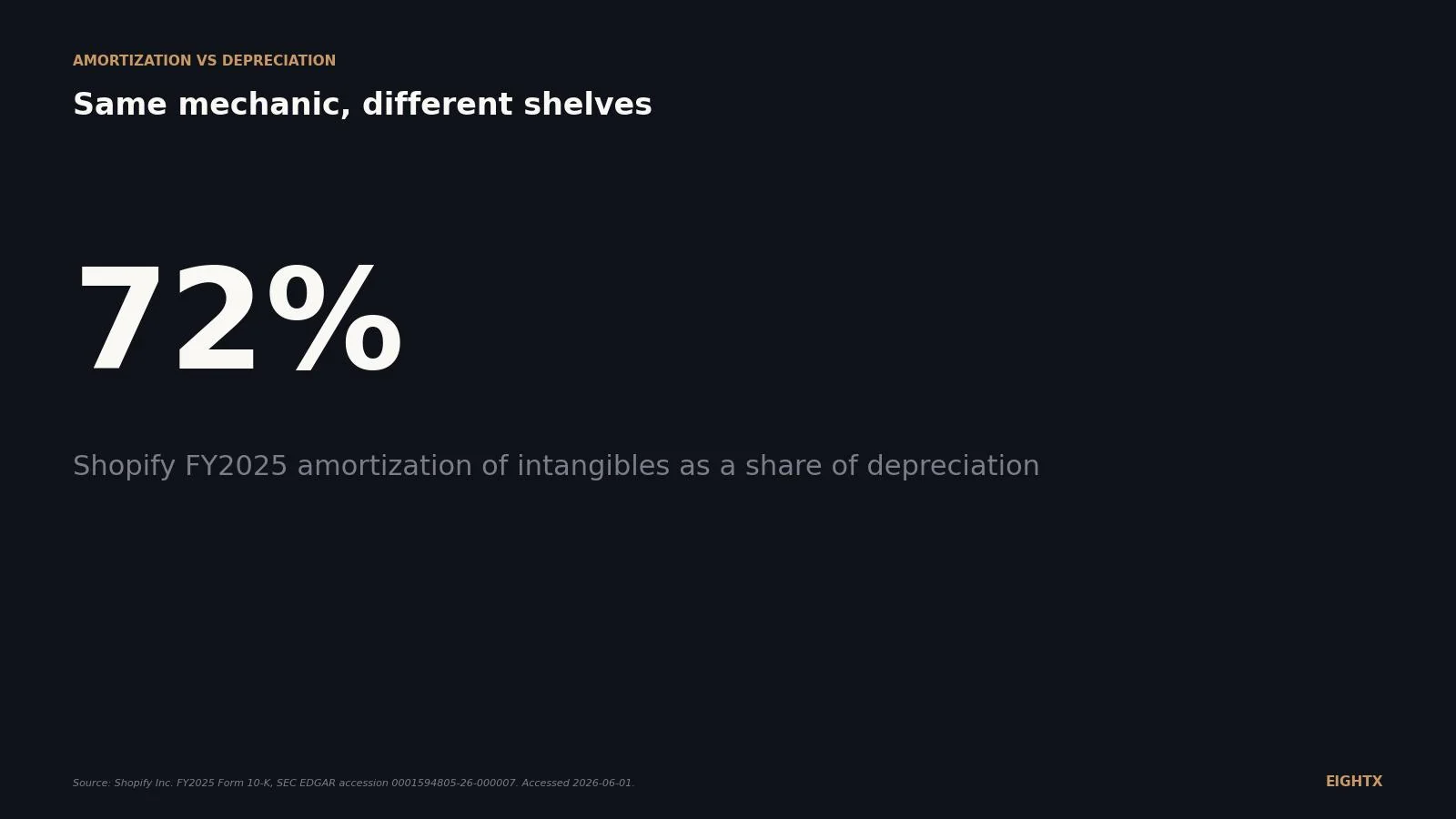
For most asset-light direct-to-consumer (DTC) brands, depreciation is small and amortization is near-zero. For platforms and post-acquisition businesses, amortization can rival or exceed depreciation because the purchase-price allocation booked acquired customer relationships and developed technology as intangibles that have to bleed off the balance sheet over time. Shopify is the cleanest public example. Its FY2025 amortization of intangibles was $13M against $18M of depreciation, so amortization was 72% the size of depreciation. In FY2022 amortization spiked to $54M, larger than the $36M of depreciation that year, because the Deliverr acquisition booked a large intangible cohort that has since fully amortized. Wayfair is the counter-example that makes the Shopify story legible. Wayfair reported only $1M of standalone amortization of intangibles in FY2025 on $11.9B of revenue, against combined depreciation and amortization of $304M. Wayfair is an organic builder, not a serial acquirer, so its non-cash drag is almost entirely depreciation of owned fulfillment infrastructure. Same industry, opposite shape of the D&A line, driven by M&A history.
How it works
Both lines work the same way on the P&L. Capitalize the cost when the asset is acquired or placed in service. Pick a useful life. Divide. Book the same expense each period until the asset is fully written off. Both add back to EBITDA, both are non-cash in the period they hit, and both create a permanent gap between what the P&L says and what the cash flow statement says. Where the two split is the asset class, the useful-life convention, and the tax treatment. Book life for capitalized internal-use software (ASC 350-40) is usually 3 to 5 years. Acquired customer relationships sit at 5 to 10 years. Warehouse picking equipment at 5 to 7 years. Leasehold improvements at the shorter of useful life or remaining lease term. Federal tax is a different schedule entirely. Acquired intangibles get amortized straight-line over 15 years under Internal Revenue Code (IRC) §197 regardless of book life, which creates a deferred-tax item that shows up on most post-acquisition balance sheets (a deferred-tax liability early in the schedule when the book life is shorter than 15 years, reversing to a deferred-tax asset late as book amortization fully runs off but tax amortization continues).
Common triggers
- You closed an acquisition and the purchase-price allocation booked a customer list, trade name, or developed technology. Those intangibles now amortize on a separate schedule from your existing PP&E.
- You are building or rebuilding your Shopify platform with capitalized internal labor and need to decide if it lands in ASC 350-40 software amortization (3-5 years), ASC 350-50 website-development amortization (the borderline call for DTC operators), or gets expensed as marketing.
- Your auditor asked whether a brand-development cost should be capitalized as an intangible or expensed as marketing. Internally developed brand is always expensed under ASC 350-30-25-3. Acquired brand is capitalized. The website rebuild is the gray zone, governed by ASC 350-50 which cross-references the 350-40 internal-use software framework.
- You are reading a public DTC 10-K to benchmark and want to know why some operators show $50M+ of amortization while others show $1M.
- You are reconciling book to tax for the K-1 or the C-corp return and the IRC §197 15-year straight-line tax life does not match the 5-year book life on a customer list.
The most common mistake
Lumping amortization into depreciation in your management reporting, then losing visibility into which line is acquisition-driven versus capex-driven. The two move on completely different operator levers. Depreciation tracks fit-out and hardware capex, so it climbs when you take on a new warehouse or refresh servers. Amortization tracks acquisitions and capitalized software, so it climbs when you buy a company or capitalize a platform build, and it falls off a cliff when a cohort fully amortizes. If you report them as one combined line, your EBITDA bridge and your capex forecast both get blurry, and you cannot answer the basic question of whether the non-cash drag in this year's P&L is a sunk acquisition cost from three years ago or a recent fit-out. For an acquirer this also flatters EBITDA in a way operating income would not. Shopify's $13M of FY2025 amortization is a real add-back to EBITDA that wouldn't show up if you were reading operating income, and it disappears entirely when the Deliverr cohort fully runs off. Split them on the P&L. Track them on separate schedules. Reconcile to the cash flow statement's combined D&A line once a quarter.
Browse the full ecommerce finance glossary for every metric and money term a DTC operator needs.
Frequently Asked Questions
what's the actual difference between amortization and depreciation?
Same mechanic, different asset class. Depreciation runs against tangible PP&E like warehouse equipment and computers, under ASC 360. Amortization runs against finite-lived intangibles like capitalized software, customer lists, and trade names, under ASC 350. Both spread the cost straight-line across the asset's useful life. Both add back to EBITDA.
is amortization a cash expense?
No. Amortization is non-cash in the period it hits the P&L. The cash went out earlier, when the intangible was acquired (or the internal labor was capitalized into a software build). What you see on the income statement each year is the spread of that earlier cash outflow across the useful-life schedule. That's why both amortization and depreciation get added back to operating income to get EBITDA, and why they show up as add-backs at the top of the cash flow statement. Capital expenditures and acquisitions hit cash flow when they happen. Amortization just spreads the P&L recognition.
is goodwill amortized or not?
Not amortized under public-company GAAP. Goodwill is tested for impairment annually under ASC 350-20 and written down only if the test fails. Private companies and not-for-profits can elect a different treatment under ASU 2014-02 and amortize goodwill straight-line over up to 10 years. For federal tax under IRC §197, goodwill is amortized straight-line over 15 years regardless of GAAP treatment, which creates a permanent book-tax timing gap.
why does Shopify's amortization keep dropping each year?
Acquired intangibles fully amortize and roll off the schedule. Shopify's amortization peaked at $54M in FY2022 from the Deliverr acquisition cohort. As that cohort hit the end of its useful life, the expense ran off: $38M in 2023, $14M in 2024, $13M in 2025. Depreciation moved separately based on fit-out and hardware capex.
should we capitalize our Shopify rebuild or expense it?
Internal-use software development under ASC 350-40 is capitalized once the application development stage starts and amortized over 3 to 5 years. Website-development costs sit under ASC 350-50, which cross-references the 350-40 framework. Preliminary planning, training, and data conversion are expensed as incurred. Most operator confusion is in the mushy middle, like outside contractor work on UX design. Default to capitalize if there is multi-year future economic benefit, expense if it is a one-off marketing or design project.