
Financial Strategy
Capitalize vs expense: the GAAP rules and the EBITDA swing every ecom and SaaS operator should know
Capitalizing a cost puts it on the balance sheet and spreads the hit over multiple periods; expensing it hits the P and L immediately. Under ASC 350-40 and ASU 2018-15, the choice can swing EBITDA by 100 to 300 basis points. Quality-of-earnings reviews routinely reverse aggressive capitalization, so getting this wrong before a raise or sale directly lowers your valuation.
Key Takeaways
- Capitalize = balance sheet plus amortize over useful life. Expense = P&L today. EBITDA is calculated before depreciation and amortization, so every dollar you capitalize moves out of OpEx and into a future line EBITDA ignores.
- ASC 730 is the baseline: expense all R&D as incurred unless another Codification topic applies (ASC 350-40 internal-use software, ASC 985-20 software-to-be-sold, in-process R&D in a business combination).
- ASC 350-40 uses a three-stage model. Preliminary project work is expensed. Application development work is capitalized. Post-implementation training, maintenance, and routine bug fixes are expensed.
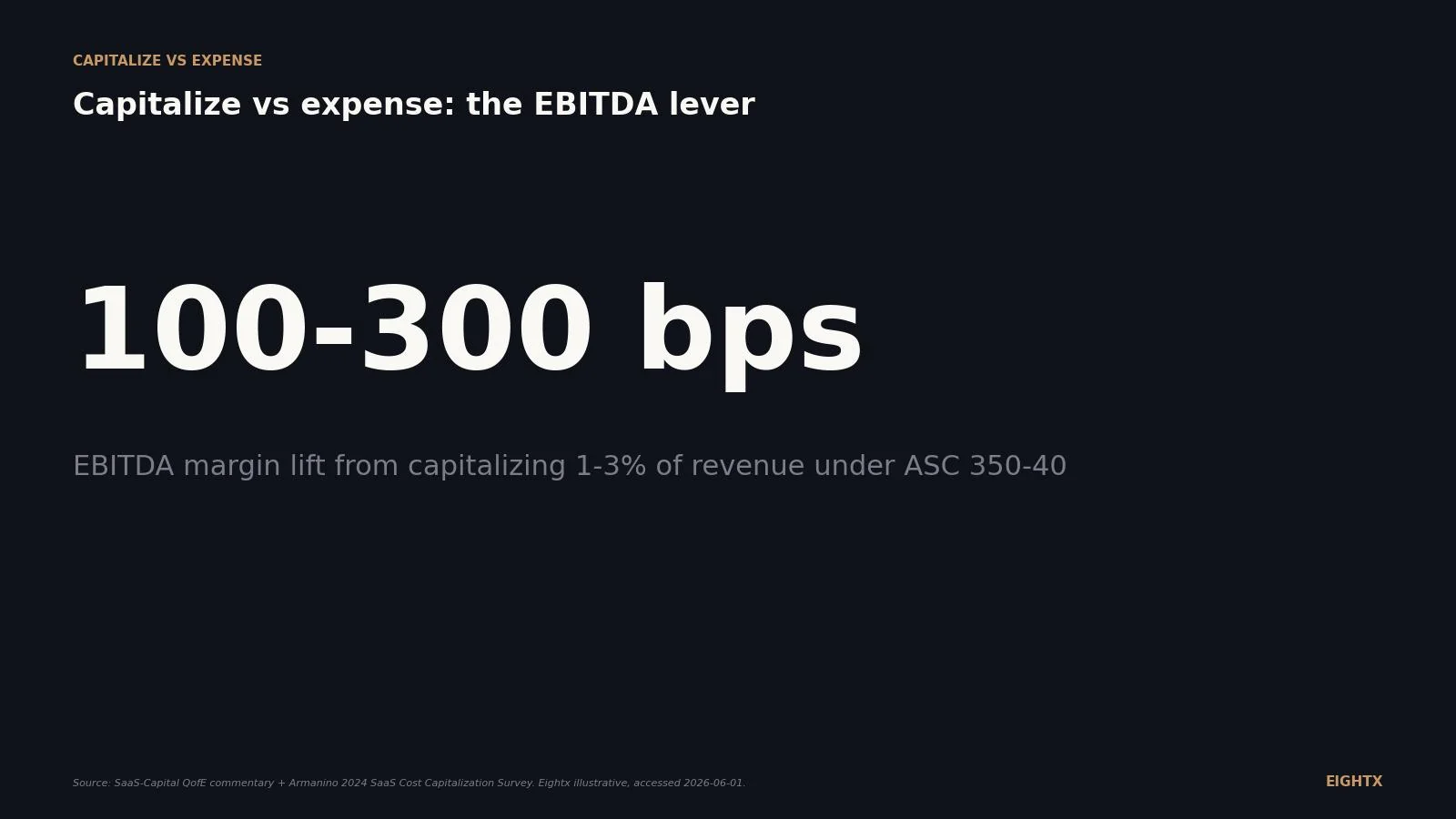
- Capitalizing 1-3% of revenue can lift reported EBITDA margin by 100-300 bps in high-growth phases, before amortization fully ramps. Cash is unchanged. A quality-of-earnings review reverses it.
- Content, blog posts, video ads, and influencer payments stay expensed under US GAAP (Generally Accepted Accounting Principles). There is no general right to capitalize brand marketing as an intangible asset. ASC 926 film guidance does not apply.
Capitalize-vs-expense is the single biggest discretionary accounting lever most growth-stage ecom and SaaS brands actually pull. The rule, simplified: if a cost builds an asset that throws off benefit for more than a year (internal software, certain SaaS implementation work, website application-development costs), GAAP lets you put it on the balance sheet and amortize it over the useful life. If it is research, planning, training, content, or marketing, you expense it now.
Founders care because EBITDA is calculated before depreciation and amortization (D&A). Every dollar you capitalize shifts out of OpEx and into a future D&A line EBITDA ignores. In a high-growth phase, that can swing reported EBITDA margin by 100-300 basis points (bps) on 1-3% of revenue capitalized, without any cash changing hands. The trap: over-capitalize content, marketing, influencer payments, or routine maintenance and a quality-of-earnings (QofE (Quality of Earnings)) team in a fundraise or sale will reverse it, dragging adjusted EBITDA right back down.
The one-line rule (and why founders care)
Capitalize means: put the cost on the balance sheet, then write it off over the useful life. Expense means: run the cost through the P&L this period. The cash leaves the business at the same time either way. What changes is where it shows up in your financial statements and how your EBITDA reads.
Take a $50M-revenue brand running 8% EBITDA margin. If you capitalize 2% of revenue ($1M) in qualifying software-development work, the full $1M moves off the P&L gross. Net of year-one amortization (roughly $200K under a five-year straight-line life), $800K of cost actually disappears from the income statement in year one. Reported EBITDA goes from $4M (8% margin) to roughly $4.8M (9.6% margin), a +160 bps swing in year one. As the capitalized base builds in years two through five (and amortization has not yet caught up to new capitalization), the steady-state-of-build view runs closer to the +200 bps headline in the chart below. Cash EBITDA, which is what a buyer cares about, stays at $4M. That is the lever.
The reason this matters in 2026: more growth-stage SaaS and DTC brands than ever are reporting "EBITDA positive" while running real cash burn. Capitalization policy is one of the reasons. It is not fraud. It is GAAP. But it does mean operators need to know what is real and what is reporting.
What GAAP says you must expense (the ASC 730 baseline)
ASC 730 is the starting point. Research and development (R&D) costs are expensed as incurred unless another Codification topic applies. The relevant exceptions are ASC 350-40 (internal-use software), ASC 985-20 (software to be sold, leased, or marketed), and the in-process R&D rules inside ASC 805 for acquired businesses.
If you cannot point to one of those carve-outs, the cost is expensed. That covers most early-stage product research, market validation work, formula development for CPG brands, prototype testing, and the meaningful chunk of "innovation" spend that growth-stage operators sometimes try to defer.
The reason ASC 730 is conservative: the future economic benefit of research is too uncertain to recognize as an asset. GAAP does not let you build a balance sheet out of hope. You have to be far enough along the development curve to point at something probable.
What GAAP says you can capitalize (ASC 350-40, ASU 2018-15, ASC 985-20)
ASC 350-40 governs internal-use software. It uses a three-stage model that any operator with an in-house engineering team or a custom Shopify Plus build should know cold.
Stage 1, the preliminary project stage, is expense-only. This is the planning, vendor evaluation, feasibility, and conceptual work before you commit to building. None of it goes on the balance sheet.
Stage 2, the application development stage, is where capitalization happens. Qualifying direct costs include external developer fees and third-party software licenses, direct internal payroll and benefits for engineers working on the project, travel directly tied to the build, and capitalized interest under ASC 835-20. Management has to commit to the project, and completion has to be probable. General overhead, data conversion, and training stay expensed.
Stage 3, post-implementation and operation, is back to expense-only. Training your team to use the new system, routine maintenance, support tickets, and bug fixes that do not add new functionality all go through the P&L. Enhancements that genuinely add new functionality can be capitalized if they meet the same Stage 2 criteria.
ASU 2018-15 extends the model to cloud computing arrangements. If you are implementing a SaaS platform (NetSuite, Shopify Plus, a workflow tool) under a service contract, the configuration, coding, integration, and testing work can be capitalized by analogy to ASC 350-40, then amortized over the contract term plus reasonably certain renewals. Training, data conversion, and ongoing usage fees stay expensed.
ASC 985-20 covers software you build to sell or license externally. Costs before technological feasibility get expensed. Costs after technological feasibility, but before general release, can be capitalized. Most DTC brands do not hit this one. SaaS brands and platform-builders do.
The decision flow:
Cost incurred
→ Is it research, planning, training, marketing, or influencer? Expense.
→ Is it routine maintenance or a bug fix with no new functionality? Expense.
→ Is it software, website, or SaaS implementation development work?
→ Internal-use software (ASC 350-40)? Capitalize Stage 2 only.
→ SaaS implementation (ASU 2018-15)? Capitalize config, coding, integration, and testing.
→ R&D outside software guidance (ASC 730)? Expense.
How this swings EBITDA, the math
Capitalization shifts cost from OpEx to a future amortization line. EBITDA ignores amortization. The result is a reported EBITDA that runs ahead of cash EBITDA for as long as the capitalized base is still building. Once amortization catches up to new capitalization (typically 3-5 years), the swing fades to zero in steady state.
The chart below shows the mechanic on an illustrative $50M SaaS brand at three capitalization policies. Reported EBITDA margin lifts roughly 200 bps per percentage point of revenue capitalized in the early years. Cash EBITDA does not move.
The data behind the chart:
Capitalization policy Reported EBITDA margin Cash EBITDA (QofE-adjusted) Swing 0% of revenue capitalized 8.0% 8.0% 0 bps 2% of revenue capitalized 10.0% 8.0% +200 bps 5% of revenue capitalized 13.0% 8.0% +500 bps
The reference table for what gets capitalized vs expensed by cost category under US GAAP:
Cost category Capitalize? GAAP source Typical P&L line if expensed Typical balance sheet line if capitalized Research costs (new product, new SKU) Expense ASC 730 R&D n/a Preliminary-stage software work Expense ASC 350-40 R&D or G&A n/a Application-development software (internal use) Capitalize ASC 350-40 n/a Intangibles, internal-use software Software upgrade adding functionality Capitalize ASC 350-40 n/a Intangibles, internal-use software Software bug fix or routine maintenance Expense ASC 350-40 Technology or G&A n/a SaaS implementation, config, coding, integration Capitalize ASU 2018-15 n/a Prepaid or Other assets SaaS implementation, training, data conversion Expense ASU 2018-15 Technology or G&A n/a Website application and infrastructure dev Capitalize ASC 350-50 (folds into 350-40 under ASU 2025-06) n/a Intangibles, software Website content, SEO, hosting Expense ASC 350-50 Marketing or S&M n/a Blog, video, or photography production Expense Advertising practice Marketing n/a Influencer or creator payments Expense Advertising practice Marketing n/a Acquired in-process R&D (business combination) Capitalize ASC 805 and 730 n/a Intangibles, IPR&D
Where founders get this wrong (and where auditors call it)
Four patterns get reversed in a QofE almost every time.
The first is routine maintenance, bug fixes, or refactoring booked as "enhancements" so they qualify under ASC 350-40 Stage 2. The rule says new functionality is required. A QofE team will ask for the project-level documentation. If the time tracking shows the engineer was patching tickets, not building features, the cost gets reclassified as expense.
The second is capitalizing marketing content, blog posts, ad creative, or influencer payments as intangible assets. There is no GAAP basis for this. Even with a long-tail content strategy, you do not control the future benefit reliably enough to meet the asset definition. Reversed in every QofE.
The third is a sudden policy shift, the classic example being a brand that capitalized 1% of revenue last year and 5% this year with no change in development activity. QofE teams flag this as policy gaming. Either you support the change with new projects and clean documentation or it gets unwound.
The fourth is a flat percentage-of-payroll allocation for capitalization, where engineering payroll is treated as X% capitalizable across the board with no project-level time tracking. ASC 350-40 requires direct attribution. A blanket percentage without supporting time data does not survive review.
Capitalize-vs-expense is not a fraud question, it is a sophistication question. The brands that get it right run capitalization as a disciplined policy with project-level tracking and a defensible threshold. The brands that get it wrong treat it as a margin lever and assume the buyer will not check. The buyer always checks.
How we handle it at Eightx
Our default for $5M-$150M ecom and SaaS clients: capitalize what GAAP clearly lets you capitalize, document it cleanly, and do not manage the business off reported EBITDA. Manage off cash EBITDA. Let GAAP capitalization be a reporting layer on top.
The practical playbook:
Set a written capitalization policy with a dollar threshold (typically $10K-$25K for $5-20M brands, $25K-$50K for $20-50M brands). Apply it consistently. Document the threshold in your accounting manual and tell your auditor.
Require project-level time tracking on engineering payroll. If your dev team uses Linear, Jira, or even a structured time-tracking sheet, you have the audit trail. If they do not, you cannot defend internal-payroll capitalization.
Track Stage 2 work separately from Stage 1 and Stage 3 in your project management. The line between preliminary planning, active development, and post-implementation maintenance is the line between expense and capitalize.
Never capitalize content, blog production, video ads, influencer payments, or general marketing. If your accounting team brings it up, push back. It does not survive review and it makes the rest of your capitalization policy look soft.
Run a parallel cash EBITDA view in your internal reporting. Every month, calculate EBITDA both ways: reported (with capitalization) and cash (with everything expensed). Use the cash version to make decisions. Use the reported version for external statements and benchmarking.
A note for AU and international readers: IFRS (IAS 38) is different. It lets you capitalize development costs that meet six specific criteria, which is generally a higher bar than ASC 350-40 but covers a wider scope. Shopify itself reports under IFRS for that reason. If you operate in both jurisdictions, you will see the same cost treated differently in each set of books.
Sources and methodology
The GAAP rule summaries here are paraphrased from the FASB Accounting Standards Codification, primarily ASC 730-10-25 (R&D), ASC 350-40 (internal-use software), ASC 350-50 (website development), ASC 985-20 (software to be sold), and ASC 805 (business combinations and in-process R&D). The Codification itself is paywalled, so we cross-referenced public summaries from Grant Thornton, KPMG (https://kpmg.com/us/en/articles/2025/rd-costs-ifrs-accounting-standards-us-gaap.html), Eliassen Group, PYA, and FinQuery for the stage-model and capitalization-criteria detail.
The ASU 2018-15 treatment of cloud computing implementation costs is summarized from FinQuery and Zenskar (https://zenskar.com/blog/saas-accounting/asu-2018-15). The ASU 2025-06 changes, effective for fiscal years beginning after December 15, 2027, are summarized from the EY Technical Line and BDO ARCH guidance.
The EBITDA-swing math draws on the SaaS-Capital commentary on capitalizing software development expenses (https://www.saas-capital.com/blog-posts/capitalizing-software-development-expenses-for-saas-businesses/) and the Armanino 2024 SaaS Cost Capitalization Survey. The illustrative $50M brand example uses a five-year amortization life and assumes the capitalized asset base is still building (so amortization runs at roughly half of new capitalization in year one). Steady-state swing fades to zero as amortization catches up.
The QofE red flags come from AKF Partners' published guidance on capitalization reviews and from SaaS-Capital's QofE commentary, supplemented by what we see in fundraise and sale prep work with our own clients.
This is a definitional reference page rather than a primary-data report. Where GAAP citations are short and public, we link to FASB directly. Where the underlying text is paywalled, we paraphrase using major accounting-firm and academic summaries.
Update cadence: refreshed when FASB issues a relevant ASU (next scheduled: post-ASU 2025-06 effective-date transition in fiscal 2028) or when material EBITDA-swing data updates from the annual SaaS Capitalization Survey.
For the cash-flow side of this conversation, see our fractional CFO services overview and the QofE-readiness work covered by our interim CFO services.
Frequently asked questions
what's the actual difference between capitalize and expense?
Capitalizing a cost puts it on the balance sheet as an asset and writes it off over its useful life as depreciation or amortization. Expensing a cost runs it through the P&L in the period you incur it. EBITDA is calculated before D&A, so capitalization lifts reported EBITDA while expensing depresses it. Cash is the same either way.
when does GAAP let me capitalize software development costs?
Three places. Internal-use software (ASC 350-40) lets you capitalize application-development-stage costs once management commits and the project is probable to complete. SaaS implementation work (ASU 2018-15) lets you capitalize config, coding, integration, and testing tied to a service contract. Software you build to sell (ASC 985-20) lets you capitalize costs after technological feasibility. Everything else falls under ASC 730 and gets expensed.
can i capitalize my shopify plus build or shopify app development?
The application-development portion (custom theme work, internal app dev, integrations, testing) is typically capitalizable under ASC 350-40 or, if it is tied to a Shopify Plus SaaS contract, ASU 2018-15. Preliminary planning, training your team to use it, data conversion, and ongoing usage fees stay expensed. You still need project-level time tracking to defend it in a QofE.
what's the dollar threshold for capitalizing something under GAAP?
GAAP does not set one. Common entity policies range from $5,000 to $100,000 per project. The only real guardrails are materiality and consistency. Pick a threshold, document it, and apply it the same way every quarter. A buyer in a QofE will accept a reasonable threshold; what they reverse is the policy that drifts case by case.
can i capitalize blog posts, video ads, or influencer payments?
No. Under US GAAP, content production and influencer payments are advertising and marketing, expensed when incurred. There is no general right to capitalize brand marketing because you do not control the future economic benefit reliably enough. The specialized film and episodic-content guidance in ASC 926 does not apply to DTC brand content.
Browse the full ecommerce finance glossary for every metric and money term a DTC operator needs.