
Financial Strategy
What is debt service coverage ratio (DSCR)? The number lenders gate your inventory loan on
Debt service coverage ratio is EBITDA divided by annual debt service payments, and SBA 7(a) lenders require a minimum of 1.20x to 1.25x before approving inventory or working-capital loans. A DTC brand with $500,000 EBITDA and $300,000 in annual principal plus interest has a DSCR of 1.67x, comfortably above the floor. Owner add-backs and RBF repayments are the traps.
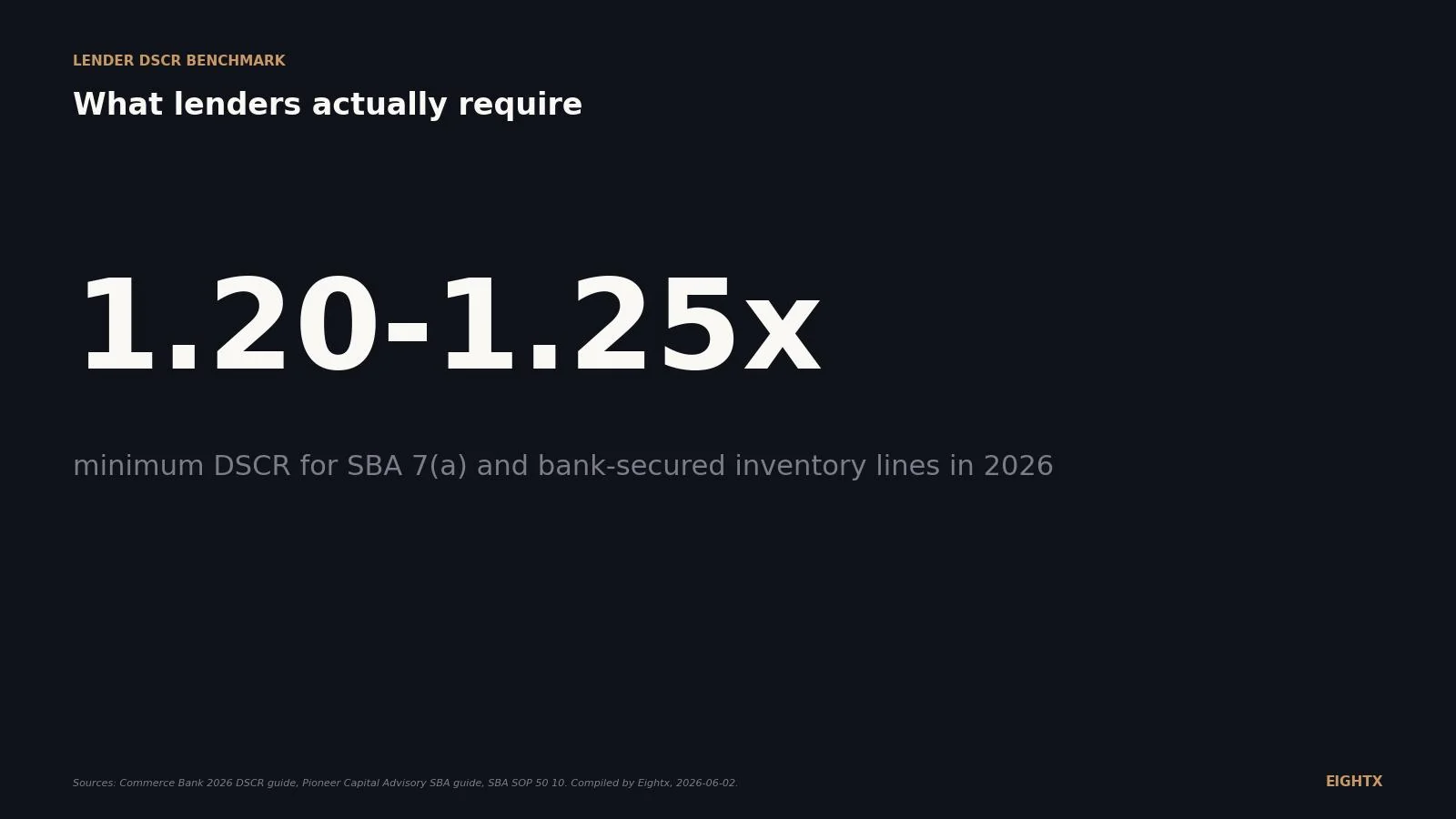
Debt service coverage ratio (DSCR) is the single number a bank or Small Business Administration (SBA) underwriter checks before they fund your inventory or working-capital loan. The math is simple: earnings before interest, taxes, depreciation, and amortization (EBITDA) divided by total annual debt service (principal plus interest on every loan, line, lease, and merchant cash advance you owe). Every secured US lender (SBA, bank-secured, asset-based) gates on the same threshold: 1.20 to 1.25x minimum for SBA 7(a) and bank-secured inventory facilities, with 1.15x as the absolute floor. Most ecommerce founders do not know they are being measured on it until the deal dies.
DSCR is the lender's safety margin. A 1.25x DSCR means your business throws off $1.25 of cash earnings for every $1 of debt payments due that year. The buffer is what keeps the lender whole if a slow quarter knocks 20% off EBITDA. Banks are not flexing the threshold right now. The commercial-bank business-loan delinquency rate hit 1.34% in Q1 2026, up from 1.02% in Q4 2023, a 31% rise that has underwriting committees enforcing DSCR minimums hard. The trap for direct-to-consumer (DTC) brands is that revenue-based lenders (Wayflyer, Shopify Capital, Clearco, Settle, Parker) do not quote DSCR publicly. They underwrite to gross-margin coverage of the remittance percentage, not generally accepted accounting principles (GAAP) EBITDA. Brands stack three or four of those facilities, look fine on revenue coverage, then get blindsided when a real bank runs the DSCR math and the answer is 0.9x. If you are sizing stacked revenue-based debt against bank capacity, the True Interest Cost calculator converts MCA factor rates to APR so you can see the real annualized cost before you stack another advance.
How it works
Illustrative example, not a specific brand. Take a DTC brand at a ~$5.5M annualized revenue run-rate doing about $1.01M of EBITDA (an 18% EBITDA-margin operator). It carries an $800K SBA term loan at 11% over 10 years (about $131K annual principal-plus-interest), a $500K bank inventory line at 7.75% interest-only (about $39K), and a $24K equipment lease. Total bank-recognized annual debt service is $194K. The DSCR on bank-recognized debt alone is $1.01M divided by $194K, which is 5.2x. Healthy on paper. Now stack a $600K Wayflyer advance at a 1.10 factor remitted at 12% of sales. At a $5.5M run-rate, 12% of sales annualizes to $660K of remittance ($5.5M × 12%). The bank adds that to debt service: $194K + $660K = $854K total. The re-cast DSCR is $1.01M divided by $854K, which is ~1.18x. The bank says no.
Common triggers
- You are applying for an SBA 7(a) loan, an inventory line, or any bank facility over $350K and need to know if your numbers will pass underwriting.
- You have stacked two or more revenue-based advances (Wayflyer, Shopify Capital, Clearco, Settle, Parker) and want to know what a bank will see when they look at your debt schedule.
- Your DSCR looks fine on the annual roll-up but a lender is pushing back, usually because Q1 or Q2 dips below 1.0x and they are reading quarterly.
- Bank prime rate moved (it was 7.50% in June 2025, 6.75% in May 2026 per Federal Reserve series MPRIME) and you want to re-run DSCR on your floating-rate inventory line.
- You are choosing between paying down a merchant cash advance (MCA) early or refinancing into a longer-tenor SBA loan, and DSCR is what makes one option work.
The most common mistake
The most common operator error is using EBITDA divided by interest-only as DSCR. That is not the formula a lender uses. Lenders divide EBITDA by principal plus interest on every facility on your debt schedule, including MCAs, buy-now-pay-later financing, net-terms factors, and equipment leases. Leaving any of those out inflates your DSCR by 20 to 50% and the lender will catch it the moment they pull your business credit report. The second error is aggressive addbacks to EBITDA. SBA lenders will typically accept owner salary above-market portion, one-time legal or platform-migration expense, and non-recurring litigation, but they haircut each one. Assume the lender will accept half of what you propose, and run your DSCR at that haircut number before you submit. The third error is annual averaging. A Q4-heavy DTC brand can show a clean 1.30x DSCR on the trailing-twelve-month roll-up while running sub-1.0x in Q1 and Q2, and any bank pulling quarterly statements will catch it and re-cast to the worst quarter, not the average. If you are about to apply, run quarterly DSCR before annual. For broader cash and debt-capacity planning, see our fractional CFO playbook.
Browse the full ecommerce finance glossary for every metric and money term a DTC operator needs.
Frequently Asked Questions
what dscr do i need for an sba inventory loan?
1.15x is the absolute floor for SBA 7(a) loans over $350K on a historical or projected basis. 1.20 to 1.25x is the lender comfort zone you should actually target. Below 1.15x the deal does not get underwritten, full stop.
is 1.2 dscr good enough for an ecommerce business?
It is the minimum a secured bank or SBA lender will accept. It is not where you should run the business. Profitable $5M to $50M DTC brands typically show 1.20 to 2.00x DSCR; mature high-margin brands run 1.50 to 2.50x. At 1.2x you have no buffer for a soft quarter, which is exactly when you need debt capacity.
does wayflyer or shopify capital care about dscr?
No. Revenue-based ecommerce lenders do not publish DSCR thresholds and do not underwrite to GAAP DSCR. They underwrite to gross-margin coverage of the daily or weekly remittance percentage. That is why brands stacking three or four of these facilities can be sub-1.0x on a true bank computation and not realize it.
how do you calculate dscr if you have an mca and a shopify capital advance stacked?
Take the annualized remittance dollars from each advance and add them to your traditional debt service. A $600K Wayflyer advance remitted at 12% of sales on a $5.5M run-rate annualizes to $660K of debt service. That number goes in the denominator. DSCR drops fast when you actually include it.
what dscr should i run my dtc brand at if i want banks to call me back?
1.50x or higher. That gives you a real buffer, room to refinance into longer-tenor SBA debt without breaching covenants, and signals to lenders that you are not stacking revenue-based debt that will show up on a bank credit pull. Banks call the brands at 1.50x plus; the brands at 1.20x are the ones chasing lenders.