
Financial Strategy
What is goodwill in an ecommerce business? The acquirer's residual, explained with Solo Brands' $410M to $73M math
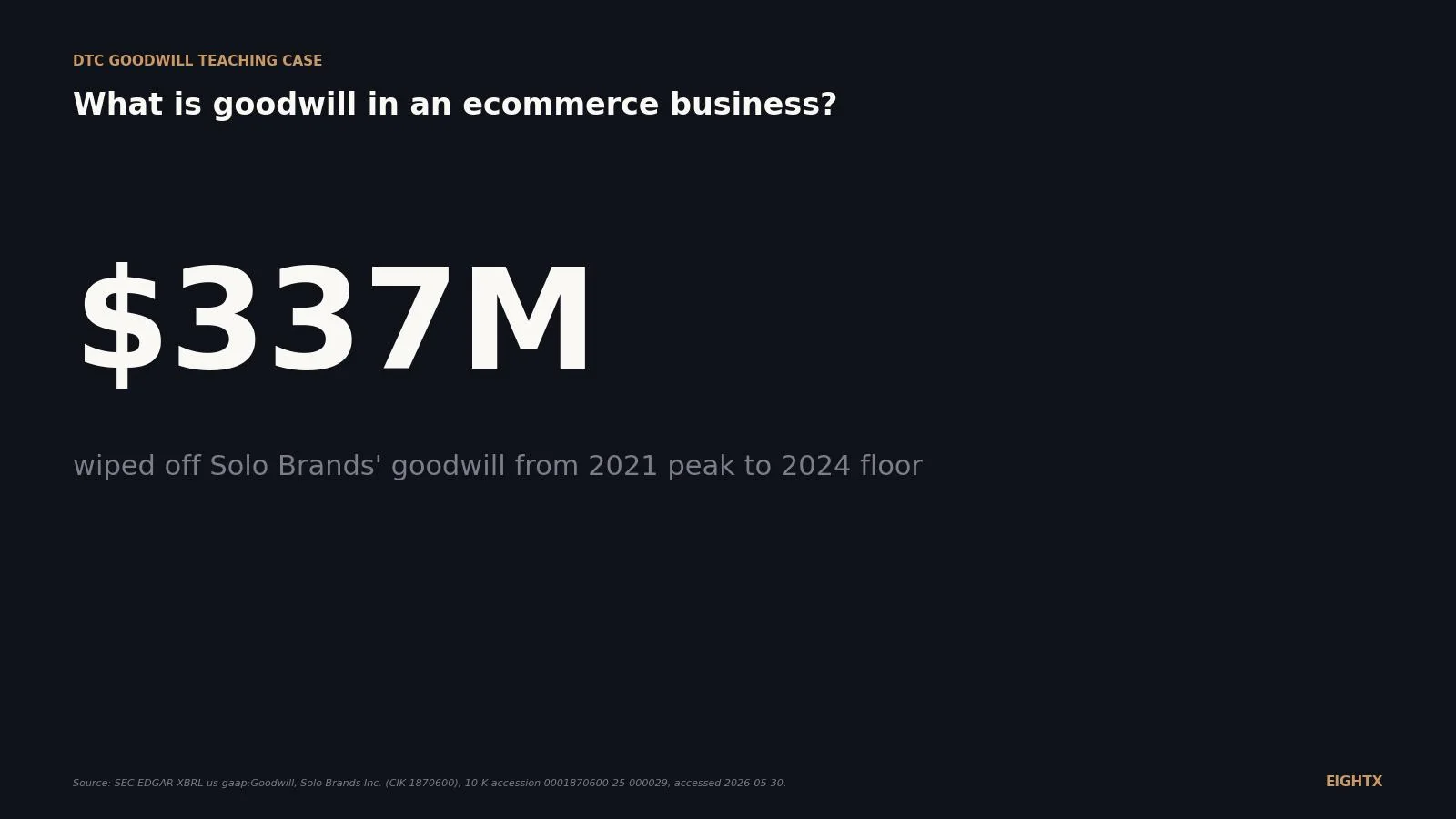
Goodwill is the premium a buyer pays above the fair value of identifiable assets in an acquisition, and Solo Brands shows what happens when that premium is mispriced: goodwill peaked at $410.6M in 2021 and was written down to $73M by 2024, a $337M impairment that wiped the equivalent of multiple years of operating profit. For founder-built brands, goodwill is rarely material, but any brand considering a roll-up acquisition should understand how purchase price allocation creates it.
Key Takeaways
- Goodwill is the leftover. When a buyer acquires an ecommerce brand, they assign fair value to every identifiable asset (inventory, brand, customer list, technology). Whatever consideration is left over is goodwill. It only appears on the buyer's balance sheet.
- Founder-grown DTC brands carry $0 in goodwill, no matter how strong the brand. US GAAP (Generally Accepted Accounting Principles) forbids recording internally generated goodwill. Honest Company has $2.27M total (from one small legacy deal), Revolve $2.04M.
- Solo Brands' goodwill went from $289M (2020) to $411M (2021 peak) to $73M (2024). About $337M of cumulative impairment hit the P&L between 2023 and 2024 as the Solo Stove, Chubbies, Oru Kayak and ISLE Surf reporting units underperformed.
- Five things ASC 805 forces buyers to carve out before booking goodwill: trademarks, customer lists and email file, developed technology (Shopify theme + custom code), supplier or manufacturing agreements, and the founder's non-compete. Each gets its own fair value.
- Public companies don't amortise goodwill. They test it for impairment at least once a year under ASC 350. Private companies can elect to amortise it on a straight line over up to 10 years (FASB ASU 2014-02), trading P&L hits today for fewer impairment shocks later.
Goodwill is the leftover line that shows up on the buyer's balance sheet when someone acquires an ecommerce brand for more than the fair value of the identifiable things they bought. It is the number that says "we paid more for this business than the sum of its individual parts." Under US GAAP (Generally Accepted Accounting Principles), it only ever appears on the acquirer's books, never the seller's, and a founder who grew their own DTC (direct-to-consumer) brand from $0 to $50M will have exactly zero goodwill on their balance sheet no matter how strong the brand is. That seems counterintuitive until you see how the accounting rules force every identifiable piece to be valued separately before anything is allowed to fall into the goodwill bucket.
Goodwill in one sentence, plus the formula
Goodwill is the residual. The formula is straightforward:
Goodwill = Purchase Price - Fair Value of Identifiable Net Assets Acquired
Worked example. A strategic buyer pays $30M cash for a Shopify-based outdoor apparel brand. The acquired company's tangible assets (inventory, equipment, working capital) are worth $10M at fair value. The identifiable intangibles (brand name, customer list, developed tech, supplier agreements, non-compete) are valued by a third-party appraiser at $12M. Total identifiable net assets: $22M. Purchase price: $30M. Goodwill: $8M.
That $8M lands on the buyer's balance sheet under "goodwill" and stays there until something forces a writedown. Under ASC 805 (the GAAP standard for business combinations), the buyer is required to do this allocation within one year of closing (the "measurement period"). Buyers who skip the work and just dump everything into goodwill get caught by their auditor and forced to redo it, usually expensively.
Why goodwill only sits on the acquirer's balance sheet
The asymmetry is one of the more confusing parts of GAAP accounting for founders. When you sell your ecommerce brand, you derecognise the assets and liabilities you sold at their existing carrying value on your books, and you book a gain or loss on disposal equal to the difference between what you received and what you wrote off. Goodwill never enters your accounting because internally generated goodwill is not allowed on any GAAP balance sheet, full stop.
The buyer, on the other hand, has to allocate the purchase price across every acquired asset and assumed liability at fair value. Anything left over (the part the buyer paid above the sum of those fair values) becomes goodwill on their balance sheet. This is why founder-grown DTC brands look so asset-light on their own books: a brand worth $80M to an acquirer is worth $0 in goodwill to the founder running it. The asset side of the founder's balance sheet shows inventory, AR (accounts receivable), some fixed assets, maybe a small trademark line if they paid for the registration. The brand equity that an acquirer would pay $40M for is sitting in the marketing P&L (profit and loss), not the assets.
This rule is why a strong founder-grown DTC business can look financially boring on paper right up until the day someone buys it. The "goodwill" only crystallises in the moment a third party transacts. Until then, it is real economic value with zero accounting representation.
What gets carved out before goodwill (the DTC-specific list)
ASC 805 requires the buyer to identify and value every separable intangible asset before plugging goodwill. For a typical Shopify or DTC brand acquisition, that means five categories of identifiable intangibles that have to be valued first:
- Trademark or brand name. Valued using the relief-from-royalty method most commonly. Useful life is often indefinite for a strong brand, which means no amortisation but annual impairment testing.
- Customer list and email file. Valued using the multi-period excess earnings method. Useful life is typically 4 to 8 years depending on churn.
- Developed technology. The Shopify theme, custom apps, proprietary recommendation logic, any backend code. Valued at replacement cost or relief from royalty. Useful life 3 to 5 years.
- Supplier and manufacturing agreements. Long-term contracts with FOB pricing or capacity locks. Valued at the present value of the savings vs market.
- The founder's non-compete. Valued at the discounted lost revenue if the founder competed. Useful life equals the non-compete term, typically 3 to 5 years.
Whatever consideration is left after all five are valued at fair value becomes goodwill. In a clean PPA (purchase price allocation), the goodwill share is usually 20% to 40% of total purchase price for a healthy DTC deal. When goodwill ends up at 60%+ of purchase price, the auditor usually pushes back and asks why the identifiable intangibles were not valued more aggressively, which is exactly the conversation a buyer wants to avoid.
The chart below shows what this looks like in practice across three public DTC issuers. Solo Brands is a roll-up acquirer; Honest and Revolve are founder-grown. The difference in goodwill carried on the balance sheet is exactly what you would expect.
Company Latest period Goodwill ($M) Growth model Solo Brands 2026-03-31 (10-Q) $73.1 Roll-up (Solo Stove + Chubbies + Oru + ISLE) Honest Company 2026-03-31 (10-Q) $2.27 Organic / founder-grown Revolve Group 2026-03-31 (10-Q) $2.04 Organic / founder-grown
What happens after the deal: ASC 350 impairment testing and the Solo Brands $337M wipe
Once goodwill lands on the buyer's balance sheet, it does not amortise (for public companies, under ASC 350). Instead, it gets tested for impairment at least once a year, and on any triggering event in between. A triggering event is something that suggests the reporting unit might not be worth its carrying value: a sustained drop in market cap, missed revenue forecast, loss of a key customer, brand reputation hit. When the test fails, the goodwill gets written down to fair value and the writedown hits the income statement as an impairment charge.
The 2022 to 2024 DTC impairment wave was real and broad. Kroll's annual US Goodwill Impairment Study (cited via Mercer Capital and Miller Kaplan) recorded roughly $136B of pretax goodwill impairments across 400 US public companies in 2022 and $83B across 353 companies in 2023. DTC and consumer-products issuers drove a disproportionate share of those writedowns because the 2020 to 2021 era of high-multiple consumer acquisitions baked in optimistic terminal growth assumptions that just did not hold once DTC unit economics deteriorated.
Solo Brands is the cleanest teaching case. Their goodwill ran from $289M (December 2020) to $410.6M (December 2021, after the Chubbies, Oru Kayak, and ISLE Surf acquisitions) to $169.6M (December 2023, first major impairment) to $73.1M (December 2024, after two more impairment tests). About $337.5M of cumulative impairment ran through the P&L over 24 months. The carrying value has held flat at $73.1M through Q1 2026, but the brand-by-brand reporting units have been disclosed as at-risk in each subsequent 10-K filing.
Period end Goodwill ($M) Note 2020-12-31 289.1 Pre-IPO baseline (Solo Stove + initial roll-ups) 2021-12-31 410.6 Peak after Chubbies, Oru, ISLE acquisitions 2022-12-31 382.7 Routine adjustments 2023-12-31 169.6 First major impairment 2024-09-30 124.8 Second impairment 2024-12-31 73.1 Third impairment (annual test) 2026-03-31 73.1 Held flat through Q1 2026
a.k.a. Brands (parent of Princess Polly, Petal & Pup, Culture Kings) is the other paper trail worth knowing about: 5 consecutive 10-Ks with goodwill-impairment discussion from 2022 through 2026. Pure DTC aggregator playbook, recurring impairment risk.
Private companies have an out. FASB ASU 2014-02 lets a private acquirer elect to amortise goodwill on a straight-line basis over up to 10 years. The election trades steady annual P&L hits for fewer surprise impairment shocks later. For a private aggregator buying 5+ Shopify brands a year, the amortisation election is usually the right call: you would rather see $5M of predictable amortisation hit operating income every year than $40M of impairment hit out of nowhere in year 4.
What this means if you're the founder selling, or the operator buying
Two completely different reads depending on which side of the table you sit on.
If you are the founder selling. Goodwill is the buyer's problem, but it affects how the deal gets structured. In an asset deal or Section 338(h)(10) stock deal, the buyer gets to amortise the goodwill they pay for over 15 years for US federal tax purposes (IRC Section 197), which makes the deal more valuable to them and gives you more room to negotiate on price. In a straight stock deal, the buyer inherits your tax basis and gets no deduction, which usually means a lower price. The PPA also matters for reps and warranties: if the buyer values your trademark or customer list aggressively (to maximise their amortisable intangibles), they'll push for tighter reps on those assets. Negotiate the PPA framework before signing, not after.
If you are the operator buying. Goodwill is what will hit your P&L if the acquired brand cannot earn its cost of capital. Budget for impairment risk explicitly in your deal model. If you are paying a high multiple at the top of a category cycle, build a sensitivity scenario for what your reporting unit fair value looks like if revenue grows 10% instead of 30%. If the implied carrying value drops below the purchase consideration, you have priced in an impairment from day one. For private acquirers, elect the ASU 2014-02 amortisation policy upfront. It will not save you from a triggering event, but it spreads the pain.
For more on how this plays into a real DTC buy-side model, see valuing customer lifetime value as an acquisition input. For how the broader 2026 DTC deal environment is shaping valuations, see our DTC funding tracker.
Internally generated goodwill is never on a balance sheet, no matter how strong the brand. It only crystallises in the moment a buyer transacts. Until then, your brand equity sits in the marketing P&L. After the deal, it sits on the acquirer's balance sheet as goodwill, and someone has to defend it to an auditor every year.
Sources and methodology
Primary balance-sheet data. Goodwill carrying values were pulled from the SEC EDGAR XBRL company concept API at the endpoint https://www.sec.gov/edgar<10-digit>/us-gaap/Goodwill.json. We pulled three issuers: Solo Brands Inc. (CIK 1870600, 43 datapoints from FY2020 through Q1 2026), Honest Company Inc. (CIK 1530979, 42 datapoints from FY2020 through Q1 2026), and Revolve Group Inc. (CIK 1746618, 56 datapoints from FY2019 through Q1 2026). Source pulls dated 2026-05-30.
Filing-level corroboration. SEC EDGAR full-text search for "goodwill impairment" against 10-K filings from DTC and ecommerce issuers confirms the recurring pattern in DTC-aggregator filings. a.k.a. Brands (CIK 1865107) carries goodwill-impairment discussion in 5 consecutive 10-K filings from 2022 through 2026 (accession numbers 0001865107-22-000033, 0001865107-23-000012, 0001865107-24-000010, 0001865107-25-000016, 0001865107-26-000008).
GAAP framework references. The accounting treatment described here follows ASC 805 (Business Combinations) for the initial purchase price allocation and ASC 350 (Intangibles, Goodwill and Other) for the subsequent measurement. We used the Deloitte DART chapter 2.1 on overall accounting for goodwill, BDO ARCH's "Business Combinations Under ASC 805," Stout's note on asset acquisitions vs business combinations, and Appraisal Economics' "Goodwill Impairment" for the impairment-testing mechanics. The private-company amortisation election is FASB ASU 2014-02, codified at ASC 350-20-15-4.
Industry-wide impairment magnitude. The 2022 ($136.2B across 400 US public companies) and 2023 ($82.9B across 353 companies) figures come from Kroll's annual US Goodwill Impairment Study, cited via Mercer Capital ("Goodwill Impairments Are on the Rise," 2024) and Miller Kaplan's knowledge centre.
Limitations. XBRL Goodwill reflects net carrying value after accumulated impairment, not gross goodwill. The Solo Brands "$337M wipe" is cumulative impairment expense across 2023 and 2024, not a single charge. EDGAR returned 404 for goodwill data on Allbirds (BIRD, CIK 1653909), FIGS (CIK 1846576), and Beyond Meat (BYND, CIK 1655210), meaning those companies either do not currently tag Goodwill in their XBRL filings or their goodwill is immaterial. Tattooed Chef is delisted. Solo Brands was selected as the lead teaching case for its clean impairment trail and recognisable Solo Stove brand.
Update cadence. This page is refreshed quarterly as new 10-Q filings update the XBRL goodwill series. Next refresh target: October 2026 (Q2 2026 filings season close).
Frequently asked questions
what is goodwill in an ecommerce acquisition in plain english?
Goodwill is the extra a buyer pays for an ecommerce brand above the fair value of all the identifiable things they actually acquired. If the inventory is worth $2M, the brand and customer list are worth $8M, and the buyer paid $15M, then goodwill is $5M. It only sits on the buyer's balance sheet, never the seller's.
does goodwill go on the seller's balance sheet or the buyer's?
Only the buyer's. The seller derecognises the assets and liabilities they sold at carrying value and books a gain or loss on disposal. The buyer assigns fair value to every acquired asset and liability under ASC 805 (Business Combinations); whatever consideration is left over becomes goodwill on their balance sheet.
why doesn't my own dtc brand have goodwill on its balance sheet?
Because US GAAP forbids recording internally generated goodwill. You can grow a $50M Shopify brand with massive customer affinity and the asset side of your balance sheet will not reflect any of that brand equity. It lives in marketing P&L, not in assets. Goodwill only enters the picture when someone buys you.
what intangibles get carved out before goodwill under asc 805?
Five big ones for ecommerce deals: (1) the trademark or brand name, (2) the customer list and email file, (3) developed technology including the Shopify theme and any custom apps, (4) supplier or manufacturing agreements, and (5) the founder's non-compete. Each gets its own fair value. Goodwill is whatever consideration is left after all five are valued.
do private companies have to test goodwill for impairment every year?
Not if they elect FASB ASU 2014-02. That accounting policy election lets private companies amortise goodwill on a straight line over up to 10 years and only test for impairment on a triggering event, not annually. It trades steady P&L hits today for fewer surprise impairment shocks later. Most private acquirers we work with elect it.
Browse the full ecommerce finance glossary for every metric and money term a DTC operator needs.