
Financial Strategy
What is keystone markup? The 2x cost rule, the math, and where it still works in 2026
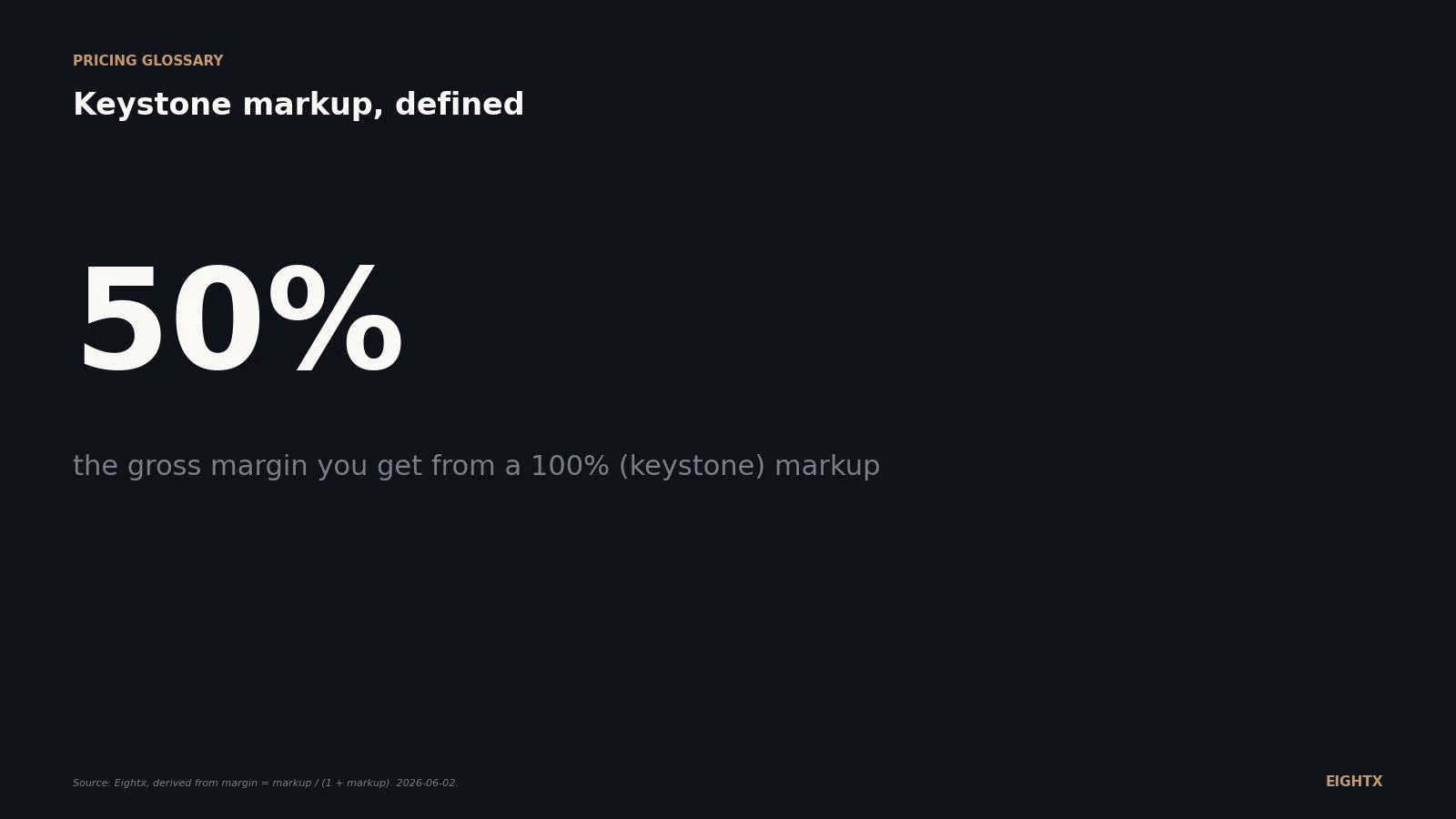
Keystone markup means pricing at 2x landed cost, which equals a 100% markup on cost and a 50% gross margin on the selling price, and it has been the default wholesale pricing heuristic in physical retail for decades. The rule breaks for DTC brands absorbing paid media, fulfillment, and returns within the margin stack, where 50% gross margin is often insufficient, and triple keystone (4x cost, 75% gross margin) is a more realistic floor for brands with CAC above $30.
Key Takeaways
- Keystone markup means selling at 2x your landed cost. That locks you to a 100% markup on cost and a 50% gross margin on price. Same trade, two different denominators.
- Markup and margin are not the same number. A 50% markup is only a 33.3% margin. The conversion formula is margin = markup / (1 + markup). Memorize it.
- Double keystone is 3x cost (200% markup, 66.7% margin). Triple keystone is 4x cost (300% markup, 75% margin). Jewelry and gift categories built their economics around triple keystone for a reason.
- MSRP is often a keystone construct in soft-line categories. Apparel, gift, and home-decor manufacturers set MSRP so wholesale cost lands around 50% of the price tag. Electronics, packaged goods, and grocery don't follow this convention.
- For DTC in 2026, keystone is a floor, not a target. A 50% gross margin gets eaten by CAC, returns, and promos. Plan for 65 to 75% gross margin if you want a real contribution margin to land.
Founders mix up markup and margin in pricing meetings every week. Sometimes a brand quotes a "100% margin" on a product, which is mathematically impossible (it would require zero cost). Sometimes they price at a "50% markup" and assume they just locked in a 50% margin, which is wrong by 17 percentage points. Keystone markup is where these two numbers do, briefly, line up. Knowing where the rule comes from, where it still works, and where it quietly fails will keep your pricing honest.
What is keystone markup?
Keystone markup is the retail rule that says: take your landed cost and double it. Retail price = cost x 2. That's the whole rule.
It dates back to late-19th and early-20th-century department stores when buyers and floor managers needed a rule simple enough to calculate by hand. The shorthand stuck. Most prices in 20th-century brick-and-mortar retail were set with keystone or a small multiple of it (1.5x for staple goods, 2.5x or 3x for boutique categories, 4x for jewelry).
"Cost" here means landed cost: the price you paid the supplier plus inbound freight, duties, and any other costs to get the unit into your warehouse. Not just the invoice line. If you price off invoice cost alone, you've already eroded your margin before the first sale.
Two things make keystone useful as a definition. First, it's clean: one multiplier, no spreadsheet. Second, it's the only point where markup-on-cost and margin-on-price both telegraph the same intuition (more on that in a second). Past keystone, the two numbers diverge fast, which is where most founders trip.
The math: 2x cost = 100% markup = 50% margin
Walk through a single SKU.
You source a candle at a $20 landed cost. You price it at $40. That's keystone.
The markup is profit divided by cost: ($40 - $20) / $20 = 1.0, or 100% markup. The margin is profit divided by price: ($40 - $20) / $40 = 0.5, or 50% margin. Same $20 of profit. Two different denominators (cost for markup, price for margin) produce two different percentages.
This is the trap. Because at keystone the numbers feel similar (one is the 100, the other is the 50, both round), founders assume the relationship is always linear. It is not. A 50% markup is a 33.3% margin. A 25% markup is a 20% margin. The gap widens at lower multiples and narrows at very high ones, but it never closes.
The single best habit you can build: when you say "100%", say which one. "100% markup on cost" or "100% margin on price" (the latter is impossible). The vocabulary slip leaks through CFO calls, supplier negotiations, and ad agency reports. It costs real money.
Markup vs margin: the conversion you need to memorize
The conversion is identity algebra, not a sourced claim:
margin = markup / (1 + markup)
Both numbers as decimals. To go the other way:
markup = margin / (1 - margin)
Drop those into a spreadsheet column once and you'll stop confusing the two.
The curve is non-linear: margin grows slower than markup at low multiples, then both grow together past keystone, then margin asymptotes toward 100% as markup runs to infinity. Below keystone is where most operators lose money quietly: a 30% markup feels healthy until you realize it's a 23.1% gross margin.
If your markup is... Your gross margin is... Cost multiplier 25% 20.0% 1.25x 50% 33.3% 1.50x 75% 42.9% 1.75x 100% (keystone) 50.0% 2.00x 150% 60.0% 2.50x 200% (double keystone) 66.7% 3.00x 300% (triple keystone) 75.0% 4.00x
Tape this table to the wall of whoever sets your prices.
Multiples beyond keystone: double, triple, and category norms
Keystone is the floor of the rule. Categories with slow turn, high perceived value, or heavy markdown risk historically priced higher.
Double keystone (3x landed cost) shows up in boutique apparel, gift, and home decor. It pencils to a 200% markup and a 66.7% gross margin, which is roughly where you need to land if you run physical retail with rent, staff, and a 25 to 35% end-of-season markdown rate.
Triple keystone (4x landed cost) is the jewelry-trade convention. The Ganoksin Orchid community has documented it for decades: a 300% markup, a 75% gross margin. Jewelry inventory turns slowly, financing the float matters, and perceived value supports the multiplier. Most independent jewelers won't touch a SKU that can't bear at least 3x.
MSRP, the manufacturer suggested retail price you see printed on tags and boxes, is often built around keystone. In many soft-line categories (apparel, gift, home decor), MSRP is set so that wholesale cost lands around 50% of the price tag, which is just keystone in retailer-facing language. Electronics, packaged goods, and grocery don't follow this convention. So when a soft-goods brand quotes you "50 off MSRP," they're really just selling at cost plus a small operating margin, which is why aggressive MSRP discounting kills wholesale brand equity.
The pattern across all of these: the multiple is set by category economics, not by a finance theory. Slow turn and high markdown risk earn the higher multiple.
Does keystone still work in 2026 ecommerce?
Honest answer: only as a floor, and only if you don't lean on paid acquisition.
A 50% gross margin sounded healthy in 1995, when a brand's main variable cost after COGS (Cost of Goods Sold) was a clerk's hourly wage. In 2026, by the time CAC (paid social, search, influencer), shipping, returns, and platform fees come out, that 50% gross margin can collapse to a 5 to 15% contribution margin. We've broken down where the line lands by category in the average contribution margin by vertical reference. Some brands print zero or negative on first-order economics and only recover via subscription or repeat purchase.
For DTC, plan around 65 to 75% gross margin (a 2.86x to 4x cost multiplier) if you want to leave room for paid acquisition, promos, and a contribution-margin number worth printing. That looks closer to double keystone than to keystone proper. Brands that hit it are usually brands with strong proprietary product, true brand pricing power, or low-cost domestic sourcing.
For wholesale, marketplace, and Amazon FBA channels, keystone or slightly above is usually all you get. The tradeoff is that you're not paying CAC directly: Amazon, Costco, or Target absorbs the acquisition cost in exchange for the wholesale discount. Different model, different math.
The rule of thumb to memorize: if your pricing strategy starts and ends at keystone in a paid-acquisition channel, you're underwriting the customer acquisition out of your own gross profit. That's not a strategy, it's a slow bleed. The next step is to calculate contribution margin for ecommerce from your real P&L instead of your supplier invoice, so you know what's actually left after CAC, returns, and promos.
Keystone tends to work when... Keystone tends to fail when... Perceived value sits well above cost (boutique apparel, jewelry, gift) Category is price-transparent (electronics, packaged goods) Markdowns and shrink are predictable Items are slow-turn or bulky (high carrying or shipping cost) You sell in store and customers cannot easily price-compare You run always-on promos at 20 to 40% off list You have no analytics team and need a simple rule You are DTC with heavy paid acquisition (CAC eats the 50%)
Keystone is the rule the rest of pricing is measured against. Use it as a sanity check, not a target. If your DTC pricing math stops at 2x cost, you're funding the next customer out of the last one's profit.
Sources and methodology
This entry synthesizes four definitional sources (Prisync, Flipkart Commerce Cloud, GrowthForce, Wiser) plus the jewelry-trade convention documented at Ganoksin's Orchid forum. The keystone math itself is identity algebra: from the keystone rule P = 2C, markup ((P - C) / C) equals 1.0 and margin ((P - C) / P) equals 0.5 by definition. The general conversion margin = markup / (1 + markup) and its inverse markup = margin / (1 - margin) follow from rearranging those two definitions; both are algebraic identities, not empirical claims.
For the DTC contribution-margin claims, we cross-reference public ecommerce P&Ls (Allbirds, Warby Parker, Figs, Brilliant Earth annual reports, 2024 and 2025 filings) and Eightx's own client book of $5M to $150M DTC brands. The "65 to 75% gross margin floor" guidance is a planning heuristic, not a benchmark: actual targets vary by category, channel mix, and AOV.
The multiplier ladder (1.5x, 2x, 2.5x, 3x, 4x) is industry convention rather than a single sourced standard. We've drawn from category-specific guidance: Flipkart Commerce Cloud's keystone glossary, Wiser's keystone pricing guide, and the Ganoksin Orchid community for triple keystone in jewelry. These conventions still hold in brick-and-mortar and wholesale; they hold less reliably in DTC, where channel economics force higher multiples.
What this page does not do: it does not track the share of DTC brands currently pricing at keystone (no public dataset exists), and it does not replace a real pricing analysis. Treat the table as a translation layer between your supplier sheet and your finance team's gross-margin target. The decision of where on the ladder your product belongs is a category, brand, and channel-economics question.
Frequently asked questions
what is keystone markup in plain english?
Keystone markup is the old retail rule that says: take your landed cost, double it, sell at that price. It locks you to a 100% markup on cost and a 50% gross margin on the sale. Same trade, two different ways of saying it.
is keystone markup the same as keystone pricing?
Yes, the terms are interchangeable in retail. Some sources call it keystone pricing (the price you set), others call it keystone markup (the math you used to get there). Both mean retail price equals 2x landed cost.
why is 100% markup only a 50% margin?
Because the two numbers use different denominators. Markup is profit divided by cost. Margin is profit divided by price. At keystone, cost equals profit, so markup is 100%. But price is 2x cost, so profit is half of price, which is a 50% margin. Same dollars, different math.
how do i convert markup to margin?
Use margin = markup / (1 + markup), with both as decimals. A 50% markup is 0.5 / 1.5 = 33.3% margin. A 100% markup is 1.0 / 2.0 = 50% margin. To go the other way, markup = margin / (1 - margin).
what is double keystone and triple keystone?
Double keystone is 3x cost (a 200% markup, 66.7% margin). Triple keystone is 4x cost (a 300% markup, 75% margin). Jewelry and gift categories have used triple keystone for decades because slow-turn inventory and high perceived value let them justify it.
Browse the full ecommerce finance glossary for every metric and money term a DTC operator needs.