
eCommerce
What is MAP pricing? Minimum advertised price, the Colgate doctrine, and how to keep your wholesale margin alive
MAP (minimum advertised price) is the lowest price a reseller may advertise publicly, governed in the US by the Colgate doctrine (a unilateral manufacturer policy, not an agreement), and it is legal in the US but mostly prohibited under competition law in the EU and UK. MAP protects wholesale channel margin by preventing price erosion on advertising platforms, while leaving the actual cart price uncontrolled, and Amazon suppresses the Buy Box for listings that violate a brand's MAP.
MAP pricing (Minimum Advertised Price) is a unilateral policy a brand publishes that sets the lowest price a reseller may advertise a product at. Not the lowest price they may sell it for. The distinction matters because the second a retailer publishes a price below MAP on a website, marketplace listing, Google Shopping feed, or email, every other retailer's automated repricer chases it down within hours. Margin collapses across the channel before the brand even notices. For ecommerce operators running hybrid direct-to-consumer (DTC) plus wholesale, somewhere around $5M to $50M in revenue, a published MAP policy is the single most important channel-governance lever you have. The absence of one is also a competitive disqualifier when premium retailers vet your brand.
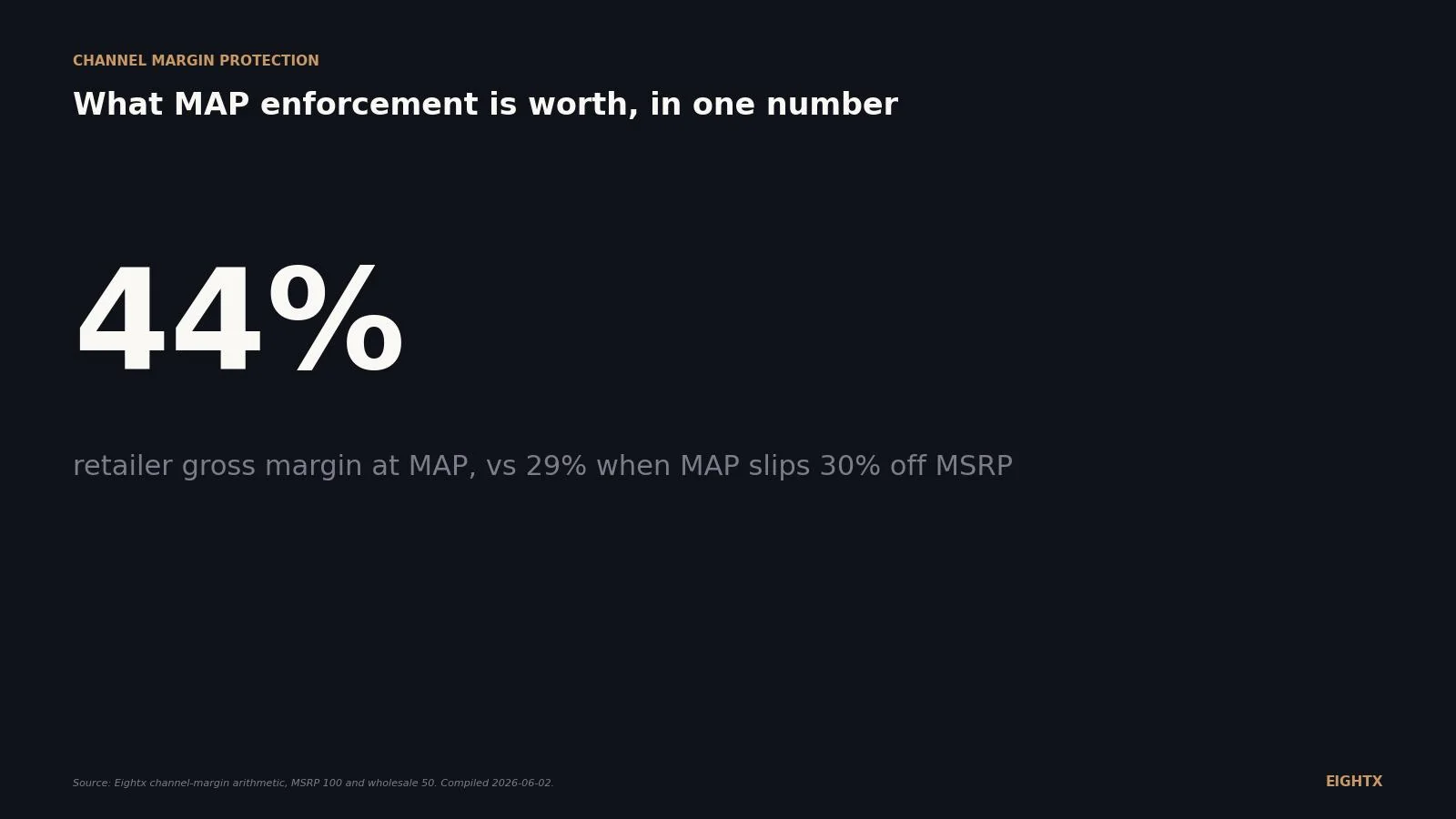
Brands use MAP because retail channels race to the bottom by default. The first reseller who undercuts MAP starts a cascade that drops everyone's gross margin within days. On a $100 manufacturer's suggested retail price (MSRP) item that you wholesale at $50, MAP enforced at $90 leaves your retailer with a 44% gross margin. If MAP slips and the street price drops to $70, that retailer's margin collapses to 28.6%. Below sustainable for most specialty stores. They either demand a wholesale-cost concession or drop your brand. MAP is also a signal: premium retailers will not carry a brand whose pricing they cannot defend in their own store. No policy means no shelf space.
How it works
A MAP policy is unilateral by design. The brand publishes the policy, sends it to all authorized resellers, and refuses to deal with violators. There is no signature, no negotiation, no agreement. That structure traces directly to United States v. Colgate & Co., 250 U.S. 300 (1919), where the Supreme Court held that a manufacturer may unilaterally announce terms and refuse to deal with anyone who breaks them, as long as there is no agreement on resale price. Modern MAP policies are drafted to fit that doctrine word for word.
The typical band is 0 to 15% off MSRP for everyday pricing, widening to 20 to 25% off MSRP during pre-approved promotional windows (Black Friday, Cyber Monday, Prime Day). Premium and luxury brands cluster tighter at 0 to 10%, commodity categories sit wider at 10 to 20%. Enforcement is graduated. Detection happens within 24 hours via automated scans of marketplace listings, Google Shopping, and major retailer sites. The reseller gets a warning email with screenshots and 24 to 72 hours to cure. If the violation persists, the brand pulls co-op funds, blocks access to new SKUs, and pauses supply (probation, 7 to 30 days). Termination is the final step, 30 to 90 days in, and revokes authorization plus any Brand Registry protections that depend on it.
Worked margin example. MSRP $100, wholesale cost $50. At MAP $90 the retailer earns ($90 minus $50) divided by $90, or 44.4% gross margin. At MAP $80, margin drops to 37.5%. At street $70, margin is 28.6%. At street $65, the race to the bottom, margin is 23.1% and the retailer is losing money on every fulfillment cost layered on top.
One important caveat: MAP is generally illegal or heavily restricted in the European Union and the United Kingdom as a vertical price restriction. The UK Competition and Markets Authority treats minimum advertised price arrangements as anti-competitive under the Competition Act 1998. Global brands maintain region-specific policies and do not enforce a US-style MAP into EU/UK channels.
Common triggers
- You are about to launch into wholesale or onboard a new authorized retailer and the buyer asks for your MAP policy.
- You sell on Amazon and Buy Box prices are sliding below MSRP because resellers are repricing against each other.
- A premium specialty retailer just told you they will not carry your brand because they cannot defend the pricing in their store.
- You have unauthorized sellers on Amazon you cannot trace and your authorized resellers are asking why you let it happen.
- Your contribution margin is fine but channel margin is shrinking quarter over quarter, and you are not sure where the leak is.
The most common mistake
Writing the MAP policy as a contract instead of a unilateral announcement. Brands draft a MAP "agreement", send it for retailer signature, and negotiate cure periods or carve-outs in the back and forth. That structure breaks the Colgate doctrine. The moment there is mutual assent on resale-related price terms, you have a vertical price-fixing arrangement, which is reviewed under the rule of reason after Leegin Creative Leather Products v. PSKS, Inc., 551 U.S. 877 (2007). Rule-of-reason is winnable but expensive and slow. The unilateral structure (publish, distribute, refuse to deal, never negotiate) keeps you inside Colgate's safe harbor. Keep the policy one-way. Resellers acknowledge receipt, they do not sign on. Cure timelines are stated, not bargained. Enforcement is consistent across every reseller, every time, because the second you grant an exception you create the inference of an agreement. The other common mistake: assuming Amazon will enforce your MAP. They will not. MAP is a brand-to-reseller matter. Marketplaces only act on intellectual-property and Brand Registry violations, not pricing disputes.
Browse the full ecommerce finance glossary for every metric and money term a DTC operator needs.
Frequently Asked Questions
is map pricing the same as msrp?
No. MSRP (manufacturer's suggested retail price) is a non-binding suggestion. MAP (minimum advertised price) is an enforceable floor on the price a reseller may publicly advertise. A retailer can sell below MAP in cart, by phone, or in store. They cannot publish a price below MAP on a listing, Google Shopping feed, email, or printed ad. Different scope, different teeth.
is map pricing legal in the us?
Yes, when structured as a unilateral policy under the Colgate doctrine. The brand announces the policy, distributes it, and refuses to deal with violators. No signatures, no negotiation. After Leegin (2007), vertical price restraints are reviewed under the rule of reason in US antitrust, so even a non-Colgate MAP arrangement is not automatically illegal, just riskier and more litigable.
is map pricing legal in the eu or uk?
Generally no. The UK Competition and Markets Authority treats minimum advertised price arrangements as anti-competitive under the Competition Act 1998. The EU's Vertical Block Exemption Regulation also restricts vertical price-fixing. Global brands maintain region-specific policies and do not enforce a US-style MAP into EU/UK channels.
how do i enforce map pricing on amazon?
You enforce it directly with the seller. Amazon does not enforce MAP. Marketplaces treat MAP as a brand-reseller issue and will not delist a violator unless a separate policy violation applies (counterfeit, IP, Brand Registry). For unauthorized sellers you cannot reach, the practical lever is controlling distribution upstream so the gray-market product does not reach Amazon in the first place, plus Brand Registry takedowns where you have a legitimate IP claim.
what is a typical map discount off msrp?
Everyday MAP is usually 0 to 15% off MSRP, widening to 20 to 25% off during pre-approved promotional events (Black Friday, Cyber Monday, Prime Day). Premium and luxury brands run tighter at 0 to 10% off. Commodity and mass categories sit wider at 10 to 20% off everyday. The numbers vary by category, but the principle is the same: tight bands daily, wider during named promo windows you announce in advance.