
Financial Strategy
What is net revenue retention for DTC? The SaaS metric subscription brands need but use wrong
Net revenue retention (NRR) measures how much revenue a cohort of subscribers generates in a later period compared to their starting period, including upsells and churn. DTC subscription brands realistically land between 75 and 95 percent, well below the 110 to 130 percent SaaS benchmark, because physical product limits upsell headroom. Below 75 percent means churn is outrunning expansion revenue entirely.
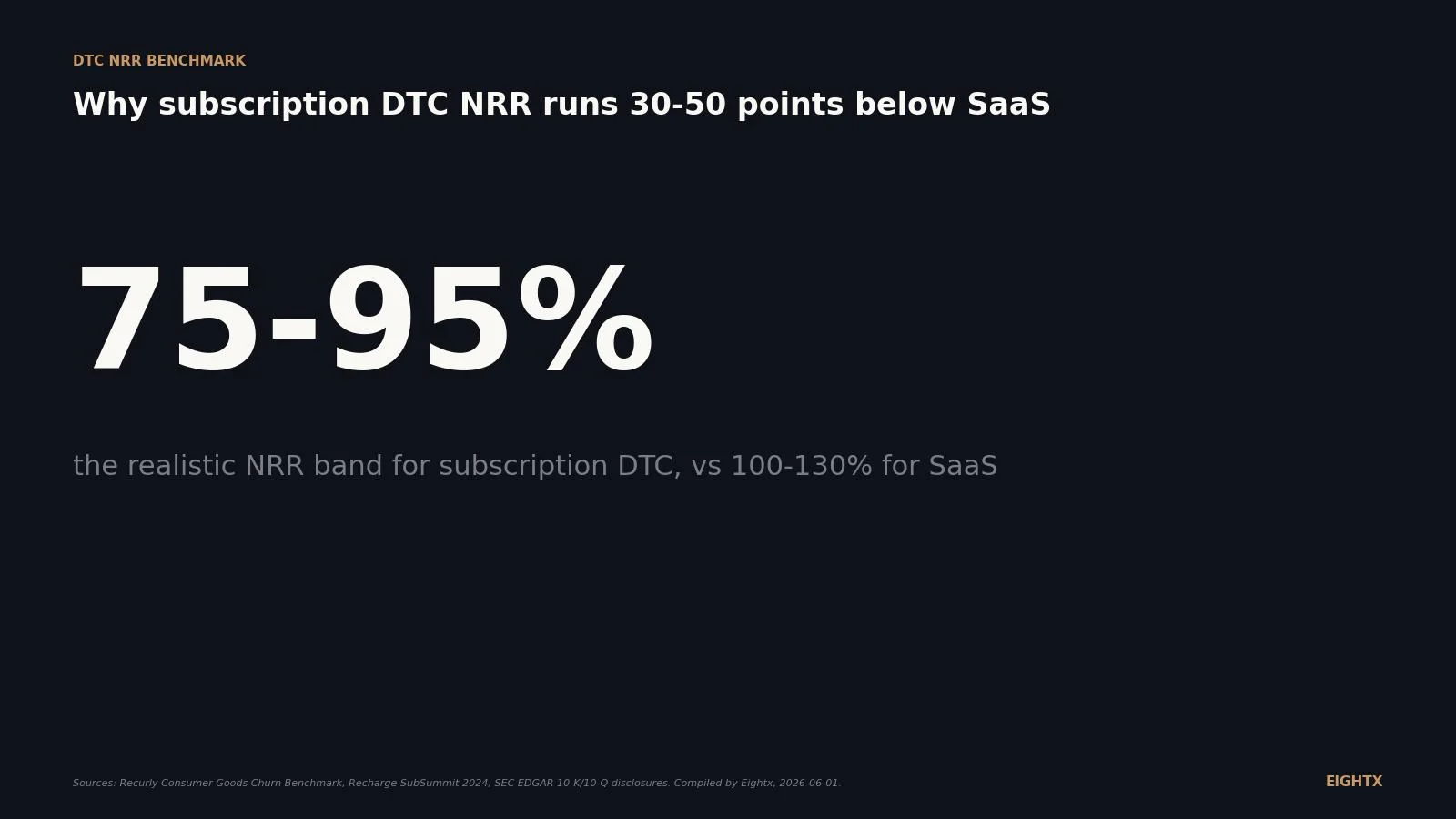
Net revenue retention (NRR) is the percentage of recurring revenue you keep from an existing cohort of customers over a period, after expansion, reactivation, contraction, and churn. It is the most useful single metric software-as-a-service (SaaS) exported to subscription commerce. Most direct-to-consumer (DTC) subscription operators either ignore it or compute it wrong. The realistic band for subscription DTC sits at 75-95%, with the top brands at 95-105%. That is roughly 30 to 50 points below the SaaS norm, and the gap is structural, not a sign you are failing.
NRR is the cleanest read on whether your subscription base is compounding or leaking. Lifetime value (LTV) tells you what a customer is theoretically worth. Churn tells you how fast they leave. NRR tells you whether the customers still on your roster this month are spending more, the same, or less than they were spending last month, expansion and churn netted out. For a Recharge, Skio, or Smartrr brand at $5M to $50M in annual recurring revenue (ARR), an NRR drift from 92% to 84% is a $400K-plus revenue hole that doesn't show up in new-customer dashboards. It is the single number a board or a buyer in mergers, acquisitions, and fundraising (M&A) will ask for first.
How it works
The formula is NRR = (Starting MRR + Expansion + Reactivation - Contraction - Churn) / Starting MRR, measured on a fixed cohort (the same set of customers, month over month, with no new acquisitions in the numerator). Worked example: a Recharge brand starts the month with $100,000 in monthly recurring revenue (MRR) from a fixed cohort. Across the month, $4,000 of expansion comes from cohort customers adding a second SKU, $2,000 comes back from reactivated paused subscriptions, $3,000 leaks out as contraction (downgraded boxes), and $13,000 churns. The math is ($100K + $4K + $2K - $3K - $13K) divided by $100K, which is 90%. That 90% is your NRR. Track it monthly on a trailing-three-month average so single-period noise doesn't whipsaw the number.
Common triggers
- You are raising capital or running an M&A process and a buyer asks for NRR or dollar-based net retention as their first metric.
- Your Recharge, Skio, or Smartrr dashboard shows churn rising but you cannot tell if expansion revenue is plugging the gap.
- Your board is benchmarking you against SaaS NRR (110-130%) and you are getting punished for running a structurally different business.
- You are debating whether to push pause-vs-cancel UX, smart dunning, or bundle expansion first, and you need one number to track the impact of each.
- You are comparing two subscription cohorts (e.g. quarterly box vs monthly replenishment) and need an apples-to-apples retention read.
The most common mistake
Benchmarking your DTC NRR against SaaS NRR. SaaS routinely lands at 110-130% because expansion is mechanical: more seats, more usage, a tier upgrade, all triggered by an existing buyer's existing workflow. DTC expansion requires a fresh purchase decision and the inventory to support a second SKU, which is why the realistic band for subscription DTC is 75-95%. Operators see Snowflake at 158% NRR in a 10-Q and conclude their 88% is broken. It is not. The broken move is the next one: trying to chase SaaS-style expansion through aggressive upsell flows that increase voluntary churn faster than they grow expansion revenue. The right comparison set is other subscription DTC (Recurly's consumer-goods benchmark, Recharge's SubSummit report, public DTC subscription proxies), not pure-play software.
Browse the full ecommerce finance glossary for every metric and money term a DTC operator needs.
Frequently Asked Questions
what's a good nrr for a subscription dtc brand in 2026?
75 to 95% is realistic for subscription DTC, with the top telehealth and replenishment brands clearing 100%. Curated-box models (apparel, beauty) usually land 70-85%. Anything above 100% in DTC is exceptional and almost always driven by ARPU expansion (bundles, premium tiers), not new-cohort growth.
how is nrr different for dtc vs saas?
Same formula, different gravity. SaaS expansion is mechanical (more seats, more usage, tier upgrades) so SaaS NRR runs 100-130%. DTC expansion needs a second purchase decision and a second SKU in inventory, so DTC NRR runs 75-95%. The 30-to-50-point gap is structural, not a sign you are failing.
what's the difference between nrr and grr?
NRR includes expansion revenue and can exceed 100%. Gross revenue retention (GRR) only counts churn and contraction, so it caps at 100%. Track both. GRR shows the leak. NRR shows whether expansion is plugging it. For DTC, healthy GRR is 60-75% and healthy NRR is 75-95%.
does nrr include new customers acquired in the period?
No. NRR is cohort-based, which means you fix the customer set at the start of the period and only measure what happens to them. New customers acquired during the period get counted in next period's starting MRR, not in this period's NRR numerator.
should i track nrr monthly or annually for dtc?
Monthly on a trailing-three-month average. Subscription DTC has more month-to-month noise than SaaS because of cancel-rebill timing, payment failures, and pause-resume cycles. A single month is too noisy to act on. A trailing three-month average smooths the seasonality and still gives you a fast read on whether your retention work is moving the number.