
Financial Strategy
What is open-to-buy (OTB)? The merchandising budget that controls every PO you write
Open-to-buy (OTB) is the dollar amount of new inventory a merchant can receive in a period, calculated as planned end-of-month stock plus planned sales plus planned markdowns, minus beginning-of-month stock minus on-order. Recalculate it weekly, run it in cost dollars for DTC, and treat it as the budget that governs every purchase order you write. Overbuying kills cash; underbuying kills sell-through and ad efficiency.
Open-to-buy (OTB) is the dollar amount of new inventory a merchant is allowed to receive in a given month or season. The canonical formula is Planned EOM Inventory + Planned Sales + Planned Markdowns - BOM Inventory - On-Order. EOM means end-of-month, BOM means beginning-of-month, and on-order is the value of purchase orders (POs) already placed but not yet received. It originated in early 20th century US department-store merchandising and is still the standard inventory-budget framework across apparel, beauty, home, and multi-brand retail. For direct-to-consumer (DTC) operators scaling past $5M, OTB is the bridge between the FP&A (Financial Planning and Analysis) forecast and the buying team's PO calendar.
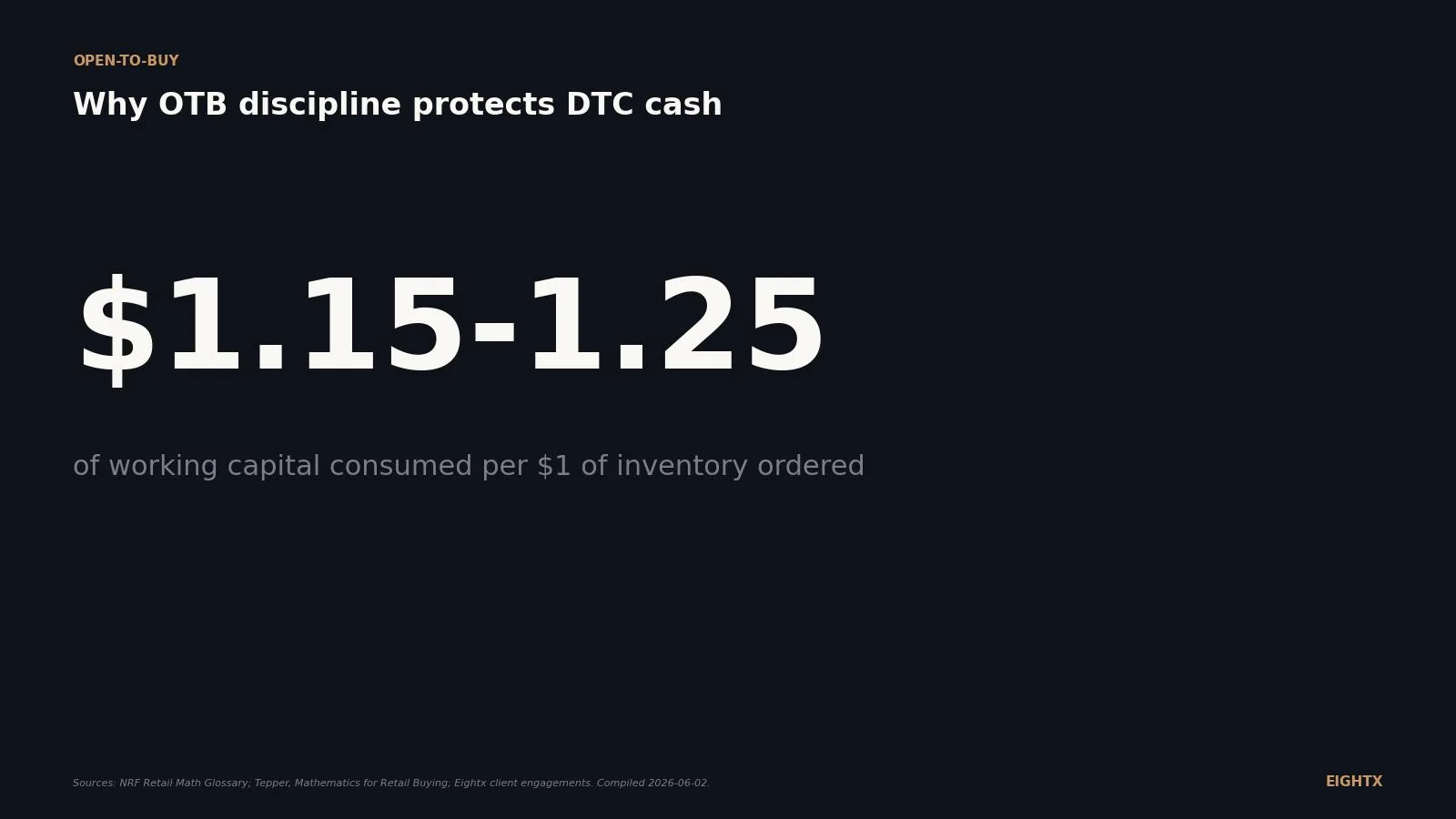
OTB stops merchants from over-committing cash to inventory that will not sell through inside its margin window. Every $1 of inventory you order consumes roughly $1.15 to $1.25 of working capital once you include freight, duty, and 3PL receiving fees. When OTB is ignored, brands end up with 6 to 9 months of stock on hand, sitewide 40% markdowns to clear it, and a working-capital hole that forces a merchant cash advance (MCA). When OTB is run weekly, it pre-empts both stock-outs (negative OTB means no room to chase a winner) and over-buys (positive OTB that does not get spent gets re-allocated to faster categories). For Shopify operators, OTB is often labelled the inventory purchase budget or PO budget. Same math, different label.
How it works
Walk the 5 inputs in order. Planned EOM Inventory is the inventory you want sitting on the shelf at month-end, in cost or retail dollars, pulled from the merchandise financial plan. Planned Sales is the forecasted net sales for the month. Planned Markdowns is the dollar value of price reductions you expect to take. BOM Inventory is what you actually have on hand at the start of the month, from Shopify or your enterprise resource planning (ERP) system. Merchandise On-Order is POs placed but not yet received, from the PO log. Worked example, $5M apparel brand for September: Planned EOM $1.1M plus Planned Sales $650K plus Planned Markdowns $80K equals $1.83M needed. Subtract BOM $1.3M and On-Order $480K: OTB equals $50K. That is your buying ceiling for the month. Recalculate weekly so the number reflects actual sell-through, not the forecast you set in June. The same calculation rolls up monthly into a 6-month seasonal plan and down weekly into the reforecast cadence.
Common triggers
- You're scaling past $5M and your PO calendar is being run from a buyer's gut feel rather than a budget.
- Inventory has crept up faster than revenue for 2 or more months and you cannot tell whether to cancel POs or accelerate markdowns.
- You're modeling a working-capital facility (line of credit, MCA, or revenue-based financing) and need a defensible monthly purchase ceiling.
- Your buyers and your FP&A lead are working from different inventory numbers (the buyer is at sell-in, finance is at sell-through).
- You're moving from one buying season per year to monthly POs and need a control that catches over-commitment before it ships.
The most common mistake
Forgetting to budget markdowns. The OTB formula treats planned markdowns as a reduction in inventory value that must be replaced by new buys to maintain EOM stock. Brands that skip the markdown line item in their plan systematically run negative OTB by month 2 of a season, because the actual markdowns happen anyway and the inventory base shrinks faster than the model predicted. The second-most common mistake is running OTB only on the 6-month plan and not the weekly reforecast. The 6-month plan sets the envelope. The weekly recalc catches over-performance and under-performance early enough to act. A category running 30% ahead of plan in week 2 needs a chase PO before the lead time eats the window. A category running 20% behind needs a markdown trigger before it eats EOM inventory.
Browse the full ecommerce finance glossary for every metric and money term a DTC operator needs.
Frequently Asked Questions
what is open-to-buy in simple terms?
Open-to-buy is the dollar amount you are allowed to spend on new inventory this month. It is calculated so that your end-of-month inventory hits your planned target after you account for forecasted sales, planned markdowns, what you already have on hand, and what is already on order. If the number is positive you can write POs. If it is negative you are already over-committed and need to cancel or markdown instead.
how often should i recalculate otb?
Weekly in mature merchandising orgs. The 6-month seasonal plan sets the envelope, monthly buckets discipline cash, and weekly reforecasts catch over-performance and under-performance early enough to chase POs or trigger markdowns. Running OTB only monthly means you catch problems 3 to 4 weeks late, which is usually past the chase window for your supplier lead time.
what does it mean if my open-to-buy is negative?
Negative OTB means your beginning inventory plus on-order is already bigger than what you need to hit planned EOM after sales and markdowns. You are over-committed. The fix is canceling POs, accelerating markdowns to clear excess, or reforecasting sales upward if actual sell-through has been beating plan. Do not write more orders until the number turns positive again.
do dtc and shopify brands actually use otb?
Yes, often under different labels. Cogsy, Inventory Planner, and most Shopify finance stacks compute a version of OTB from sales velocity, lead time, and safety stock and call it the inventory purchase budget or PO budget. Same math, friendlier interface. The mechanics matter more than the name. Above $5M in revenue, any brand running multiple POs per month should have some form of OTB control in place.
should otb be in cost dollars or retail dollars?
Department-store tradition runs OTB in retail dollars because the retail-method-of-accounting (RMA) expresses inventory in retail. Modern DTC operators usually run it in cost dollars because the operational decision (how much PO to write) is a cost decision. Pick one and stay consistent within the season. Mixing retail and cost mid-plan is the most common reason an OTB model produces a wrong answer.