
Insights
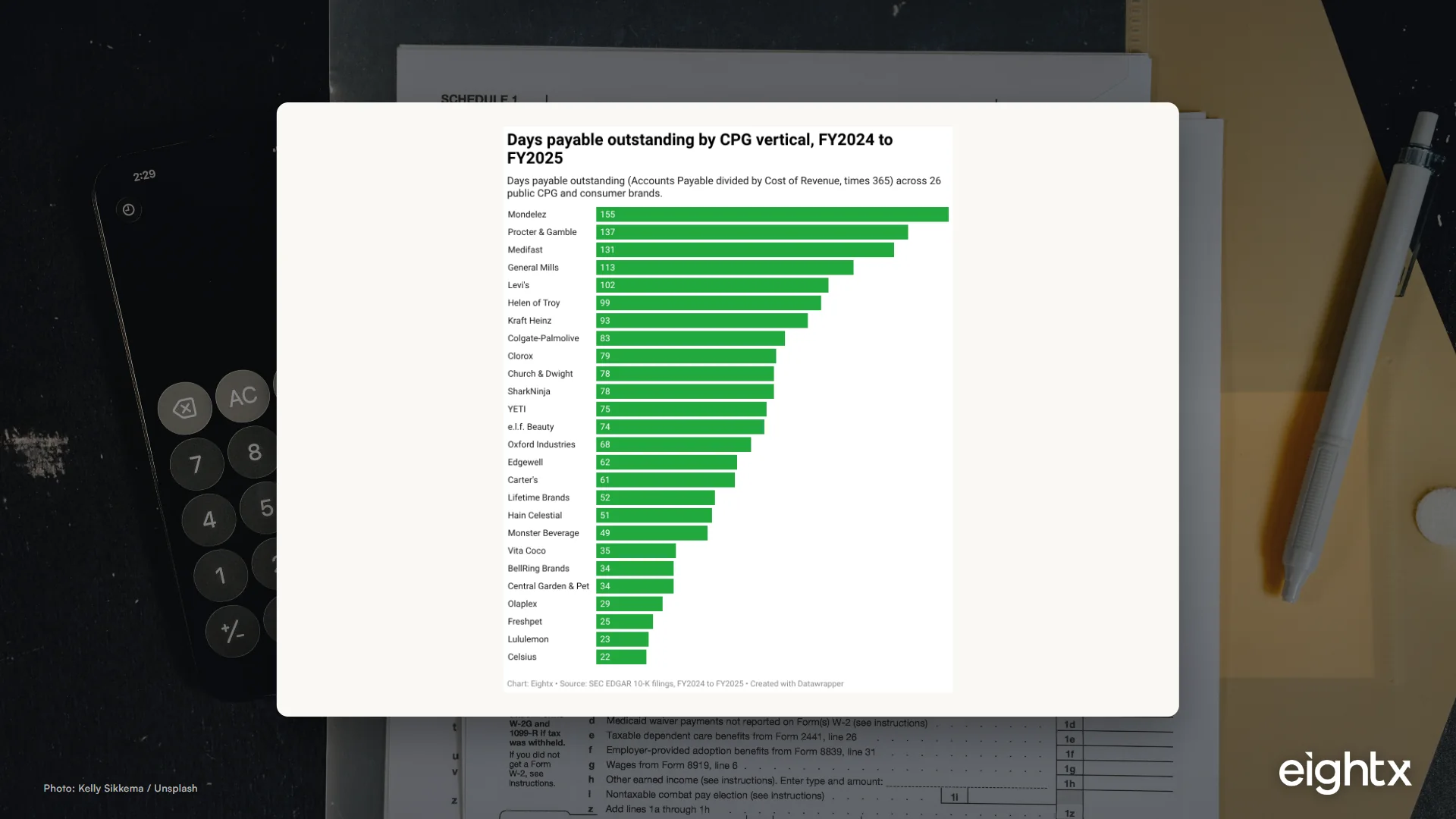
Average CPG days payable outstanding by vertical, 2026: 22 to 263 days across 28 public 10-Ks
CPG companies stretch supplier payments from 22 days (small food brands) to 263 days (large personal care). Your DPO is a working capital lever, not just an accounting line. If you are paying suppliers in 30 days while your category peers average 90, you are self-funding your supply chain and starving your ad budget. Benchmark before you negotiate.
Key Takeaways
- Public CPG days payable outstanding ranges from 22 days (Celsius) to 155 days (Mondelez) in FY2024 to FY2025. Mega-CPG and legacy apparel cluster at 100 plus days; growth beverage, pet, and direct-to-consumer apparel cluster under 50. The 133-day spread is the structural working-capital gap between buying power and supplier necessity.
- The mega-CPG 100 plus day bucket runs on formal supplier-finance programs. Procter and Gamble, Mondelez, Kraft Heinz, Colgate, Hershey, and Kenvue all disclose programs under FASB ASU 2022-04 (effective fiscal years beginning after December 15, 2022). The disclosed obligations are already inside the AP line, which is why the DPO numbers are directly comparable.
- Household staples cluster tightly at 78 to 83 days. Church and Dwight 78, Clorox 79, Colgate 83. Tight band means vendors price a 75 to 90 day expectation into their terms as table stakes. If your household-staples brand is below 60, you are leaving money on the table.
- Hain Celestial's DPO fell from 174 days in fiscal 2022 to 51 in fiscal 2024. Revenue declined every year and net income was negative in each. Vendor-trust contraction is one of the cleanest leading indicators of working-capital distress, and it shows up on the balance sheet before it shows up in the press release.
- Five extra DPO days on a $30M brand at 50 percent COGS is roughly $205,000 of free working capital. Daily COGS is annual COGS divided by 365. For a $30M, 50 percent COGS brand that is roughly $41,000 per day. If you are under 40 DPO and growing fast, negotiating net 60 or 75 with your three largest suppliers is the highest-impact cash play you are not running.
When Hain Celestial's days payable outstanding (DPO) fell from 174 days in fiscal 2022 to 51 in fiscal 2024, the company's suppliers were telling investors what management had not yet. Revenue was declining, net income was deeply negative, and vendors had quietly contracted terms from "net 90 plus" back to "net 30 if you are lucky." DPO is the single cleanest cash-flow lever a CPG operator can pull, and it is also the one a buyer, a bank, or a strategic acquirer reads first when they want to know whether your suppliers still trust you.
We pulled FY2023 to FY2025 10-K data for 28 publicly traded consumer brands across beauty, beverage, food, household staples, supplements, pet, home and kitchen, and apparel (Coty FY2023 and Estée Lauder FY2024 are the two older anchors; the rest are FY2024 to FY2025), then computed DPO consistently as (Accounts Payable divided by Cost of Revenue) times 365. The headline: Mondelez at 155 days and Procter and Gamble at 137 anchor the top, Celsius at 22 and Lululemon at 23 anchor the bottom. The 133-day spread is the structural difference between mega-CPG buying power and growth-brand necessity. This page is your benchmark grid; we will refresh it quarterly as new 10-K filings hit.
What DPO actually measures and where operators compute it wrong
DPO equals ending Accounts Payable divided by trailing-12-month Cost of Revenue, times 365. It is the realized number of days your business takes to pay suppliers. AP comes from the balance sheet, COGS comes from the income statement, and 365 annualizes the ratio so you can compare against vertical peers.
Three traps catch operators when they try to compute this against their own books. First, the AP line. Some companies (Coca-Cola is the textbook example) bundle "Accounts payable and accrued expenses" into a single line on the balance sheet. The raw calc would print 432 days for Coca-Cola in FY2024; the clean-AP DPO is closer to 75 to 90 once accrued is stripped. Use the AP-only line, not the bundled one. Second, the COGS line. Use cost of revenue, not total operating expense; SG&A is not a payable cycle, it is a payroll and marketing cycle. Third, the time window. If you compute DPO at fiscal year end and your AP is seasonally inflated by Q4 reorders, the number is biased high. Use a trailing-twelve-month or quarter-average AP if you want a clean number for board reporting.
Why this matters in dollars: every extra DPO day is roughly (daily COGS) in free working capital. For a $30M revenue brand at 50 percent COGS, that is $15M of annual COGS divided by 365, or roughly $41,000 per day. Five extra days of DPO is $205,000 of cash you can deploy into ad spend, inventory, or just sit on as runway. Ten extra days is $410,000. Most $5M to $50M operators have never run this math against their own peer set, which is why the public 10-K data below matters.
The barbell: mega-CPG runs 100 plus days, growth beverage and pet run 22 to 50
The 28-brand chart is a barbell. Mondelez (155), Procter and Gamble (137), Medifast (131), General Mills (113), Levi's (102) anchor the top. Celsius (22), Lululemon (23), Freshpet (25), Olaplex (29), Central Garden and Pet (34), BellRing (34), Vita Coco (35) anchor the bottom. The middle is a long flat zone of household-staples and home-and-kitchen brands clustered around 75 to 85 days.
Three structural bands explain almost all of the spread. The top band (100 plus days) is mega-CPG with formal supplier-finance programs plus decades of vendor relationships: P and G, Mondelez, Kraft Heinz, General Mills, Colgate. Levi's at 102 and Helen of Troy at 99 sit here too because legacy wholesale apparel funds long inventory floats off vendor terms. The middle band (60 to 90 days) is household staples and established mid-size brands (Church and Dwight 78, Clorox 79, SharkNinja 78, YETI 75, e.l.f. 74) where 75 to 90 days is table stakes. The bottom band (22 to 50 days) is growth beverage, pet, prestige beauty, and direct-to-consumer athleisure: Celsius, Vita Coco, Monster, BellRing, Olaplex, Freshpet, Lululemon. These brands either have cash-rich balance sheets that make stretching unnecessary (Celsius, Lululemon) or concentrated supplier relationships that make stretching impossible (Freshpet's perishable supply chain, Olaplex's small contract-manufacturer base).
If you are running a $5M to $50M brand, the operator question is which band you should be in given your vertical. A $20M apparel brand at 30 DPO is well below the legacy-apparel band (65 median) and has cash on the table. A $20M growth-beverage brand at 30 DPO is roughly at the vertical median, fine. Use the vertical median, not the all-brands median, as your starting point.
Median DPO by vertical: the benchmark table operators actually need
The medians cleanup the brand-level noise. Food and packaged confection at 103 days. Supplements at 83 (thin sample, N=2). Household staples at 81. Home and kitchen at 77. Beauty at 74. Apparel at 65. Beverage at 35. Pet at 30 (thin sample, N=2).
The 80-day gap between food at the top and pet at the bottom is not random. It tracks two variables: buyer clout (how many alternative suppliers exist for your inputs) and supplier balance-sheet strength (can your supplier carry the float). Food and packaged goods has the deepest supplier base globally and the strongest supplier balance sheets (industrial chemical and ingredient companies), so 100 plus days of float is absorbable. Pet at 30 days reflects the opposite: Freshpet's refrigerated supply chain has a tiny supplier base and most of those suppliers are smaller than Freshpet itself, so 30 days is the realistic ceiling without breaking the chain.
Beauty looks like a 74-day median but the underlying distribution is bimodal: prestige players (Estée Lauder, Coty) cluster around 130 to 260 historically, mass and DTC players (Olaplex 29, e.l.f. 74, Edgewell 62) cluster in the 30 to 75 band. Use the prestige-versus-mass split when you map your beauty brand.
Vertical N brands in sample Median DPO Low brand Low DPO High brand High DPO Food (packaged / confection) 4 103 Hain Celestial 51 Mondelez 155 Household staples 4 81 Church and Dwight 78 Procter and Gamble 137 Home and kitchen / housewares 4 77 Lifetime Brands 52 Helen of Troy 99 Apparel 4 65 Lululemon 23 Levi's 102 Beauty 5 74 Olaplex 29 Coty (FY2023 last surfaced) 263 Supplements / wellness 2 83 BellRing 34 Medifast 131 Beverage 3 35 Celsius 22 Monster 49 Pet 2 30 Freshpet 25 Central Garden and Pet 34
Supplier finance programs: the public-company tool now leaking down to $50M private CPG
Under FASB Accounting Standards Update 2022-04 (effective fiscal years beginning after December 15, 2022), any public company running a supplier-finance program must disclose: the key program terms, confirmed obligations outstanding at period end, a roll-forward of obligations, and the balance-sheet line where they sit (almost always Accounts Payable). The disclosure is why the DPO numbers above are directly comparable. The program balance is already inside the AP line, so the 137-day P and G figure is the "all-in" working-capital number, not the underlying vendor terms.
We pulled the EDGAR full-text search for "supplier finance program" in 10-K filings filed between 2025-01-01 and 2026-05-29; the consumer-brand cohort exceeds 18 companies and growing. Hershey, Mondelez, P and G, Kraft Heinz, Colgate, Kenvue, Mattel, YETI, Hasbro, Ralph Lauren, Kimberly-Clark, Hanesbrands, Campbell Soup, McCormick, Capri Holdings, Deckers Outdoor, Newell Brands, Hamilton Beach Brands. Hershey's most recent disclosure shows roughly $1.5B in supplier-finance obligations inside its AP line; that is real money on the cash flow statement.
The mechanics matter for private operators. A bank (Citi, JPMorgan, HSBC, Wells Fargo, increasingly C2FO and Taulia for mid-market) pays your supplier on day 20 at a discount of roughly 1.5 to 4 percent annualized. You pay the bank on day 90 or 120. The supplier gets faster cash without renegotiating with you, you get longer effective terms without burning the supplier relationship. The catch: you are effectively taking on bank financing at SOFR plus 1 to 3 percent secured by your AP, and the bank will run real underwriting on your financials.
In 2025 and 2026 these programs are now marketed down to $50M to $150M private CPG brands through C2FO, Taulia, Tradeshift, and the mid-market arms of the big banks. The decision tree is straightforward. Below $50M revenue and below 70 DPO informally: keep pushing informal terms with your three largest suppliers; you have more headroom than you think. Above $50M revenue, at or above 90 DPO informally, and growing 30 percent plus: a supplier-finance facility is your next move. Above $50M revenue, at or above 90 DPO, and flat or declining: tread carefully; the SFP becomes a debt-like signal in diligence (Hershey's $1.5B is fine; a $50M private brand with $20M outstanding under an SFP is a red flag to buyers).
Hain Celestial's DPO collapse is the canary in the working-capital coal mine
When a CPG brand distresses, suppliers tighten terms. The signal often shows up in DPO 6 to 12 months before it shows up in the press release.
Hain Celestial's DPO went from 174 days in fiscal 2022 to 46 days in fiscal 2023, then settled at 51 in fiscal 2024 and 56 in fiscal 2025. Over the same period, revenue declined every year (from $1,965M in FY2022 to roughly $1,560M in FY2025) and net income was negative in three of the four years (negative $117M in FY2023, negative $75M in FY2024, negative $531M in FY2025). Vendors saw the deterioration before equity markets fully priced it in, and they contracted terms.
The pattern repeats across distressed CPG. Vendors detect distress signals (missed payments, public guidance cuts, bond-rating downgrades, even social-media chatter about layoffs) and demand cash on delivery or short-net terms. The fastest-moving suppliers are the smaller, less-replaceable ones who cannot afford a $5M write-off if you default. The result is a DPO that compresses 50 plus days inside 12 months.
The operator implication: track your own DPO month over month and compare against your trailing six-month trend. A DPO that is shrinking while your revenue is flat or down is a leading indicator that your suppliers are losing confidence before your bank or your board has noticed. If you see a 10 plus day month-over-month compression with no operational change on your end, it is time to call your three largest suppliers and ask directly what they are hearing.
What this means for your business if you run a $5M to $150M CPG brand
Three operator decisions sit downstream of this benchmark.
Decide your vertical baseline first. Pull the median DPO for your category from the chart above, then adjust for scale. Subtract 15 to 25 days if you are below $50M revenue because most of your suppliers' default terms are net 30 and you lack volume buying power. Add 5 to 10 days if you have been negotiating with your three largest suppliers for two plus years and have a track record of clean payments. That is your target DPO for the next 12 months.
Run the growth-stage gating play. Under 40 DPO and growing 30 percent plus year over year: you are under-stretched. Negotiate net 45 or net 60 with your three largest suppliers at the next renewal, paired with a price-stability commitment or volume promise. Five to ten extra DPO days is the highest-impact cash play available to you and costs nothing. Over 90 DPO and revenue flat or down: you have maxed informal terms and a unilateral push will trigger supplier defection. Your next move is a formal supplier-finance facility through Citi, JPMorgan, C2FO, or Taulia, or a hard look at why your revenue trajectory is not supporting the working-capital structure you have built.
Build the diligence pre-read. Any buyer (private-equity, strategic, or lender) will compute your DPO themselves in week one of diligence and ask why it is what it is. If your DPO is unusually high for the vertical, expect questions about supplier-finance balances, supplier concentration, and whether the high DPO is a signal of buying power or a signal of distress. If your DPO is unusually low, expect questions about why your suppliers do not extend terms (relationship issue, payment-process issue, or credit-history issue). Have the answer ready before diligence opens; the question is not whether they will ask, it is how prepared you are when they do.
If you want help running the DPO math against your actuals and sizing the working-capital impact of moving from net 30 to net 60 across your top suppliers, book a call with an Eightx fractional CFO. For the rest of the working-capital lever set, see our companion pieces on cash conversion cycle by DTC vertical and average CPG lead time by vertical.
If you are under 40 DPO and growing fast, you are leaving 30 to 60 days of free working capital on the table; you should be negotiating net 60 or 75 with your three largest suppliers before your next raise. If you are over 90 and ramping, you have maxed informal terms and your next move is a formal supplier-finance facility. Either decision is a board-level call.
Sources and methodology
SEC EDGAR XBRL Frames API. For each brand we queried the EDGAR XBRL Frames API for AccountsPayableCurrent and Cost of Goods and Services Sold, or the closest available tag where the standard tag was not populated. We used the most recent annual filing for each brand: FY2025 fiscal-year-end for companies with a June or later fiscal close, FY2024 for calendar-year filers whose FY2025 10-K had not yet hit at the time of pull (2026-05-29). DPO was computed as (AP divided by COGS) times 365 with no smoothing or trailing-twelve adjustment beyond the disclosed annual figures.
Brand-level CIKs referenced. Procter and Gamble (CIK 0000080424), Mondelez (CIK 0001103982), General Mills (CIK 0000040704), Kraft Heinz (CIK 0001637459), Coca-Cola (CIK 0000021344), Hain Celestial (CIK 0000910406), Colgate-Palmolive (CIK 0000021665), Clorox (CIK 0000021076), Church and Dwight (CIK 0000313927), e.l.f. Beauty (CIK 0001600033), Estée Lauder (CIK 0001001250), Coty (CIK 0001024305), Olaplex (CIK 0001868726), Edgewell (CIK 0001096752), Vita Coco (CIK 0001482981), Celsius (CIK 0001341766), Monster Beverage (CIK 0000865752), BellRing Brands (CIK 0001772016), Medifast (CIK 0000910329), Freshpet (CIK 0001611647), Central Garden and Pet (CIK 0000887733), SharkNinja (CIK 0001818966), YETI (CIK 0001670592), Helen of Troy (CIK 0000916789), Lifetime Brands (CIK 0000874214), Lululemon (CIK 0001397187), Levi Strauss (CIK 0000094845), Carter's (CIK 0001060822), Oxford Industries (CIK 0000075288). Twenty-eight brands in the headline table (Coca-Cola disclosed separately as a methodology exception due to AP-and-accrued line bundling). All values pulled 2026-05-29.
Coca-Cola exception. Coca-Cola reports "Accounts payable and accrued expenses" as a single bundled line on the FY2024 balance sheet ($21,712M); a raw DPO calc against COGS of $18,324M would print 432 days. We have excluded Coca-Cola from the headline chart and table because the bundled disclosure overstates the pure-AP figure. Historical 10-Ks show pure AP closer to $4.0B to $4.5B versus accrued of $15B to $17B, implying a clean-AP DPO of roughly 75 to 90 days. Operators benchmarking against Coca-Cola should use the 75 to 90 range, not the bundled-line raw calc.
Estimate flags. Estée Lauder and Kraft Heinz had XBRL gaps in the most recent fiscal year for the AccountsPayableCurrent tag. Estée Lauder historical 10-K disclosures (FY24, filed August 2024) showed AP of $1.45B against COGS of $4.4B, implying DPO around 120 to 150. Kraft Heinz FY24 historical filings imply DPO around 86 to 97 against COGS of $16.9B. Both are flagged in the underlying research bundle. We included Kraft Heinz at 93 in the headline chart with the caveat that the figure is interpolated from historical AP-to-COGS ratios.
EDGAR full-text search for supplier finance. We ran an EDGAR full-text query for "supplier finance program" filtered to forms equal 10-K, with a date range of 2025-01-01 through 2026-05-29. The search returned 266 results. The top 50 were reviewed by relevance score; the consumer-brand subset (18 plus companies) was extracted by manual classification into the supplier-finance disclosure list referenced in section 4. FASB ASU 2022-04 is effective for fiscal years beginning after December 15, 2022, and requires quantitative roll-forward disclosure.
Hain Celestial trajectory. The FY2022 figure (174 days) was computed from the FY2022 10-K filing, AP of $283M against COGS of $593M annualized. The FY2023 figure (46 days) reflects the FY2023 10-K disclosure of $187M AP against $1,471M COGS. FY2024 (51 days) and FY2025 (56 days) are direct from the respective annual filings (filed September 2025).
Limitations. Five caveats. First, year-end snapshots can be biased by seasonal Q4 ordering patterns; quarter-average AP would smooth this but is not consistently disclosed. Second, supplier-finance program balances are inside the AP line but not consistently broken out; the headline DPO is "all in" but does not isolate the program effect. Third, public CPG companies skew much larger than the $5M to $150M private operators this benchmark targets; smaller brands typically run lower DPO because they lack volume clout and have shorter supplier relationships. Fourth, the 28-brand sample is not exhaustive across every CPG sub-vertical; we under-cover dairy, frozen food, premium spirits, and contract-manufactured supplements specifically. Fifth, the supplements and pet verticals are represented by only two public brands each (BellRing and Medifast for supplements; Freshpet and Central Garden and Pet for pet), so the medians for those two rows should be treated as directional only, not as defensible benchmarks.
Update cadence. This is a living index, refreshed quarterly as new 10-K filings hit. Next update target: August 2026, after Q2 2026 earnings season closes and the next batch of public 10-Q filings is available.
Frequently asked questions
what is a healthy days payable outstanding for a cpg brand in 2026?
There is no single number; the right benchmark is your vertical. Food and confection runs at a median of 103 days (Mondelez 155, General Mills 113, Kraft Heinz 93, Hain 51). Household staples runs 78 to 83. Beauty splits hard from 29 (Olaplex) to 140 plus (Estée Lauder). Growth beverage runs 22 to 49. Pick the closest public comp to your category and add or subtract for scale. If your DPO sits inside your vertical's interquartile band, you are healthy; if you are 30 plus days below the median, you have working-capital headroom.
how do i calculate dpo from my balance sheet?
Take ending Accounts Payable from your latest balance sheet, divide by trailing-12-month Cost of Goods Sold from your P+L, multiply by 365. That is your DPO. Use AP (not AP plus accrued expenses), and use cost of revenue (not total operating expense). Coca-Cola bundles AP and accrued on one line so a raw calc would print 432 days; the clean-AP number is closer to 75 to 90. Most accounting platforms will show this correctly if you map the chart of accounts properly.
is net 30 normal for a beverage startup or am i getting squeezed?
Net 30 is normal but it is the bottom of the band. Public growth beverage runs 22 to 49 DPO (Celsius 22, Vita Coco 35, Monster 49) because most contract manufacturers default to net 30 and growth brands lack the relationship clout to push longer. If you have been with a co-packer for 18 plus months and you are paying inside 30 days every time, you have credibility to ask for net 45 or 60 on your next renewal. The supplier rarely says yes on day one; they say yes after the third clean cycle and after the renewal pricing conversation.
why do procter and gamble and mondelez pay vendors so slowly?
Three reasons. They have massive purchase volume so suppliers cannot afford to lose the contract over terms. They run formal supplier-finance programs (disclosed under FASB ASU 2022-04) where a bank pays the supplier early at a discount and P and G or Mondelez pays the bank on day 90 plus. And they have decades of vendor relationships where the long terms are baked into the supplier's pricing. The 137 and 155 day numbers are not a sign of distress; they are a sign of scale buying power.
what is a supplier finance program and should my brand use one?
A supplier finance program (also called reverse factoring or supply chain finance) is a three-way arrangement. Your bank pays your supplier on day 20 at a small discount, you pay the bank on day 90 plus. You get the longer terms, the supplier gets faster cash, the bank earns the spread. Citi, JPMorgan, and HSBC now market these programs down to $50M to $150M private brands. The trade-off: you are effectively taking on bank financing at SOFR plus 1 to 3 percent with your AP as the collateral, and you have to disclose it (if you go public) under ASU 2022-04. Worth it once you are above $50M revenue and your DPO is already maxed informally; not worth it before then.
how does my dpo compare to public cpg brands in my vertical?
Map your vertical to the closest public comp using the median chart. Food at 103 days. Supplements at 83 (N=2, directional). Household at 81. Home and kitchen at 77. Beauty at 74. Apparel at 65. Beverage at 35. Pet at 30 (N=2, directional). Subtract 10 to 30 days from the public comp if you are under $50M revenue because you lack purchasing clout and most of your suppliers' default term is net 30. Add 5 to 10 days if you have been negotiating with your three largest suppliers for two plus years. If you sit more than 30 days below the adjusted comp, you are leaving cash on the table, unless your supplier base is highly concentrated (under three vendors covering 50 percent of COGS) or you are already capturing early-payment discounts at 2/10 net 30 or better; in those cases the low DPO is the rational choice and stretching would break the chain.
does stretching dpo hurt vendor relationships?
Yes, but the line is sharper than founders expect. The safe move is a phased extension (10 to 15 days per year, negotiated at renewal, paired with a price guarantee or volume commitment). The risky move is unilaterally moving from net 30 to net 60 mid-contract without warning, which gets you flagged in the supplier's credit team and shows up as worse pricing on your next renewal. Public CPGs use the phased pattern. Big-box buyers (Walmart, Target) use the unilateral pattern because they have no replacement risk; you do not.
should i pay early to get a discount or stretch to 60 days?
Math it out. A 2/10 net 30 discount is roughly a 36 percent annualized return on cash (2 percent saved over a 20-day window, times 18 windows per year). That beats most short-term cash returns. Take the discount if (a) you have working capital available, and (b) your cost of capital is below 36 percent. If your line of credit is at 12 to 14 percent and your operating cash is positive, take the discount. If you are funding ad spend on a 22 percent merchant cash advance, stretch and skip the discount. Either decision is legitimate; running both modes simultaneously across different suppliers is the error.