
Insights
Average ecommerce funding round size by stage in 2026: seed $3M, Series A $19.6M, and the consumer discount no one prices in
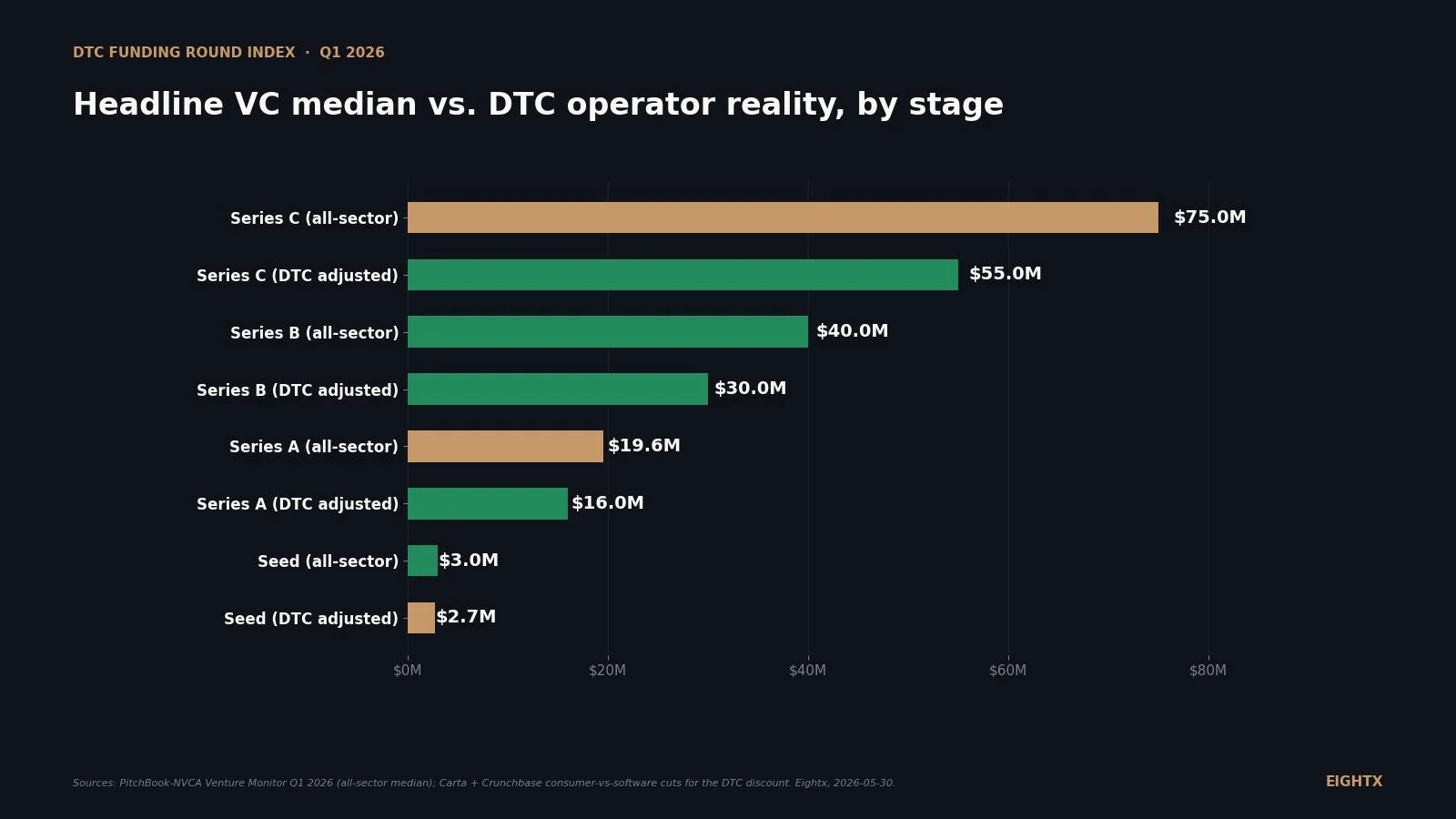
PitchBook-NVCA Q1 2026 medians are Seed $3M, Series A $19.6M, Series B $40M, and Series C $75M. DTC and consumer brands typically raise 10 to 30% below those all-sector figures because mega-AI deals inflate the headline numbers. Plan your DTC Series A raise around $12M to $17M and model 18 to 24 months of runway, not the PitchBook headline.
Key Takeaways
- Headline US VC medians in Q1 2026 are seed $3.0M, Series A $19.6M, Series B $40.0M, Series C $75.0M (PitchBook-NVCA Venture Monitor). Pre-money: seed $18.4M, Series A $62M, Series C $579M. The Series A and Series C jumps from Q4 2025 are the story.
- Those numbers are dragged up by a small number of huge AI rounds. The DTC and consumer-brand version of that curve runs 10 to 30 percent lower. Series A round size: closer to $16M. Series B: closer to $30M. Series C: closer to $55M.
- The DTC funding drought is real. US ecommerce-related funding tracked at the lowest tally in years in 2025, and consumer-startup funding fell 47 percent year-over-year in Q1 2025 (Carta via VC Cafe). The pure DTC consumer-products slice was 97 percent off the 2021 peak by 2023.
- Median Series A dilution compressed to 17.9 percent in Carta's Q1 2025 cut, down from 20.1 percent a year earlier. The market is buying smaller pieces of the company. Headline valuations overstate true economics because structured terms (liquidation preferences, ratchets) have replaced clean markdowns.
- Plan for an 18 to 24 month seed-to-Series A timeline, a roughly 28 percent graduation rate inside two years for ecommerce / D2C cohorts, and a Series A bar that did not exist in 2021: gross margin, payback, and inventory turn all clearing levels venture used to forgive.
Founders raising in 2026 keep asking us the same question. What is the actual number for a seed, a Series A, a Series B right now. The honest answer is two numbers, not one. The headline US venture median by stage is a real, sourced figure from the Q1 2026 PitchBook-NVCA Venture Monitor. The consumer and DTC version of that curve sits 10 to 30 percent below it at every stage, and that gap is the difference between modeling a raise that clears and modeling one that does not. We update this index quarterly as new PitchBook-NVCA and Carta prints land.
The headline 2026 funding medians, and why they do not apply to you
PitchBook-NVCA's Q1 2026 Venture Monitor shows US median round sizes of $3.0M at seed, $19.6M at Series A, $40.0M at Series B, and $75.0M at Series C. Pre-money valuations: $18.4M at seed, $62M at Series A, $579M at Series C. The Series A median jumped 30.7 percent quarter-over-quarter from Q4 2025's $15.0M, and Series C jumped 38.9 percent from $54.0M. Those are the numbers that ran in every venture newsletter the week the report dropped.
The catch is what is dragging those medians up. Early commentary on the Q1 2026 print (GamesBeat summary of the NVCA release) noted that the quarter hit big VC records while the top 5 AI deals accounted for most of the dollar volume. Strip those out and the by-stage medians for consumer, retail, and DTC businesses look much closer to the Q4 2025 levels, or below them. The "every stage moved up" framing is true for the aggregate. It is not true for the brand-heavy DTC business deciding whether to raise this year.
The other piece of context the headline number hides is that seed actually ticked down from Q4 2025 ($3.8M) to Q1 2026 ($3.0M). That dip is likely a sample-composition artifact (fewer mega-seeds in the Q1 mix, more standard $2M to $4M rounds), not a true market decline. But it tells you the seed band is sitting where it has sat for two years: brand-heavy seeds at $1M to $5M, software / marketplace plays closer to the all-sector median.
The trend table below makes the asymmetry visible.
Stage Q4 2025 median Q1 2026 median QoQ change Seed $3.8M $3.0M -21% Series A $15.0M $19.6M +30.7% Series B $33.8M $40.0M +18.3% Series C $54.0M $75.0M +38.9%
The consumer discount: what DTC founders are actually raising
No single source publishes a free, current, consumer-only median table by stage. PitchBook does cut consumer / retail data, but it sits behind their paywall. Carta publishes quarterly state-of-the-market reports with sector cuts but the consumer-only by-stage table is partial. The most honest read is a triangulated band: apply roughly a 10 to 20 percent discount to the all-sector medians at seed and Series A, and 20 to 30 percent at Series B and Series C. Pre-money compression runs deeper: 20 to 30 percent at Series A, 30 to 40 percent at Series B and Series C.
For a brand-heavy DTC business raising a Series A in 2026, the working numbers from consumer-focused funds (the Ellty compilation of 45 active consumer VCs is the cleanest public source) sit at $11M to $15M average check size. That triangulates with the all-sector $19.6M median run through a 20 to 25 percent consumer discount. Series A post-money for solid but non-outlier consumer / DTC brands lands at $35M to $80M, clustering around $40M to $60M. Top-decile brands with strong retention and unit economics push to $80M to $150M post-money on $20M+ checks. Stressed or bridge-like rounds clear at $30M to $40M post-money.
The DTC funding drought is the context that explains the discount. US ecommerce-startup funding tracked toward the sector's lowest investment tally in years in 2025, at roughly $7.3B globally, still down 80 percent or more from the 2021 peak (Crunchbase). The pure DTC consumer-products slice was already 97 percent off the 2021 peak by 2023 ($130M year-to-date versus $5B+ in 2021). Carta data summarized by VC Cafe showed consumer-startup funding falling 47 percent year-over-year in Q1 2025. The 2025 and 2026 environment is the harshest for branded DTC raises since pre-2018.
The master by-stage table below is the one to anchor your raise model on. It is the headline median, the pre-money, the dilution, and the directional DTC-adjusted round size, side by side.
Stage Median round size (Q1 2026 NVCA) Median pre-money (Q1 2026 NVCA) Typical dilution (Carta for seed/A, directional band midpoint for B/C) DTC consumer discount DTC-adjusted round Seed $3.0M $18.4M ~20.5% -10% $2.7M Series A $19.6M $62M 17.9% -15% $16.6M Series B $40.0M (not in snippet) ~18% -25% $30.0M Series C $75.0M $579M ~12% -27% $55.0M
Dilution and the cap-table math: how the rounds add up
Carta's Q1 2025 cut shows median seed dilution at 20.5 percent and median Series A dilution at 17.9 percent, down from 20.1 percent in Q1 2024. That roughly 2-point drop in Series A dilution is the structural read. The market is paying about the same for a Series A check size that has crept up, which means founders are giving up smaller percentages. The catch is that headline valuations overstate true economics because the gap between asking pre-money and clean economics has widened. Structured terms (liquidation preferences above 1x, participation, ratchets, milestone-based ratchets) are now doing the work that pure markdowns used to do. A "flat" Series A in 2026 with a 1.5x participating preference is functionally a down round.
The compounded math matters more than any single round. A founding team that raises a $3M seed at 22 percent, a $16M Series A at 18 percent, a $30M Series B at 18 percent, and a $55M Series C at 14 percent ends up with roughly 45 percent of the company across four rounds (0.78 x 0.82 x 0.82 x 0.86 = 0.451) before option-pool refreshes and any IPO-priced milestone clauses bite. That is materially better than the 2021-vintage cap tables we see on diligence calls, where the same brand often ended four rounds at 25 to 32 percent founder ownership because the dilution bands were higher across the board. The cleaner today's terms look, the more carefully you have to read the fine print on the preferences stack.
Timing: 18 to 24 months between rounds, and the seed-to-Series A graduation rate
The headline timing benchmark we lean on for DTC is 18 to 24 months between seed and Series A, with a roughly 28 percent graduation rate inside that window for ecommerce and D2C cohorts (IdeaProof Startup Fundraising Benchmarks 2025). Broader-market graduation has dropped to 15 to 20 percent over two years (Incisive VC, June 2025). The practical read for an operator who raised a seed in late 2024 is that your Series A target window is mid-2026 to late 2026. If you raised in 2022 or 2023 and have not yet cleared a Series A or a bridge, the math is telling you to either raise a bridge, raise an extension, or build directly to cash without the round.
The graduation rate is where the cohort math turns ugly. Of every 100 DTC seeds funded in 2022 or 2023, fewer than 30 will clear a Series A inside 24 months. Of the 70 that do not, some bridge, some are acquihired, some pivot to inventory or revenue-based financing, and some shut down. The 28 percent graduation rate is not a forecast of how much you raised; it is a forecast of how many seed-funded DTC brands of your vintage will be in the room for the next round.
What to do if you are a $5M to $50M DTC operator deciding whether to raise in 2026
Three reads to plan from.
First, anchor your round size on the DTC-adjusted curve, not the headline median. The all-sector Series A number of $19.6M is the wrong target for a brand-heavy business. A $10M to $15M check at $40M to $60M post-money is what a clean Series A actually looks like for a $5M to $20M revenue DTC operator in 2026. Modeling your raise against $19.6M sets the wrong expectation with your board, with your existing investors, and with your spend plan. Anchoring on $12M means you build a runway and a unit-economics story that actually clears.
Second, decide whether equity is the right capital category at all. The new default exit for sub-$300M DTC is a strategic acquisition at 3 to 8 times EBITDA, not a 10 to 15 times revenue IPO (see our sister post on the DTC funding drought index). If the round funds non-payroll growth (product, brand, defensibility) and your unit economics throw off cash without it, equity makes sense. If the round funds working capital or paid-acquisition arbitrage, bank debt or revenue-based financing is usually the cleaner capital, even at higher headline rates. Compare the dilution cost of $5M equity against $5M of 12 to 14 percent bank debt across three years and the equity is often more expensive on a fully diluted basis.
Third, build to the bar that exists, not the bar that used to. Series A in 2026 wants gross margin above 50 percent (above 60 percent for beauty), contribution margin positivity, payback inside 9 to 12 months on first-purchase, and channel diversification beyond paid social. Brands that show those metrics get the upper half of the valuation ranges. Brands relying on paid social arbitrage alone, post-ATT tracking softness, and a single channel are taking the bottom of the band or going home. The bar will not move down between now and 2027. Build to it.
The headline US VC medians are real, but they describe an aggregate market dragged up by a small number of AI mega-rounds. The DTC operator version of that curve sits 10 to 30 percent below the headline at every stage and is the curve you should model your raise against. The gap between those two numbers is the difference between a round that clears and a round that does not.
What we are watching next
A few signals could move the by-stage index over the next few quarters.
Q2 2026 PitchBook-NVCA print (due late July 2026). We will be watching whether the seed median climbs back to the $3.5M to $4.0M range (confirming the Q1 dip was sample composition), whether the Series A jump from $15.0M to $19.6M sticks or fades as the AI mega-round tail thins, and whether Series B and Series C compress as the public-market exit window stays closed.
Carta Q1 2026 State of Private Markets. Carta's Q1 2026 cut had not landed in the public summaries as of research date. When it ships, it is the closest public look at consumer-only dilution and pre-money trends. We will refresh the dilution numbers and the consumer-discount band in this post when that data lands.
A clear DTC IPO at material scale. If a brand-led consumer business prices a clean IPO in 2026, it changes the exit math for everything below it in the funding curve. A cleared IPO at material revenue scale reopens late-stage growth equity for the brands two and three rounds behind it. Until one prices, the late-stage discount stays where it is.
For more context on the broader funding environment, see the DTC funding drought index for the IPO drought and Census formation data, our fed funds vs DTC cost of capital post for the alternative-financing comparison, and the interim CFO services overview if you want a second read on your raise math before you take the meeting.
Sources and methodology
PitchBook-NVCA Venture Monitor. Quarterly joint publication of the National Venture Capital Association and PitchBook. Latest print as of research date is Q1 2026, published April 2026 (PDF at nvca.org/wp-content/uploads/2026/04/Q1-2026-PitchBook-NVCA-Venture-Monitor.pdf). Provides medians by stage for round size and pre-money valuation across US deals, all sectors. Reports include sector breakouts but the granular consumer / DTC median table is not in the free PDF; it sits behind PitchBook's paywall. Q4 2025 print used for trend context (nvca.org/wp-content/uploads/2026/01/q4-2025-pitchbook-nvca-venture-monitor.pdf).
Carta State of Private Markets. Quarterly report from Carta covering cap-table data for the approximately 50,000 private companies on the Carta platform. Q1 2025 print is most recent quoted (carta.com/data/state-of-private-markets-q1-2025/), providing median primary dilution by stage, median pre-money valuations, and quarter-on-quarter sector cuts. Q1 2026 print was not exposed in the public search snippets pulled at research date; the post will be refreshed when it lands.
Crunchbase News. Two pieces of editorial coverage cited: "It's Been A Down Year For E-Commerce Funding" (2025, news.crunchbase.com/fintech-ecommerce/2025-funding-down-ai-amzn/) for the 2025 aggregate, and "VCs No Longer Do DTC" (2023, news.crunchbase.com/fintech-ecommerce/direct-to-consumer-vc-funding-falls-2023/) for the 2021 vs 2023 DTC slice. Slices are tagged by Crunchbase's industry categories (E-Commerce, Consumer Goods, Direct-to-Consumer) and are not strictly comparable across years. The 2025 figure is the broader ecommerce-related aggregate. The 2023 figure is the narrower DTC consumer products tag.
Consumer / DTC investor range triangulation. Series A consumer / DTC ranges of $8M to $20M check size and $35M to $80M post-money were triangulated from the Ellty compilation of 45 active consumer-brand VCs (ellty.com/blog/d2c-investors), CRV's "Series A metrics VCs expect" (crv.com/content/series-a-metrics-vcs-expect), and AlleyWatch's March 2026 US venture report. The Ellty compilation is a range source for active consumer investors, not a published check-size median.
Timing and graduation-rate sources. Seed-to-Series A timing of 18 to 24 months and a roughly 28 percent ecommerce / D2C graduation rate inside 24 months come from IdeaProof Startup Fundraising Benchmarks 2025 (ideaproof.io/fundraising-benchmarks). Broader-market graduation-rate update from Incisive VC's June 2025 cut (incisive.vc/2025/06/10/update-on-venture-graduation-rates/).
Limitations the post calls out.
No single source publishes a free, current, consumer-only median table by stage. The directional consumer discount of 10 to 30 percent is triangulated, not measured. Carta data covers companies on the Carta platform, heavily indexed toward tech / SaaS and lighter on pure DTC physical-product brands. Useful for direction, not for precise DTC medians. PitchBook-NVCA medians for Q1 2026 are dragged up by a small number of huge AI rounds; the AI-mega-round tail is the single most important caveat for the post. Form D filings (Reg D private offerings) do not systematically include pre-money valuation or implied dilution, so they cannot be aggregated into sector-level medians.
Update cadence. This index is refreshed quarterly when PitchBook-NVCA and Carta data land. Next update target: late July 2026 with the Q2 2026 PitchBook-NVCA print, and an interim refresh when Carta's Q1 2026 State of Private Markets goes live.
Frequently asked questions
what is the average seed round size for a dtc brand in 2026?
Headline US seed median is $3.0M in Q1 2026 (PitchBook-NVCA). For a brand-heavy DTC business, plan for $1M to $5M with most normal seeds clustering around $2M to $4M. Triangulated consumer / fashion investor ranges (Ellty and vendor syntheses) sit at $1M to $5M for seed. Software-heavy ecommerce infra plays raise closer to the all-sector median.
how much should i be raising at series a if i run a $5m to $20m dtc brand?
Plan around $10M to $12M as a realistic median for a solid business, $40M to $55M post-money. Top-quartile metrics can push to $15M to $20M at $60M to $90M post-money. Stressed or bridge-like rounds clear at $6M to $8M and $30M to $40M post-money. The all-sector Q1 2026 Series A median of $19.6M is the wrong yardstick because mega-AI rounds drag it up.
whats the median pre-money valuation for a consumer series a right now?
All-sector Q1 2026 Series A pre-money is $62M (PitchBook-NVCA). For consumer / DTC, expect $35M to $80M post-money for solid but non-outlier brands, clustering around $40M to $60M post-money. Top-decile brands with strong retention and unit economics push to $80M to $150M. Bridge-like or down rounds clear at $30M to $40M.
is the dtc funding market actually open in 2026 or is everyone just being polite?
The door is narrower but still open if your unit economics clear the bar. Capital is available, the bar moved up. The bar at Series A demands real product-market fit and repeatable growth, headline consumer-startup funding fell 47 percent year-over-year in Q1 2025 (Carta via VC Cafe), and US ecommerce-related funding hit its lowest tally in years in 2025 (Crunchbase). The drought is real and continuing, but the operators clearing the bar are still getting checks.
how much dilution should i plan for at seed and series a for a dtc brand?
Seed 15 to 25 percent (combined pre-seed plus seed often 20 to 30 percent). Series A 17 to 25 percent with Carta's Q1 2025 median at 17.9 percent. Series B 15 to 25 percent. Series C 10 to 20 percent. The Series A median dropped roughly 2 points year-over-year (20.1 to 17.9), which means the market is buying smaller pieces. Headline valuations overstate true economics because structured terms (liquidation preferences, ratchets) now do the work that markdowns used to.
how long should i expect between my seed and series a as a consumer brand?
Plan for 18 to 24 months. Ecommerce and D2C cohorts inside that window show roughly a 28 percent graduation rate. Broader-market graduation has dropped to 15 to 20 percent over two years. If you raised seed in late 2024, your Series A target window is mid-2026 to late 2026. If you raised seed in 2022 or 2023 and have not bridged, the math says raise a bridge or build to cash now.
should i raise venture at all in 2026 or go inventory-financed and revenue-based?
Only raise venture if the round funds non-payroll growth (product, brand, defensibility), the terms are clean (no IPO-priced milestone clauses, no aggressive ratchets), and your unit economics throw off cash without the round. Founders we talk to are increasingly leading with bank debt before equity, then layering RBF only as a working-capital bridge for inventory and ad-spend smoothing, not as a growth-equity replacement.
what counts as a real series a in dtc right now, is it still $10m?
Consumer / DTC Series A in 2026 clusters at $10M to $15M for solid businesses, $20M+ for top-decile brands, and sub-$8M for capital-efficient or structured rounds. Revenue at Series A is usually $5M to $15M+ run-rate with solid cohort behavior, contribution margin positivity, and a path to profitability under conservative assumptions. The $10M threshold still roughly applies for a clean institutional A. Below that you are signaling either efficiency or hair on the story.