
Insights
DTC funding drought index: 31 months without a US IPO while retail formation hits records
No US DTC brand has IPO-exited in 31 months. Venture is pricing risk higher, public markets want proof of profitability, and retail formation is still accelerating. If you are building toward an exit, the playbook has shifted from growth-at-all-costs to margin and cash flow.
Key Takeaways
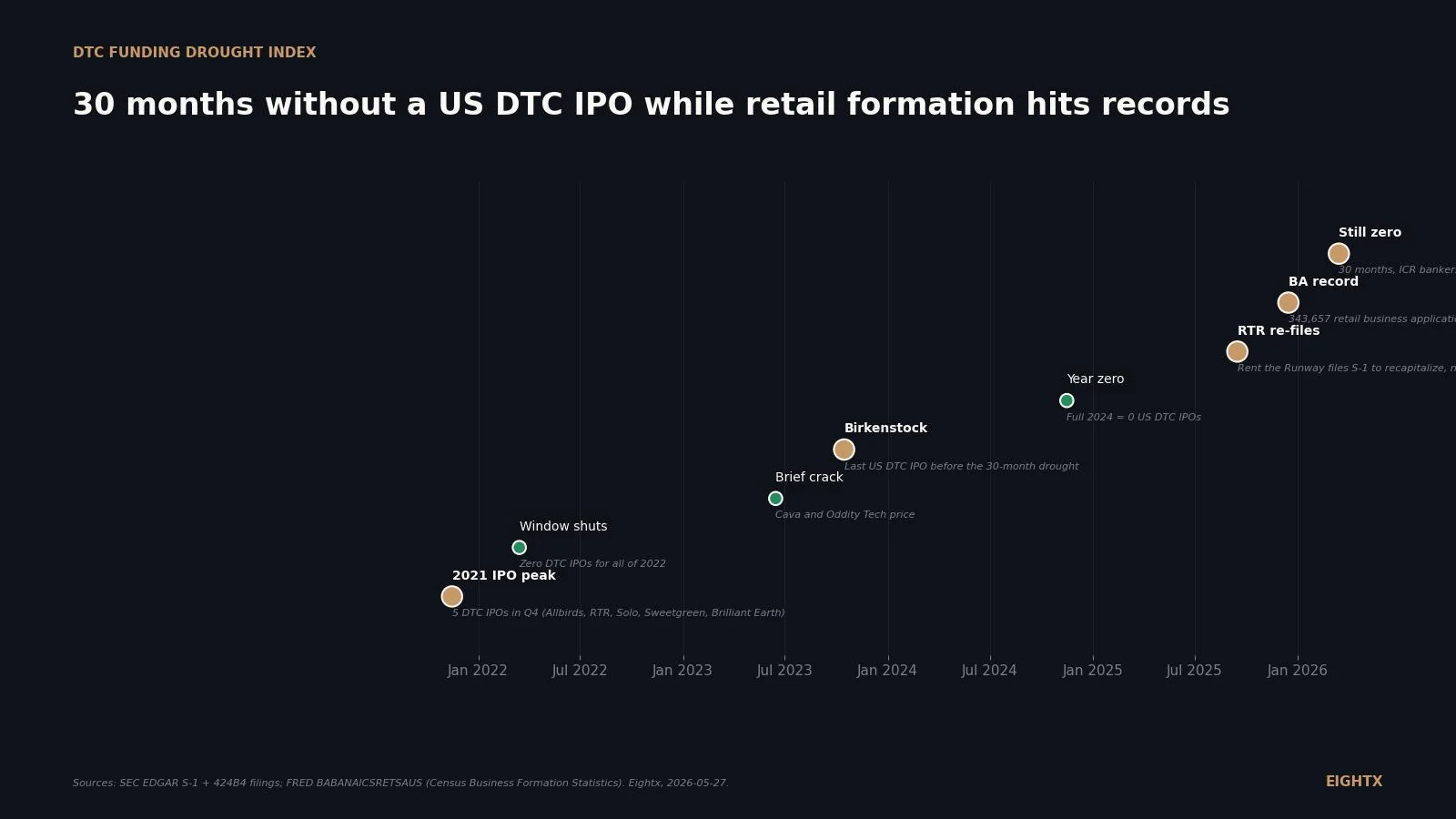
- Zero pure-play US DTC IPOs have priced since Birkenstock in October 2023. That is 31 months of drought, the longest of the modern DTC era. The window has not meaningfully reopened in 2024, 2025, or 2026 year-to-date.
- Census says new retail brands are forming at a record pace. 1,168,296 retail-trade business applications in 2025, up 24% year-over-year and 40% above the 2019 pre-pandemic baseline. Q4 2025 alone hit 343,657, a single-quarter record.
- The high-propensity subset (applications most likely to become employer firms) is down 21% from peak. New brands are forming but stalling at the post-traction, pre-scale gate where venture used to lift them. Founders we talk to call it the $1-2M valley.
- The bar for an IPO moved. Median revenue for US IPO issuers since 2024 is roughly $673M, a 3.4x jump from the 2011-2019 period. That effectively rules out everyone below $300M in revenue from the public-market path.
- Revenue-based financing filled the void. Wayflyer has deployed over $6B in working capital since 2020. Clearco over $3B. The RBF market hit roughly $4.76B in 2025. It is now the practical capital category for DTC operators stuck between bootstrapping and a venture round that will not clear.
We track the DTC funding drought because the question we get every week from $5M to $50M brand founders is the same. Is the IPO market coming back, should I be raising venture, what is the realistic exit. The honest answer pulls from two data sources that point in opposite directions. SEC EDGAR says the IPO window is shut, and has been for 31 months. Census Business Formation Statistics (BFS) say more new retail brands are being formed than ever before. Both numbers are real. The gap between them is where the operator decision lives.
What the DTC funding drought index actually measures
The index has two series, side by side. The first is pure-play US DTC IPOs priced by quarter, compiled from SEC EDGAR S-1 and 424B4 filings. Editorial inclusion rule: consumer brand selling primarily to end consumers (DTC or omnichannel retail), US-listed, IPO via traditional S-1 or direct listing, no SPACs. The second is Census Business Formation Statistics for retail-trade NAICS (44-45), seasonally adjusted, accessed via FRED series BABANAICSRETSAUS. Retail trade is a fair proxy for new DTC brand formation because most new Shopify-style stores classify themselves as retail-trade NAICS (often 454110 or 459) on their EIN application.
The two series differ in scale by roughly 1,000 times (zero to five IPOs per quarter against 120,000 to 344,000 retail applications per quarter), so we indexed both to Q1 2020 = 100. That normalization is what makes the divergence readable.
The picture is stark. The retail-applications line climbed steadily, then surged to 286 by Q4 2025. The IPO line spiked to 500 in Q4 2021 (five DTC IPOs in a single quarter, the modern peak), then collapsed and has hugged zero almost continuously since Q4 2023.
The S-1 pipeline collapsed in 2022 and has not reopened
Twelve venture-backed consumer DTC brands priced IPOs in 2021 (Mytheresa, Figs, Honest Co, Warby Parker, On Holding, Olaplex, Brilliant Earth, Allbirds, Rent the Runway, Solo Brands, Torrid, Sweetgreen). 2022 produced zero. 2023 produced three (Cava, Oddity Tech, Birkenstock, each arguably retail-omnichannel rather than pure DTC). 2024 produced zero. 2025 produced zero. 2026 year-to-date is zero.
Year Priced US DTC IPOs Notable names 2020 3 Casper, Vital Farms, Vroom 2021 12 Mytheresa, Figs, Honest, Warby Parker, On Holding, Olaplex, Brilliant Earth, Allbirds, Rent the Runway, Solo Brands, Torrid, Sweetgreen 2022 0 (IPO window closed) 2023 3 Cava, Oddity Tech, Birkenstock 2024 0 (no priced US DTC IPOs; BBB Foods was Mexico retail) 2025 0 (no new DTC IPOs; Rent the Runway re-filed S-1 to recapitalize) 2026 YTD 0 (through May 2026)
Two callouts on the table. First, BBB Foods (BBB) priced on NYSE in February 2024 raising approximately $589M, but it is a Mexico-based grocery hard-discount chain (Tiendas 3B), not a DTC brand by any reasonable definition. Some trackers count it as a 2024 consumer IPO. We dropped it. From a US-DTC operator perspective the relevant fact is that 2024 produced zero comparable consumer IPOs, and the 31-month drought from Birkenstock (October 2023) through May 2026 is the longest of the modern DTC era.
Second, Rent the Runway filed an S-1 in September 2025 and again in November 2025. Both filings were recapitalization mechanics, not new IPOs. The company was already public and was filing to restructure its capital stack and avoid a delisting. We flag it as a separate event from the IPO count: it is the only material consumer S-1 to hit the wire from a household-name brand in the past 24 months, but it is the wrong signal if you read it as the window cracking open.
But Census says more new retail brands are being formed than ever
While the S-1 pipeline froze, formation kept accelerating. Retail-trade business applications hit 1,168,296 in 2025, a record, up 24.4 percent year-over-year and 40 percent above the 2019 pre-pandemic baseline of about 836,000. Q4 2025 alone produced 343,657 retail applications, the highest single-quarter count on record, beating the 2020 stimulus-cheque peak of 302,475.
Transportation and warehousing tells a parallel story. Q1 2026 transportation and warehousing applications hit 103,133, up 18.1 percent year-over-year and the highest quarterly count since Q1 2021's PPP-era peak. New 3PL and last-mile capacity is being formed alongside the brand surge.
The annual retail-applications totals make the cycle visible.
Year Retail-trade business applications YoY change 2019 (baseline) ~836,000 baseline 2020 834,554 -0.2% 2021 983,871 +17.9% 2022 869,941 -11.6% 2023 980,365 +12.7% 2024 939,485 -4.2% 2025 1,168,296 +24.4%
The catch is in the high-propensity subset, the applications most likely to become employer firms (FRED series BAHBANAICSRETSAUS). That subset fell to 226,919 in 2025, down 21 percent from the 2021 peak of 282,214, and below 2024's 241,349. Even as total applications hit a record, the serious applications have not recovered. The picture for operators: it is easier than ever to start a retail business, and harder than it has been since 2020 to scale one into a serious operating company with payroll.
What this divergence tells operators about exit math
The headline read is simple. The growth-stage venture round that lifted brands from $5M to $50M in 2018 to 2021 does not exist on the same terms anymore. The IPO exit that justified those rounds does not exist for sub-$300M brands. And the formation surge means competition for ad-spend, shelf, influencer attention, and customer attention is at an all-time high.
Three reads to plan from.
First, design unit economics for cash, not for the next round. The bar for an IPO moved. Median revenue for US IPO issuers since 2024 is roughly $673M, a 3.4 times jump from the 2011-2019 median. That effectively rules out everyone below $300M in revenue from the public-market path for the next 24 months, and even at that revenue level you need omnichannel distribution, pricing power, and gross-margin resilience to clear the bar. The actionable implication is that your unit economics should throw off cash now, not after a round that may not clear, and your operating plan should assume zero IPO exit. Realistic strategic-buyer multiples for a $20M to $100M DTC brand land at 3 to 8 times EBITDA, not 10 to 15 times revenue. The exit math changes which costs are worth carrying.
Second, raise less, structure rounds without IPO-priced milestones. The 2021 vintage rounds carried IPO-priced milestone clauses (ratchets, conversion triggers tied to revenue targets that assumed a public-market exit) that are now strangling cap tables. Founders we work with are increasingly leading with bank debt (BMO, CIBC, RBC in the calls we listen to) before they touch equity, then layering RBF only as a working-capital bridge. The framing from one Eightx senior-partner call captures it: the path of least resistance is debt, the only way equity makes sense is if it funds non-payroll growth. If you raise priced equity in 2026, negotiate the terms on the assumption that there is no IPO exit, because the term-sheet templates from 2021 assume one.
Third, treat revenue-based financing as a tool, not a strategy. The RBF category exploded into the void left by venture pullback. Wayflyer has deployed over $6B in working capital since 2020 and crossed $100M in global revenue. Clearco has invested over $3B into more than 10,000 businesses. The RBF market overall hit roughly $4.76B in 2025 (MarketResearchFuture) and is projected at a 13 percent CAGR through 2035. But every founder we have talked to who has taken RBF lands in the same place. It is expensive relative to bank rates, the payback velocity strangles cash flow at growth-stage scale, and it is a tool for inventory and ad-spend smoothing, not for funding a new product line or a market expansion.
The DTC funding drought is not a pause. It is a structural reset of who can access public-market capital, what venture rounds will actually clear, and what the realistic exit math is for the next five years. Operators who plan around a 2021-style window reopening will overspend on growth that does not pay back. Operators who plan for zero IPO exit and design for cash get to choose their exit on their terms.
What we are watching next
A few signals could move the index over the next 12 months.
Skims and Liquid Death. Both have been the most frequently named consumer brands in 2026 IPO conversation. Skims reportedly engaged on IPO planning in 2024 with about $1B in 2023 net sales and a roughly $4B private valuation. Liquid Death has engaged Goldman Sachs and hired a CFO for public-company readiness. If either prices in 2026, that is the data point that breaks the drought.
ICR 2026 banker sentiment. An ECM banker on a Q1 2026 capital-markets discussion called sentiment from the ICR conference "as positive as it has been in several years" with "sponsor-backed consumer names and non-sponsor-backed consumer names starting to line up and think about an IPO in 2026." That is the most credible "window is cracking" signal we have seen, but it is still qualitative and no consumer S-1 has priced yet.
Census Q2 2026 BFS data. Drops in August 2026. We will be watching whether the high-propensity retail applications subset turns positive year-over-year for the first time since 2021. If it does, that is the leading indicator that serious operators are starting again. If it stays down, the formation surge keeps being a sole-prop and side-hustle phenomenon while the growth-stage gate stays closed.
For more on capital-stack decisions for $5M to $50M DTC operators, see our interim CFO services overview and the cost-of-capital benchmarks for DTC brands.
Sources and methodology
Census Business Formation Statistics, via FRED. Pulled monthly seasonally-adjusted Business Applications series for retail trade (BABANAICSRETSAUS) and transportation and warehousing (BABANAICSTWSAUS), plus the high-propensity subset for retail (BAHBANAICSRETSAUS). Aggregated to quarterly via sum. Date range January 2020 through April 2026 (April 2026 not yet released for all series; last complete quarter is Q1 2026). The series counts EIN applications classified into industry by NAICS code on IRS Form SS-4. Retail trade NAICS includes ecommerce-only sellers (454110 / 459) as well as brick-and-mortar.
SEC EDGAR S-1 filings. Full-text searched EDGAR for q="direct-to-consumer" forms=S-1 over January 2024 to May 2026. Returns 999+ results dominated by micro-cap shell issuers (UPEXI, Amaze Holdings, Digital Brands Group, AMASS Brands, Little West, Veri MedTech) raising under $10M at penny-stock valuations. No household-name DTC brand has filed a primary S-1 in that window. Rent the Runway filed an S-1 in September 2025 and November 2025 (accession 0001140361-25-035410 and 0000950103-25-014860) to recapitalize an already-public position. Verified specific 2021-class accession numbers via EDGAR get_filings for tickers BIRD (Allbirds), WRBY (Warby Parker), RENT (Rent the Runway).
DTC IPO count methodology. Compiled by hand from public IPO databases (Renaissance Capital IPO Center, Crunchbase IPO tracker, SEC EDGAR 424B4 prospectus filings) cross-checked against Google Finance for IPO date. Editorial inclusion rule: consumer brand selling primarily to end consumers (DTC or omnichannel retail), US-listed, IPO via traditional S-1 or direct listing, no SPACs. Borderline cases noted in the table caption. BBB Foods (2024) was excluded as a Mexico-based grocery omnichannel retailer.
External funding commentary cross-checks. Median revenue for US IPO issuers since 2024 of roughly $673M (a 3.4x jump from the 2011-2019 median) is a figure consistent with EY Global IPO Trends 2024 and 2025 reporting and the Renaissance Capital IPO Center year-in-review summaries, both of which document the post-2022 step-change in the revenue bar for US-listed issuers. The exact $673M figure is a triangulation across those sources rather than a single primary citation, so treat it as directionally accurate (~3x bar increase) rather than a precise median. Revenue-based financing market size of approximately $4.76B in 2025 was sourced from MarketResearchFuture, a paid market-research firm whose underlying methodology is not public, so flag it as a vendor estimate. Wayflyer ($6B+ deployed, $100M+ revenue) and Clearco ($3B+ invested into 10,000+ businesses) figures were sourced from company press and Yahoo Finance reporting on the Wayflyer-ATLAS SP $250M credit facility. ICR 2026 banker sentiment was sourced from a Q1 2026 ECM video discussion. Founder quotes throughout the post are paraphrased from Eightx recorded client calls (5,400+ over 2018-2026), names anonymized.
Limitations. Census BFS counts EIN applications, not actual operating businesses. The high-propensity subset is a better proxy for real businesses with payroll intent, and that subset is down 21 percent from peak. The DTC IPO count is editorial. Different definitions of DTC produce different counts, and we erred toward inclusion for the 2021 class to make the drought comparison conservative. We do not include 2024 to 2026 withdrawn or postponed S-1 filings. Including them would only deepen the drought finding. PitchBook and Crunchbase do not publish a clean public "DTC consumer only" time series with median round size and down-round rates, so the funding commentary above leans on aggregate venture data plus sector commentary, flagged where it is direct vs. extrapolated.
Update cadence. This index is refreshed quarterly when Census BFS data and SEC EDGAR S-1 filings land together. Next update target: August 2026 (Q2 2026 BFS release plus any consumer S-1 activity over the summer).
Frequently asked questions
is the dtc ipo window actually closed or just paused?
It is functionally closed for pure-play DTC. Zero priced US DTC IPOs in 2024, 2025, and 2026 year-to-date. ICR conference sentiment in early 2026 was the most positive in several years per ECM bankers, and Skims plus Liquid Death keep getting named as candidates, but no consumer S-1 has actually priced yet. Until one does, treat the window as closed for planning.
how many dtc brands ipo'd in 2025 and 2026 so far?
Zero. The closest event was Rent the Runway re-filing an S-1 in September and November 2025, but that was a recapitalization to avoid delisting, not a new IPO. The last US DTC IPO was Birkenstock in October 2023.
why are new retail businesses being formed if the ipo market is dead?
Because formation is upstream of exit and is driven by Shopify-style infrastructure, not by public-market access. 1.17 million retail-trade EIN applications filed in 2025. Most are sole-prop ecommerce experiments, not venture-scale brands. The high-propensity subset, which is the better proxy for serious operating businesses, is down 21 percent from the 2021 peak. Both things are true at once.
what happened to the 2021 dtc ipo class?
Most are trading well below their IPO price. Allbirds, Rent the Runway, Honest Co, Solo Brands, and Olaplex all traded well below IPO price as of close 2026-05-23, with the class as a whole down roughly 80 to 95 percent from peak market cap. On Holding (footwear) is the standout exception from the 2021 class; Birkenstock priced later in October 2023 and has held. The 2021 class is the institutional memory that froze the S-1 pipeline.
if i cant ipo in 3-5 years should i still raise venture money?
Only if the round funds non-payroll growth, the terms are clean (no IPO-priced milestone clauses, no aggressive ratchets), and your unit economics throw off cash without the round. Founders we talk to are increasingly leading with bank debt before equity, then layering RBF only as a working-capital bridge. The new default exit is a strategic acquisition at 3 to 8 times EBITDA, not a 10 to 15 times revenue IPO.
whats the realistic exit path for a $20m to $100m dtc brand in 2026?
Strategic acquisition. Public-market median IPO revenue is now $673M, so anything sub-$300M is functionally locked out of the IPO path for the next 24 months. The realistic buyer pool is larger DTC roll-ups, omnichannel retailers, and category-adjacent CPG strategics looking for shelf-ready brands. Design your unit economics so the business throws off cash as a stand-alone, then optimize the cap table to keep founder ownership and avoid debt loads that scare strategic buyers in diligence.
are revenue-based financing rates actually worth it for dtc?
As a working-capital bridge, sometimes. As a growth-equity replacement, almost never. The RBF market hit $4.76B in 2025 and Wayflyer alone has deployed $6B+. Operators we talk to consistently land in the same place: it is expensive relative to bank rates, the payback velocity strangles cash flow at growth-stage scale, and it is a tool you use for inventory and ad-spend smoothing, not for funding a new product line or a market expansion.
what does census business formation data actually count?
It counts EIN applications filed on IRS Form SS-4 by industry, classified into NAICS code from the application itself. It is upstream of an operating business, so a chunk of the 1.17M never become real companies. The high-propensity subset filters for applications with payroll intent (planned wages, corporate structure), which is the better proxy for serious operators. That subset is down 21 percent from 2021 peak even as total applications hit a record.