
Insights
Average ecommerce headcount by revenue band: what a $1M, $10M, $50M DTC brand staffs in 2026
A $1M DTC brand typically runs 2 to 4 people, a $10M brand 8 to 15, and a $50M brand 35 to 60. Revenue per headcount is the real metric to watch. Brands that scale headcount faster than revenue tend to hit a margin wall before they hit $20M, usually in ops and customer service first.
Key Takeaways
- The average US ecommerce establishment employs 14 people. But 73% have fewer than 5 employees and just 0.2% have 1,000+. Most ecom in America is a 1-5 person shop, not the 60-person Shopify Plus brand operator content describes (US Census CBP 2022, NAICS 4541).
- The recommended DTC staffing curve runs 3-6 FTEs at $1M, 15-25 at $10M, 60-80 at $50M, and 110-160 at $100M. Assumes digital-first, 3PL fulfilment, no owned retail. Brands with stores or in-house manufacturing run 1.5-2x higher at the same revenue.
- The operating-efficiency window sits between $5M and $25M. Revenue per FTE climbs from roughly $400K at $5M to $625K-$833K at $25M, then flattens. Past $100M, headcount efficiency plateaus and the gains have to come from gross margin and channel mix instead.
- Public DTC brands run leaner per revenue dollar than private ecom. The 14-company public cohort sits at a $720K median revenue per employee. Top quartile (Vita Coco, FIGS, YETI, Etsy) clears $1.2M. Bottom quartile (Stitch Fix, Lululemon, Warby Parker) carries store-side headcount that distorts the comparison.
- AI tooling is rewriting the curve below $25M. A 4-person CX team using AI agents in 2026 covers what 10-12 did in 2022. Sub-$25M brands using AI heavily are tracking closer to the top-quartile public ratio than the cohort median.
Most operator content tells you what a 60-person Shopify Plus brand looks like. The US Census Bureau says that brand is 0.2% of the distribution. The average US ecommerce establishment runs on 14 employees, and 73% have fewer than 5. The gap between what founders benchmark against and what the data actually says is the whole story.
This post is the staffing curve operators ask about constantly but no one publishes a clean answer to. We have two parallel data sources that finally let us draw the line: the US Census Bureau's County Business Patterns (CBP) 2022 dataset for NAICS 4541 (Electronic Shopping and Mail-Order Houses) and SEC 10-K human-capital disclosures for the 14-company public DTC cohort we covered in our companion post on headcount per $1M revenue for public DTC brands. One important framing note up front: Census reports by employee-size band, not revenue band. The revenue-band recommendations below are derived by triangulating the Census distribution with the public-cohort revenue-per-employee ratios and Eightx portfolio observations. Where we quote Census directly, we use employee bands. The story: the average ecom establishment with under 5 employees runs on 1.48 people, the 5-9 band averages 6.6, the 20-49 band averages 30, and the 50-99 band averages 68. The efficiency gains in revenue-per-FTE terms show up between $5M and $25M revenue, then flatten again above $50M as orgs add ops, planning, and management layers. One more upfront caveat: NAICS 4541 covers more than Shopify-style DTC, it includes catalog houses, drop-shippers, mail-order, and electronic auction houses, so the 14.03 average is the ceiling estimate for "US ecom firm headcount."
For the macro labor context behind these numbers (retail job openings up 48% YoY per JOLTS March 2026, warehousing employment down 1.41% YoY per CES April 2026, and the public-company 8-K filings telling you who is cutting), see our DTC layoff and hiring tracker.
The average US ecom firm has 14 employees (and 73% of them are tiny)
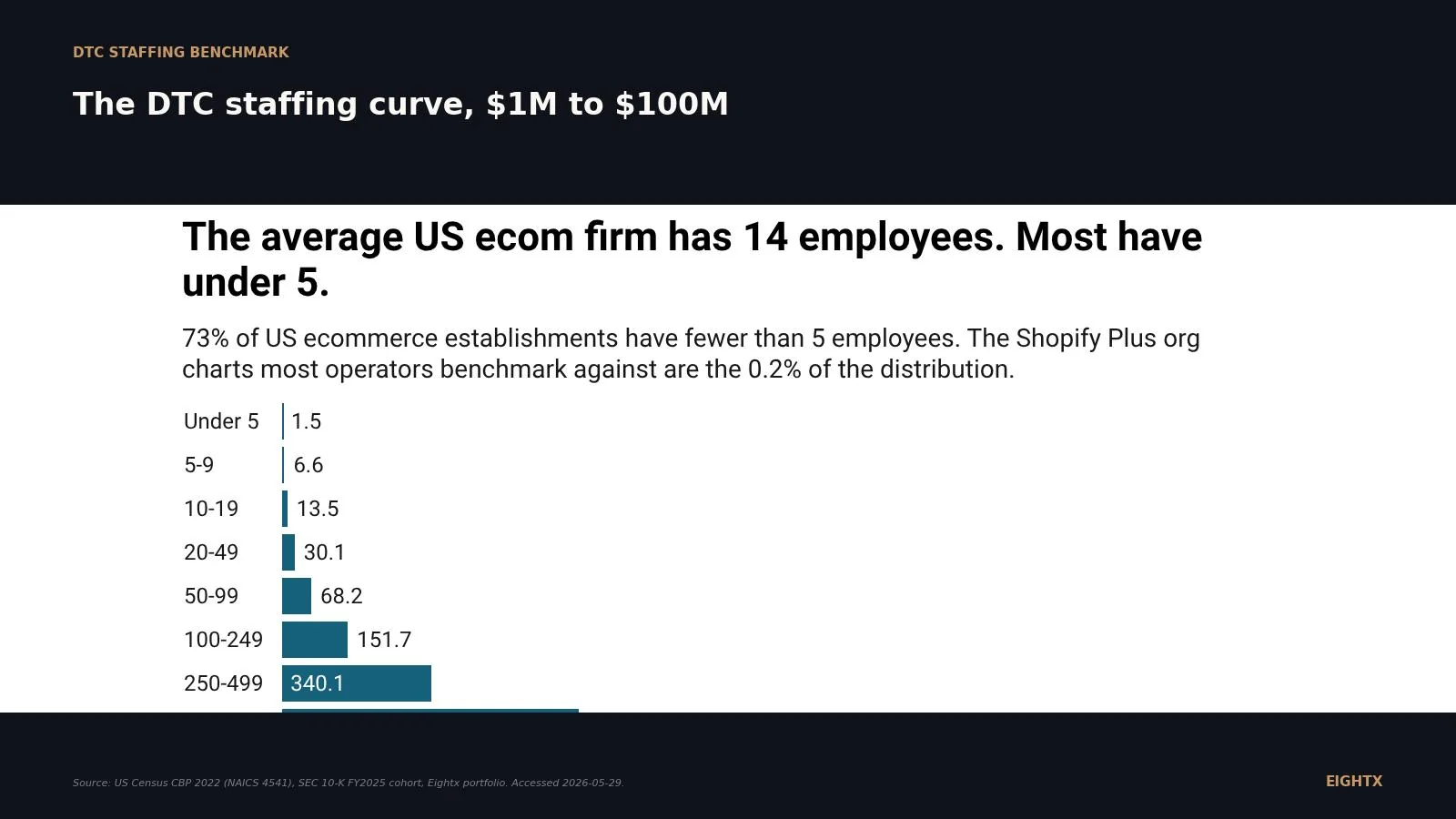
Pull the Census CBP 2022 dataset for NAICS 4541 and the distribution looks nothing like the operator content most founders read. 55,633 establishments. 780,598 total employees. That averages to 14.03 employees per ecom establishment in the US.
But the average hides the shape. 40,643 of those 55,633 establishments (73.1%) have fewer than 5 employees. They account for just 7.7% of total ecom employment. At the other end, 114 establishments (0.2%) have 1,000+ employees and carry 33% of all ecom employment. The middle (5 to 999 employees) holds the rest.
If you are running a $5M to $25M Shopify brand, you sit somewhere in the 5-99 employee band, which collectively is 92% of all US ecom establishments by count but only 27% of employment. You are the modal ecom company in America by count, and you have almost nothing in common with the Lululemon or Stitch Fix org charts most operator content describes.
The data table below shows the full distribution from the Census API pull.
Establishment size Establishments Total employees Avg per establishment Share of estabs Share of employment Under 5 employees 40,643 60,103 1.48 73.1% 7.7% 5 to 9 employees 7,090 46,486 6.56 12.7% 6.0% 10 to 19 employees 3,901 52,517 13.46 7.0% 6.7% 20 to 49 employees 2,236 67,211 30.06 4.0% 8.6% 50 to 99 employees 800 54,589 68.24 1.4% 7.0% 100 to 249 employees 500 75,854 151.71 0.9% 9.7% 250 to 499 employees 208 70,735 340.07 0.4% 9.1% 500 to 999 employees 141 95,388 676.51 0.3% 12.2% 1,000+ employees 114 257,715 2,260.66 0.2% 33.0% All sizes 55,633 780,598 14.03 100% 100%
The DTC staffing curve, by revenue band: $1M to $100M
Census reports by employee-size band, not by revenue band. To translate, we bridge through the public-cohort revenue-per-employee ratios and 35+ Eightx portfolio observations. The result is the band most founders actually want: at $X revenue, what should my FTE count look like?
The ranges below assume a digital-first DTC brand with 3PL fulfilment and no owned retail. Brands with stores, in-house manufacturing, or wholesale-heavy distribution typically run 1.5x to 2x higher at the same revenue, which is why Lululemon (39,000 employees, ~770 retail stores) shows up in the same dataset as FIGS (no stores, lean corporate).
Revenue band Total FTEs (low) Total FTEs (high) Midpoint Revenue per FTE (low) Revenue per FTE (high) Common org shape $1M 3 6 4-5 $167K $333K Founders + ops generalist + CX/VA + agency $5M 8 15 11-12 $333K $625K Marketing lead + 2 ops + 2 CX + creative + founder $10M 15 25 20 $400K $667K Functional leads emerging, first analyst/data hire $25M 30 45 37-38 $556K $833K Director layer, first eng hire, marketplace/wholesale role $50M 60 80 70 $625K $833K VP layer + middle management, multi-channel ops $100M 110 160 135 $625K $909K Full functional org, small in-house product/eng
The curve flexes between $5M and $25M. Revenue per FTE roughly doubles in that band (from $333K-$625K at $5M to $556K-$833K at $25M). Past $50M, the curve flattens. Past $100M, headcount efficiency stops improving and the gains have to come from gross margin and channel mix instead.
What the functional split looks like at each band
The blended FTE count is one question. Where those people sit is the other. The functional split shifts predictably with scale: marketing dominates early, ops and CX take over by the middle band, and engineering only becomes a meaningful share above $25M.
Function $1M $5M $10M $25M $50M $100M Marketing and growth 0.5-1 3-5 5-8 10-14 18-24 30-45 Operations and supply chain 1-2 2-3 4-6 8-10 15-20 25-35 CX and support 0.5-1 2-3 4-6 8-12 18-25 30-45 Engineering, product, data 0-0.5 0-1 1-3 3-6 6-10 12-20 G&A (incl. founder/CEO) 1-2 1-2 2-3 4-5 8-10 12-20 Total FTEs 3-6 8-15 15-25 30-45 60-80 110-160
Two patterns worth flagging. Marketing stays a high share of headcount all the way through $100M (it never drops below 25% of FTEs), because direct-response media and creative production are people-intensive even with AI tooling. Engineering only becomes meaningful above $25M, where the cost of platform customisation, data warehousing, and bespoke retention infrastructure finally outweighs SaaS spend.
Why the public DTC benchmark says leaner than your peers actually run
The 14-company public DTC cohort lands at a median revenue per employee of $720K, which sounds aspirational compared with the $300K-$500K most $20M private brands quietly run. The gap is real but partially structural.
The top quartile (Vita Coco at $1.81M, FIGS at $1.63M, YETI at $1.34M, Etsy at $1.21M) shares three choices: no owned retail stores, no in-house manufacturing, aggressive 3PL and agency use. The bottom quartile (Stitch Fix at $304K, Lululemon at $285K, Warby Parker at $216K) carries stylist or retail-store headcount funded by store-level revenue rather than corporate revenue. So the cohort median is being pulled in two directions by structural choices, not by operational efficiency alone.
For private $5M to $50M DTC operators, the practical read: target the cohort median ($720K per FTE) as a "good" outcome and the top quartile ($1M+ per FTE) as a stretch goal, but only if you genuinely match the structural choices (no stores, no in-house manufacturing, heavy agency use). If you have a retail footprint or your own factory, the public-cohort median is the wrong benchmark for you. Use the bottom-quartile $250K-$400K band and stop beating yourself up.
The other gap closer is AI. Sub-$25M brands using AI agents in CX and retention are running closer to the top-quartile ratio than the cohort median. A 4-person CX team using AI agents covers what 10-12 people did in 2022. A 3-person retention team using GPT-templated flows covers what 6-7 did in 2023. The headcount math below $25M has materially shifted in the last 18 months.
Where DTC brands over-hire (and what to cut first)
Three over-hire patterns show up repeatedly across the Eightx portfolio between $5M and $50M.
Ops and supply chain proliferation. Founders convert 3PL relationships and contractor support into in-house ops directors, supply-chain managers, and warehouse coordinators between $15M and $30M. The headcount typically doubles in 18 months. The execution rarely improves enough to justify it. The CFO move is to keep ops fractional and 3PL-served through $25M unless a specific contract, category complexity, or fulfilment economics demand otherwise.
Marketing department sprawl. A brand at $10M typically has 5 to 8 marketing FTEs (the Table 3 recommended range is 5-8 at $10M and 10-14 at $25M). In the Eightx portfolio we routinely see brands balloon from that recommended 10-14 to a dysfunctional 14-20 by $25M, mostly through specialist hires (lifecycle email manager, paid-social manager, paid-search manager, influencer coordinator, content writer, SEO manager) that each cost $90K-$150K and each contribute marginally on top of what the existing team plus agencies were already doing. The smart move is to consolidate specialist roles into senior generalists and keep agency leverage where the platform expertise actually lives.
CX hiring ahead of demand. Founders staff CX defensively between $5M and $20M because customer-experience scoring is the easiest metric to attach to FTE count. Across the 35-plus brand Eightx portfolio, the pattern is consistent: pre-AI CX teams in this band ran roughly 2-3x heavier than AI-augmented teams running the same ticket volume today. CX is the function where AI productivity gains are most provable in 2026, and the function where most $10-25M brands are still over-staffed relative to what their current ticket load actually requires.
Most operator content benchmarks you against the 0.2% of the Census distribution. The data says you are the modal ecom company in America at 5 to 99 employees, and your peers are running at $500-700K revenue per FTE with 3PL fulfilment and aggressive agency use. If you are building to a public-DTC org chart at $20M revenue, you are probably building twice the team the Census distribution implies your peer is running.
Sources and methodology
US Census Bureau, County Business Patterns (CBP) 2022. Establishment count, total employment, and total annual payroll for NAICS 4541 (Electronic Shopping and Mail-Order Houses) broken out by establishment-size class. Pulled via Census API endpoint https://api.census.gov/data/2022/cbp with parameters get=NAME,NAICS2017,NAICS2017_LABEL,ESTAB,EMP,PAYANN,EMPSZES,EMPSZES_LABEL&for=us:1&NAICS2017=4541. CBP 2022 is the latest available vintage (released in 2024) with a roughly 2-year lag. NAICS 4541 includes pure-DTC ecommerce sellers, traditional catalog and mail-order houses, drop-shippers, and electronic auction houses. The total establishment count of 55,633 is therefore an upper bound on "ecommerce firms" in the US. Average annual payroll per establishment of roughly $836K across 14 employees works out to about $59K per worker, which is broadly consistent with retail-trade BLS averages.
SEC EDGAR, 10-K Human Capital disclosures, FY2025. 14-company public DTC cohort: Lululemon (LULU), Crocs (CROX), Etsy (ETSY), YETI Holdings (YETI), Stitch Fix (SFIX), Revolve Group (RVLV), Warby Parker (WRBY), FIGS, Vita Coco Company (COCO), Purple Innovation (PRPL), The Honest Company (HNST), Beachbody (BODI), Allbirds (BIRD), Beyond Meat (BYND). Employee counts taken from the Human Capital section of each most recent FY 10-K filed in early 2026. Most cohort members are calendar-year filers, so "FY2025 10-K" in this post means the fiscal year ending in late 2025 with the underlying reporting period being CY2024 in most cases. Revenue from XBRL frames CY2024 (RevenueFromContractWithCustomerExcludingAssessedTax and Revenues). Cohort medians: revenue per employee $720K, employees per $1M revenue 1.67, operating margin 4.1%. Beachbody employee count is approximate (post-restructuring 2025). Full per-brand table lives in the companion post linked above.
BLS retail trade and warehousing snapshots. Retail trade (NAICS 44-45) and warehousing and storage (NAICS 493) employment, average hourly earnings, and JOLTS series via the BLS industry-snapshot endpoint. CES4200000001 (retail employment) sat at 15.47M in April 2026, essentially flat YoY (+0.03%). CES4348400001 (warehousing employment) sat at 1.47M in April 2026, down 1.41% YoY. Used as a sanity check on the Census payroll-per-worker math, not as a primary input to the FTE benchmark.
Eightx portfolio observations. 35-plus active portfolio brands at $5M to $150M GMV. Anonymised in aggregate per content policy. Used to validate the FTE ranges in the staffing curve table and identify the three over-hire patterns (ops sprawl, marketing department sprawl, CX hiring ahead of demand).
Methodology caveats. FTE counts in this post are W-2 only. Real team size at $5-25M is often 1.5x to 2x higher once you count fractional CFO, paid-media agency staff working on the account, fractional CMO, freelance creative, and BPO CX. The Perplexity synthesis (SaaS Capital, a16z, OPEXEngine) treats this rigorously and we follow the same convention. Census CBP 2022 is two-year-lagged; 2026-specific averages will look slightly leaner given the 2023-2025 right-sizing wave. The SEC public-cohort comparison is 14 large public companies, useful as top-end calibration but not a representative sample of private $1M-$100M DTC brands. "Recommended FTE band" in the staffing-curve table is editorial, built by triangulating Census averages, public-cohort ratios, and Eightx portfolio observations.
Update cadence. This is a living index post and gets refreshed quarterly when (a) a new Census CBP vintage releases (typically April-May each year) and (b) new public DTC FY 10-Ks land (March-April for calendar-year filers).
Frequently asked questions
how many employees should i have at $10m revenue as a dtc brand?
Plan for 15 to 25 full-time employees at $10M revenue if you are digital-first, 3PL-fulfilled, and have no owned retail. That puts you at roughly $400K to $667K revenue per FTE, which is the lower end of the public-cohort median but reasonable for a brand still building functional depth. Below 15 FTEs you are probably over-reliant on agencies and one resignation away from a fire drill. Above 25 you should be hitting $15M next year or you are over-hired.
what is the average headcount for a $5m ecommerce business?
8 to 15 FTEs is the realistic band for a $5M digital-first DTC brand in 2026. Typical org shape: marketing lead, 2 ops, 2 CX, creative/brand, and the founder running finance and strategy. If you are running a $5M brand on 4 FTEs you are heavily agency-dependent and that has its own scaling cliff.
how many people should i hire at $1m revenue?
3 to 6 people, and at least half of them should be founders, contractors, or virtual assistants. Census doesn't break out by revenue band, but its under-5-employees band averages 1.48 people and roughly maps to sub-$1M brands once you triangulate through the public-cohort revenue-per-employee ratios. Most $1M brands are running 2 founders plus a CX/VA plus a 3PL contract plus an agency, and they should stay that lean until $2M to $3M.
what is a good revenue per employee target for a dtc brand in 2026?
Use $500K to $700K per FTE as your operating-band target from $10M through $100M revenue. The public DTC cohort median is $720K. Top quartile clears $1.2M but those brands have no retail, no manufacturing, and lean heavily on 3PL fulfilment. Anything under $400K per FTE at $20M+ is a yellow flag worth a hard org-chart review.
should i hire in-house or use agencies and a 3pl at $5m to $25m?
Stay reliant on 3PL and paid-media agency through $25M unless you have a specific reason not to. The public cohort data confirms that brands clearing $1M revenue per employee share three structural choices: no owned retail, no in-house manufacturing, aggressive 3PL and agency use. You can in-house creative and retention earlier if your unit economics support it, but ops and paid media stay outside the FTE count longer than most founders expect.
how does ai change the headcount math for a dtc brand?
Below $25M revenue, AI tooling has materially flattened the FTE curve. CX agents using AI handle 2-3x the ticket volume they did in 2022. Retention teams using GPT-templated flows run leaner than the historical 1-per-$5M ratio. Above $25M the AI lift exists but is masked by the new ops, planning, and management roles that scale brings. Treat the AI advantage as real for sub-$25M planning and conservative above that.
why does the public dtc benchmark say leaner than what most $20m brands actually run?
Three reasons. First, public DTC brands have institutional pressure to keep revenue per employee high, which shows up in 10-K disclosures. Second, the public cohort includes brands like Vita Coco and FIGS that are structurally lean (no retail, no manufacturing) and pull the median up. Third, private $20M brands typically hire ahead of revenue (build to plan rather than to actuals), which adds 5 to 10 FTEs that wouldn't pass a public-company comp review.
what is the biggest org-design mistake dtc founders make between $5m and $25m?
Hiring CX ahead of demand and building an ops team that scales linearly with revenue. The first looks defensive but actually adds fixed cost before order volume justifies it. The second is more common: founders convert 3PL relationships and contractor ops support into in-house ops directors and supply-chain managers before $15M, which doubles G&A without improving execution. The CFO move is to keep ops fractional and 3PL-served through $25M unless a specific contract or category demands otherwise.