
Insights
Average time between DTC funding rounds 2026: 819 days Seed to A, 20% graduation rate
Consumer startups wait a median of 819 days between Seed and Series A (Carta, Q4 2024). Only 20% of DTC brands that raised seed rounds in 2022 have since graduated to a Series A (Crunchbase). The practical implication for runway planning is brutal: budget for 27 to 30 months between rounds, not the 18 months most founders model, and treat the Series A milestone as a 3-year operational story.
Key Takeaways
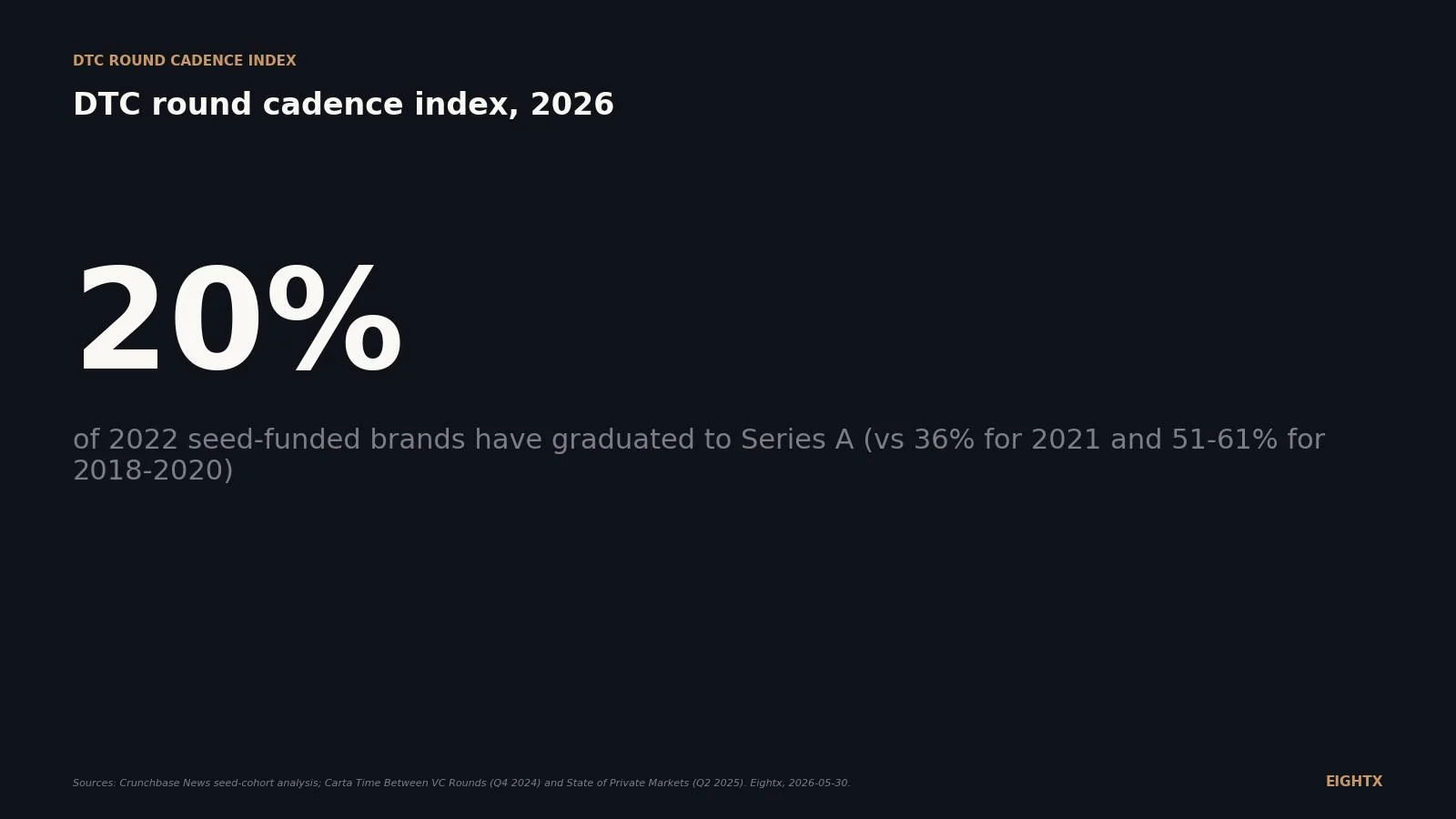
- Only 20% of seed-funded brands from the 2022 cohort have graduated to Series A as of mid-2025 (Crunchbase). For 2018-2020 cohorts the rate was 51-61%. Four in five 2022 seed DTC brands have not closed a priced A and may never.
- Consumer Seed to Series A median is 819 days (2.2 years) in Q4 2024 (Carta), longer than the all-sectors median of 774 days. Carta's all-sectors median is up roughly 84% versus Q4 2021; Carta did not publish a Q4 2021 consumer figure. The Q2 2025 closed-cohort median tightened slightly to 616 days but only counts the survivors.
- Across all sectors and stages, the median wait between rounds hit 696 days (~23 months) in Q2 2025. That is the longest reading in the modern Carta dataset.
- Fundraising-cycle length has roughly doubled, from 3-4 months in 2021 to 6-9 months in 2026. A $20M DTC brand needs to start the next round 12-15 months before runway zero, not 6-9.
- Plan for 24-30 months of runway per round and assume one extension round between Seed and A. Bridge SAFEs, Seed+ rounds, and flat A's are now standard, not failure signals.
If you're a DTC ecommerce founder modeling your next raise against a 2021 timeline, the round-cadence data says stop. Median days between Seed and Series A for consumer startups is 819 days (2.2 years) per Carta's Q4 2024 release. Carta's all-sectors Seed to A median is up roughly 84% versus Q4 2021 (Carta did not publish a Q4 2021 consumer figure), so the consumer wait sits above an already-stretched cross-sector baseline. The number that should actually drive your runway planning is not the wait time at all: it's that only 20% of seed-funded brands from the 2022 cohort have closed a priced Series A as of mid-2025 (Crunchbase). Four in five 2022 seed DTC brands never made it to the round the 819-day median is measuring. This page tracks the current round cadence, the graduation-rate collapse, and the runway-planning frame we use with private DTC clients in the $5M to $50M revenue band. Quarterly refresh.
The graduation-rate collapse is the number that should scare you
The headline funding-round-timing data hides the actual operator risk. Most coverage leads with "rounds take longer now." That is true. It also undersells what's happening.
Crunchbase News (Chris Metinko) tracked seed-funded startups by cohort year and measured what share eventually closed a priced Series A. The 2018, 2019, and 2020 cohorts graduated at 51% to 61%. The 2021 cohort dropped to 36%. The 2022 cohort is at 20% as of mid-2025.
That 20% number is the one to anchor on, not the 819-day median. The Carta wait-time figure only includes brands that actually closed a Series A. It is conditional on graduating. For the 80% of 2022-cohort brands that never close, the wait time is irrelevant: they either die, get acquired below the seed valuation, or convert to an indefinite default-alive operating mode.
The 2023 and 2024 seed cohorts are too recent to score (Crunchbase explicitly excludes them) but the available leading indicators (extension-round volume, Series A deal-count decline, IPO drought) all point lower, not higher. Plan as if the graduation rate stays at 20% for the foreseeable future.
What the round-cadence data actually shows for consumer DTC
For the brands that do graduate, here is what the wait looks like. Carta's Q4 2024 release reports a median 819 days between Seed and Series A for consumer startups, longer than the all-sectors median of 774 days. Series A to Series B for consumer is 562 days, faster than the all-sectors 732 days because the consumer A to B pool is small and selected (the ones who cleared A are the cleanest stories).
Carta's Q2 2025 State of Private Markets reports an all-stages median of 696 days between new funding rounds, the longest reading in the modern dataset. CRV separately reports a Q2 2025 Seed to A closed-cohort median of 616 days, slightly tighter than the Q4 2024 reading because the cohort that closed in Q2 2025 was a smaller, more selected pool than the cohort behind the 819-day Q4 2024 number.
The detail table below shows the underlying medians. Note the Q4 2021 column is reconstructed from Carta's "+84% increase since Q4 2021" framing on the all-sectors Seed to A median; treat it as directional, not directly quoted per stage.
Stage transition Q4 2024 consumer median (days) Q4 2024 consumer (years) Q4 2024 all-sectors median (days) Seed to Series A 819 2.2 774 Series A to Series B 562 1.5 732 Series B to Series C not isolated ~2.4 ~876
"Consumer" is Carta's narrowest available sector tag and includes DTC ecommerce, consumer CPG, food and beverage, and services. We cannot cleanly isolate Shopify-pattern DTC inside the Carta sector. PitchBook-NVCA Q1 2026 Venture Monitor sector breakdowns are paywalled and we use Carta as the open-data proxy.
Why consumer is hit harder than SaaS
Consumer rounds take longer now for three reasons that compound.
First, CAC volatility. CAC volatility, payback periods, and contribution-margin structure are scrutinized more heavily by Series A investors post-2022 than they were in the 2021 cohort. The paid-acquisition mix that consumer brands depend on for unit-economics modeling is harder to underwrite than SaaS pipeline math, which is more linear and recurring.
Second, contribution-margin focus replacing growth-at-all-costs. The 2021 playbook rewarded top-line growth. The 2026 playbook rewards contribution margin after shipping, returns, and paid acquisition. Brands optimized for the 2021 metric set need 18-24 months to retool the P&L for the 2026 metric set before the Series A pitch lands.
Third, the IPO drought. The downstream exit window for consumer brands has been closed for 31 months as of mid-2026. We tracked this in detail in our DTC funding drought index: zero US DTC IPOs since Birkenstock in October 2023. Series A investors price against the exit they can underwrite. With no IPO comp and limited strategic M&A, the priced A bar moves up.
The Eightx call data confirms this on the ground. Operators describe being "stuck in the $1-2M valley between seed and A" and stacking friends-and-family + angel + SAFE + Seed+ before the next priced round even comes up. By the time they reach a priced A, the cap table is layered with multiple bridge instruments that didn't exist in 2021-cohort plans.
What this means for runway planning at $5M to $20M GMV
Here is the 2021-versus-2026 playbook in one frame. Use this as a planning checklist when you're modeling the next 36 months of cash.
Planning dimension 2021 playbook 2026 playbook Runway target per round 12-18 months 24-30 months Fundraising cycle length 3-4 months 6-9 months When to start raising 9-12 months before zero 12-15 months before zero Extension round in plan? No Yes, assume one between Seed and A Down or flat round mentality Avoid at all costs Accept as cleanup tool Investor evaluation lens Growth at all costs Default-alive unit economics
Three things to do this week if you're between rounds. First, run the cash model out to 30 months from your last close. If you're under 18 months, start the bridge conversation with existing investors now. Second, write down the unit-economics milestone your next priced round is conditional on (contribution margin, retention cohort curve, payback period) and check whether you can hit it within 24 months of the last close. If not, the bridge is mandatory, not optional. Third, plan the fundraising cycle as a 9-month process, not a 3-month process. Build the dataroom in Q1, soft-circle leads in Q2, term sheet in Q3.
The realistic capital-strategy options in 2026
The Carta and Crunchbase data points to four practical capital paths for DTC brands sitting between Seed and A in 2026.
Bridge or Seed+ at 12-18 months. Existing investors lead a small priced or SAFE round to extend runway by 9-12 months. SVB's State of the Markets explicitly attributes the rise in extension rounds to "higher benchmarks to raise the next round" and this is now the modal path between Seed and A. It is not a failure signal. It is the planning default.
Revenue-based financing as working-capital backstop. RBF and inventory-only lines (Wayflyer, Settle, Clearco-style) cover working-capital growth without consuming equity runway. Use them for inventory and ad-spend timing, not for hiring or fixed cost. See our DTC funding drought index sidebar on RBF positioning.
Default-alive operating model. Re-tool the P&L to throw off cash at current revenue. This is the path the strongest Eightx clients are on. The brands that clear the longer Seed to A gap are also the ones investing in finance maturity (CFO support, monthly cash forecasting, contribution-margin reporting) 12 months before the next pitch. The investment compounds.
Flat or down round as a cleanup tool, not a failure. The 2021 mentality treated a flat round as a stigma. The 2026 mentality treats it as a way to recapitalize the cap table, clean up SAFE stacks, and reset preferences before the next growth round. Use it when the alternative is a death-spiral bridge.
The 819-day Seed to A median is the number that gets the headline. The 20% graduation rate is the number that should drive your runway plan. Build the cash model for a brand that has 24-30 months between rounds and a four-in-five chance of never reaching the next priced A on its current path. Then decide whether your unit economics, growth motion, and bridge access actually clear that bar. If they don't, the planning conversation is about default-alive, not about timing the next raise.
If you're modeling the next raise, our sibling tracker on DTC funding drought covers the exit side of the same picture (31 months without a US DTC IPO), and the DTC layoff and hiring tracker covers the workforce-cost side. Stop modeling against the 2021 timeline. The 2026 cadence is structural, not cyclical.
Sources and methodology
Carta Time Between VC Rounds (Q4 2024). Primary source for sector-level medians. Pulled the consumer-startup figures: Seed to A median 819 days, A to B median 562 days, both from Q4 2024 cap-table data. The all-sectors comparison points (774 days Seed to A, 732 days A to B) come from the same dataset. Carta's framing of "+84% vs Q4 2021" for the all-sectors Seed to A median is the source for the Q4 2021 reconstruction in the grouped-bar chart. URL: https://carta.com/data/time-between-VC-rounds-2024/. Accessed 2026-05-30.
Carta State of Private Markets, Q2 2025. Source for the all-stages 696-day median wait between new funding rounds in Q2 2025. The Q2 2025 sector × stage matrix is not isolated in the public report; the Q2 2025 row of the grouped-bar chart for Series A to B and Series B to C is estimated from Carta's 696-day all-stages median plus the Q4 2024 sector deltas. We soften the chart labels to "approximate" and recommend readers treat the Q2 2025 row as directional. URL: https://carta.com/data/state-of-private-markets-q2-2025/. Accessed via citation chain 2026-05-30.
CRV: Series A metrics VCs expect. Source for the 616-day Q2 2025 Seed to A closed-cohort median plus the qualitative note that "consumer companies often see lower revenue thresholds entirely" for Series A. URL: https://www.crv.com/content/series-a-metrics-vcs-expect. Accessed 2026-05-30.
Crunchbase News graduation-rate cohort analysis (Chris Metinko). Source for the 36% to 20% Seed to A graduation-rate finding (2021 vs 2022 seed cohort) and the 51-61% baseline for 2018-2020 cohorts. The 2023 and 2024 cohorts are explicitly called "too recent to analyze" by Crunchbase. URL: https://news.crunchbase.com/seed/funding-startups-timeline-series-a-venture/. Accessed 2026-05-30.
SVB State of the Markets, H1 2026. Qualitative source for the "more companies turning to extension rounds to meet runway shortfalls" framing. No specific percentage of extension or bridge rounds in the public version. URL: https://www.svb.com/trends-insights/reports/state-of-the-markets-report/. Accessed 2026-05-30.
Secondary VC commentary. The 6-9 month fundraising-cycle length and the 2025 Series A -18% deal-count / -23% capital-invested decline figures come from syntheses citing Crunchbase and PitchBook (thevccorner.com 2026 founder playbook; pitchwise.se 2026 round-cadence analyses). Primary PitchBook-NVCA Q1 2026 Venture Monitor sector breakdowns are paywalled. We attribute these stats to the synthesis sources, not directly to PitchBook.
Limitations. Three to flag. First, "consumer" is Carta's narrowest available sector tag and includes DTC ecommerce, consumer CPG, food and beverage, and services; we cannot fully isolate Shopify-pattern DTC inside the bucket. Second, the 819-day Q4 2024 figure is a closed-round median: it only reflects companies that actually closed a Series A, which is why the Crunchbase graduation-rate data is the necessary complement. Third, the Q4 2021 column of the grouped-bar chart is reconstructed from Carta's "+84%" framing on all-sectors data; the per-stage Q4 2021 numbers are directional, not directly quoted per stage.
Update cadence. This page is refreshed quarterly when Carta publishes its next Time Between Rounds update or its State of Private Markets release. Next update target: Q3 2026 (timed to the Carta Q3 2025 release).
Frequently asked questions
how long should i plan between seed and series a for a dtc brand in 2026?
Plan for 24-30 months between Seed and a priced Series A. Carta's Q4 2024 consumer median is 819 days (2.2 years) and that figure only counts the brands that actually closed an A. Add the 6-9 month fundraising cycle on top, and you need to start the round process roughly 12-15 months before runway zero.
what's the median time between funding rounds right now for ecommerce companies?
Carta's Q4 2024 consumer median is 819 days from Seed to Series A and 562 days from Series A to Series B. The Q2 2025 update tightened Seed to A to 616 days for the closed cohort, but the cohort that closed was small and selected. Across all sectors and stages the Q2 2025 median is 696 days, the longest in Carta's modern dataset.
is the seed to series a window really 2 years or is that just average dragging it out?
It's real for the survivors and worse for everyone else. The 819-day Carta median only counts brands that actually closed a Series A. Crunchbase data shows only 20% of 2022 seed brands have graduated at all, so the practical median for an unfiltered seed cohort is much longer than 2.2 years, and for 80% of brands it never closes.
how many seed-funded dtc brands actually make it to series a in 2026?
Roughly 1 in 5 from the 2022 cohort, per Crunchbase News. That is down from 36% for the 2021 cohort and 51-61% for the 2018, 2019, and 2020 cohorts. The 2023 and 2024 cohorts are too recent to evaluate, but the trend points lower.
should i raise an extension round or push toward series a with current runway?
Default to assuming one extension between Seed and A. The 2026 playbook is no longer "stretch to A in 18 months." It is "extend with a SAFE or Seed+ at 12-15 months, then close A around month 24-30." If your unit economics can support default-alive operation, the extension becomes optional rather than mandatory.
how is series a to series b timing different from seed to series a for dtc?
A to B is faster than Seed to A in Carta's consumer data: 562 days versus 819 days in Q4 2024. The reason is selection bias. Brands that close an A in this market are the ones with cleaner unit economics, so they clear the B benchmark faster when they raise. If you're already past A, your timing math is closer to 1.5 years.
what's a realistic runway target per round for a $5m to $20m dtc brand?
Target 24-30 months of runway post-close. The 2021 playbook was 12-18 months and a 3-month raise process. The 2026 playbook is 24-30 months of runway, a 6-9 month raise process, and a plan-for-one-extension assumption baked into the cash model. Anything tighter and you're racing the round-cadence math.
is taking longer between rounds a red flag with investors or is it the new normal?
New normal. Carta's median for all sectors is 696 days in Q2 2025 and SVB's State of the Markets explicitly attributes the rise in extension rounds to "higher benchmarks to raise the next round." Investors expect the wait to be long. What they care about is what you did with the time: did you grow into the next valuation band, or did you just burn through it?