
Financial Strategy
BoE Bank Rate 3.75% vs UK DTC reality: the cost of capital your Shopify brand actually pays in 2026
UK DTC Shopify brands pay significantly more for capital than the Bank of England's 3.75% rate. Banks typically charge these businesses around 6.14%, while fintech lenders such as Wayflyer and iwoca price capital much higher, ranging from 20% to 37% APR, reflecting the true cost of funding in 2026.
Key Takeaways
- The Bank of England Bank Rate is 3.75% as of June 2026, down from a 5.25% cycle peak (Aug 2023 to Aug 2024) and a 4.50% start-of-2025 level. Three holds in 2026 (Feb 5-4, Mar unanimous, Apr 8-1 with one member voting for a hike).
- BoE Money and Credit puts effective rates on new SME bank loans at 6.14% in January 2026, a +239 bps spread over the current 3.75% Bank Rate (PNFC sits at +189 bps). The spread has barely narrowed through the cutting cycle.
- Wayflyer, Uncapped, YouLend and Liberis price by factor rate, typically 1.06 to 1.30, which translates into 10 to 50 percent APR-equivalent depending on repayment speed. The BoE cutting cycle has had effectively zero pass-through here.
- Asset finance ran 6.87 to 15.04 percent p.a. in 2024 to 2025 (Clifton Private Finance). The entry rate is roughly 312 bps over Bank Rate; the upper end is 1,129 bps over.
- The gap from the policy rate to the working-capital product UK DTC brands actually use is 600 to 2,500 bps. If you anchor your 2026 capital plan to Bank Rate, you will mis-price every funding decision you make this year.
If you run a UK Shopify brand at £1M to £10M revenue, the Bank of England base rate is the headline number you see in the FT every six weeks and the number that has almost nothing to do with what you actually pay for capital. Bank Rate sits at 3.75 percent. Your bank quotes you 7 percent. Wayflyer offers you 1.10 on £300k. iwoca lands at 28 percent APR. This page is the full stack: what BoE has done, what banks are actually charging, and what the fintech layer (Wayflyer, Uncapped, YouLend, Liberis, iwoca) prices at in 2026. PNFC means private non-financial corporation in BoE data; SME means small and medium enterprise; RBF means revenue-based finance; MCA means merchant cash advance.
The headline: Bank Rate is 3.75%, but that is not what your brand pays
The Bank of England cut Bank Rate three times in 2025 (4.50 to 4.25 in May, 4.25 to 4.00 in August, 4.00 to 3.75 in December, 25 bps each; November was a hold) and has held at 3.75 percent through three consecutive 2026 meetings. Markets price 1-2 more cuts by end-2026, taking Bank Rate to a 3.00 to 3.25 percent terminal area.
None of that is what a £3M UK DTC brand actually pays. BoE Money and Credit data puts effective rates on new SME bank loans at 6.14 percent in January 2026, a +239 bps spread over the current 3.75 percent Bank Rate (PNFC sits at +189 bps). Asset and inventory finance sits 6.87 to 15.04 percent p.a. Revenue-based funders like Wayflyer, Uncapped, YouLend and Liberis price by factor rate, typically 1.06 to 1.30, which translates into 10 to 50 percent APR-equivalent depending on repayment speed.
The cost-of-capital "stack" widens, not narrows, as you go from rate to product: Bank Rate 3.75 percent, 3-month interbank 3.71 percent, BoE new-PNFC loan 5.64 percent, BoE new-SME loan 6.14 percent, asset finance 6.87 to 15.04 percent, fintech RBF 10 to 30 percent APR-equivalent, MCA 25 to 50 percent. If you anchor your 2026 plan to Bank Rate, you mis-price every capital decision you make this year.
What the BoE has actually done in 2025-2026
The MPC ran three cuts in 2025 (May, August, December, 25 bps each; November held) and three holds in 2026 with telling vote splits.
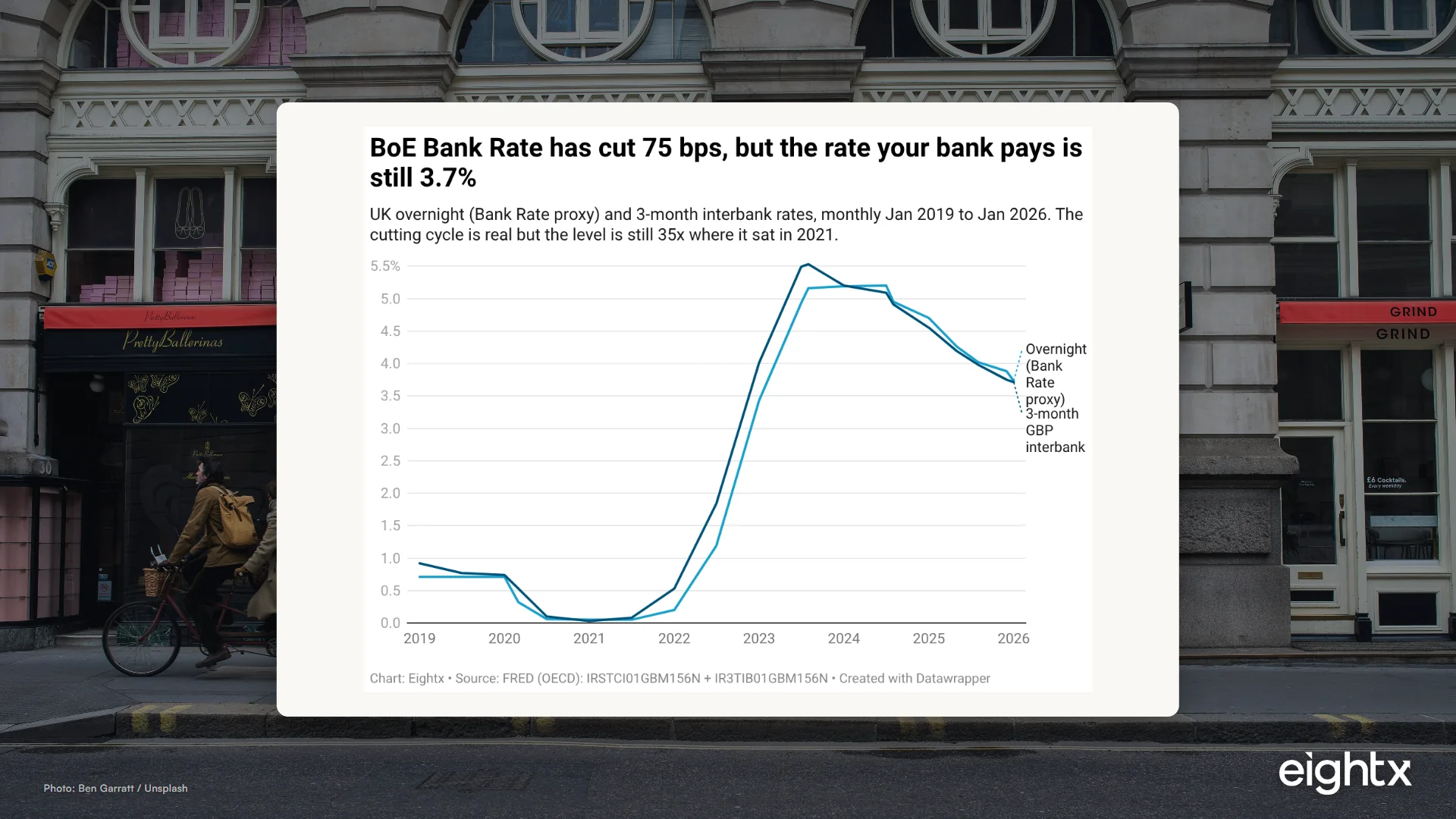
The line chart shows UK overnight (a clean Bank Rate proxy) against 3-month interbank GBP, monthly from January 2019. Both peaked around 5.2 to 5.5 percent in mid-2023 and have declined together, with 3-month interbank tracking slightly lower than overnight as 2026 cuts get priced in. The current level (3.71 to 3.73 percent) is still vastly above where it sat in 2021, when overnight was 0.05 percent (the cleanest cycle-trough-to-current comparison available).
| Meeting | Decision | New Bank Rate | Vote split |
|---|---|---|---|
| 2025-05-08 | Cut -25 bp | 4.25% | 3-way split (2 voted -50, 2 voted hold) |
| 2025-08-07 | Cut -25 bp | 4.00% | not flagged |
| 2025-09-18 | Hold | 4.00% | 7-2 (2 wanted -25) |
| 2025-12-18 | Cut -25 bp | 3.75% | 5-4 (4 wanted hold) |
| 2026-02-05 | Hold | 3.75% | 5-4 (4 wanted -25) |
| 2026-03-19 | Hold | 3.75% | unanimous |
| 2026-04-30 | Hold | 3.75% | 8-1 (one wanted +25) |
The 5-4 splits and the April hike vote matter for any operator planning 2026 inventory purchases. The MPC is genuinely divided, which means a single CPI print can flip the path. Plan for a 3.50 to 4.00 percent Bank Rate band, not a point estimate.
The bank-loan layer: BoE Money and Credit data
The BoE Money and Credit statistical release is the single best UK data source on what banks are actually charging operating businesses, because it reports the effective interest rate on new business each month, not the stock rate.
November 2025: effective rate on new PNFC bank loans fell 13 basis points to 5.64 percent. January 2026: SME new-loan effective rate sat around 6.14 percent. Versus the current 3.75 percent Bank Rate, that is +189 bps for PNFC and +239 bps for SME, and the spread has barely narrowed through the cutting cycle.
Why the spread didn't collapse with the cuts: banks add a credit-risk margin on top of Bank Rate that reflects their funding costs, regulatory capital reserves and your specific default probability. When Bank Rate falls, the funding-cost component falls with it, but the risk-margin component is driven by your covenants and credit history, not by policy. So a 75 bps cut at the BoE passes through as roughly 50 to 60 bps off the new-loan rate, not the full 75.
For your business, the practical read: if you have a strong-credit, covenant-light relationship with HSBC, Barclays, NatWest or Lloyds, your renewal in 2026 should price 50 to 75 bps better than your 2024 origination. If you don't have a bank relationship at all (a common spot for sub-£5M DTC brands), the fintech stack is the only option, and the spread there is a different conversation.
The fintech stack: Wayflyer, Uncapped, YouLend, Liberis, iwoca
This is where most £1M to £10M UK Shopify brands actually fund inventory and ads. None of these lenders publishes a public price grid. Pricing is presented as factor rates and fixed fees on a per-deal basis, and the APR-equivalent depends on how fast you pay it back.
The chart ranks midpoint rates from Bank Rate up through fintech RBF and MCA. The visual gap from policy rate to the products you actually use is the entire point of this post.
| Capital product | Rate band (%) | Midpoint (%) | Typical advance (GBP) | Best for |
|---|---|---|---|---|
| BoE Bank Rate (policy benchmark) | 3.75 | 3.75 | reference only | reference only |
| BoE PNFC new-loan effective (Nov 2025) | 5.64 | 5.64 | reference only | reference only |
| BoE SME new-loan effective (Jan 2026) | 6.14 | 6.14 | £50k to £500k | strong-credit working capital |
| Asset finance (Clifton PF, 2024-25) | 6.87 to 15.04 | 11.0 | £25k to £500k | vehicles, equipment, fit-out |
| Wayflyer RBF (APR-equivalent) | 10 to 30 | 20 | £100k to £750k | Shopify inventory + ads |
| Uncapped RBF (APR-equivalent) | 12 to 40 | 26 | £50k to £1M | ecom growth working capital |
| iwoca term loan (APR) | 20 to 40 | 30 | £50k to £250k | fast unsecured top-up |
| Liberis MCA (APR-equivalent) | 20 to 45 | 32 | £50k to £250k | Shopify card receipts |
| YouLend MCA (APR-equivalent) | 25 to 50 | 37 | £25k to £500k | embedded checkout advance |
The advance-size column matters more than operators usually realise. A senior partner inside our team describes the typical UK Shopify deal as "ranges are going to be between 3 to 500" (£3k to £500k advances), scaling with monthly revenue. Wayflyer has become the named default in UK operator conversation the way Stripe became the default for payments.
Spread over Bank Rate: where the cuts went and where they didn't
The cleanest way to see how the BoE cutting cycle passed through to UK working capital is to plot the spread between each product and Bank Rate.
Bank loans price 189 to 239 basis points above Bank Rate. Asset finance runs 312 to 1,129 bps above. Wayflyer RBF clears 625 to 2,625 bps. Liberis and YouLend MCA push to 1,625 to 4,625 bps. The fintech spreads have not visibly narrowed through the BoE cuts, which is the cleanest evidence that Wayflyer/Uncapped/Liberis pricing is set by risk and competition, not by SONIA.
What this means for a £3M UK Shopify brand right now
Three practical reads.
Worked example: a £300k advance, three ways. If you need £300k for an inventory PO and ad spend over the next 9 months:
- Bank-backed term loan at 6.14 percent SME effective rate. Interest cost over 9 months is roughly £13.8k. Funds in 4 to 8 weeks if you have a covenant-ready package.
- Wayflyer RBF at a 1.10 factor over 9 months. Total fee is £30k, APR-equivalent roughly 18 to 22 percent. Funds in 24 to 72 hours. No covenant.
- iwoca term loan at 28 percent APR over 9 months. Interest cost roughly £63k. Funds in 24 to 48 hours.
The bank is roughly half the cost of Wayflyer and a fifth of iwoca, but it is only available if you can clear covenant and timeline. Most sub-£5M UK DTC brands cannot. When capital is this expensive, the cheapest money is the spend you avoid, which is why tightening your payables stack with the right AP automation tool earns its keep before you ever draw on a line.
Match the product to the cash cycle. Bank lines and asset finance are for capex and cash flow, not growth investment. Wayflyer-style RBF is designed for fast-payback inventory and ad spend (the lender takes a slice of your daily Shopify receipts and you pay it down in 6 to 12 months). MCA products are for emergency cash, not planned growth. The single biggest mistake we see is operators putting growth investment on MCA pricing because it funds fast and then strangling cash flow when daily remits eat their margin.
Avoid the cash-flow strangle from fast payback. From a 2025 founder conversation: "If you get Wayflyer, Shopify Capital, Clearco, whatever, you have to pay it back so quickly that it doesn't really help your cash flow." Bank lines and asset finance get used for cash flow; RBF gets used for growth investment that pays back the same period it borrows for. If you mis-match, you create the exact cash trap RBF is supposed to solve.
Bank Rate is at 3.75 percent. The all-in cost of capital for a typical £3M UK Shopify brand is somewhere between 15 and 25 percent depending on how much of your capital sits with banks vs. fintech. The BoE cutting cycle has shaved 50 to 75 basis points off your bank rate. It has done nothing for the majority of your working capital that sits with Wayflyer, Uncapped, Liberis or YouLend. Plan accordingly.
What we're watching
The next BoE decision is in June 2026. The market-implied path puts 1-2 cuts by year-end, taking Bank Rate to 3.00 to 3.25 percent. We are watching whether the April 2026 hike vote becomes a coalition of two or three in the June meeting (which would push the next cut into Q1 2027) or whether a soft CPI print pulls the next cut forward to August.
On the fintech side, we are watching whether any UK RBF or MCA lender publishes a public price grid. Multifi has been pushing this since 2024 and no major lender has moved. If one of Wayflyer, Uncapped or YouLend does publish in 2026, it will reset the transparency baseline for the entire market. We will refresh this page quarterly aligned to BoE Money and Credit release (next refresh: October 2026 after Q3 print).
For more on what UK operators should do about working-capital cost in 2026, see our virtual CFO services for UK ecommerce brands and the related fractional CFO services overview. For US-side cost-of-capital benchmarks, see Fed Funds vs DTC cost of capital 2026.
Sources and methodology
Bank of England Bank Rate and MPC decisions. Compiled from the BoE Bank Rate database (bankofengland.co.uk/boeapps/database/Bank-Rate.asp) and individual MPC monetary policy summary pages from May 2025 through April 2026. Vote splits drawn from minutes summaries; dashes in our table mean the summary did not flag a notable split. Cross-checked against Trading Economics (April 2026 8-1 hold) and Equals Money economic-calendar forward dates.
BoE Money and Credit effective rates. Pulled from BoE statistical releases: November 2025 ("effective interest rate on new loans from banks to UK PNFCs decreased by 13 basis points, to 5.64 percent in November"), January 2026 SME series quoted at approximately 6.14 percent. Series sit in the CFMHSDE/CFMHSCQ family of effective rates on new sterling lending to PNFCs with the SME breakdown. These are origination rates, not stock rates, so they represent the rate on new business each month. Spread calculation uses the Bank Rate as of the period-end month.
Interbank rates (FRED). Pulled monthly observations January 2019 through April 2026 from two OECD-sourced series on FRED: IR3TIB01GBM156N (3-month or 90-day interbank rate, last point January 2026 at 3.71 percent) and IRSTCI01GBM156N (immediate / overnight call money rate, last point April 2026 at 3.73 percent). The overnight series tracks Bank Rate very closely (within a few bps once the rate corridor stabilised in 2020). The 3-month series is the closer proxy for what banks fund themselves at when lending to SMEs.
Asset finance bands. Clifton Private Finance, asset finance market commentary, 2024-25: "best asset finance rates on the market range between 6.87 percent and 15.04 percent per annum." This is a UK broker observation, not a BoE statistical series; we present it as a market-indicative band, not a precise mean.
Fintech / revenue-based / merchant cash advance pricing. None of Wayflyer, Uncapped, YouLend or Liberis publishes a public price grid in 2026. Pricing is presented as factor rates and fixed fees on a per-deal basis. Our ranges synthesise: (a) Multifi's 2026 "Transparency Gap in UK SME Finance" report which references factor rates of 1.10 to 1.30 and uses a 1.25 on £10k example for Liberis-style MCAs; (b) lender-published examples on Wayflyer.com and Clear.co; (c) founder-review aggregations from 2024 to 2026. APR-equivalents are calculated by treating the fee as a flat one-off cost and assuming 6 to 12 month payback (the typical Wayflyer / Uncapped tenor). Actual borrower APR is sensitive to repayment speed and can be materially higher than the stated band when sales are strong and repayment is fast.
Market-implied path. Forward path summarised qualitatively from JP Morgan Asset Management's split-MPC note plus economic-calendar commentary aggregated by Equals Money, indicating 1-2 further cuts priced into 2026 and a 3.00 to 3.25 percent terminal. We do not represent the 3.00 to 3.25 percent as a precise SONIA OIS strip quote.
Limitations. BoE Bank Rate only changes at MPC dates, so a 2-decimal-place spread calculation depends on which day you snap the comparison; we use the period-end Bank Rate. "DTC" is editorial: the same fintech products are used by physical retailers and B2B distributors, and the ranges we cite are general-merchant ranges judged applicable to a UK Shopify operator at £1M to £10M revenue. Asset finance bands are broker observations, not BoE statistics; treat as illustrative.
Update cadence. This page is a living index, refreshed quarterly aligned to BoE Money and Credit releases (January, April, July, October). Next refresh: October 2026 after Q3 BoE print and Q3 fintech pricing scan.
Frequently asked questions
what is the bank of england base rate today and is it still going down?
The Bank Rate is 3.75 percent as of June 2026, held flat at three consecutive MPC meetings in 2026 (February 5-4 split, March unanimous, April 8-1). Markets price 1-2 more cuts by year-end, taking Bank Rate to a 3.00 to 3.25 percent terminal area, but the votes have been close and one April member voted for a hike.
if base rate is 3.75% why is my business loan still 7%?
Banks add a credit-risk margin on top of Bank Rate that covers their funding costs, capital reserves and your default probability. BoE Money and Credit data shows effective new-loan rates to UK SMEs sat at 6.14 percent in January 2026, which is +239 bps over the current 3.75 percent Bank Rate. The spread has not collapsed with the cuts because the risk margin is driven by your covenants and credit history, not the policy rate.
what is the actual cost of capital for a uk dtc brand right now?
It depends entirely on which product you use. Strong-credit bank facilities sit around 6 percent. Asset finance is roughly 7 to 15 percent. Wayflyer and Uncapped revenue-based finance translates to 10 to 30 percent APR-equivalent. Liberis and YouLend merchant cash advance products land at 20 to 50 percent APR-equivalent. The all-in stack for a typical £3M Shopify brand using a blend of these sits at a weighted average of 15 to 25 percent, far above Bank Rate.
how does wayflyer pricing compare to a bank loan in 2026?
On a £300k advance over 9 months, a Wayflyer deal at a 1.10 factor costs you £30k in fees, which annualises to roughly 18 to 22 percent depending on repayment speed. A bank-backed term loan of the same size at the 6.14 percent SME rate would cost roughly £13.8k in interest over 9 months. The bank is cheaper, but only if you can clear covenant and timeline; Wayflyer funds in 24 to 72 hours.
what is a factor rate and what is the apr equivalent?
A factor rate is a single multiplier (e.g. 1.10) applied to the advance amount. A £100k advance at 1.10 factor means you pay back £110k regardless of how long it takes. The APR equivalent depends on payback speed: a 1.10 factor over 12 months is roughly 11 percent APR, over 6 months it is roughly 21 percent. Multifi argues APR is the honest comparison; lenders prefer factor because it is easier to quote in a sales call.
how much can a 3m revenue uk shopify brand borrow from wayflyer or uncapped?
Wayflyer typical UK advances run £100k to £750k for a £1M to £10M revenue brand. Uncapped goes higher, £50k to £1M. YouLend sits at £25k to £500k. Liberis is similar at £50k to £250k. Term loans from iwoca run £50k to £250k. None of these lenders publishes a public price grid in 2026, so the actual rate you get depends on your last 12 months of revenue, blended margin and Shopify payments data.
did boe rate cuts pass through to ecommerce fintech lenders?
No. The 75 bps of cuts from May to December 2025 mapped directly into BoE effective bank-loan rates (PNFC peaked around 5.8 percent mid-2025 and fell to 5.64 percent by November). Wayflyer, Uncapped, YouLend and Liberis pricing has not visibly moved. The Multifi 2026 transparency report flags this gap as a structural feature of fintech pricing: factor rates are set by risk and competition, not by SONIA.
when will the bank of england cut rates again?
Market-implied path puts the next cut in Q3 or Q4 2026, with 1-2 cuts priced by year-end and a terminal Bank Rate of 3.00 to 3.25 percent. The April 2026 vote split (8-1 with one member voting for a hike) shows the MPC is genuinely divided, so any sharper-than-expected CPI print could push the next cut into early 2027. Plan your 2026 capital decisions to a Bank Rate band of 3.50 to 4.00 percent, not a point estimate.