
Financial Strategy
Virtual CFO services UK 2026: what £3,000-£10,000/month buys an ecommerce or DTC brand
UK virtual CFO services cost 3,000 to 10,000 pounds per month in 2026, compared to 300,000 to 400,000 pounds all-in for a year-one full-time hire. For 1M to 30M pound ecommerce and DTC brands, the fractional model delivers the same cash forecasting, margin analysis, and investor-ready reporting at 10 to 30 percent of the full-time cost.
Key Takeaways
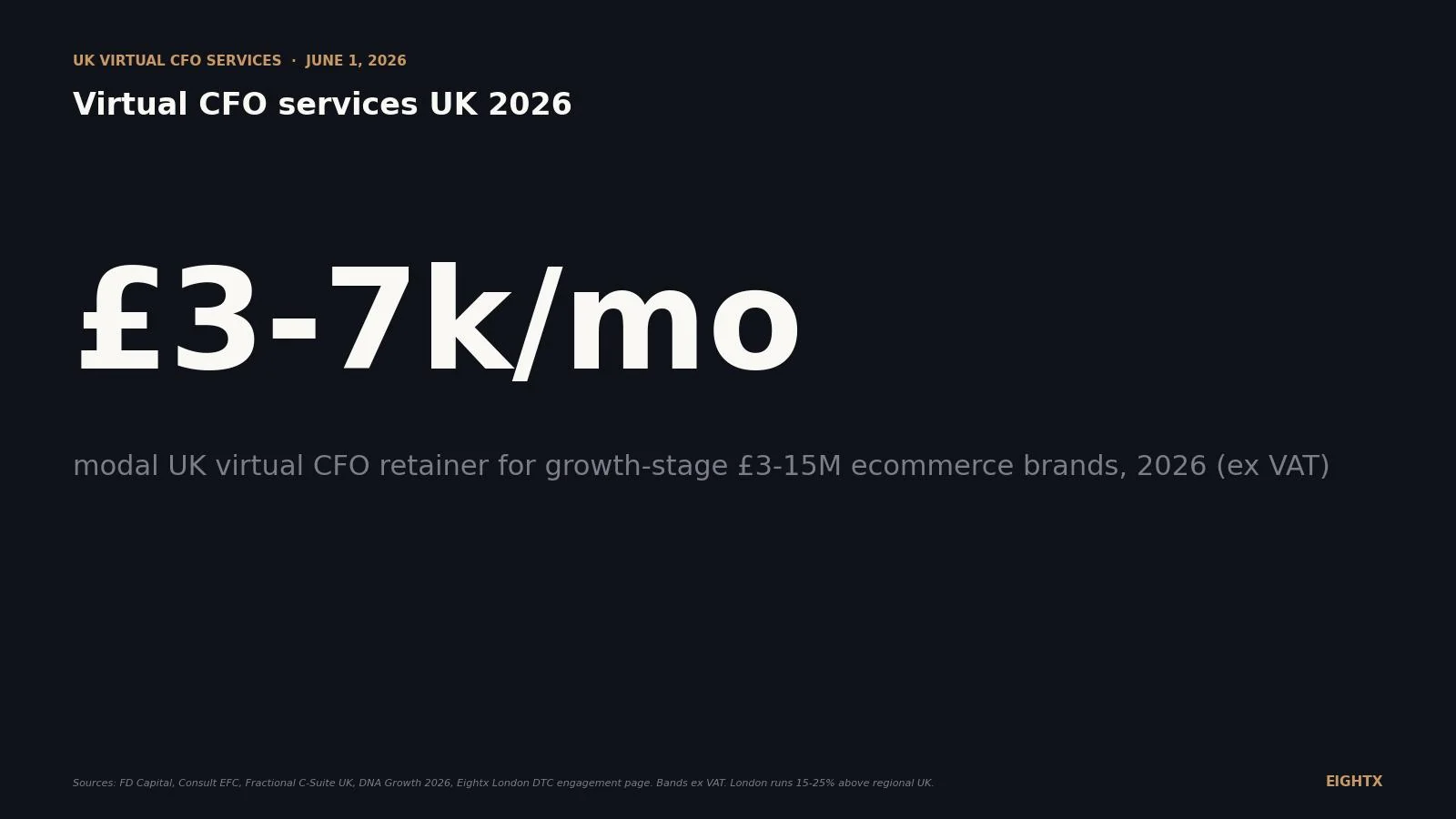
- UK virtual CFO retainers in 2026 cluster at £3,000-£7,000 per month for growth-stage £3-15M ecommerce brands, with light-touch under-£1M engagements at £2,000-£3,500 and PE-backed complexity at £7,000-£12,000+. All figures ex VAT.
- A full-time UK CFO costs roughly £300,000-£400,000 year-one all-in at the £3-30M revenue band (base plus 18-22% employer on-costs, STI at target, and a 30% retained-search fee on first-year total cash compensation). Year-two recurring drops to roughly £270,000-£320,000 once the one-off search fee rolls off. That's 3-4x the virtual annual cost across the same revenue range.
- The Bank of England Bank Rate is 3.75% (30 April 2026 decision, held), but the UK 10-year gilt yield rose to 4.82% in April 2026 from a 3.91% trough in September 2024. Your working-capital cost is still higher than 2022 even as the headlines say rates are easing.
- 27.3% of UK retail is online (ONS J4MC, April 2026), structurally above the US. UK Shopify alone has 251,169 active stores and 6,233 on Shopify Plus (Storeleads, accessed 2026-06-01). Your TAM as a UK DTC operator is durable, but VAT, MTD and ECCTA admin scale with it.
- The accountant files VAT, MTD and CT600. The CFO designs the system around them. Crossing the £90,000 VAT threshold, MTD for Income Tax phase-in from April 2026, and the 25% corporation tax band above £250,000 profit all sit in CFO scope as design and stress-test items, not filings.
If you run a UK ecommerce or direct-to-consumer (DTC) brand between £1M and £30M in revenue, the same finance problem keeps landing on your desk. Value Added Tax (VAT) crosses the £90,000 threshold and the cash dynamics change. Gross margin moves the wrong way under a Bank of England Bank Rate that's eased to 3.75% but a UK 10-year gilt yield that's risen to 4.82%. The bookkeeper can model the books but can't model the next 18 months.
A full-time UK Chief Financial Officer (CFO) costs roughly £300,000 to £400,000 year-one all-in at mid-market scale once base salary, employer National Insurance, pension, holiday accrual, Short-Term Incentive (STI) bonus at target and a retained-search fee on first-year total cash compensation are stacked on (the full-time CFO base bands cited below synthesise registration-gated 2026 UK salary guides; see methodology). Year-two recurring drops to roughly £270,000 to £320,000 once the one-off search fee rolls off. A virtual or fractional CFO covers the same strategic scope (forecasting, cash, gross-margin diagnostics, fundraising prep, board reporting) for £3,000 to £10,000 per month in London and £2,500 to £7,000 in regional UK. The question isn't whether virtual is cheaper. It almost always is until you cross around £30M revenue. The question is what scope you should expect, which UK regulatory items belong in CFO scope versus accountant scope, and how to evaluate fit before signing the retainer. This is the canonical UK answer.
What a UK virtual CFO actually does for an ecommerce brand
A virtual CFO is a senior finance leader who serves your brand on a monthly retainer rather than as a full-time employee. For a UK ecommerce or DTC brand, the core scope covers six things: rolling 13-week cash forecast, monthly board pack with KPI commentary, gross-margin and contribution diagnostics by SKU or channel, ad-spend stress test against the budget, fundraising or lender support, and senior partner attendance at one weekly leadership meeting.
It is not bookkeeping, VAT filing or year-end accounts. Those sit with your accountant or controller. Confusing the two is the single most common reason UK founders feel their CFO retainer isn't pulling its weight. The bookkeeper records what happened. The CFO designs what should happen next and stress-tests it against cash.
In practice, the UK virtual CFO market splits into three rough delivery models: solo senior practitioners (often ex-Big-Four or ex-FD), boutique firms with a named partner plus an analyst (Eightx sits here), and large multi-client agencies. All three publish in the £2,000-£12,000+ per month band depending on revenue stage and complexity. The differences show up in scope depth, weekly cadence and named-senior availability, not in headline rate.
When to hire one (the operator signals, not the revenue threshold)
The revenue number is the wrong trigger. Operator signals are the right trigger, and three of them dominate.
You've crossed the £90,000 VAT threshold and cash feels tighter than top-line implies. VAT changes the rhythm of your working capital. You collect VAT on every sale and remit quarterly, but the gap between collection and remittance can mask a real cash hole if your inventory cycle isn't aligned. A virtual CFO models this with a 13-week cash forecast that nets VAT in and out, and adjusts your ad-spend or purchase cadence around the quarterly payment.
Your gross margin moved 200 basis points the wrong way and you can't isolate why. This is the most common signal we see at Eightx. The drop usually isn't one driver. It's a mix of mix shift (lower-margin SKUs taking share), promotional intensity, freight, FX on landed cost, and 3PL pick-pack creep. Untangling it needs a contribution-margin view by SKU and channel that bookkeeping records don't produce.
You're raising or refinancing in the next 6 to 12 months. UK VC and lender diligence in 2026 is more rigorous than it was in 2021. A credible data room, a 3-statement model, a defensible CAC and contribution view, and a clean cash forecast are table stakes. Building this against a deal calendar takes 6 to 12 weeks of CFO time. Starting at the term-sheet stage is too late.
The UK macro context backs this up. ONS J4MC shows 27.3% of UK retail sold online in April 2026, up from 26.8% in January 2025. The UK is structurally one of the most online retail economies in the world. Your TAM is durable. But it's also a TAM that operates under VAT, MTD for Income Tax (phasing in from April 2026), Plastic Packaging Tax, EORI for cross-border, and ECCTA director-verification compliance. The admin scales with the opportunity.
What it costs in 2026: London vs regional UK, by revenue stage
UK virtual CFO retainers in 2026 published market data cluster like this.
The chart shows the published low and high of each band. The modal range for an embedded growth-stage UK ecommerce brand is £3,500-£7,000 per month. London runs roughly 15-25% above regional UK for equivalent seniority.
Revenue stage Typical monthly retainer (London) GBP Days per month Core scope Pre-£1M / pre-funding £2,000-£3,500 1-2 Cash forecast, fundraise narrative, 13-week cash £1-3M (early growth) £3,000-£5,000 2-3 Driver model, VAT cash timing, unit economics £3-10M (embedded growth) £3,500-£7,000 3-5 Monthly board pack, GM diagnostics, ad-spend stress test £10-30M (multi-channel) £5,000-£10,000 5-8 Multi-entity consolidation, EU VAT, treasury £30M+ (complex / PE-backed) £7,000-£12,000+ 8-12 Lender management, M&A prep, KPI architecture
Two notes for UK operators. First, all UK virtual CFO retainers we cite are ex VAT. Add 20% if you're not VAT-registered or if your VAT recovery position doesn't fully cover the input. Second, hourly billing outside a retainer in 2026 sits at £110-£400 UK-wide, £130-£500 in London for senior fintech or Private Equity (PE) specialists, with day rates of £700-£1,500 mainstream and up to £900-£3,200 at the top of the London market.
Virtual CFO vs full-time CFO: the actual math
The published market view of UK full-time CFO base salary in 2026 looks like this: seed and early-stage £80,000-£120,000, growth and scaleup £120,000-£180,000, mid-market £160,000-£250,000, and large or listed £250,000-£400,000+. The Hays UK Salary Guide 2026, Robert Half UK Salary Guide 2026, Michael Page UK 2026 and Marks Sattin guides are all registration-gated as of June 2026. The bands above synthesise the published market view via Scale with CFO and HarperMay.
Now stack the year-one costs the offer letter doesn't show. Employer National Insurance is 13.8% above the secondary threshold (£175 per week, £9,100 per year, 2026/27). Statutory pension auto-enrolment minimum is 3%. Holiday accrual proxy is 12.07%. The Apprenticeship Levy adds 0.5% on UK payrolls above £3M after a £15,000 allowance. Total employer on-costs land at approximately 18-22% of base. A mid-market £200,000 base CFO plus 30% STI at target plus a 30% retained executive-search fee on first-year total cash compensation puts year-one all-in at £395,284 in our worked example below (year-two recurring drops to £317,484 once the one-off search fee rolls off).
The pattern holds at every revenue band. At £1-3M, full-time runs roughly 3.75x the virtual cost. At £30-100M, it's still 2.7x. The gap narrows with complexity but rarely closes before £30M revenue or a PE-backed transaction calendar.
Cost component Amount (GBP) Note Base salary (mid-market midpoint) £200,000 Synthesised UK market view, 2026 Employer National Insurance (13.8% above £9,100) £26,344 HMRC employer NI rate 2026/27 Employer pension (3% auto-enrolment minimum) £6,000 Statutory floor; many CFOs negotiate 5-10% Holiday accrual (12.07% statutory proxy) £24,140 Cash-equivalent of statutory leave Apprenticeship Levy (0.5% above £3M payroll) £1,000 Company-wide, not CFO-attributable; included only if total UK payroll exceeds £3M STI bonus at 30% target £60,000 Target; actual depends on plan outcome Retained executive-search fee (30% of TC) £77,800 One-off year-one cost, base + STI Year-one total cash cost £395,284 Excludes onboarding ramp productivity loss Year-two recurring (no recruitment fee) £317,484 Cash-out basis
The virtual CFO equivalent at £3-10M revenue: 12 months at the £5,250 midpoint of the £3,500-£7,000 band equals £63,000 annual cost. At £10-30M revenue: 12 months at £7,500 midpoint equals £90,000. The pricing gap is structural because the scope and availability gap is structural. A full-time CFO gives you 40+ hours a week and direct management of the finance team. A virtual CFO gives you 3-8 days a month of senior strategic input and lets your existing controller or bookkeeper do the execution.
What sits in CFO scope vs accountant scope in the UK (2026 regulatory map)
This is the question UK founders get wrong most often. The CFO doesn't file your VAT. The CFO designs the system that decides when to register, how to time inventory purchases against quarters, and how to stress-test cash if MTD-ITSA changes the records workflow from April 2026. The filings sit with the accountant or bookkeeper.
Item 2026 threshold / rate Who designs it (CFO) Who files it (accountant / bookkeeper) VAT registration £90,000 turnover (from 1 April 2024) CFO models cash timing Bookkeeper or accountant files quarterly returns Making Tax Digital for Income Tax Over £50k from April 2026, over £30k April 2027, over £20k April 2028 CFO designs records system Bookkeeper files quarterly updates Corporation Tax 19% small profits, 25% main, marginal relief £50k-£250k CFO models effective rate Accountant files CT600 R&D tax relief Merged scheme from 1 April 2024 CFO scopes eligibility and cash impact R&D specialist files the claim Plastic Packaging Tax 10 tonnes per 12 months trigger CFO tracks threshold and cost model 3PL or compliance lead files EORI (post-Brexit imports / exports) GB EORI required for non-UK trade CFO factors landed-cost model Customs broker or import agent files Companies House ID verification (ECCTA 2023) Phased 2024-2026 CFO ensures governance compliance Company secretary or director files
For a UK ecommerce brand growing through £1M, £5M and £10M revenue, the regulatory load roughly doubles at each gate. The CFO's job is to anticipate the gate, design the workflow before you cross it, and price the cash impact into your forecast. Your accountant then executes the filings cleanly because the system was designed two quarters ahead, not retrofitted under deadline pressure.
The cost-of-capital backdrop most UK founders are mispricing in 2026
The headline says rates are easing. The Bank of England held Bank Rate at 3.75% at the 30 April 2026 decision, down from a 5.25% peak in 2023-2024. The next decision is 18 June 2026. But the working-capital cost most UK operators actually pay is closer to the gilt curve, and that's gone the other way.
The UK 10-year gilt yield was 3.91% in September 2024. It rose to 4.82% by April 2026. The cost-of-capital gap between policy rate and long-end has widened even as Bank Rate has eased. For a DTC brand, that gap shows up in your inventory financing, your revenue-based finance facility, your trade-credit insurance and your asset-backed lending margin. None of these reprice off Bank Rate cleanly. They reprice off a blend of Sterling Overnight Index Average (SONIA), gilt yield and a credit spread that hasn't tightened.
A virtual CFO's job at this point in the cycle is to model the right cost of capital into your inventory cycle, your ad-spend payback period and your cash conversion cycle. Using Bank Rate as your cost-of-capital input understates the hurdle rate your business actually faces by roughly 100 basis points (the April 2026 gap between the 3.73% UK interbank proxy and the 4.82% 10-year gilt yield is 109bps, and most working-capital facilities sit somewhere along that curve). That's the difference between an ad-spend ROAS that looks profitable and one that actually clears its capital cost.
The UK cost-of-capital story in 2026 is not "rates are coming down." It's "policy rate is down 150 basis points, the long end is up 90 basis points, and your working-capital cost is somewhere in between." A virtual CFO models that gap. A bookkeeper records the interest expense after the fact.
How to evaluate an Eightx UK engagement (or any UK virtual CFO)
Five questions cover most of the fit risk. Run them in your first conversation with any UK fractional or virtual CFO before signing the retainer.
Who specifically is on my account each week, named. The honest answer is one senior plus zero, one or two supporting analysts or controllers. A vague "the team" is a flag. At Eightx, a named senior partner is on every account.
Show me a redacted weekly board pack. Ask for a real artefact. A two-page summary plus a six-page detail pack is the modal good answer. KPI commentary, 13-week cash, gross-margin bridge and a single P0 decision item should all appear. If the sample looks like a templated dashboard with no commentary, the engagement will produce the same.
How do you handle UK-specific items. Specifically: VAT cash timing, MTD-ITSA records workflow from April 2026, R&D merged-scheme eligibility, and post-Brexit EORI implications for your supply chain. A UK-experienced CFO can answer these in plain English in 60 seconds each. A US-only CFO can't.
Notice period and rollover. 30 days notice with no auto-rollover is the UK standard for a high-quality engagement. 90 days notice or auto-renewal lock-in is a flag. Quality providers keep retention by delivering value, not by contract structure.
What does success look like in the first 90 days. A crisp answer here is the strongest fit signal. The right answer for a UK growth-stage brand: 13-week cash forecast operating, monthly board pack delivered, one gross-margin or ad-spend stress-test workstream in flight, and at least one finance-team or accountant-workflow improvement shipped. If the answer is generic ("we'll get to know your business"), the engagement will be too.
For UK-specific finance context beyond this page, our interim CFO services overview covers the temporary-employee variant, and the outsourced CFO services for ecommerce breakdown covers the full-stack finance team model for brands that need bookkeeping plus controller plus CFO in one provider.
Sources and methodology
UK virtual CFO retainer benchmarks. Triangulated from FD Capital (fdcapital.co.uk/virtual-cfo/), Consult EFC SaaS Fractional CFO guide (consultefc.com/saas-fractional-cfo-cost-uk/), Fractional C-Suite UK rates (fractional-csuite.com/cfo/uk/), DNA Growth 2026 practical guide, and the Eightx London DTC fractional CFO page. All figures ex VAT. London runs roughly 15-25% above regional UK for equivalent seniority across all six sources.
UK full-time CFO base salary projection. The Hays UK Salary Guide 2026, Robert Half UK Salary Guide 2026, Michael Page UK 2026 and Marks Sattin 2026 guides are registration-gated as of June 2026. The bands cited synthesise Scale with CFO (scalewithcfo.com/post/cfo-salary-uk) and HarperMay London 2026 (harpermay.com/blog/cfo-salary-london-2026-guide-for-companies-hiring-a-cfo-655), which themselves cross-reference the gated guides plus PayScale UK and Indeed UK self-reported data. The published market view is the most current 2026 view available.
UK employer on-costs. Employer National Insurance at 13.8% above the secondary threshold (£175 per week, £9,100 per year, 2026/27) per HMRC. Statutory pension auto-enrolment minimum 3% per The Pensions Regulator. Apprenticeship Levy at 0.5% on UK payrolls above £3M after a £15,000 allowance. Holiday accrual at 12.07% statutory proxy per gov.uk. Aggregated uplift over base salary lands at 18-22% before any STI bonus.
Retained executive-search fees. 30-33.3% of first-year cash compensation is the modal range across TGS Executive Search (tgsus.com/executive-search-blog/executive-search-fees-search-firm-pricing/), Cowen Partners and CFO-Search. Some boutiques quote 25% on the low end and 35% on the high end. For a £200,000 base plus £60,000 STI mid-market CFO, the retained fee at 30% of total cash compensation is approximately £78,000.
UK macroeconomic context. Bank of England Bank Rate at 3.75% per the 30 April 2026 decision (next decision 18 June 2026). UK 10-year gilt yield at 4.82% in April 2026 from FRED series IRLTLT01GBM156N. UK call money or interbank rate proxy at 3.73% in April 2026 from FRED IRSTCI01GBM156N. UK internet retail share at 27.3% in April 2026 per ONS J4MC, up from 26.8% in January 2025.
UK Shopify landscape. Storeleads (storeleads.app) returned 251,169 active Shopify storefronts in GB and 6,233 on Shopify Plus when filtered by platform=shopify&country=GB on 1 June 2026, plus 183,037 WooCommerce GB stores for comparison. The 2.5% Shopify Plus rate in the UK runs above the global Plus rate of approximately 1.5%, suggesting a UK overweight on Plus-tier brands.
UK regulatory items. VAT registration threshold of £90,000 from 1 April 2024 per HMRC. Corporation Tax 19% small profits, 25% main rate, marginal relief between £50,000 and £250,000 per gov.uk. MTD for Income Tax phasing per the ATT MTD FAQ: over £50,000 qualifying income from April 2026, over £30,000 from April 2027, over £20,000 from April 2028. Plastic Packaging Tax 10 tonnes per 12 months trigger per HMRC. ECCTA 2023 Companies House director identity verification phased across 2024-2026.
Triangulation layer. Pinecone search across the Eightx 5,400+ founder-call library returned 19 unique segments on UK CFO hiring, Shopify cash flow, VAT and HMRC pain, and fractional vs full-time decision points. All client references in this post are anonymised. Perplexity Sonar Pro deep research completed seven queries on UK CFO pricing, salary guides, employer on-costs and retained-search fees on 1 June 2026.
Update cadence. This page is refreshed quarterly when new UK salary-guide editions land and when the Bank of England updates the policy rate. Next refresh target: September 2026, after the August 2026 Monetary Policy Committee decision.
Frequently asked questions
how much does a virtual cfo cost in the uk per month in 2026?
Most growth-stage UK ecommerce engagements sit at £3,000-£7,000 per month ex VAT in 2026. Pre-£1M and light-touch advisory runs £2,000-£3,500 per month. PE-backed or multi-country complexity runs £7,000-£12,000+ per month. London rates are roughly 15-25% above regional UK for equivalent seniority.
what's the difference between a virtual cfo, fractional cfo and outsourced fd in the uk?
In UK practice the three terms overlap almost completely. Virtual CFO and fractional CFO are used interchangeably and describe a senior finance leader who serves multiple clients on a retainer. Outsourced FD (Finance Director) is the older UK term and sometimes implies a more controller-heavy scope, but most modern UK providers use Virtual CFO or Fractional CFO. The scope you actually get depends on the provider, not the label.
when should a uk shopify brand hire a virtual cfo?
Three operator signals usually trigger it. You've crossed the £90,000 VAT threshold and cash feels tighter than top-line implies. Your gross margin moved 200 basis points the wrong way and you can't isolate the driver. Or you're raising or refinancing in the next 6 to 12 months and need a credible model. Most UK Shopify brands cross at least one of these between £1M and £3M revenue.
is a virtual cfo cheaper than a full-time cfo for a uk ecommerce brand?
Almost always, until you cross roughly £30M revenue or take on PE-backed complexity. A full-time UK CFO at a £200,000 base lands at roughly £300,000-£400,000 year-one all-in once 18-22% employer on-costs, STI at target and a 30% retained-search fee on first-year total cash compensation are stacked on. Year-two recurring drops to about £270,000-£320,000 once the one-off search fee rolls off. A virtual CFO at the same scope sits at £48,000-£90,000 annual cost. The gap closes as revenue and complexity rise but rarely flips before £30M.
does a uk virtual cfo handle vat, mtd and hmrc filings or is that the accountant?
The accountant or bookkeeper files VAT, MTD updates and the CT600. The CFO designs the system around them: when to register, how VAT timing hits cash, how MTD for Income Tax from April 2026 changes the records workflow, and how the 19%/25% corporation tax bands affect your effective rate as you scale. Filings sit with the accountant, system design sits with the CFO.
can a virtual cfo help me raise from a uk vc or get bank financing in 2026?
Yes, and it's one of the engagements where the spend pays back fastest. A UK virtual CFO typically owns the data room, the 3-statement model, the cash forecast and the lender or VC narrative. Most UK virtual CFOs come from a mix of corporate finance, audit and operator backgrounds, and many work with lenders like Wayflyer, Outfund, Uncapped, Liberis or HSBC's growth-loan desk.
how do i evaluate a uk fractional cfo before signing the retainer?
Five questions cover most of the risk. Who specifically is on my account each week (named senior, not "the team"). What does your weekly board pack look like (ask for a redacted sample). How do you handle UK-specific items: VAT timing, MTD records, R&D merged scheme. What's your notice period and rollover (30 days is standard, 90 is a flag). And what does success look like in the first 90 days. If you don't get crisp answers on the first call, that's the answer.
do i need a uk-based virtual cfo or can i use a us or international one?
A UK-based or UK-experienced CFO is materially better for any brand with UK VAT exposure, MTD obligations, R&D claims or post-Brexit EORI complexity. A US-only CFO will be excellent on unit economics and ad spend but will miss the VAT cash-timing math, the corporation-tax marginal-relief band, and the MTD-ITSA rollout. Eightx works on both sides of the Atlantic for this reason. If your brand sells into the UK but is US-headquartered, a US CFO plus a UK-experienced advisor on retainer is usually the right shape.