
Insights
Dext vs Hubdoc 2026: which receipt capture tool actually accelerates your monthly close
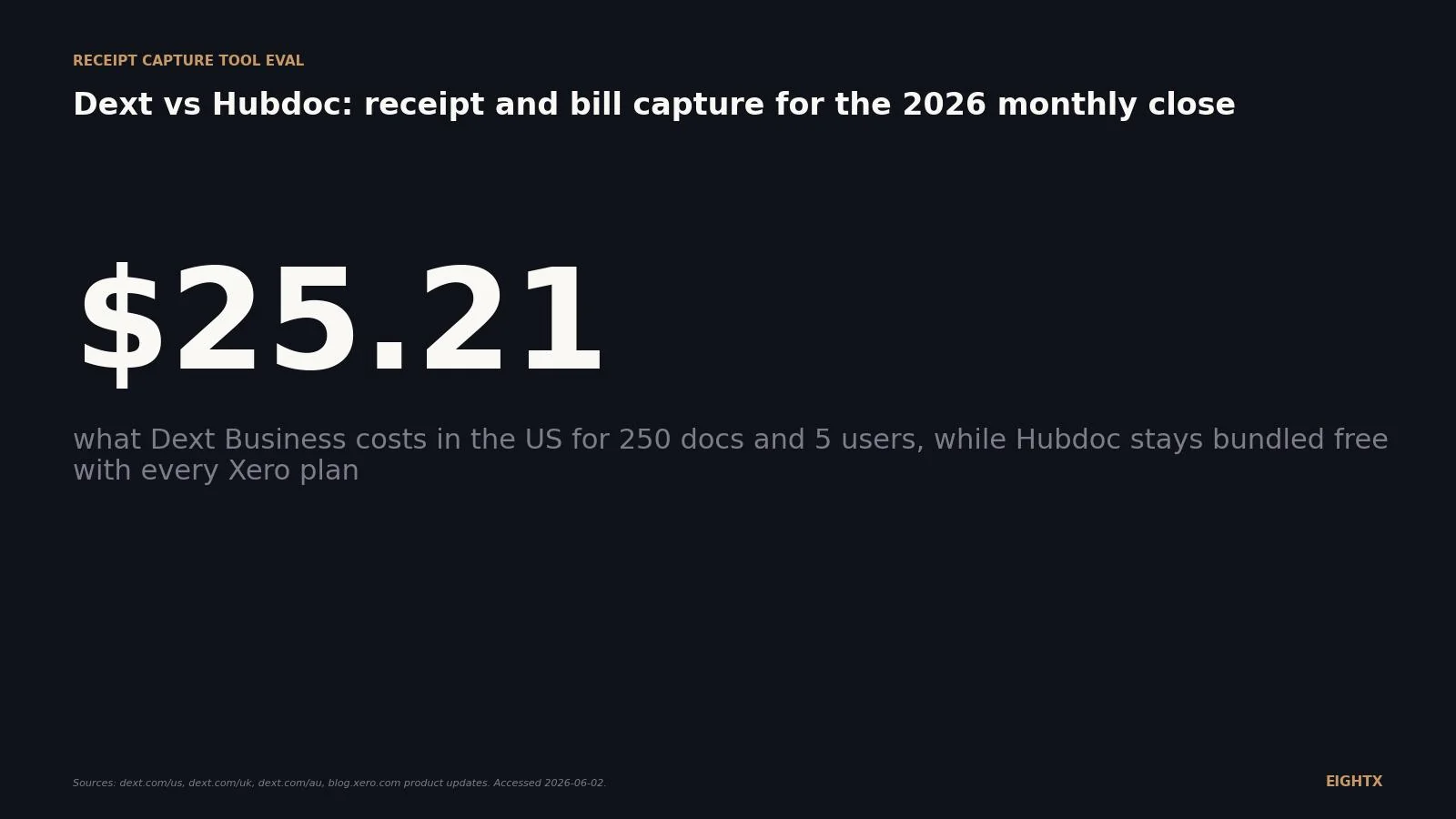
Dext Business starts at $25.21 per month in the US while Hubdoc is bundled at no extra cost inside a Xero subscription, making Hubdoc sufficient for most brands under $3M with clean, document-light AP workflows. Dext earns its premium for ecom brands with high supplier-invoice volume, multi-currency purchasing, or teams where automated fetch from supplier portals meaningfully cuts close time.
Key Takeaways
- Dext Business starts at USD $25.21 per month for 250 documents and 5 users in the US. The UK entry plan is the priciest in USD terms at about $30.50 once you convert from GBP 24.17, and Australia is the cheapest at about $21.80 (AUD 33.58).
- Hubdoc is bundled free in every Xero Business plan. No standalone subscription, no published per-document cap, no separate seat license. The constraint flows from your Xero plan tier, not from Hubdoc itself.
- Hubdoc retired its bank and utility auto-fetch on 27 June 2022. What used to pull from 700-plus institutions is now zero, with no replacement product launched in four years. If you needed fetch, you already left.
- Dext sells line item, bank statement, and supplier statement extraction as metered credits. Hubdoc has no metered line item product. For 3PL freight invoices, Amazon FBA fee statements, and ad platform SaaS receipts, that gap is where the $25 per month actually pays back.
- Decision rule: under $3M revenue on Xero with simple AP, stay on Hubdoc. QuickBooks Online stack, multi-entity, or 500+ bills per month, switch to Dext. Everything in between is a judgment call against your bookkeeper's hourly rate.
Receipt and bill capture used to be a one-decision tool category for ecommerce finance teams. Hubdoc came free in Xero, so you used Hubdoc. Then Xero bought Hubdoc in 2018, retired the auto-fetch in 2022, quietly stopped promoting the QuickBooks Online integration, and never replaced the fetch product. Dext kept building. In 2026 the choice between the two is no longer just about price. It is about which set of ecom-specific bills your tool can actually code without your bookkeeper opening every PDF.
This is the comparison for direct-to-consumer (DTC) and ecommerce operators sitting at $1M to $50M in annual revenue, with the close-acceleration math written in plain bookkeeper hours, not vendor marketing.
The 30 second answer for ecom operators
Use Hubdoc if you are on Xero, under $3M in annual revenue, processing fewer than 200 bills per month, and your AP is mostly recurring SaaS plus a handful of suppliers with stable category codes. Hubdoc captures the receipt, pushes the bill to Xero, and your bookkeeper takes 90 seconds per item to code and reconcile.
Use Dext if any one of these is true: you are on QuickBooks Online (QBO), you process more than 500 bills per month, you run multiple entities (US Inc plus AU Pty plus UK Ltd is the classic cross-border ecom shape), or your invoices need line item coding (3PL pick-pack-storage breakdowns, Amazon Seller Central fee statements, freight bills with fuel surcharges).
Everything in between is a judgment call. The cleanest test is this: take five of your most painful invoices from last month (the ones your bookkeeper had to manually split), and ask yourself whether the Dext line item credits would have saved more time than they cost. If yes, switch.
Pricing reality: free is not really free
Hubdoc is bundled free in every Xero Business plan since 2018. There is no separate subscription, no document cap published on the Xero pricing page, no seat license. What you actually pay for is your Xero plan: Starter, Standard, or Premium. Hubdoc sits inside that.
Dext Business is the entry plan most ecom brands land on. In the US it lists at USD $25.21 per month for 250 documents and 5 users. In the UK the same plan is GBP 24.17 per month, which converts to roughly USD $30.50 at June 2026 indicative FX. In Australia it is AUD $33.58 per month, about USD $21.80 converted. Same product, three different prices once you control for currency.
The Dext partner tier is a separate price grid for accountants and bookkeepers running multiple client organizations. There are only two named tiers on the public partner pricing page (Essentials and Advanced) despite occasional third-party references to a "Pro" tier. Advanced adds team and location setup, custom workflows, advanced automation, and practice insights on top of Essentials.
Dimension Dext Business (entry) Hubdoc (with Xero plan) Monthly cost (US) USD $25.21 USD $0 (bundled) Documents per month 250 (then extraction stops) Not published / Xero plan governed Users included 5 Per Xero plan Annual cost (US) USD $302.50 USD $0 Overage Buy credits or upgrade tier N/A Accounting integrations Xero, QBO, Sage, Zoho Xero (QBO legacy, not promoted)
The price gap is misleading on its own. Hubdoc looks free, but the free version only does what it does (header level extraction and Xero publishing). Dext costs $25 a month, but the question is whether the line item, bank statement, and supplier statement extraction Dext adds clears the $300 per year in bookkeeper time saved. For a $10M brand pushing 800 bills a month through a 3PL with line item complexity, that math clears in the first week.
What Hubdoc lost (and why it matters for ecom)
Hubdoc shipped two product changes in the past four years that quietly reduced its scope.
The bigger one: the standard auto-fetch product, which used to pull bills and statements from 700-plus banks and utility providers, closed to new connections on 31 January 2022 and fully retired on 27 June 2022. Existing connections stopped fetching. No replacement fetch product has launched in the four years since.
For ecom brands this matters in two specific places. First, you used to be able to point Hubdoc at your Stripe, Shopify Payments, Amazon Seller Central, and bank login, and it would pull the monthly statement automatically. That is gone. You now upload, or your bookkeeper does. Second, your utility bills (warehouse electricity, office internet, SaaS receipts that arrive in a vendor portal but not in email) used to pull on a schedule. Also gone. Both are now manual fetches into the Hubdoc inbox.
The smaller change is the QuickBooks Online integration. Hubdoc still technically connects to QBO, but Xero-owned product content (hubdoc.com, xero.com, blog.xero.com) no longer promotes it as a current integration. There is no formal deprecation notice. We treat it as legacy. If you run QBO and you bought Hubdoc for QBO publishing, you are working against the product roadmap.
The combined effect: Hubdoc in 2026 is a free, mobile-and-email document capture tool that publishes header-level data to Xero. It is no longer a fetch tool, no longer a multi-platform tool, and no longer a line item tool. That is fine if your AP volume is modest. It is a meaningful gap if your volume scales.
What you actually get with Dext
Dext is built around three things Hubdoc no longer does well: line item extraction, multi-entity workflows, and non-Xero integrations.
Line item extraction runs on a credit model. Each tier includes a credit allowance for line item, bank statement, and supplier statement extraction. When you exhaust the allowance, you either upgrade or buy overage. The way it works for an ecom brand is straightforward: you upload a 3PL invoice, Dext extracts header-level fields (vendor, date, total) for free, and you spend one credit to extract every billable line (pick fees, pack fees, storage, kit assembly, returns processing). The bookkeeper codes once at the line level instead of splitting a single bill into 12 GL entries manually.
Supplier rules are the second payback. You can set rules per supplier that auto-code categories, allocate to projects, attach to specific bank feeds, and route to approvers. Hubdoc has basic rules. Dext rules are deep enough that a brand with a stable supplier list (recurring ad platform SaaS, recurring 3PL, recurring software vendors) can reach near-zero touch coding within a month.
Multi-entity is the third. Dext partner Advanced supports team and location setup with cross-entity supplier rules and practice insights. For a brand running a US Inc plus AU Pty plus UK Ltd, that means one Dext login coordinates capture across all three books instead of three separate Hubdoc instances inside three separate Xero orgs.
Capability Dext Hubdoc Mobile capture Yes Yes Email-in Yes (per entity address) Yes Header data extraction Yes Yes Line item extraction Yes (metered credits) Limited, not metered Bank statement extraction Yes (metered credits) Limited Supplier statement reconciliation Yes (metered credits) No Supplier rules and auto-coding Deep Basic Bank and utility auto-fetch No (not the core product) Retired 2022-06-27 Xero publish Yes Yes (native) QBO publish Yes (first tier) Legacy, not promoted Multi-entity portal Yes (partner plans) Per organization Multi-currency Yes Yes (via Xero) Approval workflow Lightweight Lightweight Practice insights and analytics Advanced tier No
The ecom-specific stress tests
The matrix above is generic. Here is where each tool actually breaks for ecom operators.
3PL freight and pick-pack invoices. A typical mid-size 3PL invoice has 8 to 20 line items: receiving, putaway, storage by SKU, picks, packs, kit assembly, returns processing, freight surcharges. Hubdoc captures the header total. Dext captures the lines. If your COGS reporting needs SKU-level fulfillment cost attribution, Hubdoc forces a manual split every month. Dext does not.
Amazon Seller Central fee statements. The monthly fee statement is a multi-line document with referral fees, FBA fulfillment fees, storage fees, refund administration, advertising, and removals. Header-level capture (Hubdoc) puts the full balance in one GL line. Line item capture (Dext) splits it into the right cost categories. If you are running channel-level contribution margin reporting, this is the highest-payback single integration.
Ad platform SaaS receipts. Recurring Meta, Google, TikTok, and Klaviyo receipts arrive monthly with stable formats. Both tools handle these well via supplier rules. The Dext rules engine is meaningfully more capable, but Hubdoc rules clear the bar for a tidy recurring SaaS stack.
Multi-currency cross-border purchasing. Both tools support multi-currency. Both rely on Xero or QBO for the actual FX rate handling. The difference is in the partner plan layer: if you run a US Inc that imports from a UK supplier and pays in GBP, Dext Advanced lets you set cross-entity supplier rules so the same supplier coding applies in both books. Hubdoc treats each entity as a separate setup.
Supplier statement reconciliation. This is the unsung Dext feature. You can upload a supplier statement, Dext compares it against the bills already captured, and flags missing or duplicated bills. In our practice at Eightx, brands with a long supplier tail routinely surface missing or duplicated bills each month through this workflow (anecdotal operator pattern, not a benchmarked rate). Hubdoc does not do this.
Decision framework: when to upgrade, when to stay
The decision rule, in five rows:
Scenario Recommended tool Why Under $3M revenue, Xero, under 200 bills per month, simple AP Hubdoc Free, attached-to-Xero workflow is enough Xero, $3M to $10M, 500+ bills per month, 3PL plus ad-spend complexity Dext Line item plus supplier rules cut material bookkeeper time on coding and reconciliation (Eightx operator pattern across client brands, anecdotal not benchmarked) QuickBooks Online (any size) Dext Hubdoc QBO is legacy with no roadmap Multi-entity (US Inc plus AU Pty etc.) Dext partner Advanced Team and location setup plus cross-entity rules High-volume multi-currency cross-border purchasing Dext Stronger rules and Dext Commerce option for ecom sales side
The receipt capture decision is not about $25 per month. It is about whether your bookkeeper opens every 3PL invoice and every Amazon fee statement to manually split lines. If yes, Dext pays back in week one. If no, Hubdoc free is enough.
If you are about to commit, run the test we run for clients: pull last month's 10 most painful invoices (the ones that took the longest to code), and walk them through Dext's free trial line item extraction. If 7 or more save real time, the subscription clears. If fewer than 5 do, you are not yet in upgrade territory.
For more context on the broader ecom finance stack and where receipt capture sits inside it, see our notes on the DTC layoff and hiring tracker (the labor side of the same close acceleration problem) and our interim CFO services overview.
Sources and methodology
Dext Business pricing was pulled directly from dext.com/us, dext.com/uk, and dext.com/au on 2026-06-02 from the entry-plan widget on each regional homepage. Public pages disclose only the entry plan (250 documents and 5 users). Higher volume tiers exist but are not published with explicit prices. USD-converted figures use indicative June 2026 FX rates (GBP/USD 1.26, AUD/USD 0.65) and should be refreshed at re-publish.
Dext partner tier structure was pulled from dext.com/en/partner/pricing. Essentials and Advanced are the only two named partner tiers as of 2026-06-02. We could not find a public "Pro" tier despite occasional third-party references to one.
Hubdoc bundling status was confirmed against current Xero product content (xero.com, blog.xero.com, hubdoc.com). Hubdoc has been included free in Xero Business plans since the 2018 acquisition. No standalone Hubdoc subscription is sold today.
The Hubdoc auto-fetch retirement dates are pulled verbatim from blog.xero.com/product-updates/hubdoc-importing-docs-changing/. Standard fetch connections closed to new users on 31 January 2022 and all existing standard fetch connections were fully retired on 27 June 2022.
Hubdoc QuickBooks Online status is judged from the absence of current first-party promotion on xero.com, hubdoc.com, and blog.xero.com. No explicit deprecation notice exists. We treat the QBO integration as legacy, not formally deprecated, and flag this as editorial judgment rather than a vendor statement.
Limitations: Dext's full document-volume tier grid and per-user upgrade pricing are not publicly published beyond the entry plan. Hubdoc has no published per-document cap. Both vendors gate detailed pricing for higher volumes behind sales conversations. This page is refreshed quarterly when Dext or Xero publish material pricing or product changes; next update target: September 2026.
Frequently asked questions
is hubdoc still free with xero in 2026
Yes. Hubdoc is included in every Xero Business plan (Starter, Standard, Premium) at no extra cost, exactly as it has been since the 2018 acquisition. There is no published per-document cap. The real limit is whatever your Xero plan allows for invoices, bills, and bank reconciliation lines.
does hubdoc work with quickbooks online anymore
Technically yes, but it is legacy. Xero-owned product content no longer promotes the QBO integration, and there is no public roadmap for it. If you are running QBO, treat Hubdoc as deprioritized and move to Dext or a QBO-native capture tool.
what does dext actually cost per month
Dext Business entry is USD $25.21 per month in the US for 250 documents and 5 users, GBP 24.17 in the UK, and AUD 33.58 in Australia. Higher volume tiers exist but are not publicly priced. Partner plans (Essentials and Advanced) are priced separately for accountants and bookkeepers running multiple clients.
is dext worth it if i am already on xero with hubdoc free
Only if you hit one of three triggers. You are processing more than about 500 bills per month, you need line item extraction off 3PL or freight invoices, or you run multiple entities. Below those triggers, free Hubdoc plus a tidy supplier rule set inside Xero usually wins.
does hubdoc fetch from banks automatically
No. Hubdoc closed new standard fetch connections on 31 January 2022 and fully retired all existing connections on 27 June 2022. There is no replacement fetch product. If you want auto-fetch from utilities or telcos, you need a different tool entirely.
can dext or hubdoc capture line items off a 3pl invoice
Dext yes, Hubdoc no. Dext sells line item extraction as metered credits, included in your plan allowance with paid overage above it. Hubdoc extracts header-level data (vendor, total, date) and does not split a 3PL invoice into pick, pack, storage, and freight lines.
how many bills per month before i should upgrade from hubdoc to dext
Practical rule of thumb: 500 bills per month is the upgrade line. Below that, the time savings from Dext rules and line item coding do not clear the $300 per year subscription plus the change-management cost. Above 500, the payback in bookkeeper hours usually clears in the first month.
what is the difference between dext essentials and advanced
Essentials is the base partner tier (Dext for a firm running multiple client orgs). Advanced adds team and location setup, custom workflows, advanced automation, and practice insights. If you only run one or two client books, Essentials covers it. If you run more than five with shared supplier rules, Advanced earns the upgrade.
what happens if i exceed the dext document limit
Uploads still succeed but extraction stops running until your next billing cycle or until you upgrade. You will see documents queued in the Dext inbox without parsed data attached. Plan ahead during seasonal spikes (peak Q4 for ecom) or buy credit overage in advance.