
Insights
How much does an ecommerce tech stack cost in 2026? Real prices by revenue stage
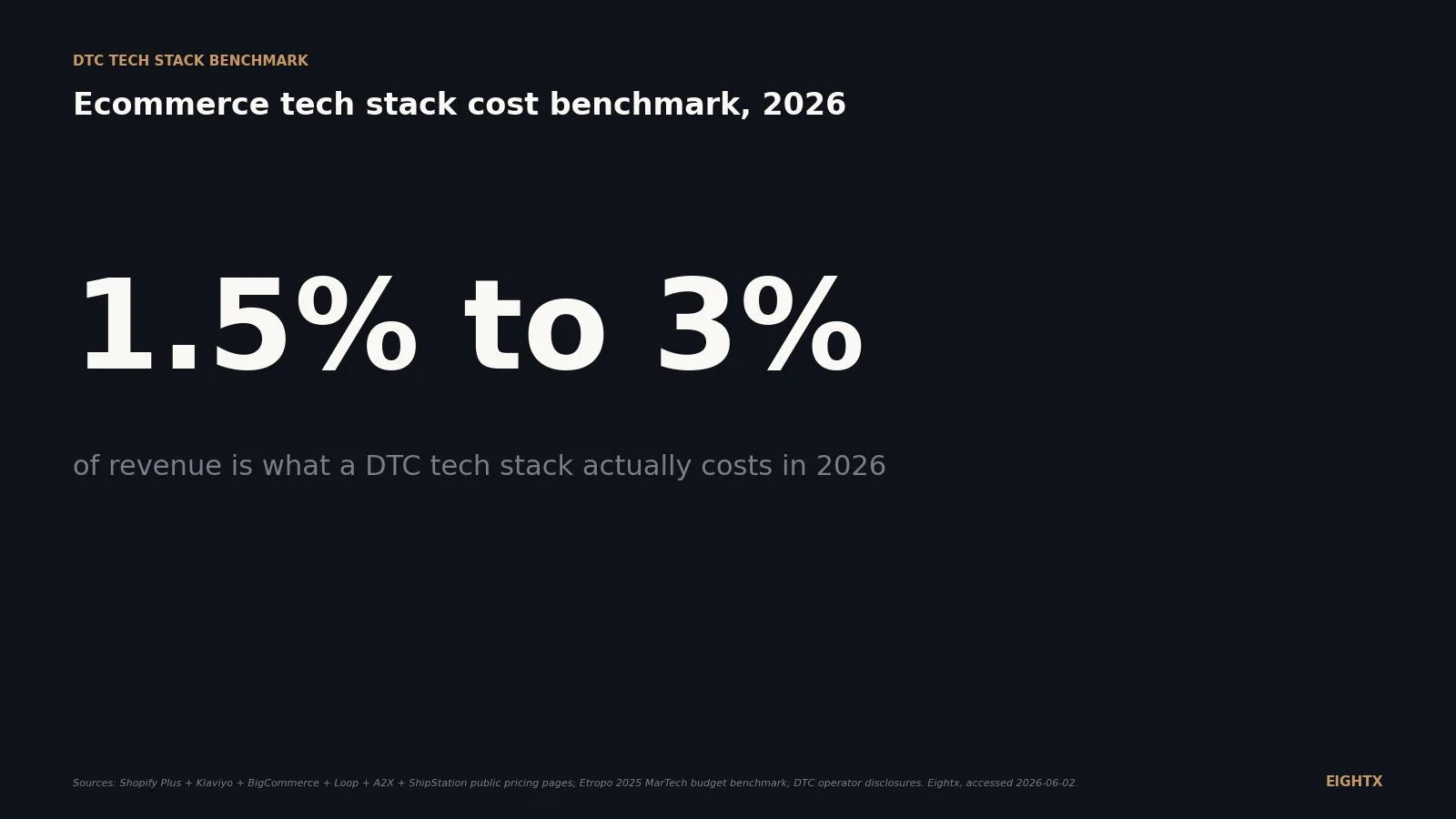
A typical DTC brand spends 1.5% to 3% of revenue on SaaS in 2026, dropping from around 3% at $1M to closer to 1.5% at $50M as fixed-cost platforms get leveraged. The post maps real 2026 vendor prices by revenue stage, including Shopify Plus at $2,300 per month, Klaviyo at $400 to $1,500 per month depending on list size, and a full core stack totaling $4,000 to $8,000 per month for a $10M brand.
Key Takeaways
- The honest 2026 answer is 1.5% to 3% of revenue, with sub-$5M brands typically running 2% to 4% and $100M+ brands at 1% to 1.75%. Anyone quoting a single number is selling something.
- Shopify Plus's published floor is $2,300 per month on a 3-year term ($2,500 on a 1-year). Add 0.25% to 0.40% of GMV above the negotiated threshold, capped near $40,000 per month.
- Klaviyo email-only is roughly $80 at 5K contacts, $250 to $400 at 25K, and $400 to $900 (midpoint $650) at 100K. SMS is sold separately as credit packs and lands quote-only at higher tiers.
- Most enterprise vendors don't publish list prices. Attentive, Triple Whale, Northbeam, Avalara, ShipBob, BigCommerce Enterprise, Gorgias Advanced, and Recharge Pro all require a sales call. Budget a 25% to 40% premium over published rates once you need them.
- The bill explodes at three platform transitions: Shopify Basic to Standard (around $70 per month step), Advanced to Plus (around $1,900 step), and Plus self-serve to enterprise CDP plus warehouse plus headless (a $15,000 to $30,000 step plus 6 to 12 months of integration cost).
Most operators ask "how much should our tech stack cost?" and get either a vendor pitch or a $19 per month app-store fantasy. Neither helps. The honest 2026 answer is a banded percent of revenue (1.5% to 3% is the real spread) that compounds into very different absolute dollar bills at $1M, $10M, and $100M GMV. This post publishes the real per-vendor list prices we could find (or flag as quote-only), maps them to four stage archetypes, and calls out where the bill explodes at each transition. It matters because for most DTC brands, software is the second-largest fixed cost behind labor, and it's the one operators consistently misjudge by 30% to 50% in both directions.
The honest answer: 1.5% to 3% of revenue, depending on stage
Cross-industry MarTech benchmarks land software (MarTech specifically) at roughly 1.7% of revenue for the average company: MarTech is roughly 22% of the marketing budget, and marketing is roughly 7.7% of revenue (Etropo, 2025). DTC brands consistently run hotter than that average at smaller revenue, and lighter than it at scale.
The reason is mechanical. Fixed-cost SaaS (the Shopify platform fee, the Klaviyo base, the helpdesk minimum) doesn't compress when your revenue is small. A $1M brand running Shopify Standard, Klaviyo, a reviews app, and a helpdesk pays a similar bill to a $3M brand running the same four tools. The denominator is what changes, not the numerator.
At scale, the opposite happens. A $100M brand still pays for the same four headline platforms (just at higher tiers), but the absolute dollars grow much slower than revenue. Headless commerce, a data warehouse, and FP&A tooling layer on top, but they don't double when revenue doubles.
The takeaway for an operator: don't benchmark against a single number. Find your stage band, plot where you sit inside it, and ask why if you're above the high line. The high band exists for a reason (some brands genuinely need more tooling), but most $3M brands sitting at 4% are there because they bought apps from newsletters, not because their P&L needed them.
What that looks like in dollars at each stage
Translating the percent band into absolute monthly dollars makes the conversation concrete. At $1M revenue, a 3% typical band is about $2,500 per month. At $100M, a 1.25% typical band is about $104,000 per month. The same percent moves very differently in dollars.
What sits inside those totals changes shape across the stages. A $1M brand's bill is dominated by the Shopify platform fee, Klaviyo, and a few utility apps. A $25M brand has added a helpdesk at scale, a subscription app, a reviews and loyalty bundle, attribution tooling, and accounting (the returns line scales with your actual return rate by vertical, which is what justifies a Loop Returns or Yotpo Loyalty buy at this stage). A $100M brand has added data warehouse, BI, experimentation, ERP, OMS, and PIM categories that don't exist in the smaller-stage stacks.
Revenue stage Platform Email/SMS Reviews/Loyalty Helpdesk Subscriptions Returns Attribution Shipping Accounting Tax Other apps Headline subtotal Warehouse / BI / ERP / un-itemized Typical total (band) $1M $105 $80 $30 $60 $0 $0 $0 $0 $29 $0 $200 ~$500 ~$2,000 ~$2,500 $5M $399 $400 $200 $300 $200 $59 $300 $50 $49 $200 $500 ~$2,700 ~$8,800 ~$11,500 $25M $2,500 $1,200 $1,500 $1,500 $1,500 $300 $2,500 $229 $199 $1,000 $2,000 ~$14,000 ~$27,500 ~$41,500 $100M+ $5,000 $8,000 $10,000 $10,000 $10,000 $2,000 $15,000 $2,000 $1,000 $5,000 $15,000 ~$83,000 ~$21,000 ~$104,000
Published list prices for the core stack (what you can actually look up)
Most published list prices cluster between $10 and $400 per month. The headline exception is Shopify Plus at $2,300 per month, and even that's a floor (the variable revenue share above the threshold takes most Plus brands meaningfully higher).
The chart above only includes vendors with public per-month pricing. The full table below adds the quote-only enterprise vendors and shows the pricing mechanism for each. For a deeper Klaviyo-versus-Attentive-versus-Mailchimp pricing comparison at the Shopify Plus tier, see our Klaviyo plan tier on Shopify Plus breakdown.
Vendor Category Public floor Quote-only above Mechanism Shopify (Basic / Standard / Advanced) Platform $39 to $399 Plus tier Self-serve flat fee Shopify Plus Platform $2,300 Custom enterprise 3-year term floor + 0.25% to 0.40% GMV above threshold BigCommerce Platform $399 (Pro) Enterprise Sales volume bands; Pro caps at $400K trailing 12-mo sales Klaviyo Email ~$80 at 5K profiles Custom over 250K Per active profile (calculator) Attentive SMS Not published All tiers Platform fee + per-message Postscript SMS ~$100 Higher tiers quote Platform + per-message Gorgias Helpdesk ~$10 (Starter) Pro / Advanced quote Per ticket caps Zendesk Suite Helpdesk $55 per agent Enterprise Per agent Recharge Subscriptions ~$99 Pro / Enterprise quote SaaS + % of subscription GMV Yotpo Reviews Reviews $19 (Growth) Bundle / Loyalty quote Order volume tiers Okendo Reviews Custom All tiers Order volume Loop Returns Returns $59 Plus tier custom Returns per month + overage Triple Whale Attribution Not published All tiers Revenue and ad-spend tiers Northbeam Attribution Not published All tiers Ad-spend tiers Shogun Page builder Self-serve tiers Frontend custom Pages / traffic caps ShipStation Shipping $9.99 $229 (Enterprise) Shipments per month ShipBob 3PL Not published All tiers Storage + pick + pack A2X Accounting $29 $99+ multi-channel Orders / settlements Avalara Tax Not published All tiers Custom by volume + jurisdictions TaxJar Tax Public tiers Higher tiers quote Orders per month
The pattern is consistent: anything that touches enterprise SMS, attribution, tax, 3PL, or page-builder frontend is quote-only above the entry tier. The published floor is rarely what an operating brand actually pays.
The three platform transitions where the bill explodes
Three jumps reshape the stack at different revenue stages. Each one adds 6 to 12 months of integration cost on top of the SaaS bill, which is the part most operators forget when they budget the move.
Shopify Basic to Standard ($39 to $105, around $70 per month step). Trivial dollar move but it unlocks better reporting and lower card rates. Most brands cross this threshold by the second quarter of trading and shouldn't think hard about it.
Shopify Advanced to Plus ($399 to $2,300, around $1,900 per month step). This is the first real budget conversation. You'll spend the $1,900 only when you actually need checkout customization, Shopify Flow at scale, more than ten staff accounts, or B2B / multi-storefront. If your reason is "we crossed $1M GMV," that's not a Plus reason. Most $5M to $10M brands stay on Advanced longer than they think they should and don't regret it.
Plus self-serve to enterprise CDP + data warehouse + headless (a $15,000 to $30,000 per month step). The jump that quietly shows up around $25M to $50M. You need it when the Shopify-app stack starts losing data fidelity (attribution, repeat customer logic, multi-region inventory). The SaaS bill goes up by $15K to $30K per month and you'll need an additional 6 to 12 months of engineering integration before the new stack delivers value. Budget both. Most teams budget only the SaaS side.
Where brands consistently over- and under-spend
Two opposite mistakes show up at opposite ends of the revenue band.
Sub-$5M brands over-spend. The most common pattern is apps as procrastination: adding tools instead of doing the work the tools were supposed to enable. Audit any $3M brand and you'll find two attribution apps (paying for both), two reviews apps (only displaying one), a subscription app activated for a SKU set that doesn't subscribe, and three or four utility apps that nobody on the team can name. The fastest margin recovery at this stage is usually a 90-minute stack audit, not a vendor change.
$25M+ brands under-spend in three specific categories. The data warehouse and BI tooling that should follow Plus rarely gets purchased on time. FP&A tools that would let finance stop running the business from spreadsheets get postponed. And the experimentation platform that would let growth teams stop guessing at LP variants is often skipped entirely. The first conversation we usually have with a $30M brand is about what's missing from the stack, not what to cut.
Software is the second-largest fixed cost behind labor for most DTC brands, and it's the one operators consistently misjudge by 30% to 50% in both directions. Sub-$5M brands over-spend because tools feel like progress. $25M+ brands under-spend because the founder's original stack stopped scaling two revenue tiers ago and nobody bought what was supposed to replace it.
How to audit your own stack in 90 minutes
The exercise is mechanical. Pull every recurring software charge from your business card statement for the last three months. Categorize each by function (platform, email, reviews, helpdesk, etc.). Sum the monthly total. Calculate it as a percent of trailing 12-month revenue. Compare against the band in Chart 1.
Then ask three questions of every line item. Is this tool currently delivering the outcome it was bought for? Is there a duplicate or near-duplicate tool elsewhere in the stack? If we cancelled it today, how long until somebody noticed?
The third question is the cleanest filter. Anything where the answer is "more than two weeks" is a cancel candidate.
For more on how this fits with the broader DTC P&L right now, see our DTC layoff and hiring tracker and the fractional CFO services overview for how we run these audits inside an existing finance function.
Sources and methodology
Primary vendor pricing pages consulted in May to June 2026. Shopify Plus floor figures ($2,300 on 3-year, $2,500 on 1-year) cross-confirmed across the Shopify Plus pricing page and four independent partner sources (Flatline Agency, BrokenRubik, 20North). Shopify Payments rate card pulled from the public Plus pricing page. BigCommerce Pro list at $399 with the $400K trailing-12-month sales cap pulled from the BigCommerce essentials pricing page. Klaviyo per-active-profile ranges triangulated across the Klaviyo public pricing calculator and three 2026 comparison reviews (Aedan Rose, beehiiv blog, Sequenzy).
Benchmark sources for the percent-of-revenue bands. Etropo's 2025 MarTech budget calculator anchors the cross-industry average (MarTech roughly 22% of marketing budget, marketing roughly 7.7% of revenue, implied MarTech roughly 1.7% of revenue). DTC operator disclosures and Darkroom Agency's 2026 DTC report inform the stage-by-stage spread, particularly the complexity inflections at $5M and $25M revenue.
Inclusion / exclusion rule. Chart 3 (published list prices) and Table 2 only include vendors with a public per-month list price for typical DTC use. Enterprise-only vendors (Attentive, Triple Whale, Northbeam, Avalara, ShipBob, BigCommerce Enterprise, Gorgias Advanced, Recharge Pro, Yotpo bundles) are flagged as quote-only in Table 2 and excluded from the chart. Operators should plan a 25% to 40% premium over published comparable rates once they need any of these.
Limitations. Most enterprise-tier pricing is non-public and the Shopify Plus variable revenue share is set per merchant. The "total stack" estimates at $25M+ and $100M+ include data warehouse, BI, experimentation, ERP, OMS, and PIM categories that aren't broken out in Chart 3 or Table 2. Per-vendor figures are list prices and don't reflect negotiated discounts, multi-year prepay terms, or partner-program credits. Most $25M+ brands negotiate 20% to 40% off list on Shopify Plus, Klaviyo, and Attentive renewals, which is the single largest swing in this post that we can't generalize for you. All figures are USD; AU and UK list prices typically differ by 10% to 15% on FX, plus regional surcharges (GST/VAT) and a small premium on Shopify Plus floor pricing in non-USD markets.
Update cadence. This is a living index. We refresh the per-vendor figures quarterly when Shopify Plus and Klaviyo update their pricing pages, and tag the post with iso_date_modified only when a public price actually changes. Next scheduled review: September 2026.
Frequently asked questions
how much should i be spending on software at $5m revenue?
Around 2% to 3.5% of revenue, so roughly $8,000 to $14,500 per month for a $5M brand. If you're north of 4% at this stage, the most common culprits are duplicated tools (two attribution apps, two review apps) and apps you bought during a busy quarter and never turned off. Cancel ruthlessly before you add anything.
is shopify plus actually $2,000 a month or is that a starting number?
It's a starting number. The published 2026 floor is $2,300 per month on a 3-year term or $2,500 per month on a 1-year. Above a negotiated GMV threshold (which Shopify sets per merchant), you pay an additional 0.25% to 0.40% of GMV, capped at around $40,000 per month. Most $25M to $50M Plus brands end up paying $8,500 to $15,000 per month all in once the revenue-share kicks in (0.30% of GMV above the negotiated threshold, plus the $2,300 floor).
what's the real shopify plus price including the transaction fee?
Add Shopify Payments processing on top of the platform fee. The Plus rate for US online Visa and Mastercard is roughly 2.15% + $0.30 per transaction. If you use a third-party gateway instead, Shopify charges an additional 0.15% to 0.20% surcharge on top of whatever the gateway charges. For most operators, staying on Shopify Payments is cheaper unless your gateway has a sweetheart deal.
how much does klaviyo cost at 25k contacts in 2026?
Email-only at 25K active profiles runs roughly $250 to $400 per month, with the exact number set by Klaviyo's per-active-profile calculator. SMS is priced separately as credit packs. As of June 2026, there is no documented price hike, so the current Klaviyo pricing page is the 2026 price; we'll bump iso_date_modified the moment that changes.
what's a normal saas percentage of revenue for a dtc brand?
1.5% to 3% across the lifecycle. Sub-$5M brands typically run 2% to 4% (higher because fixed-cost SaaS doesn't compress at small volume). $10M to $50M brands sit around 1.5% to 2.5%. $100M+ brands run 1% to 1.75%. Run your own number against your trailing 12-month revenue before you trust an industry average.
when does it make sense to leave shopify advanced for plus?
When you can name three Plus-only features you'll actually use within 60 days. The most common real triggers are checkout customization (Plus only), Shopify Flow at scale, more than ten staff accounts, and B2B or multi-storefront. If your reason is "we crossed $1M GMV," that's not a Plus reason. The $1,900 per month step rarely pays back on revenue alone.
how many apps does a typical $10m shopify store run?
Around 25 to 40 paid SaaS tools, plus another 10 to 20 free or freemium apps. Most of the count growth past 25 is small utility apps (form builders, page editors, niche reporting), not headline platforms. At $5M to $10M, the headline platforms (Shopify, Klaviyo, the helpdesk, the returns app) typically carry the majority of the bill; past $25M, warehouse, BI, and attribution categories crowd them down to roughly half.
should i pay for triple whale or is ga4 plus the ad platforms enough?
Below $5M GMV, GA4 plus the platform reports is usually enough. Triple Whale's value shows up when paid spend is high enough that a 5% to 10% better attribution read changes ad budget allocation by more than the tool costs. The honest threshold is roughly $50K per month in paid spend; below that, you're paying for a dashboard. (For the CAC math behind that threshold, see our average CAC by ecommerce vertical benchmark.)