
Cash Flow
Surviving a Cash Crunch: The 30-Day Plan for DTC Brands
Surviving a cash crunch is a sequencing problem, not a sales problem. In the first 30 days, pull levers by speed to cash: cut ad spend to the profitable core and stretch payables first, renegotiate or pause purchase orders next, accelerate AR collection, then line up bridge financing only if those four do not close the gap.
Key Takeaways
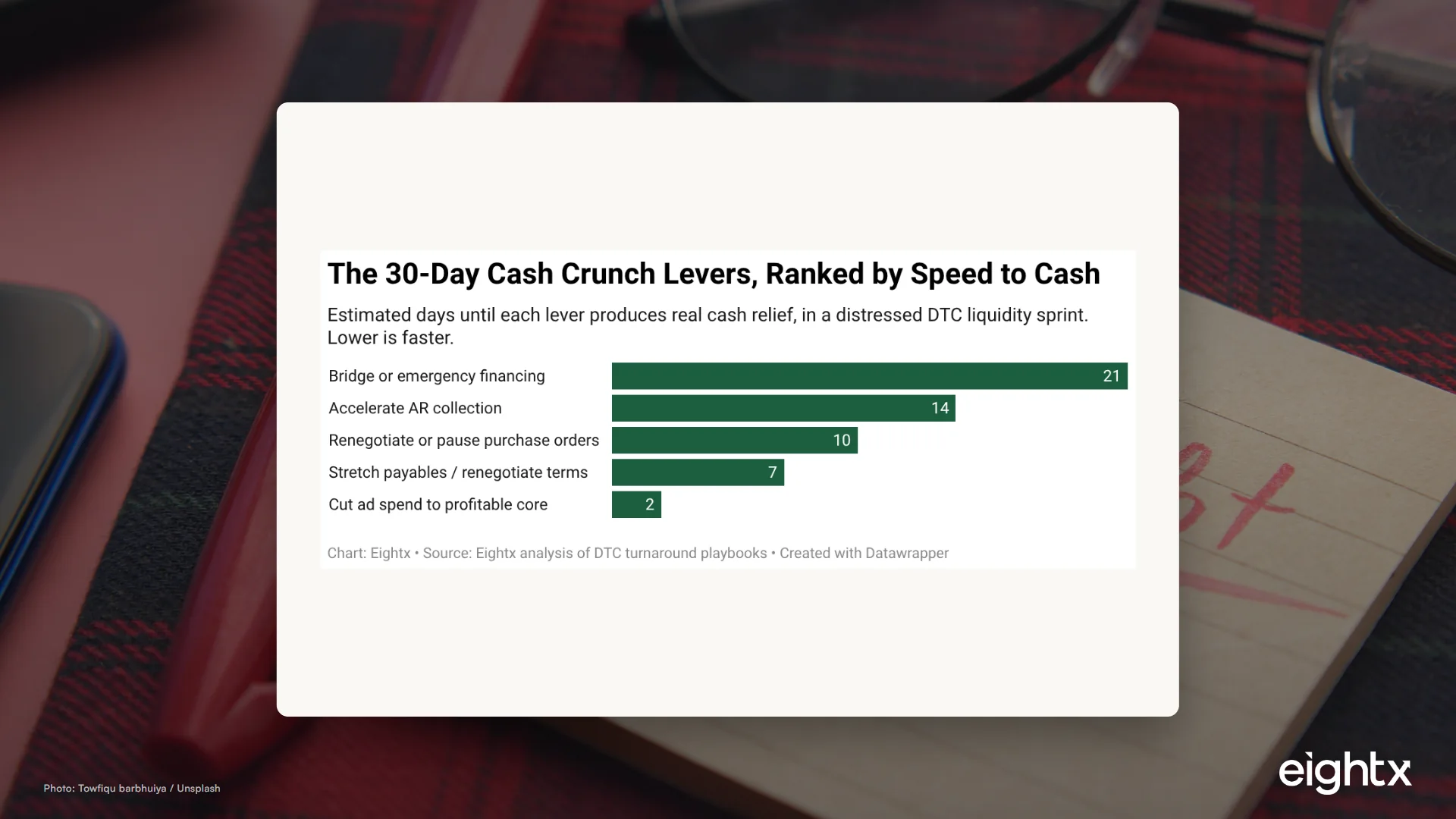
- Cutting ad spend to the profitable core reduces burn in about 2 days; bridge financing takes roughly 21 days to land, so sequence accordingly.
- Compute true runway against cash minus committed outflows, not your bank balance: $500K with a $300K PO due next week is really $200K of runway.
- Roughly 82% of small business failures involve cash flow, and the median small business holds only about 27 days of buffer, so under 4 months of runway is genuinely urgent.
- Stretching payables and renegotiating POs are usually the fastest sources of real cash, often inside 7 to 14 days.
- Raise financing before you are desperate: business-loan delinquency just hit a cycle-high 1.34% and banks are still net-tightening, so cheap money goes to brands that still look healthy.
If your bank balance is dropping every week and you can see the bottom, you do not have a strategy problem. You have a sequencing problem. The brands that survive a cash crunch are not the ones with the best ideas. They are the ones that pull the right levers in the right order, fast, before the gap closes.
This is the 30-day plan I run with brands when cash gets tight. It is built around one principle: pull the levers that produce cash fastest first, and use the slow, expensive levers only as a backstop. Below is the priority order, what each lever buys you, the real-data reason the financing backstop is getting harder to reach, and how to rebuild your forecast so you never get surprised again.
First, know your real number
Before you touch a single lever, get your true runway. Most founders compute it wrong. Cash runway is cash on hand divided by monthly net burn, where net burn is monthly outflow minus inflow, smoothed over a rolling 3-month average. See what is cash runway for the full definition.
The mistake that kills people is using the headline bank number. If you have $500K in the bank but a $300K supplier purchase order settling next week, your true runway is computed against $200K, not $500K. Real runway is available cash after near-term committed outflows. Build that number first, because it tells you how many of the levers below you actually have time to pull.
Here is the context that should make this feel urgent. The median US small business holds only about 27 days of cash buffer, according to the JPMorgan Chase Institute, the amount of typical outflows it could cover if inflows stopped. Most brands are roughly four weeks from a crunch at all times. So under 4 months of runway is the danger zone at any stage, and when I talk to founders running a brand at this size, the common reaction to seeing the true number for the first time is that the situation is more urgent than the bank balance made it look. If you are there, this is a this-quarter problem, not a next-quarter one.
Why this is a sequencing problem, not a sales problem
A cash crunch is almost never a demand problem. Roughly 82% of small business failures involve cash flow problems, per SCORE, an SBA resource partner, which makes a cash crunch the single most common way a business dies. Meanwhile demand for ecommerce is still climbing: US ecommerce sales (Census electronic shopping and mail-order, NAICS 4541, seasonally adjusted) hit a record of about $128.4B in March 2026, up roughly 26% from about $101.3B in mid-2023. Customers did not stop buying. Cash got trapped in inventory, purchase orders, and receivables while burn kept running.
That reframe matters because it changes what you do next. If the problem were demand, you would chase revenue. Because the problem is internal working capital, you free trapped cash instead. The pattern we see again and again is a brand that looks healthy on a revenue chart and terrifying on a cash chart, because the cash is real, it is just sitting in the wrong place. One founder I talked to had purposely carried more inventory than was financially appropriate as risk mitigation, drawing it down slowly. That is a defensible call, but it is also the textbook way cash gets trapped, and a crunch is exactly when you reverse it.
The levers, ranked by speed to cash
Not all cash is equally fast. Some levers reduce burn in days; others take three weeks to land a dollar. Here is the order I work them, fastest first.
The shape matters. Cutting ad spend and stretching payables move cash inside the first week. Bridge financing, even when it closes, is roughly three weeks out. So you never start with financing. You start with the fast levers and buy yourself the runway to negotiate the slow ones from a position of strength. Here is the same ranking as a table, with the window for each lever and what it actually does.
| Order | Lever | Window | What it does |
|---|---|---|---|
| 1 | Cut ad spend to profitable core | Days 1 to 3 | Fastest burn reduction; stop buying unprofitable demand |
| 2 | Stretch payables, renegotiate terms | Days 3 to 7 | Often the cheapest cash; net 30 to net 60 frees weeks of float |
| 3 | Renegotiate or pause purchase orders | Days 3 to 14 | Cuts committed future outflows and frees near-term cash |
| 4 | Accelerate AR collection | Days 7 to 14 | Cash already earned; depends on others paying |
| 5 | Bridge or emergency financing | Days 7 to 30 | Backstop only; costs money and is slowest to land |
Source: Eightx analysis of DTC turnaround playbooks. Day ranges are operator midpoints, not published statistics.
The 30-day plan, in order
1. Cut ad spend to the profitable core (Days 1 to 3). This is the fastest burn reduction you have. Pull every campaign, audience, and channel that loses money or has long payback, and keep only what has proven, fast payback. Do not cut to zero. Zero starves the cash inflow you still need. The disciplined version, the one I coach, is to hold an always-on baseline of spend plus an efficiency-rated layer you pull up and down. In a crunch you pull that layer down hard, not off. The goal is to stop buying unprofitable demand, not to stop selling.
2. Stretch payables and renegotiate terms (Days 3 to 7). Call your largest vendors before you miss anything. Ask for an extension, a temporary pause, or a switch from net-30 to net-60. Put it in writing. Stretching payables is a financing instrument, and it is often the cheapest one you can get. When we have worked through this with brands, the move that lands is paying a small premium to buy float: faced with a supplier already threatening not to ship, you bump the terms out by four weeks and offer to pay 1% more than you pay now. For a supplier that size, an extra 1% is a return they do not get elsewhere, so they take it, and you just bought a month of breathing room for one point. Be realistic about your bargaining power, though. For the average brand under $10M, you do not have much pull with suppliers and you are not going to bluff your way into it, so lead with the relationship, not a threat.
3. Renegotiate or pause purchase orders (Days 3 to 14). Every committed PO is future cash leaving the building. Reduce deposit sizes, delay shipments, cut order quantities to match real demand, or re-time production. This both frees near-term cash and shrinks the committed outflows that were dragging down your true runway in the first place. Over-ordered inventory is trapped cash, and a cash crunch is exactly when you free it. The single biggest flag I see is an inventory balance that is far too high: a brand sitting on 250 days of inventory has a very long cash conversion cycle, and getting that down toward 3 to 4 months frees real liquidity. See free trapped working capital for the deeper playbook.
4. Accelerate AR collection (Days 7 to 14). If you sell wholesale or have any receivables, this is real cash sitting outside your bank account. Clear the old invoices off the register first, call every overdue account, offer a small early-payment discount where it pencils, and tighten follow-up. It is slower than vendor levers because it depends on someone else paying, but it is cash you have already earned. One caution on the discount math: giving up a 2/10 net 30 discount to hold cash longer is an implicit cost of roughly 36.5% a year, so use early-pay incentives to pull cash in, not to push it out.
5. Line up bridge or emergency financing (Days 7 to 30, backstop only). Only after the first four levers have run their course do you size the remaining gap and finance it. Financing takes documentation and diligence, costs money, and is slowest to land. If you are weighing your options here, read bridge financing vs equity to close a cash gap. And the broader lesson, per our top recommendations to improve cash flow, is to finance when you do not need it so the money is available when you do.
The financing lever is getting more expensive and harder to reach
The cruel irony of the last lever is that lenders offer the best terms when you look healthy, which is exactly why you raise before you are desperate. The 2026 data makes that case better than any pep talk.
Business-loan delinquency at all commercial banks hit 1.34% in Q1 2026, the high of the current cycle, up from 0.97% in early 2023; at smaller banks it is 1.76%. As more borrowers fall behind, lenders price risk higher and screen harder. On top of that, banks have been net-tighteners of small-firm credit for 16 straight quarters, a reading of plus 6.6% in Q2 2026, eased from a plus 49% peak in 2023 but still tightening, not loosening. And money is not cheap: the bank prime rate was 6.75% in May 2026, SBA 7(a) loans run roughly 9.75% to 14.75%, and online or fintech inventory financing for thinner-file ecommerce borrowers commonly starts at 15% APR and climbs from there.
A cash crunch is rarely a demand problem. It is cash trapped in inventory, POs, and receivables while burn keeps running. Pull the fast, cheap levers first, and arrange financing while you still look healthy, because in 2026 the brands that wait until they are desperate borrow at the worst rates, if they can borrow at all.
The spread between borrowing as a healthy brand and borrowing as a desperate one is the whole argument for sequencing. Here is what the last lever actually costs.
| Source | Typical all-in cost | Notes |
|---|---|---|
| Bank line of credit or term loan | High single digits | For healthy borrowers; prime was 6.75% in May 2026 |
| SBA 7(a) loan | ~9.75% to 14.75% | Slower to close; documentation heavy |
| Revenue-based or working-capital financing | Low-to-mid double digits | Factor-rate products; faster to fund |
| Online or fintech term loan | 15%+ APR | Common for thinner-file ecommerce borrowers |
| Merchant cash advance or factoring | Highest, often very high effective APR | Last resort |
Source: Prime rate from FRED (DPRIME, May 2026); cost ranges from NerdWallet, Nav, and the Fed Small Business Credit Survey, 2025-2026.
Rebuild the forecast so it never happens again
Surviving the 30 days is step one. Step two is making sure you see the next crunch coming a quarter out instead of a week out.
- Switch to a 13-week cash forecast. Monthly is too coarse when cash is tight. Model inflows and outflows week by week so a PO due in week 6 shows up in week 6, not buried in a monthly average.
- Forecast committed outflows separately. Deposits, POs, loan payments, and tax. These are the items that make your true runway lower than your bank balance, so they get their own line.
- Track runway weekly under 6 months, monthly above it. The closer you are to the danger zone, the tighter the cadence.
- Right-size working capital. A cash crunch is usually an inventory or AR problem in disguise. Excess inventory and stretched receivables are cash you cannot deploy. See what is working capital for the ratio bands; above roughly 2.5x usually signals trapped cash you can pull back.
- Keep books current. You cannot forecast off stale data. Clean, current books are what let you act in days instead of weeks.
For the strategic version of all of this, our cash flow mastery guide lays out how to make predictable cash the default rather than the exception.
Methodology
The five days-to-first-cash figures are midpoints of typical ranges synthesized from DTC turnaround playbooks and our work running these triages with brands; actual timing varies with vendor terms, ad-billing cycles, and lender speed. Treat the lever ranking as a sequencing guide, not a guarantee; the right order for your brand depends on where your cash is actually trapped.
The macro figures are real and sourced. The roughly 82% cash-flow-failure share is from SCORE, an SBA resource partner. The median 27-day cash buffer is from the JPMorgan Chase Institute study "Cash is King." Business-loan delinquency (1.34% all banks, 1.76% small banks, Q1 2026), net bank tightening for small firms (plus 6.6% in Q2 2026, down from a plus 49.2% peak in 2023-Q3), and the 6.75% prime rate come from the Federal Reserve via FRED (series DRBLACBS, DRBLOBS, DRTSCIS, and DPRIME). US ecommerce sales come from the Census Monthly Retail Trade Survey, NAICS 4541, seasonally adjusted, which is the closest public proxy for ecommerce rather than a pure DTC measure. Financing cost ranges are typical 2025 to 2026 figures from NerdWallet, Nav, and the Fed Small Business Credit Survey, and are not a substitute for a real quote on your file. Runway thresholds and the true-runway calculation draw on Eightx's cash runway and working capital reference pages.
Frequently Asked Questions
what should i do first in a cash crunch?
Map your true runway, then cut ad spend to the profitable core. Cutting unprofitable media reduces burn within about 2 days and buys you time to work the slower levers without firing customers or staff in a panic.
how do i calculate my real runway during a cash crunch?
Take cash on hand and subtract committed near-term outflows like deposits and POs settling soon, then divide by monthly net burn. If you have $500K but a $300K PO due next week, your true runway is computed against $200K, not $500K.
how many days of cash does the average small business have?
About 27 days, per the JPMorgan Chase Institute. The median small business could cover only roughly four weeks of typical outflows if money stopped coming in, which is why under 4 months of runway should feel urgent, not theoretical.
is it safe to stretch payables with suppliers?
Yes, if you communicate first and prioritize relationships you cannot afford to lose. Call your largest vendors, ask for an extension or a temporary pause, and put it in writing. Silence and missed payments destroy terms; a proactive ask usually preserves them.
should i cut all my ad spend in a cash crunch?
No. Cut to the profitable core, not to zero. Keep the campaigns and audiences with proven payback and kill everything that loses money or has long payback. Going to zero starves the cash inflows you still need.
when should i get bridge financing instead of cutting costs?
Use financing as a backstop, not a first move. Work the operational levers first because financing takes roughly 21 days to close and costs money. If the gap remains after ad cuts, payable stretches, PO changes, and AR collection, line up a bridge while you still look fundable.
is it harder to get a business loan right now than it used to be?
Yes. Business-loan delinquency at all commercial banks hit a cycle-high 1.34% in early 2026 and banks have been net-tightening small-firm credit for 16 straight quarters. Lenders are screening harder and pricing risk higher, so arrange financing while the business still looks healthy.
how many months of runway is dangerous for a dtc brand?
Under 4 months is the danger zone at any stage. Working-capital-funded brands should target 6 to 12 months. Below 6 months, track cash weekly, not monthly, and start triage before you hit the danger line.