
Cash Flow
Inventory-to-Cash: Freeing Trapped Working Capital in 2026
Most DTC cash is trapped in inventory and receivables. Measure it with the cash conversion cycle: days inventory outstanding plus days sales outstanding minus days payable outstanding. Then free it by turning inventory faster, tightening receivables, and extending payables. At a $20M brand, shaving 42 CCC days releases roughly $1.1M of cash.
Key Takeaways
- Inventory is the main trap: public DTC brands run a median 120 DIO, and FIGS sits at 220 CCC days, so most of your cash is sitting on a shelf.
- The cash conversion cycle is DIO + DSO - DPO. It tells you exactly how many days your cash is locked between paying suppliers and collecting from customers.
- Every $1M of working capital you free is worth about $120,000 a year at a 12% cost of capital, or roughly $329 a day per $1M.
- In a $20M worked example, cutting DIO from 100 to 75, extending DPO from 30 to 45, and tightening DSO frees roughly $1.1M of one-time cash.
- Pull the inventory and payables levers first: they move the most cash and cost the least. Borrowing is the last resort, not the first.
Your profit and loss statement says you are making money. Your bank balance says you are broke. Both are usually right, and the gap between them has a name: trapped working capital. For most DTC and CPG brands that hold inventory, much of the cash you earned last quarter is not in the bank. It is sitting in a warehouse as inventory, or in a wholesale receivable you have not collected yet. (A pure drop-ship or services brand carries little of this trap, which is exactly why those models run lean.) You paid for it, the customer has not, and that gap is where growing brands quietly run out of money.
The good news is that trapped cash is findable and freeable. You find it with one number, the cash conversion cycle, and you free it with three levers you already control. This post shows the math, walks a worked example, and quantifies what each lever is worth so you pull the one that frees the most cash first.
Where the cash is actually trapped
Start with where to look. Your working capital is current assets minus current liabilities, and the operational core of it, what an acquirer measures as net working capital, is accounts receivable plus inventory minus accounts payable. That formula is also the map of where your cash hides.
For most ecommerce brands, inventory is the big trap. Public DTC brands carry a median of 120 days of inventory, meaning roughly four months of cost of goods is sitting as stock at any moment. FIGS runs an extreme 235 days inventory; even Crocs, a tightly run operator, holds 77. Receivables are the second trap, but only if you sell wholesale: pure DTC collects from Shopify or Amazon in days, so DSO runs 8 to 12 days, while a brand on net-30 to net-60 wholesale terms waits weeks for the same dollar. The third bucket, payables, is the one lever that works in your favor, because money you owe suppliers is cash you get to keep using.
The one number that finds it: the cash conversion cycle
The cash conversion cycle (CCC) measures how many days your cash is locked in the operating cycle. The formula is simple:
CCC = DIO + DSO - DPO
- DIO (days inventory outstanding) = average inventory / daily COGS. How long product sits before it sells.
- DSO (days sales outstanding) = average receivables / daily revenue. How long you wait to collect after the sale.
- DPO (days payable outstanding) = average payables / daily COGS. How long you take to pay suppliers.
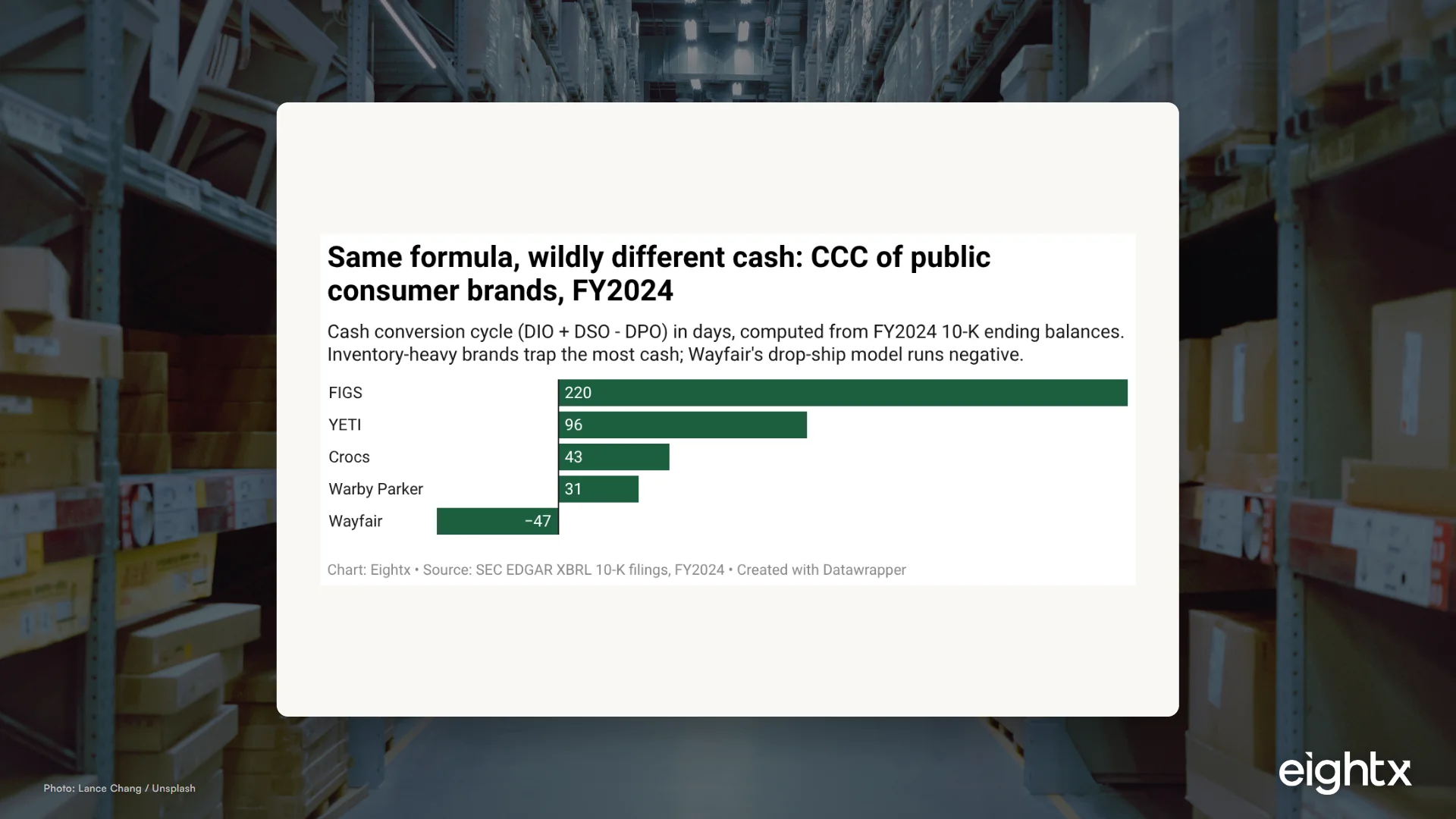
Public DTC brands span a wide range. Computed from FY2024 10-K filings, FIGS sits at 220 CCC days, Crocs at 43, and Wayfair at -47 on a structurally negative drop-ship model. The same formula, applied to brands selling broadly similar products, produces wildly different cash positions.
Break those cycles into their parts and the driver is obvious. Inventory days swing from 235 at FIGS to 3 at Wayfair, while receivables stay small and payables offset the rest.
| Brand | DIO | DSO | DPO | CCC |
|---|---|---|---|---|
| FIGS | 235 | 4 | 19 | 220 |
| YETI | 148 | 24 | 75 | 96 |
| Crocs | 77 | 23 | 57 | 43 |
| Warby Parker | 55 | 1 | 25 | 31 |
| Wayfair | 3 | 5 | 55 | -47 |
Inventory dominates. That is also why the median of this five-brand group is 77 DIO while the broader Eightx cohort runs a median of 120: a handful of public names is a smaller, leaner sample than the wider DTC field, so read the two medians as different cohorts, not a contradiction. Smaller brands typically run tighter than the public giants: Wayflyer's 2025 SMB data puts Shopify-only DTC near 17 days, Amazon FBA near 39, and multi-channel plus wholesale near 60, so do not benchmark a $5M brand to a public-cohort range. The point is not to hit a target someone else set. The point is that every day in your CCC is a day your cash is gone, and you can put a dollar figure on it.
When an Eightx advisor sits down with a founder, the cycle is usually the first thing that jumps out. As one put it on a recent call: "The first thing I noticed was inventory balance is very, very high. You have roughly 250 days of inventory which is super, super high. And so your cash conversion cycle is very, very long, and reducing that would free up liquidity." A number like that is not a ratio problem. It is hundreds of thousands of dollars sitting on a shelf.
What a day of trapped cash costs
Here is why this is not an academic exercise. Every $1M of working capital trapped in your cycle costs about $120,000 a year at a 12% cost of capital, or roughly $329 a day per $1M. That is the interest you pay to carry it on a line of credit, or the return you forgo by not deploying it into ads, product, or hiring. Compress your CCC by 30 days at $20M in revenue and you free roughly $1.6M of cash, which is real money you stop paying to hold. The cash is already yours. You are just letting it sit in a form that costs you to keep.
A worked CCC example
Take a $20M DTC brand running 45% COGS, so $9M of cost of goods, or about $24,658 a day. Revenue is about $54,795 a day. Suppose it carries 100 DIO, collects in 5 DSO, and pays suppliers in 30 DPO.
| Component | Days | Cash tied up |
|---|---|---|
| DIO (inventory) | 100 | $2,465,800 |
| DSO (receivables) | 5 | $273,975 |
| DPO (payables) | -30 | -$739,740 |
| Cash conversion cycle | 75 | about $2.0M trapped |
A 75-day CCC means this brand has roughly $2M of cash locked in its cycle at any moment. Now free it with the three levers, holding the business otherwise constant.
- Turn inventory faster: DIO 100 to 75. Cutting 25 days at $24,658 a day frees about $616,000.
- Extend supplier terms: DPO 30 to 45. Adding 15 days at $24,658 a day frees about $370,000.
- Tighten receivables: DSO 5 to 3. Trimming 2 days at $54,795 a day frees about $110,000.
That is a new CCC of 33 days and roughly $1.1M of one-time cash freed, plus about $132,000 a year you stop paying to carry it. No raise, no new lender, no dilution.
The three levers, ranked by impact
Notice the order. Inventory and payables move the most cash because they are the biggest balances. Receivables matter most for wholesale brands and barely move for pure DTC. Here is how to prioritize them.
- Extend payables first, because it is usually the fastest. Push your top suppliers from net-30 to net-45 or net-60. You are not selling anything or changing operations, you are just keeping cash longer. Terms like this are earned by showing up: as one operator described a client, "We had a client some time ago that would go to Vietnam and China once a year, and they ended up getting 60-day terms. Once you build it, that's the whole key." Bargaining power matters here, though. A brand under $10M often has little of it, as one operator put it: "For the average business under $10 million, you don't have a lot of power. If you make up 10% or more of a supplier's business is where you have a little more room to push." Smaller brands earn terms by becoming a meaningful share of a supplier's book, posting a letter of credit, or occasionally offering a small premium, roughly 1% more, to stretch the clock. If you are heading toward a sale, watch the line where extending terms tips into working capital true-up territory, because a buyer will normalize your payables in the deal, but for everyday operating cash it is the first move.
- Turn inventory faster, because it is the biggest pool. Cut SKU sprawl, reorder by velocity, kill the dead 20% that ties up cash without earning it, and tighten safety stock with better forecasting. Every day you shave off DIO frees a full day of COGS, so on a $9M-COGS brand each day is worth about $24,658.
- Tighten receivables, mostly if you sell wholesale. Invoice the day you ship, enforce terms, offer a 2/10 net 30 early-pay discount, and stop financing slow-paying retail accounts for free. For pure DTC this is a rounding error, so do not spend energy here if Shopify already pays you in days.
What to do about it
- Compute your CCC this week. Pull average inventory, AR, and AP, divide by daily COGS or revenue, and get your real number. You cannot free cash you have not located.
- Find the biggest bucket and attack it. For almost every inventory-holding brand that is DIO. Rank SKUs by cash tied up versus contribution and cut the bottom.
- Call your three largest suppliers. Ask for net-45 or net-60. The worst case is no. The likely case is you free six figures by Friday.
- Put a dollar figure on it. Multiply trapped days by daily COGS, then by your real cost of capital, so the team sees that this is money, not a ratio. Anchor on the $329 a day per $1M.
- Free the cash before you borrow it. Work the levers before you draw a line or take revenue-based financing. The cheapest working capital is the cycle you do not have to finance. Profit does not guarantee access to cash: one operator recalled "a company doing $80 million that made 16 months in a row of profit and they still couldn't find the capital they wanted." The cycle is where that cash was hiding.
Freed working capital is the cheapest growth capital there is. It funds inventory and ads at the same time, with no interest and no dilution. If your cash crunch is acute, our ecommerce cash crunch plan walks the triage step by step.
Methodology
CCC benchmarks (median 120 DIO, 8 to 12 day DTC DSO, 30 to 45 day DPO, the roughly $1.6M freed from 30 days of compression at $20M) are from Eightx's cash conversion cycle guide. Public-company components (FIGS 220 CCC days, Crocs 43, Wayfair -47, and the underlying DIO/DSO/DPO) are computed from FY2024 10-K filings via SEC EDGAR XBRL, using single-period ending balances (inventory, AR, and AP at fiscal-year-end over that year's COGS or revenue, times 365). The textbook method averages beginning and ending balances; that would shift the figures modestly but not the directional story. The $120,000/year carrying cost per $1M at a 12% cost of capital is from Eightx's working capital drag calculator. Working capital and net working capital definitions are from Eightx's glossary pages. The $20M worked example uses realistic but illustrative figures: 45% COGS, $24,658 daily COGS, $54,795 daily revenue, with inventory and payables levers valued on COGS per day and receivables on revenue per day; the $1.6M headline values 30 days on revenue per day, which is why it exceeds the worked example's 42-day, COGS-weighted result. External DTC CCC ranges (the Wayflyer SMB bands and the broader-cohort medians) are third-party synthesis from 2026 market research, not independently confirmed filings, so treat them as directional estimates rather than primary figures. The five named public brands' DIO/DSO/DPO are the primary, filing-derived data. Internal Eightx benchmark and definition pages cited above are published at eightx.co/blog. Model your own balances before acting.
Frequently Asked Questions
where is my ecommerce cash actually trapped?
Almost always in inventory first, then receivables. Public DTC brands carry a median 120 days of inventory, so most of your cash is sitting as stock on a shelf or in a container. Receivables matter if you sell wholesale, where net-30 to net-60 terms can stretch DSO into weeks. Pure DTC collects in days, so AR is usually small.
how do I calculate the cash conversion cycle?
Cash conversion cycle equals days inventory outstanding (DIO) plus days sales outstanding (DSO) minus days payable outstanding (DPO). DIO is average inventory divided by daily COGS, DSO is average receivables divided by daily revenue, and DPO is average payables divided by daily COGS. The result is how many days your cash is locked in the operating cycle.
why does my p&l show profit but my bank account is empty?
Because profit and cash are not the same thing. Your P&L records a sale when you ship, but the cash can still be tied up in inventory you already paid for or a wholesale receivable you have not collected. That gap is trapped working capital. Measure it with the cash conversion cycle and you can see exactly how many days of cash are locked between paying suppliers and getting paid.
what is the fastest way to free trapped working capital?
Extend supplier payment terms. It frees cash without requiring you to sell anything, and moving even your top suppliers from net-30 to net-45 or net-60 releases real cash on day one. Brands under $10M have less bargaining power and may need a letter of credit or a small premium to win terms, but it is still usually the fastest lever. After that, turn slow inventory faster and tighten any receivables you control.
should I borrow to fix a working capital problem?
Borrow last, not first. The cheapest working capital is the cycle you do not have to finance. Free trapped cash with the inventory and payables levers before you draw on a line, because borrowing adds interest cost on top of a problem the levers solve for free. Use debt only to fund genuine growth once the cycle is tight.
can a DTC brand have a negative cash conversion cycle?
Yes, and it is the goal for some models. A negative CCC means you collect from customers before you pay suppliers, so growth funds itself. Wayfair runs about -47 days on a drop-ship model. Most brands that hold inventory will not go negative, but every day you cut still frees cash.