
Tax
LLC vs S-Corp: Income Tax Strategy for Ecommerce in 2026
An S-corp election saves an ecommerce owner self-employment tax by splitting profit into a reasonable salary, which is payroll-taxed, and distributions, which are not. The math turns positive once net profit runs roughly $60K to $80K consistently, where 2026 savings clear the payroll and compliance cost of running the election.
Key Takeaways
- Self-employment tax is 15.3% on 92.35% of an LLC owner's net profit in 2026: 12.4% Social Security up to the $184,500 wage base, plus 2.9% Medicare with no cap.
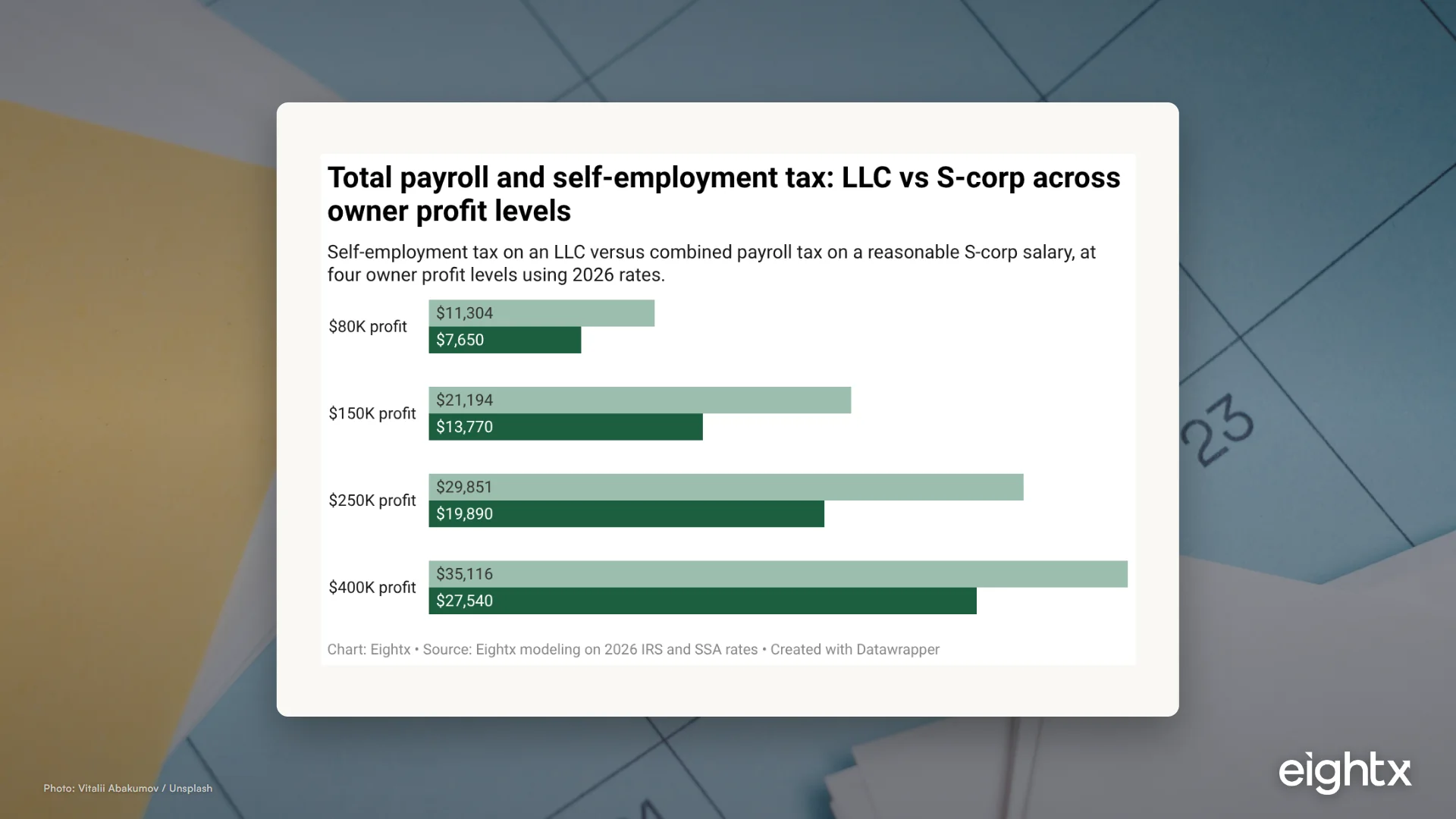
- An S-corp pays payroll tax only on the owner's reasonable salary, not on distributions, so on $150K of profit a $90K salary cuts the FICA and SE bill from about $21,194 to $13,770.
- The election usually turns net-positive once profit runs about $60K to $80K consistently, after the $2K to $4K of extra payroll and tax-prep cost it requires.
- The savings flatten at high profit because a large reasonable salary eats most of the Social Security wage base anyway, so the distribution shield mostly dodges the 2.9% Medicare piece.
- Reasonable compensation is the audit risk: the IRS can reclassify distributions as wages if your salary is unreasonably low, so document the number against market pay for your role.
Most ecommerce owners are an LLC because that is what the formation service defaulted them into, and most of them keep overpaying self-employment tax for years because nobody ran the numbers. The LLC-versus-S-corp question is not about liability protection, both protect you. It is about how much of your profit gets hit with the 15.3% self-employment tax, and whether the S-corp election can legally shrink that bill by more than it costs to run.
This is one of the highest-ROI tax moves available to a profitable owner-operated brand, and the math is not complicated. Below is exactly how the self-employment tax works in 2026, where the S-corp election starts to pay net of cost, and a worked example at four profit levels so you can find yourself on the curve.
How an LLC owner gets taxed: the 15.3% bite
By default a single-member LLC is a disregarded entity and a multi-member LLC is a partnership. Either way the profit flows straight to your personal return, and on top of income tax you owe self-employment tax. Per the IRS, that rate is 15.3% on 92.35% of your net earnings: 12.4% for Social Security and 2.9% for Medicare.
The 12.4% Social Security piece only applies up to the wage base, which the Social Security Administration set at $184,500 for 2026. Above that, only the 2.9% Medicare portion continues, and there is no cap on it. High earners also pay an extra 0.9% Additional Medicare Tax above $200,000 single or $250,000 married filing jointly.
The important part: as an LLC owner, you pay this on essentially all your profit. There is no salary-versus-distribution split. That is the leak the S-corp election plugs. For the broader entity-structure context, our ecommerce tax strategy guide walks the LLC, S-corp and C-corp tradeoffs side by side.
How the S-corp election changes the math
An LLC can elect to be taxed as an S-corp without changing its legal form. Once it does, you become a shareholder-employee. You pay yourself a salary through payroll, which carries the same 15.3% in combined employer and employee FICA, and you take the rest of the profit as a distribution, which carries no FICA at all.
That is the whole game: payroll tax applies to the salary, not the distribution. The catch is that the salary cannot be a token amount. The IRS requires shareholder-employees to take reasonable compensation for the work they do before pulling distributions, and it can reclassify distributions as wages if your salary is unreasonably low. Reasonable means what you would pay someone else to run your role.
So the savings are real but bounded. You are not dodging payroll tax on all your profit, only on the slice above a defensible salary.
Worked example: total tax at four profit levels
Here is the self-employment tax an LLC owner pays versus the payroll tax an S-corp owner pays on a reasonable salary, at four profit levels, using 2026 rates. The S-corp salaries here are illustrative reasonable figures: $50K, $90K, $130K and $180K.
The dollar detail behind the bars:
| Net profit | LLC self-employment tax | S-corp salary | S-corp payroll tax | Gross saving |
|---|---|---|---|---|
| $80K | ~$11,304 | $50K | ~$7,650 | ~$3,654 |
| $150K | ~$21,194 | $90K | ~$13,770 | ~$7,424 |
| $250K | ~$29,851 | $130K | ~$19,890 | ~$9,961 |
| $400K | ~$35,116 | $180K | ~$27,540 | ~$7,576 |
Two things to read off this. First, the crossover. At $80K the gross saving is about $3,654, and once you net out the $2K to $4K of extra payroll and tax-prep cost an S-corp requires, you are only modestly ahead. That is why the rule of thumb is that the election starts to pay somewhere around $60K to $80K of consistent profit, not before. This lines up with the entity-structure guidance in our ecommerce tax strategy guide, which flags the same range.
Second, the savings flatten at the top. At $400K the gross saving actually dips below the $250K figure. That is not an error: a $180K salary already pushes you near the $184,500 Social Security wage base, so the distribution above it only escapes the 2.9% Medicare piece, not the full 15.3%. The S-corp shield is most powerful in the middle, where a modest salary sits well under the wage base and the distribution dodges the full rate. The saving curve makes the hump obvious:
To be clear about our role here: we are not tax experts and we do not file your taxes. What we do is make sure you have a good CPA in your corner, then interface with them every quarter, here is what is going on, here is what we should do, who handles what. When we run this curve for a founder, the job is to translate the table into a clear net number and a salary that is fundable every month, then hand the election itself to the CPA. The math is honest precisely because nobody on our side is guessing at your personal return.
A note on what this is not. Both structures are pass-through, so your federal and state income tax are broadly the same either way. The S-corp does not lower income tax, only self-employment and payroll tax. For where income tax rates actually land for scaled brands, our benchmark on what public DTC brands pay in taxes shows profitable brands clustering at a 22% to 29% effective rate.
For reference, here are the 2026 figures that drive every number above:
| Item | 2026 figure | Source |
|---|---|---|
| Self-employment tax rate | 15.3% on 92.35% of net profit | IRS |
| Social Security portion | 12.4% up to the wage base | IRS |
| Medicare portion | 2.9%, no cap | IRS |
| Social Security wage base | $184,500 | SSA |
| Additional Medicare Tax | 0.9% above $200K single / $250K joint | IRS Topic 560 |
| Typical extra cost to run an S-corp | $2,000 to $4,000 per year | 2026 CPA fee synthesis |
| Breakeven profit (rule of thumb) | $60K to $80K consistent | 2026 CPA synthesis |
The tradeoffs nobody mentions when they pitch you the election
The savings are real, but an S-corp is more machine to run. Be honest about the cost side.
When we talk to founders running brands at this size, the salary question is where they get nervous, and they are right to. We have literally never seen a CEO under $30M pay themselves $300K, and even at a $30M brand the owner usually did not. Reasonable compensation has to be defensible against what the role is worth and what the business can actually afford, which in practice keeps owner salaries far lower than founders fear. The other thing the pattern shows again and again: owner money gets miscoded constantly. Withdrawals booked as a draw when they should be a shareholder loan, distributions split across months and classified wrong. An S-corp only works if the books are clean enough that payroll, distributions and contributions each land in the right bucket.
- Payroll infrastructure. You have to run actual payroll, withhold and remit taxes, and file quarterly. That is a payroll provider and a real salary hitting your bank on a schedule, not a once-a-year owner draw.
- Higher accounting fees. A separate 1120-S return plus payroll filings typically adds $2K to $4K a year over a simple LLC return. That cost is the denominator in the payback math.
- Reasonable-compensation risk. Lowball your salary to maximize distributions and you invite reclassification. The savings only hold if the salary is defensible against market comp for your role.
- Ownership restrictions. An S-corp caps you at 100 shareholders and bars non-resident-alien and entity owners. If you have a foreign co-founder or plan to raise from a fund, this can be a real constraint, and is one reason venture-track brands often stay C-corp instead.
- Reasonable salary funds your retirement and benefits base. A salary that is too low also shrinks your Social Security credits and the comp base for solo 401(k) contributions. The lowest legal salary is not always the smartest one.
What to do about it
- Pull your trailing-twelve-month net profit, not revenue. This decision rides on profit. If you are netting under roughly $60K consistently, stay an LLC and revisit when profit grows. Above that, keep going.
- Set a defensible reasonable salary. Benchmark what it would cost to hire someone to run your role, write it down, and keep the support. This number is your audit defense, so do not eyeball it.
- Run the net savings, not the gross. Take the FICA saving from the table, subtract $2K to $4K of added payroll and accounting cost, and confirm the remainder is worth the admin. If it is marginal, wait a year.
- Mind the timing. An S-corp election generally has to be filed within roughly the first two and a half months of the tax year to apply to that year, so a late decision can cost you a full year of savings. Decide before year end.
- Coordinate the CPA and the CFO. Your CPA files the election and the return; your fractional CFO models the savings against cash flow and makes sure the salary you set is fundable every month. Run both before you flip the switch.
- Reassess at the top end. If profit has climbed past a few hundred thousand and you are pushing the wage base with salary anyway, re-check whether the incremental shield still justifies the overhead, and whether a different structure fits a future raise or sale.
The way we frame it for founders: have someone look at the structure to make sure it still makes sense for where the brand is, then enact it. Most of the time it is all just documentation, a defensible salary, a clean payroll run, and an election filed on time. If you want this modeled against your actual numbers and a salary you can defend, that is the kind of work we do alongside your CPA every day. For adjacent moves once the structure is right, see our work on R&D tax credits for ecommerce and on sales tax audit preparation, and the full picture in our ecommerce sales tax strategy guide.
Sources and methodology
The tax rates here are primary-sourced, not estimated. The 15.3% self-employment tax (12.4% Social Security plus 2.9% Medicare) on 92.35% of net profit comes from the IRS Self-Employment Tax page. The $184,500 Social Security wage base is the 2026 figure published by the SSA Contribution and Benefit Base table. The 0.9% Additional Medicare Tax above $200,000 single or $250,000 joint is from IRS Topic No. 560. The reasonable-compensation requirement is from the IRS S-corporation compensation page, which states that shareholder-employees must take reasonable compensation before non-wage distributions.
The worked example models self-employment tax as 15.3% on 92.35% of net profit, with the Social Security portion capped at the $184,500 wage base and the 0.9% surtax added above $200K single. The S-corp side applies the same combined 15.3% FICA to the stated reasonable salary, subject to the same wage-base cap. All four rows were recomputed deterministically from the published 2026 rates and reconcile to the dollar with the figures in the table.
The four salaries ($50K, $90K, $130K and $180K) are illustrative reasonable figures, not prescriptions. The gross saving moves with whatever salary you set, so treat the curve as a shape, not a quote. Breakeven ($60K to $80K of consistent profit) and cost-to-run ($2K to $4K per year) are ranges synthesized from 2026 CPA pricing and break-even guidance; both run higher in California, New York and New Jersey. We deliberately did not cite a current national count of LLCs versus S-corps, because no reliable 2026 figure was available.
Figures exclude federal and state income tax, which are broadly equivalent under both pass-through structures. This is general information, not tax advice; confirm your specific position with a licensed tax professional before you file an election.
Frequently Asked Questions
should my ecommerce business be an llc or s-corp?
If your net profit runs consistently above roughly $60K to $80K, an S-corp election usually saves more in self-employment tax than it costs in payroll and compliance. Below that, the LLC is simpler and the savings are thin. The S-corp only helps if you pay yourself a defensible reasonable salary and run real payroll, so it is a discipline decision as much as a tax decision.
how much does an s-corp save in self-employment tax?
It depends on profit and your reasonable salary. On $150K of profit with a $90K salary, you pay payroll tax on the $90K instead of self-employment tax on all of it, dropping the FICA bill from about $21,194 to about $13,770, a roughly $7,400 gross saving. Net of $2K to $4K of extra cost, that is real money, and it repeats every year.
what is a reasonable salary for an s-corp owner?
A reasonable salary is what you would pay someone else to do your job, given your role, hours, experience and what the business can afford. The IRS can reclassify distributions as wages if the salary is unreasonably low. For an owner-operator running an ecommerce brand, that often lands in the $60K to $180K range depending on revenue and how hands-on you are. Document the number against market comp.
at what profit level does the s-corp election pay off?
Roughly $60K to $80K of consistent net profit is where the self-employment tax savings start to clear the $2K to $4K of extra payroll and tax-prep cost an S-corp requires. Below that the math is marginal and the added admin usually is not worth it. The key word is consistent: a one-time spike does not justify the structure.
does an s-corp lower my income tax too?
Mostly no. Both an LLC and an S-corp are pass-through entities, so the profit lands on your personal return and faces the same federal and state income tax either way. The S-corp advantage is specifically self-employment and payroll tax on the distribution portion, not income tax. Anyone selling an S-corp purely as an income-tax cut is overselling it.
what are the downsides of electing s-corp status for an ecommerce brand?
You take on payroll filings, a separate business return, higher accounting fees, and reasonable-compensation audit risk if you lowball your salary. There are also ownership restrictions, at most 100 shareholders and no non-resident or entity owners, which can complicate an outside investment or a foreign co-founder. For a simple owner-operated brand none of this is fatal, but it is real overhead.
why do the s-corp savings stop growing at high profit?
Because a reasonable salary at high profit eats most of the Social Security wage base. Once your salary nears the $184,500 cap, the distribution above it only dodges the 2.9% Medicare piece, not the full 15.3%. So the shield is widest in the middle, around $150K to $250K of profit, and narrows again as you scale up.
what is the 2026 self-employment tax rate and social security wage base?
The 2026 self-employment tax rate is 15.3% on 92.35% of net profit: 12.4% Social Security plus 2.9% Medicare. The Social Security portion only applies up to the 2026 wage base of $184,500; above that, only the 2.9% Medicare continues, with no cap, plus a 0.9% surtax above $200K single or $250K joint.