
Compliance
R&D Tax Credits for Ecommerce and CPG Brands (2026)
The federal R&D credit (Section 41) is worth about 14 percent of qualifying research expenses above 50 percent of your prior three-year average, and many ecommerce and CPG brands miss it. Product and formulation development, custom software, and process improvement can qualify. The 2025 OBBBA restored immediate domestic R&D expensing under Section 174A, so brands now deduct and credit the same work.
Key Takeaways
- The Section 41 credit is worth about 14 percent of qualifying research expenses under the Alternative Simplified Credit, or 6 percent for first-time claimants.
- Formulation work, custom software, and process improvement can all qualify if they pass the four-part test, even though most private DTC brands report zero R&D on the income statement.
- The 2025 OBBBA created Section 174A, restoring immediate expensing of domestic R&D for tax years after 2024, with retroactive relief back to 2022 for small businesses.
- Qualified startups under $5M in receipts can offset up to $500,000 of payroll tax per year with the credit, even with no income tax liability.
- Foreign R&D is excluded from the credit and still amortizes over 15 years, so where the work happens matters.
Most ecommerce and CPG founders think the R&D tax credit is for chip designers and biotech labs. It is not. If your brand reformulated a product, built custom software, or re-engineered a manufacturing process, you may be sitting on a federal credit worth roughly 14 cents on every qualifying dollar above 50 percent of your prior three-year research average, and most brands your size never claim it.
This matters more in 2026 than it did two years ago. The 2025 tax law restored immediate expensing of domestic R&D, so the same work that generates a deduction can also generate a credit. The problem is that almost nobody in DTC accounts for product and software work as research, which means the dollars are invisible at tax time. Let me demystify it and put numbers on it.
Why brands like yours miss the credit
Most consumer brands never break out R&D as a line item at all. They bury product development inside cost of goods sold or general overhead. Private brands look the same in the books we see: across the $5M to $50M brands we work with, R&D is functionally zero on the income statement.
That accounting habit is exactly why the credit gets missed. The IRS does not care which line your books use. It cares whether the activity passes a test. If you paid a chemist to iterate a serum, a developer to build a custom subscription engine, or an ops lead to dial in a new fill line, those dollars may qualify regardless of where your bookkeeper parked them.
When I talk to founders running a brand this size, the thing they keep saying is that they assumed the credit was not for them because their accountant never raised it. One operator had spent two years and roughly $300,000 of developer time building a proprietary inventory and fulfillment system, all of it expensed into general overhead, and had never once considered it research. That was a real credit walking out the door every April.
The cost of missing it is real money. The R&D credit is a dollar-for-dollar reduction in tax, not a deduction, so a $70,000 credit is worth far more than a $70,000 write-off at any tax rate.
What actually qualifies under Section 41
Qualifying research has to pass a four-part test under IRC Section 41(d), summarized in the IRS Audit Techniques Guide:
- Section 174 test. The work must be treated as research or experimental expense.
- Technological in nature. It relies on physical or biological science, engineering, or computer science.
- Permitted purpose. It aims to develop a new or improved product, process, formula, or software with better function, performance, reliability, or quality.
- Process of experimentation. Substantially all of the activity (at least 80 percent) involves resolving technical uncertainty through testing alternatives, prototyping, modeling, or trial and error.
For an ecommerce or CPG brand, the activities that most often qualify are:
- Product and formulation development. New SKUs, reformulations to hit a shelf-life or texture target, removing an ingredient without losing performance. Food, beverage, beauty, and supplement brands do the most of this.
- Custom software. A bespoke subscription engine, a proprietary fulfillment or inventory algorithm, a custom integration layer. Plugging in off-the-shelf Shopify apps does not count, but building something novel with technical uncertainty can.
- Process improvement. Re-engineering a fill or packaging line, developing a new manufacturing process with a co-manufacturer, designing a quality system that requires experimentation rather than routine inspection.
What does not qualify: market research, consumer surveys, advertising, routine quality control, style and taste changes, duplicating an existing product, and anything done after commercial production starts.
How much the credit is worth
There are two ways to compute the credit. The Regular Research Credit is 20 percent of QREs above a base amount tied to your gross receipts and historical spend. The Alternative Simplified Credit (ASC) is 14 percent of QREs above 50 percent of your average QREs for the prior three years, and most brands elect it because the documentation is far simpler. First-time claimants with no prior QREs get 6 percent of current-year spend.
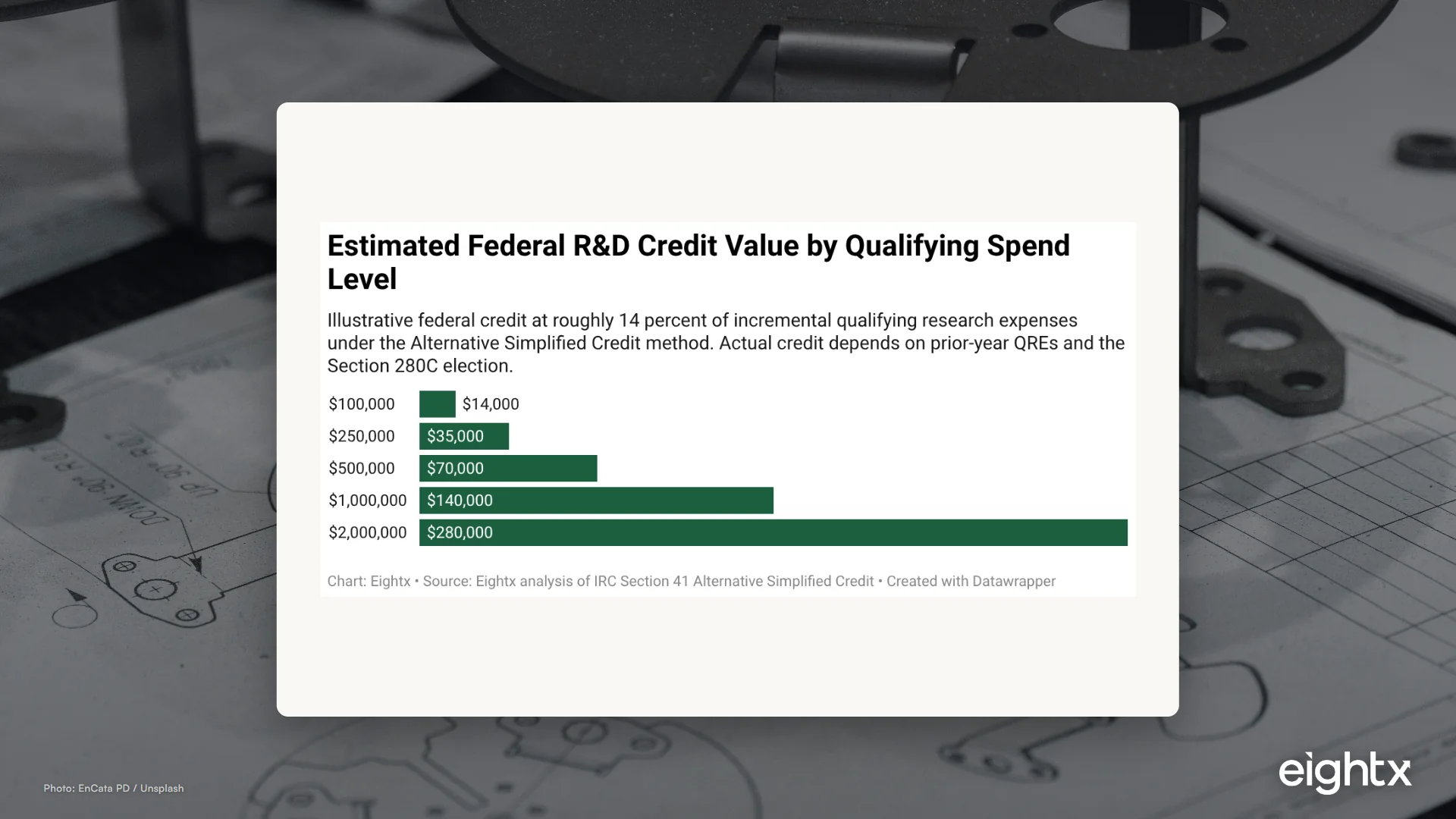
Here is the rough math at a few spend levels, using the ASC rate as a planning estimate:
A brand with $500,000 of genuinely qualifying research expense is looking at a credit in the ballpark of $70,000 against federal tax. Several states layer their own credit on top. The numbers here are illustrative and assume the incremental spend equals the stated level, so treat them as a sizing exercise, not a promise. Note too that the gross 14 percent is itself trimmed if you elect the Section 280C reduced credit to keep the full deduction, so do not stack that haircut on top a second time.
Qualifying research expenses are a specific list. The table below shows what counts, what gets excluded, and the catch on each category.
| Cost category | Counts as a QRE? | The catch |
|---|---|---|
| W-2 wages | Yes, at 100% | Only the portion of time spent doing, directly supervising, or directly supporting research |
| U.S. contractor payments | Yes, at 65% | Foreign contractors are excluded entirely |
| Supplies consumed in research | Yes, at 100% | Must be used up in the work, not capital equipment |
| Cloud and computer costs | Yes, at 100% | Only the share used for qualified research, not general hosting |
| Overhead, rent, depreciation | No | Excluded even if tied to the research team |
| Advertising and market research | No | Never qualifies, regardless of how technical the testing feels |
The pattern we see again and again is that the wage bucket is where the real money sits. A founder who personally spent half their year leading a reformulation, plus two technical hires, can build a six-figure QRE base out of payroll alone, before a single contractor invoice gets counted.
The 2025 Section 174 change, and why it matters
From 2022 through 2024, a punishing rule forced companies to capitalize and amortize R&D over five years instead of deducting it immediately. That hurt cash flow precisely for the brands investing in product.
The 2025 One Big Beautiful Bill Act fixed it. New Section 174A permanently restores immediate expensing of domestic R&D for tax years beginning after December 31, 2024. Small businesses (those under the Section 448(c) gross-receipts test, roughly $31M in average annual gross receipts for tax years beginning in 2025, indexed for inflation) can also retroactively elect immediate expensing back to 2022 by amending returns, with a filing window into 2026. Larger taxpayers can deduct remaining 2022 to 2024 domestic balances in 2025, or spread them over 2025 and 2026.
Two coordination points matter. First, foreign R&D did not get the fix: it still amortizes over 15 years and does not qualify for the Section 41 credit at all. Where the work happens changes both the deduction and the credit. Second, you cannot take both the full deduction and the full credit on the same dollars. Under Section 280C you either reduce your Section 174A deduction by the credit amount, or elect the reduced credit (about 79 percent of the gross credit) and keep the full deduction. Most brands elect the reduced credit to keep the accounting clean.
What to do about it
Here is the sequence I walk founders through:
- Inventory the work, not the ledger line. List every product reformulation, software build, and process change from the last open tax years. Ignore where it sits in your P&L.
- Run each item through the four-part test. Be honest. Technical uncertainty and a process of experimentation are the parts brands fail. If you just swapped a vendor, it does not qualify.
- Pull the qualifying costs. Wages by time spent on research, supplies consumed, cloud costs, and 65 percent of U.S. contractor invoices. Tie each to a business component.
- Pick a method. Use the ASC unless your historical base genuinely favors the regular credit. For a first claim, expect the 6 percent rate.
- If you are a startup, elect the payroll offset. Under $5M in receipts and within five years of your first revenue, you can offset up to $500,000 of payroll tax per year per the IRS QSB rules, even with no income tax.
- Coordinate with Section 174A and 280C. Decide between the reduced credit and the deduction haircut before you file, not after.
- Document contemporaneously. The credit lives and dies on documentation. Keep project notes, test logs, and time records as you go.
This sits inside a broader ecommerce tax strategy alongside the entity-level decisions that drive your overall rate, like LLC versus S-Corp structure, which is often the bigger lever on what you actually pay.
Methodology
Credit rates, qualifying expense categories, the four-part test, the $500,000 payroll offset, and the Section 174A expensing rules are drawn from the IRS Audit Techniques Guide for the research credit, IRS guidance on the qualified small business payroll tax credit, and analysis of the 2025 One Big Beautiful Bill Act. The chart values are illustrative estimates that apply the 14 percent Alternative Simplified Credit rate to the stated incremental spend, assuming the spend is fully incremental above the ASC base; actual credits depend on prior-year QREs, the chosen method, and the Section 280C election. This is general information, not tax advice.
Frequently Asked Questions
do ecommerce and cpg brands qualify for the r&d tax credit?
Yes, more often than founders assume. Formulation development, custom software builds, and documented process improvement can qualify under the Section 41 four-part test, even though most private DTC brands report zero R&D on their income statement.
how much is the federal r&d tax credit worth?
Under the Alternative Simplified Credit method the credit is about 14 percent of qualifying research expenses above 50 percent of your prior three-year average, or 6 percent for first-time claimants with no prior QREs. The regular method is 20 percent of the excess over a base amount.
what changed with section 174 in 2025?
The 2025 One Big Beautiful Bill Act created Section 174A, which permanently restored immediate expensing of domestic R&D for tax years beginning after December 31, 2024. It also gave small businesses a retroactive option back to 2022. Foreign R&D still amortizes over 15 years.
can a startup with no income tax use the r&d credit?
Yes. A qualified small business with $5M or less in current-year gross receipts and no receipts more than five years ago can elect to offset up to $500,000 of payroll tax per year, split between Social Security and Medicare, even with no income tax liability.
what counts as a qualifying research expense?
Wages for employees doing, supervising, or directly supporting qualified research, supplies consumed in the work, cloud and computer costs used in research, and 65 percent of payments to U.S. contractors. Overhead, depreciation, advertising, and routine quality control do not count.
how do you claim the r&d tax credit?
You compute the credit on IRS Form 6765, attach it to your return, and keep contemporaneous documentation tying expenses to qualifying activities and the process of experimentation. Startups also flow the payroll offset election to Form 941.