
Supply Chain
Footwear Import and Tariff Tracker 2026: Where US Shoes Come From and What the Duty Costs
In 2025 the US imported 26.6 billion dollars of footwear (HS 64). Vietnam led at 36 percent, China fell to 26 percent, Indonesia took 11 percent. In 2026 most origins pay base MFN duty plus a 10 percent Section 122 surcharge, while China stacks a Section 301 duty (7.5 to 25 percent) on top.
Key Takeaways
- US footwear imports (HS 64) totaled 26.6 billion dollars in 2025, with Vietnam at 36.3 percent, China at 26.1 percent and Indonesia at 11.2 percent.
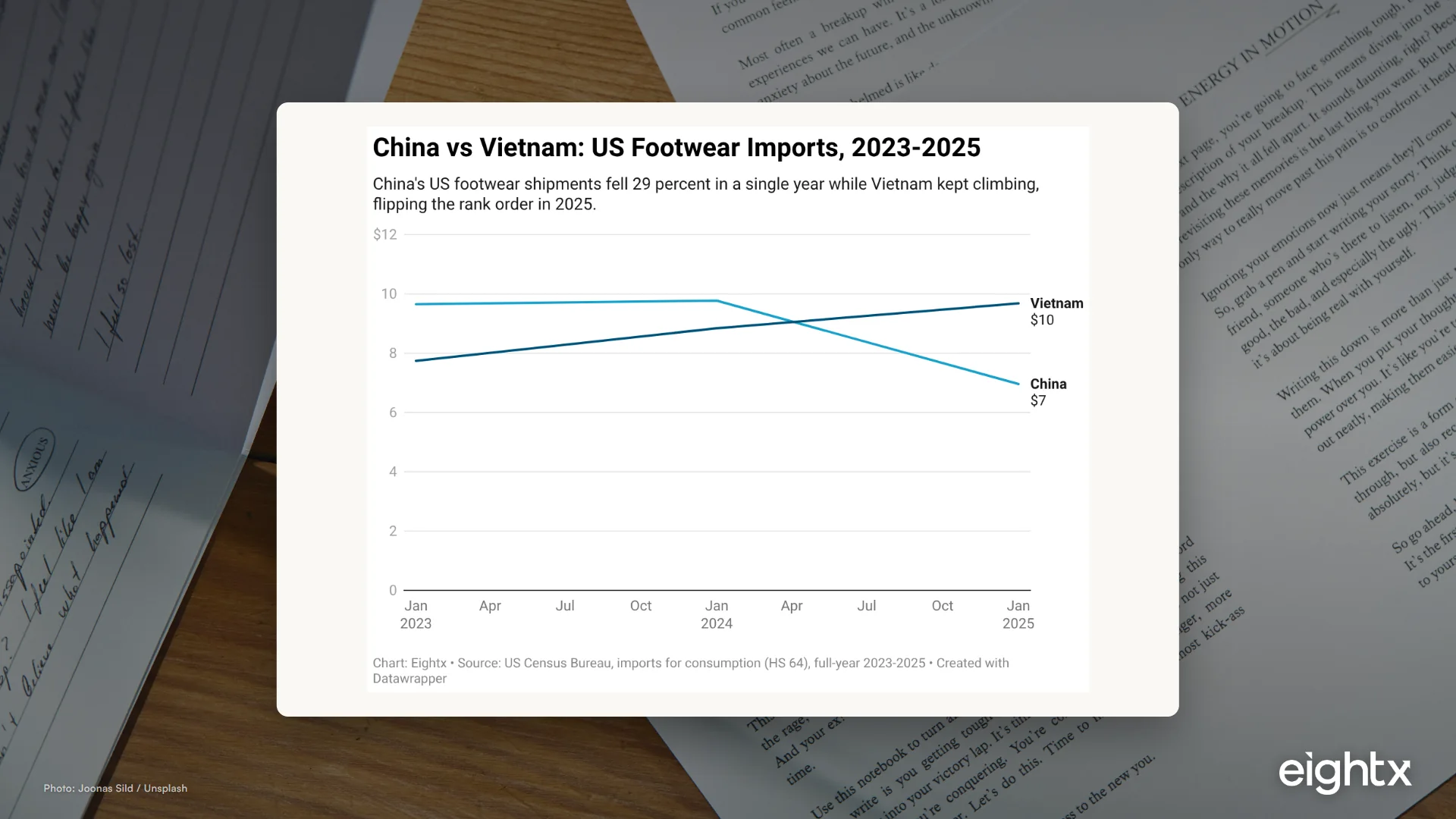
- 2025 was the year China lost the #1 spot. China's footwear shipments fell 29 percent in one year, from 9.77 billion dollars to 6.96 billion, while Vietnam climbed to 9.68 billion.
- In 2026 most origins pay base MFN duty plus a uniform 10 percent Section 122 surcharge; China stacks an extra Section 301 duty of 7.5 to 25 percent depending on the product list.
- Base MFN footwear duties range from near zero to about 48 percent, so the HS line matters as much as the country.
- The next risk is proposed forced-labor Section 301 duties on Cambodia (10 percent) and India (12.5 percent), not yet collected as of June 2026.
Ask a shoe brand where its product is made and most will say "China and a backup factory." Ask the customs broker, and you get the number that actually changed in 2026: for the first full year on record, China was not the largest source of US footwear. Vietnam was, by a wide margin, and China's shipments did not just slip. They fell 29 percent in a single year.
That re-sort is not trivia. It decides your landed cost in 2026, because the duty load now lands very differently on China than on Vietnam, Indonesia or Italy. If your sourcing map and your duty math are not stitched together, you are flying your gross margin blind. Here is where US shoes actually come from, what each origin costs in duty this year, and what to do about it before your next purchase order.
The year China lost the shoe lead
We pulled full-year US import-for-consumption data from the Census Bureau for HS chapter 64, the code that covers footwear and parts, for 2023, 2024 and 2025. The trend is sharper than any static snapshot. China shipped 9.65 billion dollars of footwear in 2023 and 9.77 billion in 2024, comfortably the leader both years. In 2025 it collapsed to 6.96 billion, a 28.8 percent drop in twelve months. Vietnam, meanwhile, climbed from 7.74 billion (2023) to 8.84 billion (2024) to 9.68 billion (2025) and took the top spot.
That is a rank flip the duty stack is now locking in. When I talk to founders running a footwear brand this size, the thing they keep saying is that their peers who still manufacture in China are "basically panicking" as the stacked duties hit, because almost everyone they know sources from China and is having the same pricing conversation at the same time. The data says the smartest of them moved volume a year early. The crowd is moving now.
Where US footwear actually comes from
Zoom out to the full 2025 origin mix and the concentration in Southeast Asia is more extreme than most founders assume. Total US footwear imports came to 26.6 billion dollars, down 2.6 percent from 2024. Vietnam took 36.3 percent, China 26.1 percent, Indonesia 11.2 percent. Italy holds the high-value leather and luxury lane at 7.4 percent, Cambodia is the next diversification hub at 5.0 percent, and India, often cited as the next big shoe origin, was still under 2 percent.
The product mix matters as much as the country. By 4-digit line, leather-upper shoes (HS 6403) are the biggest category at 11.22 billion dollars (42 percent), ahead of textile-upper sneakers and canvas (HS 6404) at 7.85 billion (29 percent) and rubber or plastic molded footwear (HS 6402) at 6.19 billion (23 percent). This mirrors the broader sourcing map we built across consumer categories in our DTC import origins by category hub, where Vietnam also leads apparel and furniture.
The 2026 duty stack, by origin
Knowing the origin mix only matters once you layer the tariff on top, and in 2026 the tariff is not one number. It is a stack with three parts.
- The base MFN (most-favored-nation) duty, set by the exact 10-digit HS line. For footwear this ranges from near zero to about 48 percent depending on material and construction, with a chapter average near 11 to 12.5 percent.
- A uniform 10 percent Section 122 surcharge that applies to essentially all non-USMCA footwear imports regardless of origin. It took effect February 24, 2026 after the earlier IEEPA "reciprocal" tariffs were struck down by the Supreme Court that month, and it is statutorily temporary (a 150-day window scheduled to lapse around July 24, 2026 unless extended).
- A Section 301 duty that applies to Chinese goods only. Here is the nuance the headlines get wrong: most footwear sits on List 4A at 7.5 percent, not the 25 percent that applies to goods on Lists 1 and 3. So the "55 percent all-in" number you see quoted only holds for the higher-list products.
The practical result: every origin on your map pays its base rate plus 10 points, and China pays an additional 7.5 to 25 points on top of that. The China premium over a comparable Vietnamese shoe is roughly 7.5 to 25 percentage points once the stack clears, depending entirely on which Section 301 list your specific style lands on.
| Origin | 2025 import share (HS 64) | 2026 duty treatment over base MFN |
|---|---|---|
| Vietnam | 36.3% | +10% Section 122, no country-specific add-on |
| China | 26.1% | +10% Section 122 plus Section 301 (7.5% List 4A footwear, up to 25% on Lists 1/3) |
| Indonesia | 11.2% | +10% Section 122, no country-specific add-on |
| Italy / EU | 7.4% | +10% Section 122, no country-specific add-on |
| Cambodia | 5.0% | +10% Section 122, proposed +10% forced-labor 301 (not yet in effect) |
| India | 1.9% | +10% Section 122, proposed +12.5% forced-labor 301 (not yet in effect) |
The base rate inside that stack swings wildly by HS line, which is why two factories in the same country can carry completely different duty.
| Product | HS code | Base MFN duty |
|---|---|---|
| Leather knee-high boots | 6403.20 | ~6% |
| EVA / plastic clogs | 6402.99 | 9% |
| Textile-upper athletic shoe | 6404.19.90 | 9% |
| Rubber / rain boots | 6401.92 | 37.5% |
| Chapter 64 average | 64 | ~11-12.5% |
What this does to landed cost
Put real numbers on it. Take a synthetic athletic shoe with a 20 percent base MFN rate and a 30 dollar FOB cost. Out of Vietnam it lands at roughly 30 percent all-in duty (20 plus 10), or 9.00 dollars per pair. Out of China the same shoe lands at 37.5 percent if it sits on List 4A (20 plus 10 plus 7.5), which is 11.25 dollars per pair, and at 55 percent if it falls on a higher list (20 plus 10 plus 25), which is 16.50 dollars per pair. The per-pair China premium is therefore 2.25 dollars at the low end and 7.50 dollars at the high end.
For a brand moving 200,000 pairs a year, that premium is 0.45 million to 1.5 million dollars in extra annual duty, purely on origin, before you touch freight or the merchandise processing fee. When founders this size call us, the first thing we do is build that exact model, because the headline tariff rate is almost meaningless until you weight it by where you actually buy and which list your styles sit on. The same dynamic shows up across categories in our work on the DTC tariff exposure index.
One more trap we see constantly: the duty is owed at entry, in cash, when the container clears customs. Operators repeatedly flag a 30,000 dollar duty bill landing at port with no warning on the timing. You cannot claw that back from a customer who already paid the old price, which is why re-pricing has to happen before the PO, not after the goods land.
The new 2026 risk: forced-labor 301 on India and Cambodia
If your diversification plan leans on India or Cambodia, watch USTR closely. On June 2, 2026 it proposed additional Section 301 duties on 60 economies for failing to enforce forced-labor import bans: Cambodia at 10 percent and India at 12.5 percent. These are not collected yet. The comment deadline was July 6 and hearings were set for July 7, 2026, so the rates are proposed, not in effect.
But this is exactly the lane brands just moved into. India's full-year footwear imports reached 502 million dollars in 2025, and the origin is climbing fast as diversification volume routes its way. The pattern we see again and again is that a brand reroutes out of China, congratulates itself, and discovers the new origin carries its own emerging duty risk. And rerouting to dodge China duties does not work the way founders hope: send a China-made shoe through Canada or Mexico and back into the US, and you still pay the China tariff, because the product still says made in China. Build the contingency into your model now rather than discovering it on a landed invoice.
What to do about it
Here is how I would run this if footwear were your category.
- Pull your own origin mix by 10-digit HS line, not by vendor name. We have watched brands sourcing components through a middleman with no clarity on how much tariff they were actually absorbing. Two factories in the same country can sit on different HS lines with very different base rates.
- Build a landed-cost model that adds base MFN plus the 10 percent Section 122 plus, for China only, the correct Section 301 rate for that product's list. Recompute gross margin per SKU at the new stack, and fold in freight mode while you are at it, because the choice between air and sea freight swings both cash and margin as hard as a tariff line does.
- Quantify the China premium per pair and per year. If it is six or seven figures, a sourcing shift pays for itself fast even after factory qualification costs.
- Stress-test India and Cambodia scenarios with the proposed forced-labor 301 added (12.5 percent and 10 percent). Part of our scope when we forecast for a brand is building three versions, because if the tariffs come into play your pricing is very different than if they do not. A point estimate is useless when the real problem is volatility.
- Re-price or re-spec before the next PO. One brand we work with raised US shipping from 35 to 45 dollars and "haven't had a peep," so demand is often less elastic than founders fear. Test the pass-through rather than absorbing the whole duty into margin.
Stop sourcing by vendor name and start modeling landed cost by HS line and country of origin. The headline tariff rate is meaningless until you weight it by where you actually buy and which Section 301 list your styles land on. China is no longer the default, but moving volume without remodeling margin just trades one blind spot for another.
Related reading. For how these tariff costs hit specific footwear P&Ls, see our Steve Madden teardown and our Wolverine World Wide teardown.
Sources and methodology
Import figures are full-year imports-for-consumption value (CON_VAL_YR) for HS chapter 64, pulled from the US Census Bureau International Trade API for 2023, 2024 and 2025. The December reading of each year is the full calendar-year cumulative. Country shares are each country's value divided by the 26.6 billion dollar 2025 total, with the "total for all countries" line used as the denominator. The "all other countries" residual (2.07 billion dollars, 7.8 percent) is the total minus the eight named origins.
The 4-digit product breakdown (HS 6402, 6403, 6404, 6405) is pulled from the same source for full-year 2025. Leather uppers (6403) lead at 11.22 billion dollars, ahead of textile uppers (6404) at 7.85 billion and rubber or plastic (6402) at 6.19 billion.
The 2026 duty treatment reflects three measures. The 10 percent Section 122 surcharge took effect February 24, 2026 under Section 122 of the Trade Act of 1974, per Federal Register notice 2026-03824 (91 FR 9339); it is a temporary 150-day measure scheduled to lapse around July 24, 2026 unless extended. It replaced the IEEPA "reciprocal" tariffs the Supreme Court struck down February 20, 2026 in Learning Resources, Inc. v. Trump. Section 301 and Section 232 measures were not affected by that ruling.
Section 301 duties on Chinese footwear are drawn from the USTR Section 301 China program. Most footwear sits on List 4A at 7.5 percent; the 25 percent rate applies to Lists 1 and 3. We present this as a range rather than a single number because the all-in load depends on each style's list assignment.
Base MFN rates are illustrative ranges; the exact rate depends on the full 10-digit subheading (material, construction, value and gender), drawn from the 2026 HTSUS Chapter 64 and CBP rulings. The proposed forced-labor Section 301 duties on Cambodia (10 percent) and India (12.5 percent) come from USTR's June 2, 2026 determination and Federal Register notice 2026-11296; as of June 2026 they are proposed, not collected. Census import value is the customs value of the goods, not duty paid; the duty figures here are modeled from MFN plus surcharge logic. For broader sibling context see our work on the apparel import shift.
Frequently asked questions
where does the us import most of its footwear from?
Vietnam. In 2025 Vietnam supplied 36.3 percent of US footwear imports by value, ahead of China at 26.1 percent and Indonesia at 11.2 percent. China was the long-time leader but fell to second in 2025.
did china stop being the biggest shoe supplier to the us?
Yes, in 2025. China's US footwear imports fell from 9.77 billion dollars in 2024 to 6.96 billion in 2025, a 29 percent drop in one year, while Vietnam rose to 9.68 billion and took the top spot.
what are the 2026 us tariffs on footwear from china?
There is no single rate. Chinese footwear pays its base MFN duty plus a 10 percent Section 122 surcharge plus a Section 301 duty. Most footwear sits on List 4A at 7.5 percent, but goods on Lists 1 and 3 carry 25 percent, so the all-in load varies by product.
is the section 301 rate on chinese footwear 25 percent or 7.5 percent?
Usually 7.5 percent. Most footwear is on Section 301 List 4A, which carries 7.5 percent, not the 25 percent that applies to Lists 1 and 3. The headline 55 percent all-in figure only holds for the higher-list goods, so check your exact HS line.
is it cheaper to import shoes from vietnam than china in 2026?
Usually, yes. Vietnam pays MFN plus the uniform 10 percent Section 122 surcharge but no China-specific Section 301 duty, so it avoids the 7.5 to 25 point premium China carries. Run the math by HS line because base rates vary widely.
which footwear origins face new 2026 tariff risk?
Cambodia and India. On June 2, 2026 USTR proposed Section 301 forced-labor duties of 10 percent on Cambodia and 12.5 percent on India, among 60 economies. As of June 2026 these are proposed, not yet collected by CBP.
how do i figure out the real landed cost of my shoes by country?
Pull your origin mix by 10-digit HS line, not by vendor name. Add base MFN, the 10 percent Section 122 surcharge, and for China only the Section 301 rate for that product's list, then recompute gross margin per SKU.