
eCommerce
Packaging cost squeeze 2026: glass +44%, aluminum cans +39%, corrugated +30% since 2020
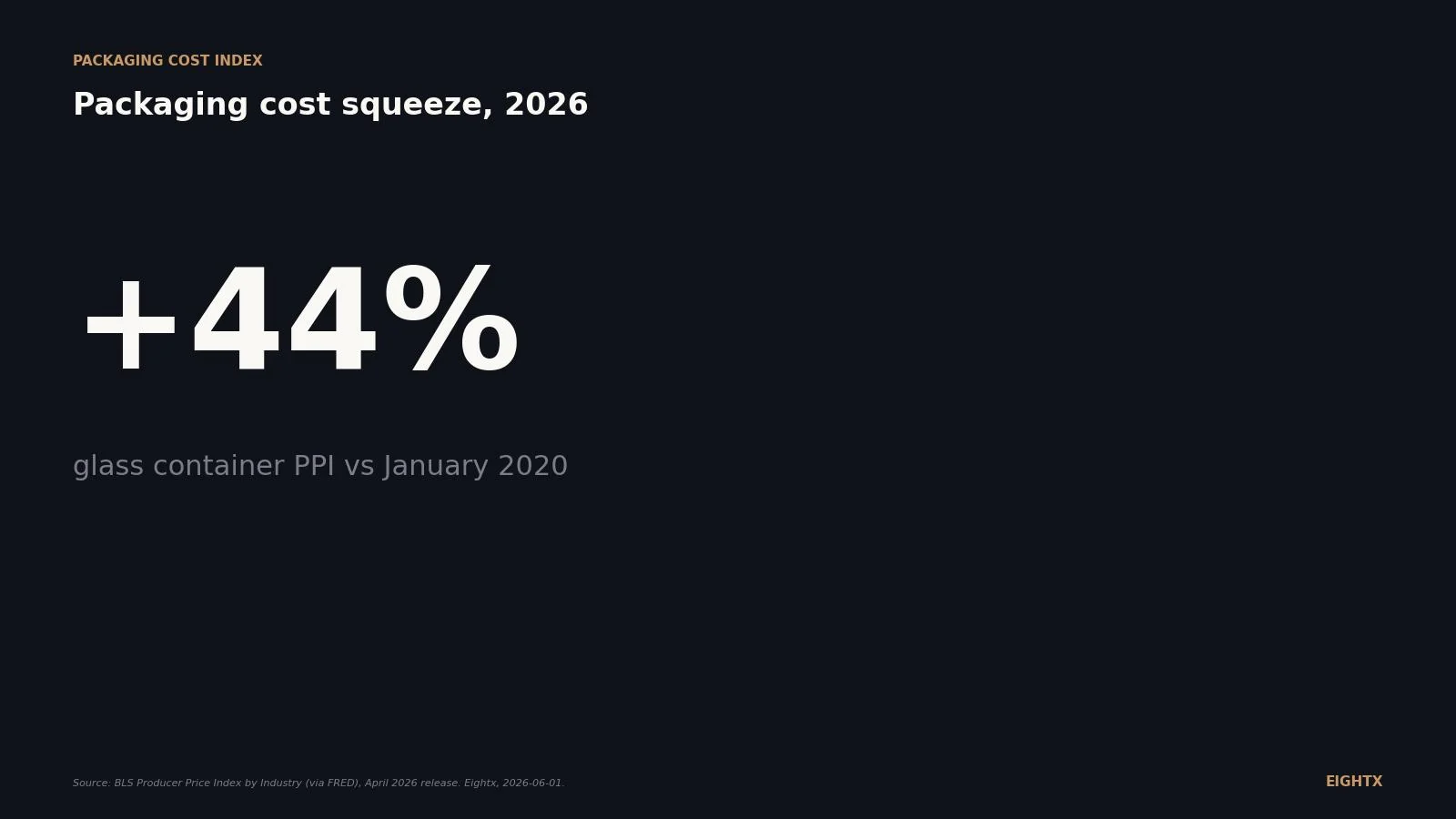
Every major packaging substrate is up 30% or more since January 2020, per BLS PPI data through April 2026. Glass containers sit at plus 43.8%, aluminum cans at plus 39.2% (with a 10.8% year-over-year jump in 2026 driven by Section 232 tariffs and tight converter capacity), plastic film and bag at plus 36.9%, and corrugated paperboard at plus 30.0%. The 90-day window before Q4 freight surcharges land is the renegotiation moment, not the contract-renewal anniversary.
Key Takeaways
- Glass containers are up 43.8% since January 2020 (BLS PPI, April 2026). Ardagh and O-I Glass run the category and have held headline pricing flat through 2025 to 2026; the cumulative move is the story.
- Aluminum cans jumped 10.8% year-over-year through April 2026, the steepest YoY move of any packaging substrate. Section 232 tariff re-imposition plus tight North American converter capacity is the driver.
- Corrugated paperboard is the calmest line at +1.0% YoY post-Smurfit-WestRock merger. The merged converter pitches optimization (cube reduction, fewer SKUs) instead of headline discounting. That window will close.
- Plastic film and bag PPI accelerated to +7.4% YoY in April 2026, with a +4.7% single-month jump in April alone. That hits every poly mailer, bubble mailer, and shrink-wrap line item on your fulfillment invoice.
- Sustainable packaging premiums for 2026 are not flat. PCR plastic runs +5% to +15% over virgin. Paper-based beverage bottles run +10% to +30%. Treat the upgrade as a P&L project with measurable AOV or retention return, not a brand project.
If you run a DTC brand, the packaging line on your COGS is up double-digits since 2020 across every substrate you might use. We pulled the BLS Producer Price Index for the four packaging materials that matter most (glass containers, aluminum cans, corrugated paperboard, and plastic film and bag) and rebased each series to January 2020 = 100. Every line is up between 30 and 44 percent as of April 2026. This page is the operator read on what's driving each number, where the breakouts are, and what to do before Q4 freight surcharges land on top.
The numbers: every packaging substrate is up 30%+ since 2020
The BLS Producer Price Index by Industry tracks what packaging manufacturers charge their direct buyers (your contract converter, your bottle supplier, your can-maker). It is the cleanest public read on packaging input cost direction. The four series that matter for a DTC operator (glass containers, aluminum cans, corrugated paperboard, plastic film and bag) all sit 30 to 44 percent above January 2020 levels.
Rebasing each series to Jan 2020 = 100 lets you see the relative move in one chart. Glass has run furthest from base, plastic film and corrugated are tightest to the line. Aluminum is the one that broke out in 2026.
The data table below shows the April 2026 snapshot.
Substrate BLS series ID Apr 2026 index % change since Jan 2020 YoY % change Glass containers PCU3272133272130 220.672 +43.8% +2.9% Aluminum cans PCU3324313324313 167.046 +39.2% +10.8% Plastic film and bag PCU3261132611 213.877 +36.9% +7.4% Corrugated paperboard PCU32221132221105 390.067 +30.0% +1.0%
The headline read: the substrate decision is not the lever. Every option is up 30 percent or more cumulatively. The lever is right-sizing, contract structure, and category positioning on the premium versions. If packaging is meaningfully eroding your gross margin, the 90-day window before Q4 surcharges is the negotiation moment.
The 2026 breakout: aluminum cans +10.8% YoY, plastic film accelerating
Aluminum cans printed the steepest YoY move of any packaging substrate at +10.8 percent through April 2026. Glass, corrugated, and plastic film all stayed under 8 percent. The aluminum number is what you'd expect from a category absorbing reported Section 232 tariff re-imposition on top of already-tight North American converter capacity, where industry reporting through 2024 to 2026 flagged limited new line additions across the major producer set. If you can your product, treat your 2026 renewal as the hardest conversation on the calendar and check our tariff impact on DTC margins coverage for category benchmarks.
Plastic film and bag is the under-the-radar story. The series accelerated from a flat 2024 to +7.4 percent YoY in April 2026, with a +4.7 percent single-month move in April alone (204.406 to 213.877). That is the largest one-month move in the series since 2022. If your fulfillment line items include poly mailers, bubble mailers, or shrink-wrap, the April invoice is the warning shot. Q4 will be worse if it sticks.
The macro context behind both moves is the BLS final demand goods print at +6.0 percent YoY through April, with transportation and warehousing services up 5.0 percent in a single month. Your packaging supplier is paying more for inputs and more to move them. Pass-through arrives next quarter unless you have a contract lock. See our freight cost FRED vs SEC shipping breakdown for how the surcharge cycle has moved through 2025 to 2026.
Why glass and corrugated stayed (relatively) calm, and why that's not durable
Glass at +2.9 percent YoY and corrugated at +1.0 percent YoY look like quiet lines. The reason isn't slack capacity. It's vendor consolidation.
Glass is dominated by Ardagh Group, O-I Glass, and Verallia. Three names, limited price competition at sub-volume DTC accounts, and a pricing book that holds list flat across long renewal windows. The 43.8 percent cumulative move since 2020 is what they extracted in 2021 to 2023; they're now holding the line at the new base.
Corrugated tells the same story with a different name. The Smurfit Kappa plus WestRock merger closed in 2024 and Smurfit Westrock has spent 2025 to 2026 repositioning as a "supply chain optimization partner" rather than a commodity box seller. The pitch you'll hear in renewal: we'll cube-reduce your existing cartons, consolidate your SKUs, and run the freight math. The pitch you won't hear: a list price cut. That posture suppresses headline price competition. It does not mean your dollar cost falls.
The window where corrugated stays at +1 percent YoY closes when either (a) a regional converter consolidates with a national, or (b) freight surcharges land and the merged company decides to take pricing instead of absorbing the input cost. Plan for +2 to +4 percent on corrugated by Q4 2026 even if the headline series stays calm through summer.
The sustainable-packaging premium reality check
If a brand or sustainability lead is pushing for a packaging substrate swap in 2026, the premium math matters. Treating sustainability upgrades as a P&L project (with AOV or retention return measured) rather than a brand project is the only way the numbers work.
Format Premium vs standard Typical use case PCR plastic bottles and jars +5% to +15% Beauty, personal care Higher-cullet glass +1% to +5% Beverage, spirits Paper-based bottles +10% to +30% Beverage (niche) Aluminum cans (high recycled content) Embedded (~0%) Beverage Recyclable mono-material pouches 0% to +10% Food, CPG Recycled-content corrugated 0% to +5% Ecommerce shippers
The cheapest sustainable swap is recycled-content corrugated at 0 to 5 percent over standard. The most expensive is paper-based bottles at +10 to +30 percent. PCR plastic sits in the middle at +5 to +15 percent, down from +20 to +30 percent in 2022 but not at parity.
Extended Producer Responsibility (EPR) fee schedules in California, Oregon, and Colorado start hitting in 2027. The fee structures penalize non-recyclable packaging on a per-pound basis. If you sell into those states, the 2027 EPR fee starts compressing the PCR premium net of avoided fees. Model the breakeven on your SKUs before you commit to a multi-year contract on virgin resin.
What to do this quarter: five plays
If packaging is more than 5 percent of your COGS, the next 90 days are the negotiation window before Q4 freight surcharges land. Five plays we run with operator clients.
Right-size your cartons. Five to fifteen percent of corrugated plus dim-weight freight combined, depending on how bad your current carton mix is. If you ship more than three SKUs out of two carton sizes, you are paying for air. Smurfit Westrock will run the audit for free; get a regional converter to bid the same spec before you sign.
Move custom-mold glass to catalog molds. Custom glass molds carry tooling amortization, longer lead times, and supplier lock-in. A catalog mold at Ardagh or O-I that's "close enough" cuts unit cost 8 to 15 percent and lets you split-source. Brand purity loses a small thing. Margin gains a real thing.
Sign 12-month locks before mid-June. The next BLS PPI release lands on June 12 and the negotiation cycle restarts. Lock pricing now on a 12-month basis. Push for index-linked contracts above a freight surcharge cap; suppliers want the upside protection, you want the cap.
Upgrade PCR only where retention math covers the premium. Run the AOV and 90-day retention test on PCR versus virgin for one SKU before you commit the whole catalog. If repeat rate moves more than 2 percentage points, the +5 to +15 percent premium pays back. If it doesn't move, the upgrade is brand spend.
Get your 2027 forward in the room. Suppliers will trade a small 2026 concession for a 2027 commitment because their planning teams want certainty more than yours do. The trade is worth 2 to 4 percent on the 2026 contract. If you want a fractional CFO to run the negotiation math with you, that is the call we take all day.
The substrate decision is not the lever in 2026. Every option is up 30 percent or more cumulatively. The lever is right-sizing, contract structure, and a sustainability premium budget that earns its return. Operators who treat packaging as a 90-day P&L project save 8 to 15 percent. Operators who treat it as a brand project pay the index.
Sources and methodology
BLS Producer Price Index by Industry. Four series were pulled from January 2020 through April 2026 via the FRED public mirror of BLS data: PCU3272133272130 (glass container manufacturing, including value of packaging), PCU3324313324313 (aluminum cans including lids, ends, and parts shipped separately), PCU32221132221105 (corrugated paperboard in sheets and rolls, lined and unlined), and PCU3261132611 (unsupported plastics film, sheet, and bag manufacturing). All four series are not seasonally adjusted. The PPI publishes preliminary monthly values that are revised for up to four months, so April 2026 numbers will be revised through August 2026.
Index rebasing. Chart 1 rebases each substrate series to January 2020 = 100 via the transformation (value / Jan-2020 value) × 100. This lets all four substrates be read on one axis despite different BLS reference periods. Year-over-year percent change in the table and Chart 2 is computed as (Apr 2026 value / Apr 2025 value) - 1.
BLS PPI April 2026 release context. Final-demand goods PPI ran +6.0 percent year-over-year through April. Transportation and warehousing services posted +5.0 percent in a single month, which is the leading indicator for packaging-supplier freight pass-through. Both pulled from the BLS news release for April 2026 (bls.gov/news.release/ppi.htm).
Sustainable packaging premium ranges. Perplexity Sonar Pro research from May 2026 was cross-checked against Sustainable Packaging Coalition policy roundup material. PCR plastic +5 to +15 percent, paper-based bottles +10 to +30 percent, recycled-content corrugated 0 to +5 percent. These are 2026 ranges and have compressed materially from 2022 highs.
Limitations. The BLS PPI measures producer prices at the converter level, not the contract prices DTC brands pay. DTC brands at sub-100k unit volumes typically pay a 10 to 25 percent surcharge over PPI-tracked base prices due to MOQ penalties, decoration, and distributor margin. There is no public BLS series for "ecommerce poly mailer specifically." PCU3261132611 (unsupported plastics film, sheet, and bag) is the closest proxy and is what most beauty and CPG brands' poly-mailer contracts track to. Section 232 aluminum tariff timing was inferred from triangulated research; verify with the USTR before quoting specific tariff percentages.
Update cadence. BLS PPI updates monthly around the 13th. This page refreshes quarterly (January, April, July, October posts) to match the release cycle and prevent stale data. Next update target: late July 2026 for the June PPI print.
Frequently asked questions
how much have ecommerce packaging costs gone up since 2020?
Every major substrate sits 30 to 44 percent above January 2020 levels as of April 2026. Glass containers are up 43.8%, aluminum cans 39.2%, plastic film and bag 36.9%, corrugated paperboard 30.0%. These are BLS Producer Price Index numbers, so they track what packaging makers charge their buyers, not retail container prices. DTC brands at sub-100k unit volumes typically pay another 10 to 25 percent on top of that for MOQ penalties, decoration, and distributor margin.
why did aluminum can prices jump in 2026?
Two reasons stacking. Section 232 aluminum tariffs are reportedly back in force per industry coverage (verify the specific rate with USTR before quoting it), and North American can converter capacity is tight after a decade of underinvestment. The result was a +10.8% YoY move through April 2026, more than triple the rate for glass or corrugated. If you can your product, your 2026 renewal is the hardest conversation of the year.
is corrugated box pricing going to drop in 2026?
Probably not. Corrugated paperboard is the calmest line at +1.0% YoY, but the reason is consolidation, not slack capacity. Smurfit Kappa and WestRock merged in 2024 and the combined company is pitching optimization (right-sizing, fewer SKUs, cube reduction) instead of headline discounts. That posture holds list pricing flat. It does not mean prices fall. Plan for flat to +2% on corrugated through 2026, and use the optimization door to take real volume out.
how much extra does PCR plastic packaging cost vs virgin?
Plus 5% to plus 15% in 2026, depending on resin (HDPE versus PET versus PP), recycled content percentage, and volume. The premium has compressed from the 20 to 30 percent range you saw in 2022, but it has not gone to zero. Treat the upgrade as a P&L project with measurable AOV or retention return, not a brand project. Extended Producer Responsibility fee avoidance in CA, OR, and CO starts narrowing the gap further in 2027.
should i switch from glass to aluminum to save on packaging?
Probably not on cost alone. Glass is up 43.8% since 2020, aluminum cans 39.2%. The headline gap is small and the YoY direction is the opposite: aluminum is accelerating, glass is calmer. Switch substrate for shipping weight, breakage, sustainability positioning, or shelf differentiation, not to chase a packaging cost spread that mostly closed in Q1 2026.
what's the cheapest sustainable packaging option in 2026?
Recycled-content corrugated, at 0 to 5 percent over standard. Aluminum cans already embed high recycled content with effectively no premium. The expensive options are paper-based beverage bottles at +10 to +30 percent and lightweight PCR plastic at +5 to +15. Match the substrate to the channel: corrugated for shippers, aluminum where the format fits, save PCR upgrades for the SKUs where retention math covers the premium.
how do i lock in packaging pricing before Q4?
Three moves. First, sign 12-month locks now before BLS PPI prints the next release in mid-June and starts another negotiation cycle. Second, ask for index-linked contracts with a freight surcharge cap. Suppliers like the protection on input prices, you like the cap on the upside. Third, get your 2027 forward in the room. Suppliers right now will trade a small 2026 concession for the 2027 commitment. They want planning certainty more than you do.
how much can i save by right-sizing my shipping cartons?
Five to fifteen percent of corrugated and dim-weight freight combined, depending on how bad your current carton mix is. If you ship more than three SKUs out of two carton sizes, you are paying for air. Smurfit Westrock will run the audit for free and propose new dies. The catch is they price the new cartons. Get a second quote from a regional converter before you sign the optimization deal.