
Cash Flow
Payment Processor Payout Timing and Cash Flow: The Money Shopify, Stripe, and PayPal Hold
Payment processors hold your cash two ways: a payout lag of about 2 business days at Stripe and 2 to 5 business days in the US at Shopify Payments, and a rolling reserve withholding 5 to 15 percent of sales for 30 to 180 days. A growing 20M brand on a 10 percent, 90-day reserve has roughly 493K parked at the processor, on top of payout float.
Key Takeaways
- Stripe pays out on a roughly 2 business day rolling delay and Shopify Payments in about 2 to 5 business days in the US; new accounts wait 7 to 14 days for a first Stripe payout and up to 21 days for PayPal funds (Stripe Docs, Shopify Help, PayPal Help).
- A rolling reserve withholds 5 to 15 percent of every sale for 30 to 180 days; the money is still yours but it sits as restricted cash until the window closes (Eightx).
- A 20M brand on a 10 percent, 90-day rolling reserve has about 493K locked at the processor at steady state, plus roughly 219K of payout float.
- Payout lag is a one-time fixed float you set once; a rolling reserve scales with revenue, so it gets bigger exactly as you grow.
- The fatal error is booking reserved cash as collected revenue in your forecast, then wondering why payroll is tight on a record month.
Every ecommerce founder watches revenue. Almost none of them watch the gap between when a sale closes and when the cash is actually usable. That gap is where payment processors quietly sit on your money, and at scale it is large enough to force a line of credit draw on a month you grew.
There are two separate mechanics at work, and operators routinely confuse them. The first is payout lag: the normal couple of days between a customer's card clearing and the money landing in your bank. The second is a rolling reserve, where the processor withholds a slice of every sale for months. One is a small fixed float. The other grows with you. Let me walk through both the way I do it on a founder call, then show you the cash impact on a growing brand.
When I talk to founders running a brand this size, what they keep saying is that they spend more time managing treasury than they should, simply because the cash is thinner than the revenue suggests. They are reconciling a Stripe balance, an undeposited Shopify balance, and a reserve line every single week, and none of it shows up cleanly in the bank account. That gap is not a rounding error. It is real working capital sitting on someone else's balance sheet.
Payout lag: the float you fund once
When a customer pays, the money does not appear in your bank that night. Stripe runs a rolling payout delay of roughly 2 business days for standard, lower-risk US accounts, while Shopify Payments lands US payouts in about 2 to 5 business days after a sale, with 2 days as the regional minimum a settled account drifts toward (Stripe Docs, "Receive payouts"; Shopify Help Center, "Payout timing"). A Monday sale typically lands midweek to late in the week. Payouts settle on business days only, so a Friday-through-Sunday weekend of sales does not start moving until the following week, and bank holidays push it further.
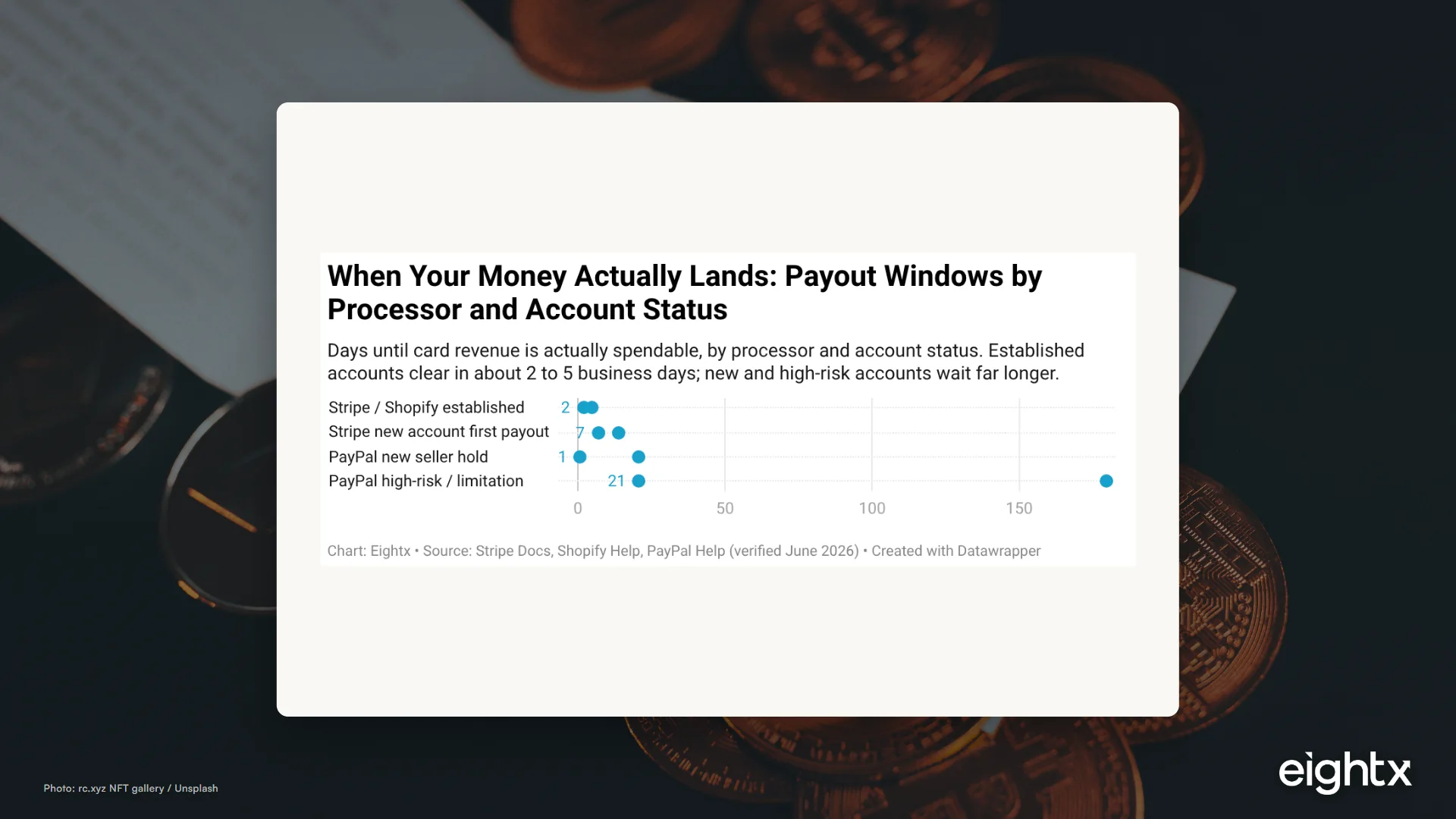
New accounts wait longer. Stripe holds a brand new account's first payout for 7 to 14 days after the first live payment (Stripe Docs, "Receive payouts"). PayPal is the harshest: a new seller's funds can be held up to 21 days, released sooner only if you add tracking and the courier confirms delivery, or 7 days after you mark a service order complete (PayPal Help, "New seller payments on hold").
The thing to understand about payout lag is that it is a one-time float. Once you are past the new-account window, the lag is constant, so you fund it once and it stays roughly fixed in dollar terms relative to your daily sales. Annoying, predictable, manageable.
The chart above is the part new founders underestimate. An established account on Stripe or Shopify is the friendly 2-to-5-day band. A brand new PayPal account is a different planet: funds can sit up to 21 days, and a high-risk limitation can stretch a hold to 180 days. The table below lays out the same windows with the per-processor caveats.
| Processor | Standard payout delay | New-account / first payout | Notes |
|---|---|---|---|
| Stripe | ~T+2 business days | 7-14 days (up to 30 high-risk) | Non-waivable first-payout hold; business days only |
| Shopify Payments | 2-5 business days (US) | Longer initially, decreases to regional minimum | Plus 1-3 bank days to appear; Shopify Balance can land in ~1 business day |
| PayPal | Varies by account | Up to 21 days | Released ~24h after delivery confirmation; 7 days after marking a service complete |
Rolling reserves: the float that grows with you
A rolling reserve is a different animal. The processor withholds a percentage of every sale, commonly 5 to 15 percent, and holds it 30 to 180 days before releasing it (Eightx, "What is a payment reserve rollover"). On a $100 sale at a 10 percent reserve with a 90-day release, $90 hits your bank on the normal payout schedule and $10 books into the reserve, available on Day 91 if no chargebacks or refunds ate into it.
Each processor runs it slightly differently. Shopify Payments documents reserves as temporary percentage-based or fixed-amount holds, with the unused portion returned at the end of the period. PayPal runs both a rolling reserve (a percentage of daily transactions, released on schedule) and a flat minimum reserve. Stripe sets reserves per-account in the underwriting agreement with no public percentage range, triggered when its risk team flags elevated exposure (Eightx, "What is a payment reserve rollover"). One thing to be clear on: not every brand carries a rolling reserve. Reserves are risk-triggered and set per-account, so a brand on a clean, low-dispute Stripe or Shopify account may never see one. The scaling figures below are what a reserve costs you if you have one, not an inevitable tax on growth.
Here is why a reserve is so much more dangerous to cash than payout lag: it scales with revenue. The dollars parked equal your daily sales times the reserve percentage times the holding period. Grow your revenue and the trapped cash grows in lockstep, at exactly the moment you most need cash for inventory and ad spend.
The cash-timing impact on a growing brand
Put numbers on it. Take a brand moving from $5M to $50M, fund payout float at a 4 calendar day lag, and assume it picks up a rolling reserve somewhere past $5M as it adds subscriptions and volume. The cash parked at the processor goes from a rounding error to something that distorts the whole balance sheet.
At $5M with no reserve, you are funding about $55K of payout float and nothing else. At $20M with a 10 percent, 90-day reserve, you have roughly $219K in transit plus about $493K of restricted reserve cash, over $700K you cannot touch. At $50M on an 8 percent reserve, the reserve alone approaches $1M. That is real working capital, sitting on Stripe's or Shopify's balance sheet instead of yours, and it lengthens your cash conversion cycle by adding days between the sale and usable cash.
The pattern we see again and again is that this trapped cash bites hardest on the brands that are growing fastest. When a brand is already holding inventory from purchase to cash collection for six or seven months, and then you add a reserve that parks another few hundred thousand on top (about $493K in the $20M, 10 percent case above), the cash conversion cycle gets long enough to be dangerous. We have sat with founders running 250 days of inventory whose real problem was not profit, it was that almost none of their cash was usable when they needed it. Trapped processor cash is the same disease in a different organ.
| Brand revenue | Payout float (4-day lag) | Rolling reserve | Total cash held |
|---|---|---|---|
| $5M (no reserve) | ~$55K | $0 | ~$55K |
| $20M (10%, 90 days) | ~$219K | ~$493K | ~$712K |
| $50M (8%, 90 days) | ~$548K | ~$986K | ~$1.53M |
This cash is not free to leave parked, either. With the bank prime loan rate at 6.75 percent in June 2026 (FRED, Bank Prime Loan Rate), financing a $712K trapped balance on a line of credit runs roughly $48,000 a year in interest, and the $50M brand's ~$1.53M trapped costs about $103,000 a year. Prime averaged 3.25 percent back in 2021, so the cost of leaving cash at your processor instead of in your business has roughly doubled. When I talk to founders this size, that annual carrying number is usually what makes them finally chase a reserve review.
The mistake that breaks the forecast
The error I see most is booking reserved cash as if it were collected. The order closes, the bank balance moves up by 90 percent of the sale, and the withheld 10 percent never appears anywhere because nobody marked it as restricted. Three months later the founder is asking why payroll is tight on a record month. The cash is real, but it is at the processor.
This is the same failure mode that wrecks a 13-week cash flow forecast built on order dates instead of payout dates. If your model assumes Monday's sales are spendable Monday, you are overstating available cash by the entire payout lag every single week, before you even account for reserves. The bigger and faster-growing the brand, the bigger the lie.
What to do about it
- Time every card inflow by payout date, not order date. Shift each week's card revenue forward by your actual payout lag (about 2 business days for Stripe, 2 to 5 in the US for Shopify) in your 13-week cash flow forecast.
- Mark reserve balances as restricted cash on the balance sheet. Open a "Stripe reserve" or "Shopify reserve" asset account. Never net it out of revenue.
- Model a new reserve as an outflow for its first 90 days, then a steady-state hold. After the window, weekly reserve inflows and outflows roughly cancel, but the parked balance stays put until the policy lifts. When we work through this with founders, what works is building a separate version of the cash flow that unlocks the reserve against the deficit, so you can see exactly how the trapped balance lands before it actually does. It becomes a modeled line item, not a guess.
- Know your trapped-cash number. Multiply daily sales by reserve percent by holding days, add the payout float, and put that figure in front of your bank. For a $20M brand that is often $700K plus.
- Push for faster payouts and reserve reviews. Use eligible daily payout schedules or Shopify Balance for faster settlement, and request a reserve review after 90 days of clean dispute data under 0.5 percent.
- Stop relying on the cash you cannot touch. If reserves and float are funding your growth assumptions, you are one bad chargeback week away from a cash crunch. See free trapped working capital for where else your cash hides and weekly cash flow KPIs for the dashboard that catches this early.
If you want a CFO to quantify your payout float and reserves, mark them correctly, and build them into a forecast, that is exactly the work we do at Eightx. For the full framework on running cash in a growing brand, start with our guide to cash flow mastery.
Methodology
Payout timing figures are drawn from primary processor documentation: Stripe's and Shopify's payout timing pages and PayPal's new-seller hold policy, verified June 2026. Reserve mechanics and the 493K worked example follow our payment reserve rollover reference. The trapped-cash chart and table are an illustrative model: float equals daily sales times a 4 calendar day lag, and reserve equals daily sales times the stated reserve percentage times a 90-day rolling hold. Daily sales assume revenue divided by 365. Treat the worked figures as a framework, not a benchmark for any specific brand; your actual lag, reserve percentage, and period are set per-account by your processor.
Frequently Asked Questions
how long does it take to get paid by shopify payments, stripe, and paypal?
Stripe runs a rolling payout delay of roughly 2 business days in most regions, and Shopify Payments typically lands US payouts in about 2 to 5 business days, so a Monday sale lands midweek to late in the week. New accounts wait longer: Stripe holds a first payout 7 to 14 days, and PayPal can hold a new seller's funds up to 21 days unless you confirm delivery. Payouts settle on business days only, so weekends and holidays push the date out.
what is the difference between payout lag and a rolling reserve?
Payout lag is the normal delay between a sale and money landing in your bank, usually about 2 business days at Stripe and 2 to 5 business days in the US at Shopify Payments. It is a one-time float you fund once. A rolling reserve is different: the processor withholds 5 to 15 percent of each sale for 30 to 180 days as protection against chargebacks and refunds. Lag delays all your cash briefly; a reserve holds a slice of it for months.
how much cash does a rolling reserve actually tie up?
At steady state, a rolling reserve ties up roughly your daily sales times the reserve percentage times the holding period in days. A 20M brand at 54,795 a day in sales on a 10 percent, 90-day reserve has about 493K parked at the processor. That figure scales with revenue, so it grows exactly as you do, which is why fast-growing brands feel it most.
is reserved or in-transit cash still mine?
Yes. Both payout float and reserve balances are your money, not fees. In-transit cash is simply on its way to your bank. Reserve cash is restricted: the processor holds it against potential chargebacks and refunds, and releases the unused portion at the end of the period. Track both as restricted or in-transit cash on the balance sheet, never as a deduction from revenue.
how do i model payout timing in a cash flow forecast?
Time inflows by payout date, not order date. In a 13-week cash flow forecast, shift each week's card revenue forward by your payout lag, then subtract any reserve withholding as an outflow for the first 90 days of a new reserve. After 90 days a rolling reserve reaches steady state and nets close to zero week to week, but you have permanently parked about a quarter of reserve dollars at the processor.
can i get my payouts faster or my reserve reduced?
Sometimes. Shopify and Stripe offer faster or daily payout schedules on eligible accounts, and Shopify Balance can land funds within one business day. For reserves, ask the processor for the policy in writing, request a review after 90 days of clean dispute data under 0.5 percent, and bring your chargeback ratio, refund rate, and AOV to the conversation. With clean dispute data, a reserve often comes down on the first review.