
Insights
The real cost of free shipping in 2026: diesel, warehouse wages, and the surcharge stack that broke the $13 parcel
US diesel hit $5.52 per gallon the week of 25 May 2026 (FRED), up 58 percent year-over-year. A 3-pound residential Zone 5 UPS Ground parcel now runs $18.80 all-in, with surcharges making up 51 percent of the invoice. A defensible free-shipping threshold sits 20 to 30 percent above AOV for most $50 to $150 AOV brands.
Key Takeaways
- US diesel hit $5.52/gal the week of May 25, 2026 (FRED GASDESW), up 58% YoY and 58% YTD after a 21-day spike in March 2026. Diesel is the index every carrier fuel surcharge tracks.
- Warehouse PPI is up 51.7% since January 2021 (BLS PCU493---493---, 167.9 in April 2026). Warehouse wages are up 24% over the same window. Your 3PL has been quietly recouping that through accessorial creep and renewal asks.
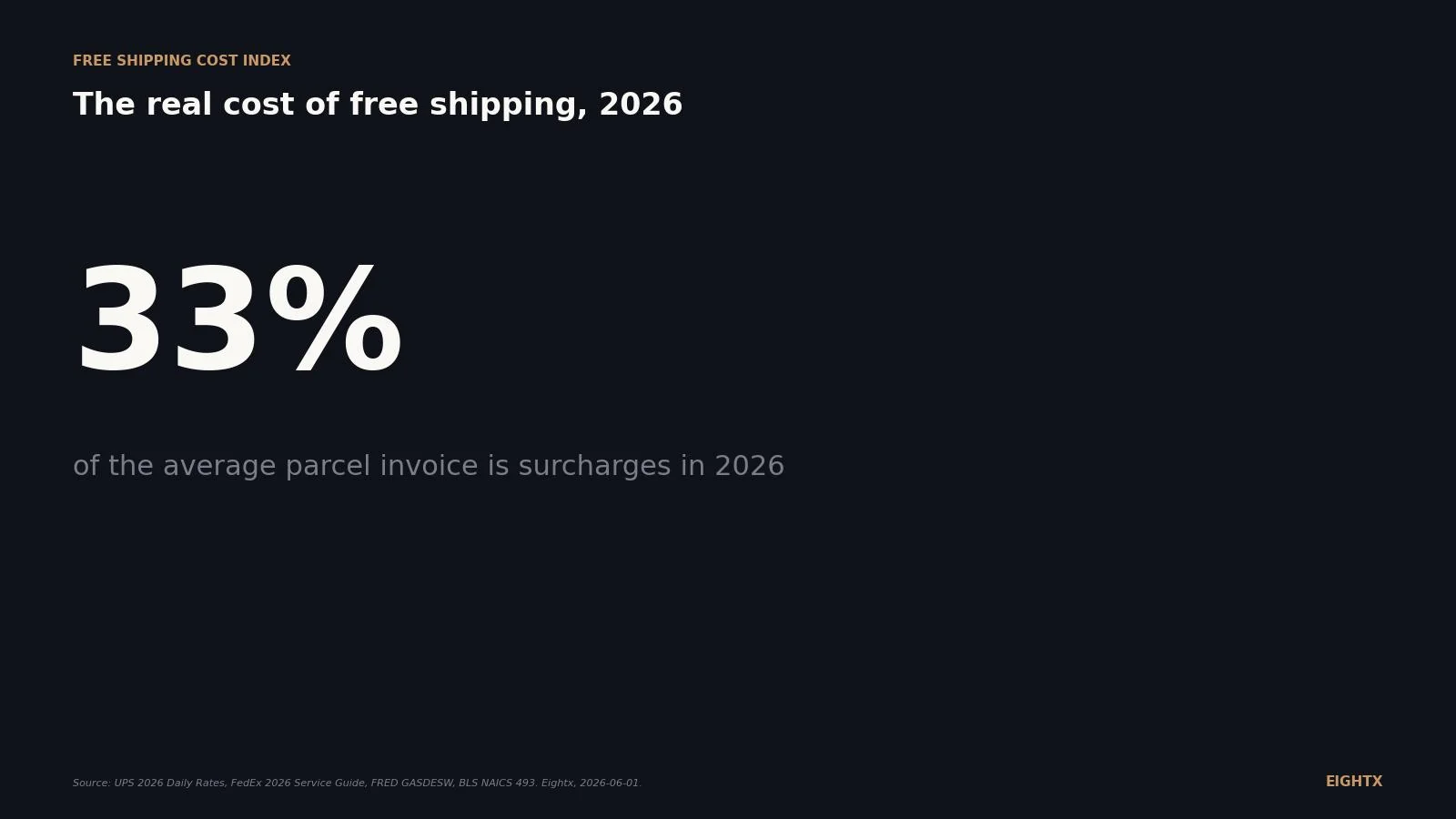
- Surcharges are now ~33% of an industry-average commercial Ground parcel ($4.30 of a $13 invoice) and ~51% of a typical DTC residential Zone 5 parcel ($9.55 of an $18.80 invoice) because the residential delivery surcharge is itself a surcharge line. The decomposition is in the table below.
- UPS and FedEx each took a 5.9% headline GRI for 2026; USPS Ground Advantage went up 7.8%. Residential surcharges climbed to $6.45-$6.95. USPS closes its dim-weight divisor advantage (166 to 139) on July 12, 2026, pending PRC approval.
- A defensible 2026 free-shipping threshold sits 20-30% above AOV for most $50-150 AOV brands. Below $75 AOV with sub-50% contribution margin, the math forces a threshold near 40% above AOV or a flat-rate model. The formula is in the worksheet below.
Free shipping is the default expectation on Shopify checkouts in 2026, but the cost stack underneath it has shifted hard. US diesel sat at $5.52 a gallon the week of May 25, 2026, up 58% year-over-year after a 21-day spike in March. Warehousing wages hit $33.25 an hour in March, up 24% cumulatively since January 2021. The Producer Price Index for warehousing is up 51.7% over the same window. On top of that, UPS and FedEx each took a 5.9% headline general rate increase (GRI) for 2026, USPS Ground Advantage went up 7.8%, and residential surcharges climbed to $6.45 to $6.95 per parcel.
This post is the living index of what free shipping actually costs a US direct-to-consumer (DTC) brand right now. We refresh it quarterly when FRED, BLS, and the major carriers update. The operator question we are answering: at a given average order value (AOV), contribution margin, and parcel weight, what is the real free-shipping threshold that protects margin in 2026, and how do diesel, warehouse wages, and carrier surcharges feed into that math.
What "free shipping" really costs in 2026: the four-line stack
Free shipping is never free for the brand. It is a marketing line item paid out of contribution margin per order. In 2026 there are four cost lines feeding the stack: the diesel-indexed fuel surcharge, the warehousing labor and PPI line that drives your 3PL invoice, the carrier base rates, and the surcharge stack that has quietly grown to about a third of the average commercial parcel and over half of a typical DTC residential parcel.
A note on parcel framing before the table. Industry analyses of 2026 UPS/FedEx rate cards put surcharges at ~33% of the average commercial Ground invoice (about $4.30 of a $13 charge). DTC brands ship ~100% residential, and the residential delivery surcharge is itself a surcharge line ($6.45 to $6.95). That means a typical DTC parcel's surcharge share runs materially higher than the published commercial-average number. The illustrative parcel below is a 3-lb residential Zone 5 UPS Ground shipment built from the 2026 rate card plus published surcharge tables. It is not an industry average; it is a defensible model parcel that lets you decompose the bill on the parcel type DTC brands actually ship.
Cost component USD per parcel Share of total Base transportation (Ground, 3lb, Zone 5, 2026 post-GRI rate) $9.25 49% Residential delivery surcharge $6.50 35% Fuel surcharge (~15% of base + handling) $1.30 7% Dim weight / additional handling (avg) $0.80 4% Address correction + accessorials (avg) $0.55 3% Peak/seasonal surcharge (Q4 amortized) $0.40 2% Net all-in parcel cost, 2026 $18.80 100%
Two things to notice. First, the residential surcharge alone ($6.50) is now larger than the entire USPS Ground Advantage cost on a sub-1-lb parcel. Second, the surcharge lines (residential, fuel, dim, accessorials, peak) total $9.55 of the $18.80 invoice. That is 51% of the bill in line items that either did not exist or were materially smaller five years ago. The industry-average commercial Ground parcel runs surcharges closer to 33% because residential delivery is not on the commercial bill; for DTC brands shipping ~100% residential, the surcharge share is structurally higher.
Diesel doubled in 90 days. Here is what that does to your fuel surcharge.
US diesel held a $3.40 to $3.80 band through 2024 and 2025. Then it broke. Between March 2 and March 30, 2026, FRED GASDESW (US Diesel Sales Price, Weekly) moved from $3.90 to $5.40 a gallon. It has stayed above $5.30 ever since. The week of May 25 closed at $5.523, up 58.4% year-over-year and 58.8% year-to-date.
This matters because every parcel carrier with a fuel surcharge indexes it to a public diesel benchmark, almost always the EIA national average that GASDESW tracks. (USPS Ground Advantage is the exception, with no fuel surcharge.) UPS and FedEx publish weekly surcharge tables. When the spot price moves, your invoice moves 1 to 2 weeks later. The 90-day spike showed up as a step change in the fuel-surcharge percentage on April and May 2026 invoices, and it is the single biggest driver of why the 5.9% headline GRI can land materially higher once fuel resets through your actual all-in 2026 rates.
Two practical implications. First, if your 2026 budget assumed a flat fuel-surcharge percentage, you are running short. Re-forecast against a $4.50 to $5.50 a gallon base case for the rest of the year. Second, when you re-negotiate your 3PL or carrier contract this fall, push for a symmetric fuel-surcharge clause. The standard table is asymmetric in practice. The carrier gets the upside fast and gives back the downside slowly. A capped clause with a 30-day reset moves that math back in your favor.
The 3PL invoice math: warehouse PPI up 52%, wages up 24%, employment falling
The Producer Price Index for warehousing and storage (BLS PCU493---493---) hit 167.9 in April 2026, up 51.7% since January 2021. Average hourly earnings in warehousing (BLS CES4348400003) reached $33.25 in March 2026, up 23.9% over the same window. Warehousing employment (BLS CES4348400001) is in its 11th consecutive month of year-over-year decline at 1,469,600 jobs. Costs up, capacity down.
Metric Jan 2021 Apr 2026 Change vs Jan 2021 YoY PPI Warehousing & Storage (Dec 2003 = 100) 110.7 167.9 +51.7% +3.99% Avg hourly earnings, warehousing $26.84 $33.25 (Mar 2026) +23.9% +4.13% Employment, warehousing (thousands) 1,489.0 1,469.6 -1.3% -1.41%
The PPI is the pricing-pass-through index for your 3PL. A 52% cumulative move is what your fulfillment partner has been quietly recouping through accessorial fees, minimum-order charges, and contract renewals. Your 2021 quote is no longer your 2026 rate.
The employment line is where the renegotiation room sits. 11 straight months of year-over-year decline means 3PLs over-built in 2021 to 2022 and have been right-sizing since. They lost the capacity cushion. That gives you room on rate at renewal that did not exist 18 months ago. Bring your volume trend, peer-rate intel from operators in your size band, and a credible second-bidder name. Most 3PL renewal conversations move on data, not vibes.
The 2026 carrier rate cards: UPS +5.9%, FedEx +5.9%, USPS +7.8%, dim divisor 139
UPS published a 5.9% average GRI for 2026 (effective December 22, 2025), with sub-5-lb Ground packages running closer to 5.95% and the minimum charge moving from $11.32 to $11.99. FedEx took the same 5.9% on standard list rates (effective January 5, 2026). USPS filed and PRC approved a 7.8% increase on Ground Advantage, 6.6% on Priority Mail, 5.1% on Priority Mail Express, and 6.0% on Parcel Select (Docket CP2026-2, effective January 18, 2026). USPS also filed a second mid-year adjustment for July 12, 2026 (Docket CP2026-8) that includes the dim-divisor change.
Carrier Service Effective Headline change Key surcharge change UPS Domestic Ground GRI 2025-12-22 +5.90% Ground residential $6.10 to $6.50 UPS Sub-5lb Ground 2025-12-22 +5.95% Min charge $11.32 to $11.99 FedEx Standard list rates 2026-01-05 +5.90% Ground/Home residential $5.95 to $6.45 (+8.4%) USPS Ground Advantage 2026-01-18 +7.80% No fuel or residential surcharge added USPS Priority Mail 2026-01-18 +6.60% (no notable surcharge change) USPS Priority Mail Express 2026-01-18 +5.10% (no notable surcharge change) USPS Parcel Select 2026-01-18 +6.00% (no notable surcharge change) USPS Ground Advantage 2026-07-12 (pending) Dim divisor 166 to 139 Closes USPS dim advantage on bulky-light parcels
The dim-divisor change is the most under-reported rate move of 2026. USPS historically used a divisor of 166 to convert package dimensions to billable weight, which made USPS Ground Advantage, Priority Mail, and Parcel Select the carrier of choice for light, bulky DTC parcels (think apparel polybags, small accessory boxes). On July 12, 2026, the divisor moves to 139, matching UPS and FedEx. Apparel polybag and small-box brands will see effective USPS rates rise on their bulky-light SKUs. Run your top 20 SKUs through the new dim calculation before July, and if you can compress packaging by 10 to 15%, do it now.
The headline ladder for a 1, 3, and 5-lb residential Zone 5 parcel:
Weight USPS Ground Advantage UPS Ground all-in FedEx Ground all-in 1 lb $10.01 $13.20 $13.10 3 lb $12.60 $17.80 $17.50 5 lb $15.05 $22.40 $22.10
What the math says about your free-shipping threshold in 2026
The free-shipping threshold worksheet, in one line:
Real free-shipping threshold = (avg parcel cost + pick/pack + packaging) / (contribution margin %)
Three worked examples using the illustrative $13 average parcel cost (UPS/FedEx residential Zone 5, 3-lb) plus $2 of pick/pack and packaging, for a $15 all-in fulfillment cost:
- $75 AOV, 60% contribution margin. Threshold math: $15 / 0.60 = $25 of revenue is needed to absorb the parcel. Your $75 AOV already clears that comfortably. You can offer free shipping over $75 or even drop the threshold to $50 if the conversion lift pays for it.
- $50 AOV, 50% contribution margin. Threshold math: $15 / 0.50 = $30 of revenue is needed. You need a threshold of at least $52 to protect margin on every order. If your current threshold is $35, you are running below break-even on the orders between $35 and $52.
- $35 AOV, 45% contribution margin. Threshold math: $15 / 0.45 = $33 of revenue. You need a threshold near $58, which is 65% above your AOV. That is why low-AOV brands rarely offer truly free shipping. They use flat-rate ($5 to $7) or hybrid (free over a high threshold) instead.
For an interactive version that lets you sweep AOV, contribution margin, and parcel weight, see our contribution margin calculator. The shipping line plugs straight in.
Operator pattern from the calls we have with $5-50M DTC brands (anecdotal, not benchmark): shipping cost commonly runs 10 to 15% of revenue, average per-order shipping cost lands in the mid-single-digit dollars once you net the threshold lift against the cost absorbed on free orders, and the most common free-shipping threshold sits in the $45 to $49 band (typically 75 to 100% of AOV). Above $150 AOV with 40%+ contribution margin, operators almost universally absorb the full carrier bill. Below $75 AOV, the conversion penalty of removing free shipping usually outweighs the AOV lift of a higher threshold. The $75 to $150 band is where threshold testing actually matters.
What we are watching next quarter
Surcharges are 33% of the industry-average commercial Ground parcel and over half of a typical DTC residential Zone 5 parcel because residential delivery is itself a surcharge. The $13 commercial Ground charge from 2021 is an $18.80 residential Zone 5 invoice in 2026. The brands that survive the next two GRIs are the ones running threshold math against a four-line stack, not a single shipping budget number.
Three updates we will fold in for the September 2026 refresh:
- USPS Docket CP2026-8 ruling (July 12, 2026). The dim-divisor 139 change is filed but pending PRC approval at publish. If it lands, USPS Ground Advantage rates on bulky-light SKUs rise immediately, and our 1-lb price advantage on residential parcels narrows.
- FedEx Q3 peak surcharges. FedEx historically announces September peak surcharges in early August. We will price those into the residential surcharge line in the September refresh.
- Diesel direction. The March 2026 spike is a step change, not a one-week event. If diesel rolls back to a $4.50 base by Q3, the fuel-surcharge line eases. If it holds above $5.30, the GRI math compounds on top of the surcharge math.
For more on how shipping and warehousing costs hit DTC unit economics, see our 3PL Cost Index 2026 and the average ecommerce return rate by vertical. The returns post is where the next dollar of margin usually hides once you have your free-shipping threshold dialed.
Sources and methodology
FRED GASDESW (US Diesel Sales Price, Weekly). Weekly weighted-average diesel price in dollars per gallon, derived from the US Energy Information Administration (EIA) survey of approximately 350 retail outlets. We pulled the full series from 2021-01-04 through 2026-05-25 (282 weekly observations) for the diesel chart and year-over-year math. Source URL: https://fred.stlouisfed.org/series/GASDESW.
BLS PCU493---493--- (PPI Warehousing and Storage). Monthly Producer Price Index for the warehousing and storage industry, Dec 2003 = 100, not seasonally adjusted. We pulled January 2021 through April 2026 (preliminary) via the BLS series API. The 51.7% cumulative change is (167.9 - 110.7) / 110.7. The 3.99% year-over-year is (167.9 - 161.5) / 161.5.
BLS CES4348400003 (Average hourly earnings, warehousing and storage). Monthly seasonally-adjusted hourly earnings of all employees in NAICS 493. We pulled January 2021 through March 2026 (preliminary). The 23.9% cumulative change is (33.25 - 26.84) / 26.84. The 4.13% year-over-year is (33.25 - 31.93) / 31.93. The wages series ends one month behind the PPI and employment series at publish.
BLS CES4348400001 (Employment, warehousing and storage). Monthly seasonally-adjusted employment in NAICS 493 in thousands. April 2026 prints 1,469,600 jobs, the 11th consecutive month of year-over-year decline.
USPS PRC Dockets CP2026-2 and CP2026-8. Competitive product price changes effective January 18, 2026 (CP2026-2) and a second adjustment effective July 12, 2026 pending PRC approval (CP2026-8). The July adjustment includes the dimensional-weight divisor change from 166 to 139 on Ground Advantage, Priority Mail, Priority Mail Express, and Parcel Select.
UPS 2026 Daily Rates and FedEx 2026 standard list rates. Headline GRI percentages and residential surcharge dollar values were pulled from the primary carrier rate cards (effective December 22, 2025 for UPS and January 5, 2026 for FedEx), cross-checked against 2026 analyses from 3PLcenter, ShipperHQ, Shippo, Cahoot, and GoBolt.
Baymard Institute, Cart Abandonment Rate Statistics 2026. 70.22% average cart abandonment with unexpected shipping cost cited by 48% of abandoners as the leading reason. https://baymard.com/lists/cart-abandonment-rate.
Pitney Bowes Parcel Shipping Index 2024. 22.37 billion US parcel shipments in 2024, +3.4% year-over-year. https://www.pitneybowes.com/us/shipping-index.html.
2024 free-shipping benchmark synthesis. 77.2% of Top-1000 US ecommerce retailers offer free shipping in some form, 20.4% on all orders, average threshold $64, consumer willingness $43. Used as the most-defensible adoption benchmark for 2024-2026. https://redstagfulfillment.com/what-percentage-consumers-expect-free-shipping/.
Operator-voice patterns drawn from anonymized founder-call segments in our internal RAG library covering $5-50M DTC brands across CPG, apparel, and beauty. Client identifiers removed. Patterns paraphrased.
Limitations. No primary-source figure exists for "% of US DTC brands offering free shipping in 2026." NRF, Shippo, ShipStation, and Pitney Bowes do not publish a directly comparable 2026 number in the materials we accessed. The illustrative parcel breakdown is a defensible model, not an industry average; carriers publish rate matrices by zone, weight, and service, not "average cost per parcel." USPS Docket CP2026-8 is filed but pending PRC approval at publish. The wages series is one month behind PPI and employment.
Update cadence. This index is refreshed quarterly when FRED, BLS, USPS PRC, and major carrier rate cards update together. Next refresh target: September 2026 (post the July 12 USPS docket ruling and FedEx Q3 peak announcement).
Frequently asked questions
how much does free shipping actually cost me per order in 2026 if my aov is $75 and i ship 1-3 lb parcels?
For a typical $75 AOV brand shipping a 3-lb residential Zone 5 parcel, the all-in carrier cost lands near $13 to $18 depending on UPS/FedEx vs USPS Ground Advantage. Add $1 to $2 of packaging and pick-pack and you are looking at $14 to $20 of fulfillment cost per order. On a 60% contribution margin, that absorbs 31 to 44% of your gross profit before you have spent a dollar on customer acquisition. The free-shipping math only works if your threshold or AOV growth keeps gross margin per order above $25 to $30.
should i raise my free-shipping threshold or eat the carrier rate hike this year?
Test the threshold lift first. The conversion penalty of moving a $50 threshold to $60 is usually smaller than the margin recovery on the orders below the new bar. Baymard's 2026 cart-abandonment data shows unexpected shipping cost is still the leading abandonment reason at 48% of abandoners, so be honest about display: list the threshold clearly on PDP and cart, not just at checkout. Eat the rate hike only if your CM per order has at least $5 of headroom above the new all-in parcel cost.
what is the real fuel surcharge mechanism at ups and fedex and why is it still going up when diesel falls?
UPS and FedEx publish weekly fuel-surcharge tables indexed to the EIA national diesel price. The tables lag the spot price by 1 to 2 weeks, so a sharp diesel move shows up in your invoice 7 to 14 days later. Both carriers also reset the index breakpoints periodically, which is how the floor on the surcharge can rise even when diesel is flat. The mechanism is asymmetric in practice. The percentage goes up faster than it comes down.
how do i tell if my 3pl is passing through the 7.8% usps ground advantage increase or absorbing it?
Ask for the line-item rate sheet for January 2026 versus January 2025 on three of your most common SKU weight/zone combos. If your effective USPS Ground Advantage rates moved more than 4 to 5%, they passed the full hike through. If they moved 2 to 4%, they ate some. If they did not move at all, they are renegotiating with USPS or eating the gap, both of which mean room to negotiate on your next renewal.
is usps ground advantage still cheaper than ups ground for a sub-1-lb residential parcel in 2026?
Yes, usually by $2 to $4 on a sub-1-lb residential parcel. USPS Ground Advantage runs around $10 all-in at 1 lb Zone 5 with no fuel or residential surcharge. UPS Ground equivalents come in near $13 once fuel and residential are added. The gap closes above 3 to 5 lb where UPS commercial rates start to compete and disappears on bulky-light SKUs once the July 12, 2026 USPS dim-divisor change to 139 kicks in (pending PRC approval).
what does the dimensional weight divisor change from 166 to 139 at usps mean for my apparel polybag skus?
It is the biggest under-reported rate change of 2026. USPS historically used a divisor of 166 to convert package dimensions to billable weight, which made it the carrier of choice for light, bulky DTC parcels (polybags, small boxes). Effective July 12, 2026, the divisor moves to 139, matching UPS and FedEx. A 12 x 9 x 4 polybag that billed at the actual weight under the old divisor may bill at a higher dimensional weight under the new one. Test your top 20 SKUs in the rate calculator before July.
is there any benchmark for what percent of dtc brands offer free shipping in 2026?
Not a primary-source 2026 number that we trust. The most defensible benchmark is a 2024 synthesis of the Top-1000 US ecommerce retailers: roughly 77% offer free shipping in some form and only about 20% on all orders, with an average threshold of $64 and an average consumer willingness near $43. NRF, Shippo, ShipStation, and Pitney Bowes do not publish a directly comparable 2026 number in the materials we accessed. Treat any single 2026 percent claim with skepticism.
is 'free shipping over $x' or '$5 flat rate' more profitable at $50-$100 aov?
Flat rate usually wins on contribution margin per order in the $50-$100 AOV band; threshold usually wins on AOV lift. Run a four-week A/B with the threshold set 20 to 30% above current AOV against a $5 flat rate. Watch contribution margin per order, AOV, and conversion together. If contribution margin per order is flat to up and conversion does not drop more than 3 to 5%, the threshold is better. If conversion craters, flat rate is the safer play.