
Insights
3PL Cost Index 2026: warehouse wages, diesel, headcount, and parcel PPI
3PL costs rose again in 2026, driven by warehouse wage floors, diesel stubbornness, and parcel surcharges that never fully unwound. This index tracks the four cost drivers that set your per-unit fulfillment floor. Use it to stress-test your 3PL contract before renewal season.
Key Takeaways
- Warehouse wages are up 18.2% since January 2022 (BLS CES NAICS 493). March 2026 hit $33.25/hr, +4.1% year-over-year. Wage inflation is still running hot.
- US diesel jumped 48% year-over-year in April 2026 ($3.72 to $5.50/gal, FRED GASDESM). The Q1 2026 90-day move was +56%, the sharpest snap since the Russia-Ukraine spike of Q2 2022.
- Warehousing employment is in its 11th straight month of year-over-year decline, 1.47M jobs in April 2026, down 6.7% from the December 2022 peak (and 5.6% below the January 2022 baseline). The cushion 3PLs built in 2021-2022 is gone.
- PPI for couriers and messengers rose 37% since January 2022 (FRED PCU492492, 383.9 in April 2026), with a +3.3% one-month jump from March to April. Parcel carriers are passing the wage and fuel hit through faster than warehouses are.
- The renewal map is segment-specific. The squeeze thesis applies to private DTC-focused 3PLs (ShipBob, ShipMonk, Stord). GXO, XPO, and Ryder are publicly guiding to margin expansion in 2026.
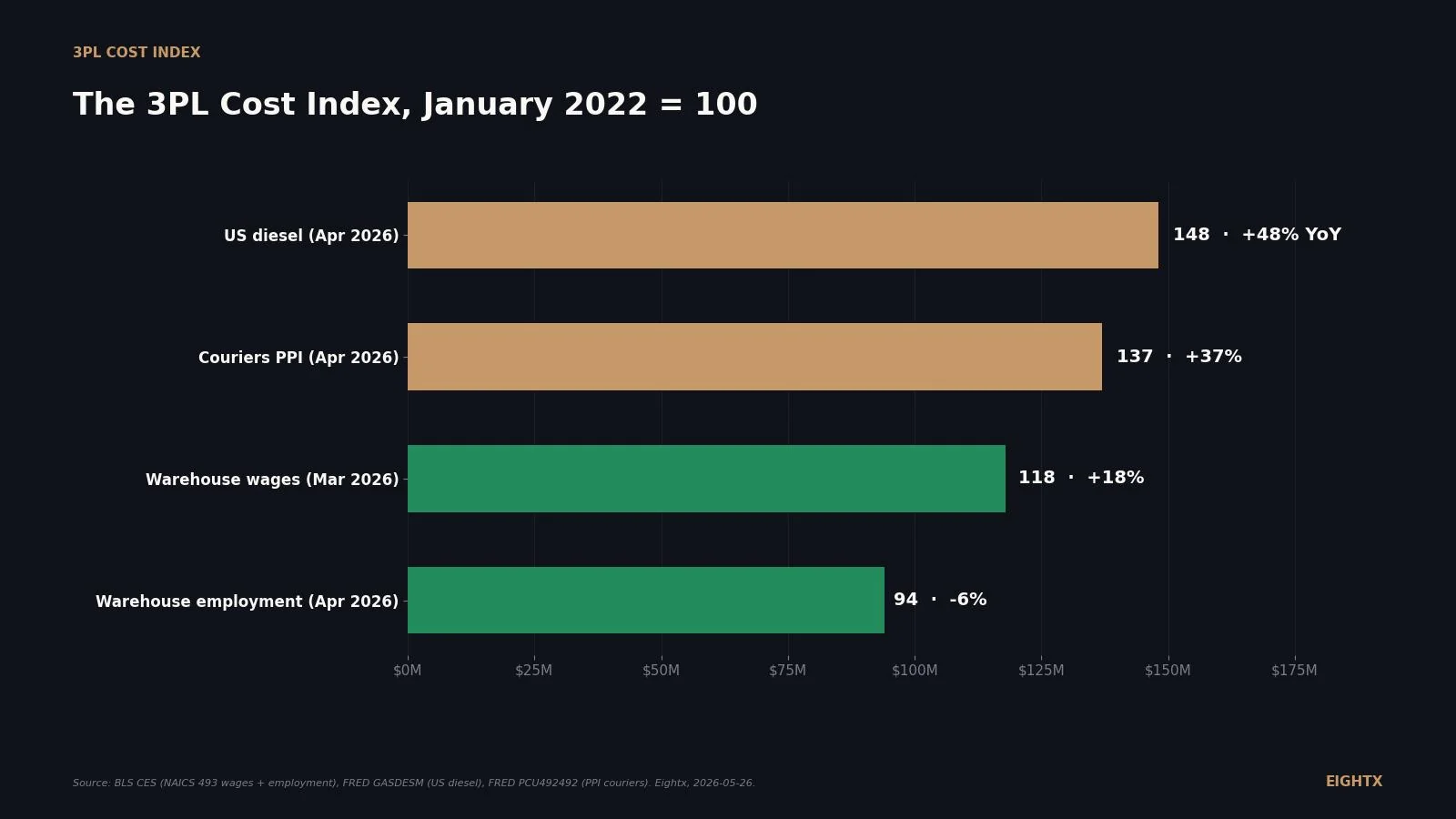
Your 3PL renewal conversation should start with four lines on a chart. Warehouse wages are up 18% since January 2022. US diesel is up 48% year-over-year in April 2026 after a brutal Q1 90-day spike. Couriers PPI is up 37%. And warehousing employment is down 6.7% from its December 2022 peak. Costs up, capacity down, but not evenly. That uneven wedge is your renewal-leverage map.
One caveat before you take this to your renewal: the squeeze thesis applies to private DTC-focused 3PLs (ShipBob, ShipMonk, Stord, Shipfusion, Saddle Creek, Quiet Logistics, Radial). The public-traded majors (GXO, XPO, Ryder) are guiding to margin expansion in 2026, so don't anchor a GXO renewal in "you're squeezed." Section 3 below covers the split.
This post is the living index. We refresh it quarterly when BLS, FRED, and JOLTS data drop, with one job: tell DTC operators which 3PL line items have room to move and which ones are pass-through.
What the 3PL Cost Index is showing right now
Four series, all rebased to January 2022 = 100, all pulled from public BLS and FRED feeds on 2026-05-26.
Warehouse wages (BLS CES4348400003). March 2026 average hourly earnings hit $33.25, up from $28.12 in January 2022. That's +18.2% over the index window and +4.1% year-over-year. Still running hot vs. CPI. Wages have not rolled over.
Warehouse employment (BLS CES4348400001). April 2026 employment was 1,469,600 jobs, down from a December 2022 peak of 1,587,500. That's -6.7% from peak (and -5.6% vs the January 2022 baseline of 1,557,500) and -1.4% year-over-year. April 2026 is the 11th consecutive month of year-over-year decline in the sector.
US diesel (FRED GASDESM). April 2026 average was $5.50/gal, up from $3.72 a year earlier (+48% YoY) and up from $3.52 in January 2026 (+56% in 90 days). The Q1 2026 spike is the sharpest 90-day move since the Russia-Ukraine spike of Q2 2022.
Couriers PPI (FRED PCU492492). April 2026 hit 383.9, up 37.3% from the January 2022 baseline. The index jumped 3.3% in a single month from March to April 2026, evidence that parcel carriers (FedEx, UPS, USPS) are passing the wage and fuel hit through to shippers in close to real time.
The punchline: cost inflation and capacity contraction are happening simultaneously. That doesn't mean every 3PL is equally squeezed. It means the storage, pick-pack, and labor lines on your contract have margin compression behind them while the carrier base rates and fuel surcharges have unrecovered cost inflation. Different leverage points for different lines.
Series Source Jan 2022 Latest Change vs Jan 2022 YoY change Warehouse wages ($/hr) BLS CES4348400003 $28.12 $33.25 (Mar 2026) +18.2% +4.1% Warehouse employment (000s) BLS CES4348400001 1,557.5 1,469.6 (Apr 2026) -5.6% -1.4% US diesel ($/gal) FRED GASDESM $3.72 $5.50 (Apr 2026) +47.7% +48.0% PPI couriers and messengers FRED PCU492492 279.7 383.9 (Apr 2026) +37.3% +12.3% T/W/U job openings (000s) BLS JOLTS supersector 515 297 (Mar 2026) -42.3% +12.5% T/W/U layoffs rate (%) BLS JOLTS supersector 1.1% 1.8% (Mar 2026) +0.7 pp +0.2 pp
The diesel snap is the renewal trigger
The Q1 2026 diesel move from $3.52 to $5.50/gal (+56% in 90 days) is the single most actionable signal for any operator with a 3PL contract coming up for renewal. Why: most 3PL fuel surcharge clauses have a reset cadence (weekly, monthly, or quarterly) that determines how fast that diesel move passes through to your invoice.
If your contract resets quarterly, your Q3 surcharge is about to step up materially based on the Q2 diesel band. If it resets annually at renewal, you have one window to renegotiate the surcharge structure before the new floor locks in. If it has no reset cadence at all (rare but real), your 3PL is eating the move and you're going to see a rate-card replacement at renewal.
The Q1 2026 diesel spike correlates with the tariff round but the causal split between tariffs, OPEC+ supply discipline, and refinery utilization isn't disaggregated in this dataset. EIA's April 2026 Short-Term Energy Outlook revised full-year 2026 retail diesel up to $4.80/gal from $4.12/gal, citing tight global oil balances (inventories falling 8.5M b/d in Q2) and US refinery utilization near 95%. Tariffs affect freight demand and mode-shift, but the dominant 2026 driver is supply-side.
Practical Q2 2026 planning band: base case $4.00 to $4.75/gal, stress case $4.75 to $5.50+/gal. The PPI couriers print (+3.3% in a single month) confirms FedEx and UPS are pricing into the stress case, not the base.
Carrier behavior backs the read. April 13, 2026 UPS updated its domestic fuel surcharge table. FedEx ran similar adjustments through April and May. USPS implemented a time-limited 8% price increase on Priority Mail, Ground Advantage, and Parcel Select effective April 26, 2026, specifically citing rising transportation costs. None of them are absorbing the move. All of them are passing it through.
Warehouse labor: cheap to threaten, expensive to replace
The labor side of the 3PL story is the inverse of fuel. Where carriers are passing fuel through aggressively, 3PLs have lost their ability to absorb labor inflation.
From a December 2022 peak of 600,000 job openings, the transportation/warehousing/utilities supersector dropped to 297,000 openings by March 2026 (-50.5%). Quits rate fell from 3.3% in late 2022 to 2.3% by March 2026, meaning workers can't find better jobs elsewhere. Layoffs and discharges rate climbed from about 1.0% in early 2022 to 1.8% in March 2026, with a December 2025 spike to 2.5%.
The read: your 3PL is shedding workers, not hiring them. They lost the headcount cushion they built in 2021-2022 and they can't easily rebuild because hiring is expensive when wages are still climbing 4%+ year-over-year. They need volume commitments more than they need rate increases.
Important caveat: this thesis applies more cleanly to private DTC-focused 3PLs (ShipBob, ShipMonk, Stord, Shipfusion, Saddle Creek, Quiet Logistics, Radial) than to public-traded GXO, XPO, and Ryder. GXO reported record FY 2025 revenue and guided to EBITDA expansion in 2026. XPO's Q4 2025 revenue grew (vs prior year) with operating income near flat. Ryder's Q2 2025 disclosures confirm fuel is treated as a pass-through. The large public 3PLs are selling value-added services, automation, and efficiency, and they have visible pricing power. The squeeze story is the private DTC tier.
This matters for two reasons. First, if you're with GXO or XPO, don't anchor your renewal in "you're squeezed." Anchor in "what's the volume-tier discount." Second, if you're with a private DTC 3PL, the BLS plus FRED wedge above is the entire negotiation case. Bring it printed.
What to push for on your 2026 renewal
This is the operator playbook. Asking ranges are based on our reads of public-company 3PL margins plus the BLS and FRED data above, and they're consistent with reported renewal outcomes at ShipBob and ShipMonk for accounts with volume or growth leverage.
Line item 2026 negotiation leverage Why Asking range Storage per pallet/sqft High Headcount down 6.7% from peak; private 3PL needs your volume 8-15% reduction Pick-pack per unit High Wage inflation absorbed below pass-through; private 3PL margin squeezed 5-12% reduction Inbound receiving Medium Less volume-sensitive; waivable on multi-brand or growth 3-8% reduction or absorb minimum Carrier base rates Low (re-bid, don't renegotiate) Couriers PPI +37% since 2022; carriers passing through aggressively Re-bid annually with 2-3 carriers Fuel surcharge clause High (structure, not rate) Diesel +48% YoY; reset cadence and symmetry matter more than the rate 4-point defensible clause (see below) Peak-season surcharges Medium 3PLs not capacity-constrained this peak; sector quits rate down Flat or trade for volume commit Monthly minimums High The cushion 3PLs built in 2021-2022 is gone; waivers possible Negotiate down 20%+ or eliminate Long-term storage trigger High Day-count is the single most-negotiable storage line Push 90 days to 180+ days, or seasonal waiver
The single highest-leverage addition to most contracts isn't a rate cut. It's the fuel surcharge clause. Four points to negotiate:
- Named third-party index. Use EIA Weekly Retail On-Highway Diesel Price (the same series FRED GASDESM tracks monthly). Don't accept "carrier index" or "internal benchmark."
- Clear trigger threshold. $0.25/gal moves only. Anything smaller and you're paying for volatility, not cost.
- Symmetry. The surcharge must decrease when fuel drops, not just increase. Most 3PL contracts ratchet up and stick.
- Baseline anchor. Lock the baseline price at contract award. Without it, you don't know what the floor is and your 3PL can re-baseline at renewal.
If your 3PL pushes back on any of the four, especially symmetry, you have your answer about who's eating the upside.
For more context on the labor side of this story, including the public-company workforce-reduction filings, see our DTC layoff and hiring tracker. Renewal negotiations interact directly with the broader interim CFO services work because the 3PL line is usually the second-largest variable cost on a DTC P&L after paid media.
How we'll update this index
Quarterly. BLS CES releases monthly (first Friday of the month, prior month data). FRED GASDESM updates monthly end-of-period. JOLTS releases monthly with a six-week lag. Next natural refresh: late August 2026 for Q2 close, then end of Q3.
What would flip the read: diesel rolling over below $4.00/gal sustained for two months would soften the renewal urgency on fuel structure. Warehouse employment turning positive year-over-year for the first time since June 2025 would mean the headcount-unwind story is over and private-3PL pricing power returns. Couriers PPI rolling over (vs. another +3% one-month jump) would suggest parcel carriers are absorbing rather than passing through.
Costs up, capacity down, but not evenly. Diesel and parcel carriers are passing the hit through fast. Storage, pick-pack, and labor are where private DTC 3PLs are squeezed. Your renewal should treat those as two different negotiations, not one.
Sources and methodology
BLS CES (Current Employment Statistics), NAICS 493 warehousing and storage. Average hourly earnings of all employees from series CES4348400003. All-employees employment from series CES4348400001. Both seasonally adjusted. Pulled via the BLS public API on 2026-05-26 for the 2022-01 through 2026-04 window. Latest wage data point is March 2026 (one month behind the other series, noted in the chart figcaption and aria description). Latest employment data point is April 2026 (preliminary).
FRED US Diesel Sales Price. Monthly series GASDESM, source EIA Weekly Retail Gasoline and Diesel Prices, units dollars per gallon (end of period), not seasonally adjusted. Latest observation: April 2026 at $5.501/gal. This is U.S. on-highway retail diesel, the same series most 3PL fuel surcharge clauses reference (or should).
FRED PPI Couriers and Messengers. Monthly series PCU492492, index December 2003 = 100, not seasonally adjusted. Latest observation: April 2026 at 383.899. This is the producer price for courier services (FedEx, UPS, USPS, regional carriers), which proxies parcel-rate inflation downstream of 3PL pick-pack.
BLS JOLTS, Transportation/warehousing/utilities supersector (NAICS 48-49 + 22). Job openings series JTS480099000000000JOL. Quits rate JTS480099000000000QUR. Layoffs and discharges rate JTS480099000000000LDR. JOLTS does not break out NAICS 493 warehousing as a standalone monthly series, so we use the supersector as the labor-dynamics proxy. Warehousing is the dominant component along with trucking. This is documented honestly in the chart aria description.
Indexing methodology. Each series rebased to January 2022 = 100. For monthly series with January 2022 value V₀, the indexed value at month t = (V_t / V₀) × 100. No seasonality adjustment beyond the source-provided seasonal adjustment (where applicable). PPI series are NSA from FRED.
Limitations. BLS does not publish wages or employment for NAICS 4931 (general warehousing) separately from 4932 (refrigerated) etc. at monthly frequency. CES4348 (warehousing and storage, 4-digit) is the closest monthly NAICS cut available. "3PL" is not a clean BLS classification. NAICS 493 (warehousing) plus NAICS 4922 (couriers) plus parts of NAICS 484 (trucking) make up what an operator calls a 3PL. This index uses 493 for the labor proxy and PPI couriers for the parcel-output proxy. Reasonable approximation, not perfect. The Q1 2026 diesel spike is confirmed in FRED data but the causal attribution between tariffs, OPEC+, and refinery utilization is not disaggregated; EIA STEO points to supply-side tightness as the primary driver.
Update cadence. Quarterly. Next refresh: late August 2026 for Q2 close.
Frequently asked questions
how much should i push for on a 2026 3pl renewal given wage and diesel data?
Based on our reads of public-company 3PL margins plus the BLS and FRED data in this index, 8 to 15% off storage and 5 to 12% off pick-pack are realistic asks if you're with a private DTC-focused 3PL (ShipBob, ShipMonk, Stord, Shipfusion). Public-3PL accounts (GXO, XPO, Ryder) won't move that far because their margins are guiding to expansion, not compression. Anchor your ask in your volume trend plus the headcount-down, wages-up wedge in the chart above.
is the q1 2026 diesel spike about tariffs or about something else?
It correlates with the Q1 2026 tariff round but the causal split between tariffs, OPEC+ supply discipline, and refinery utilization isn't disaggregated in this dataset. EIA's April 2026 STEO revised full-year 2026 diesel up to $4.80/gal driven mainly by tight global oil balances and refinery utilization near 95%. Tariffs are a secondary factor, not the primary driver. Plan for a $4.00 to $4.75/gal base case in Q2 and a $4.75 to $5.50+ stress case.
what's the difference between negotiating storage versus negotiating freight in 2026?
Storage and pick-pack lines are where private 3PLs are squeezed, so they're negotiable. Carrier base rates aren't, because the parcel PPI is up 37% since 2022 and FedEx plus UPS are passing it through via 5.9% headline general rate increases that hit 8 to 12% all-in once surcharges and dimensional weight rules apply. Re-bid your freight with two or three carriers annually. Renegotiate storage and pick-pack at renewal.
what's a defensible fuel surcharge clause look like for a 2026 contract?
Four points. One, name a third-party index, usually EIA Weekly Retail On-Highway Diesel Price (the same series GASDESM tracks monthly). Two, set a trigger threshold of about $0.25/gal so minor moves don't reset your surcharge. Three, require symmetry, meaning the surcharge has to come down when fuel drops, not just go up. Four, lock a baseline price at contract award so you know what the floor is. Any 3PL pushing back on symmetry is telling you they want to keep the upside without giving back the downside.
how do i know if my 3pl is actually under margin pressure or just claiming they are?
Public-traded 3PLs file 10-Ks. GXO, Ryder, and XPO are guiding to margin expansion in 2026, so the squeeze story doesn't apply to them. Private DTC-focused 3PLs don't disclose, but the BLS plus FRED wedge (headcount -6.7% from peak, wages +18%, couriers PPI +37%) tells you the sector cushion is gone. If your 3PL is ShipBob, ShipMonk, Stord, Shipfusion, or similar, assume they're in the squeezed tier and bring data.
why did warehouse employment keep falling in 2025-2026 if ecommerce volume is up?
Three reasons. One, 3PLs over-hired in 2021 to 2022 and are still right-sizing. Two, automation absorbed some of the volume growth, so labor productivity is up. Three, JOLTS shows transportation/warehousing/utilities layoffs rate at 1.8% in March 2026, up from 1.0% in early 2022, meaning the sector is quietly shedding people even as the economy grew. It's not a demand story. It's a capacity-unwind story.
should i lock a long-term 3pl contract now or stay quarterly given the volatility?
If you have leverage (growing volume, multi-brand, Q4-heavy), lock 12 to 24 months on storage and pick-pack with a capped annual increase and the four-point fuel surcharge clause above. If your volume is flat or declining, stay 12 months or shorter so you can re-bid as the headcount unwind plays out and private-3PL margins compress further. The volatility is in fuel, not in storage or pick-pack.
how does the bls warehousing wage data compare to what my 3pl is actually paying labor?
BLS CES4348400003 shows $33.25/hr for March 2026 (all employees, seasonally adjusted, NAICS 493). Your 3PL's effective labor cost is higher once you include benefits, supervisor load, and shift premiums, usually $42 to $55 fully loaded. If your 3PL is quoting labor as the reason for a rate increase, ask them which of those layers moved. Most of the 2025-2026 wage move is in base hourly, not in the load.