
Financial Strategy
Settle vs Wayflyer: the true APR of inventory financing for DTC brands (2026)
Wayflyer's typical 8% flat fee repaid in 90 days converts to a 32.5% effective APR, while Settle's 1.4% per month simple interest on a 90-day advance is approximately 17% APR. The factor-rate-to-APR gap matters most when repayment stretches beyond 90 days, at which point Wayflyer's fixed fee becomes cheaper, and the post provides modeled dollar-cost comparisons on a $500K advance at 60, 90, 180, and 365-day payback speeds.
Key Takeaways
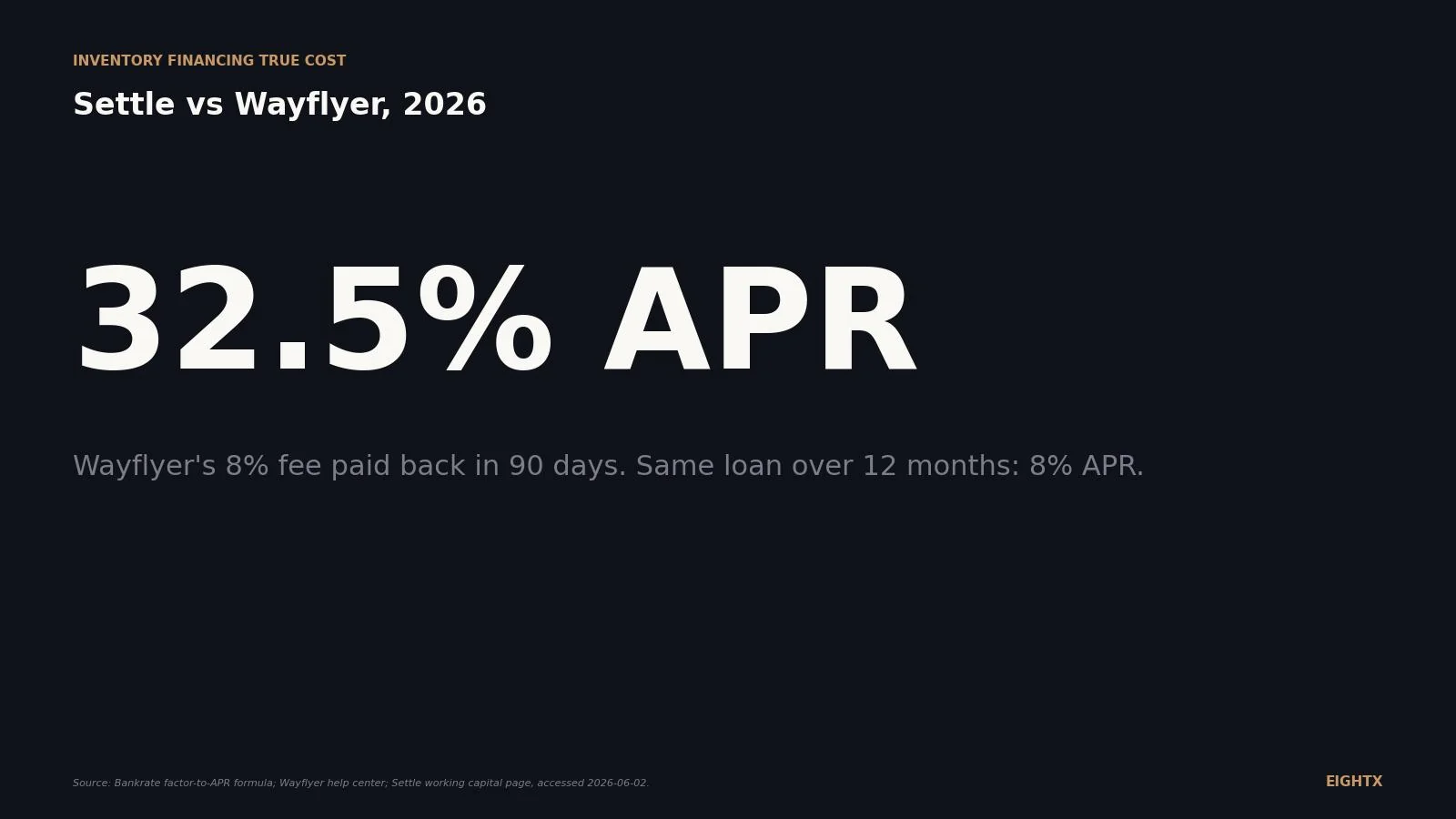
- Wayflyer's headline fee is not an APR. It is a fixed flat fee of 2 to 10% of the funded amount, charged at origination. Pay it back in 90 days and an 8% fee = 32.5% effective APR. Pay it back in 12 months and the same 8% fee = 8% APR.
- Settle quotes simple interest of 12 to 24% APR on 30 to 210 day fixed terms. Settle's own example: 1.4% per month = 17.03% APR. Interest stops accruing the day you repay.
- The cross-over point sits around 5 to 6 months. For payback under 5 months, Settle is cheaper. For payback over 6 months, Wayflyer's flat fee becomes cheaper. Your actual inventory turn decides this, not the headline rate.
- Funding ranges overlap but speed and structure differ. Wayflyer: $5K to $20M, revenue-based daily sweeps or fixed installments, 24 hour cash. Settle: $20K to $15M, fixed biweekly or monthly schedule, AP and bill-pay tooling included.
- Convert before you sign. APR ≈ (factor − 1) × (365 / payback days) × 100. Run this on any inventory-financing quote that uses a flat fee, factor rate, or origination-fee structure. The number you get is what your bank loan would have to beat.
You took a $500K Wayflyer advance at an 8% fee. Total owed: $540K. If you pay it back in 90 days, you just paid 32.5% APR. If you pay it back over 12 months, you paid 8% APR. Same loan. Same fee. Four times the cost. The difference is structure, not pricing.
Settle and Wayflyer both fund inventory and AP for direct-to-consumer brands in the $5M to $150M revenue band. The headline numbers look comparable. They are not comparable. One is a flat fee charged at origination. The other is simple interest accrued on outstanding principal. Which one is cheaper depends entirely on how fast you repay, and most operators sign without running the math.
This post is the math. APR conversion formula, two charts, one table, and a cross-over point that tells you which lender wins for your actual inventory cycle.
The headline numbers, and why they're misleading
Wayflyer publishes a fee range of 2 to 10% of the funded amount in its own help center. Most quotes land in the 5 to 10% band. Settle quotes simple interest of 12 to 24% APR on 30 to 210 day terms, with the company's own example pegging 1.4% per month at 17.03% APR.
Read those side by side and Wayflyer looks cheaper. An 8% fee is smaller than a 17% APR. That instinct is wrong. The 8% is not an APR. It is a flat factor charged once, at origination, regardless of how fast you repay. The 17% APR is a per-year rate that accrues only while the principal is outstanding.
Two completely different cost structures. Comparing the headline numbers is like comparing the price of a one-time room booking against an hourly rate. The shape matters more than the digit.
How each one is actually priced
Wayflyer's pricing model is a fixed flat fee. You take $500K at 8%, you owe $540K. The $40K is locked the day you sign. There is no early-payoff discount. Repaying in 90 days costs the same dollars as repaying in 12 months. Wayflyer collects through one of two structures: a daily sweep of 6 to 15% of revenue (their published example is 10%) on the cash-advance product, or fixed installments on the 3 to 24 month term-loan product.
Settle's pricing model is simple interest. You take $500K at 1.4% per month, you accrue $7K of interest in month one, another $7K in month two, and so on until you repay. Pay it off at month three and you owe $521K. Pay it off at month nine and you owe $563K. The clock stops the day you repay.
The structural fork is prepayment behavior. Wayflyer's cost is locked at origination. Settle's cost is locked at repayment. That single difference is the entire post.
Dimension Settle Wayflyer Product type Inventory and AP financing (fixed-term line) Revenue-based financing and term loans Pricing model Simple interest on outstanding balance Fixed flat fee on advance Headline rate 12 to 24% APR (~1.4%/month example) 5 to 10% flat fee of funded amount Funding range $20K to $15M $5K to $20M Term length 30 to 210 days fixed 3 to 24 months (varies by product) Repayment Fixed schedule (biweekly or monthly) % of daily sales OR fixed installments Early payoff Interest stops; cost drops No discount; full fee owed Personal guarantee Almost never required Typically none; UCC may apply Min monthly revenue Not publicly disclosed $10K to $20K depending on geography Geography US-focused US, Canada, UK, AU, IE, ES, NL, BE, DE, DK, SE
Converting Wayflyer's fee to an APR, the formula every CFO should run
The formula Bankrate and Ramp both publish for converting a flat fee or factor rate to an APR is the conservative approximation:
APR ≈ (factor − 1) × (365 / payback days) × 100
Worked example. $500K Wayflyer advance at an 8% fee. Factor is 1.08. Expected payback 90 days. APR ≈ (1.08 − 1) × (365 / 90) × 100 = 32.4%.
Same loan, same fee, paid back over 270 days. APR ≈ 0.08 × (365 / 270) × 100 = 10.8%.
Same loan, same fee, paid back over 365 days. APR = 8% flat.
The chart below runs that math for an 8% Wayflyer fee across the full payback range, against Settle's flat 17.03% APR example. The point of the chart is not to crown a winner. It is to show that there is no single answer. Your payback days decide.
The cross-over sits at roughly 172 days. Faster than that, Settle is cheaper. Slower than that, Wayflyer is cheaper. The exact number shifts with the Wayflyer fee size and Settle's quoted APR, so the table below gives you the full grid for Wayflyer.
Wayflyer fee 90 days 180 days 270 days 365 days 3% 12.2% 6.1% 4.1% 3.0% 5% 20.3% 10.1% 6.8% 5.0% 6% 24.3% 12.2% 8.1% 6.0% 8% 32.5% 16.2% 10.8% 8.0% 10% 40.6% 20.3% 13.5% 10.0%
Total dollar cost on a $500K advance, the cross-over point
The APR view is one lens. The dollar view is the other lens, and it changes the answer for slower-turning brands. Wayflyer's total cost is flat. You owe $540K whether you repay in 3 months or 12. Settle's total cost compounds linearly: $521K at 3 months, $542K at 6 months, $563K at 9 months, $584K at 12 months.
The cross-over for an 8% Wayflyer fee against 1.4%/month Settle interest sits between month 5 and month 6. If your inventory turn predictably runs 3 to 4 months, Settle wins the dollar math. If your inventory turn runs 7 months or more, Wayflyer wins. If you're in the 5 to 6 month band, the headline rate doesn't decide. Your cash-flow preference does.
Which one is right for your brand
Wayflyer wins if you need cash in 24 hours, you want revenue-based flex through a seasonal trough, your inventory cycle runs 7+ months, or you are not sure when your stock will sell through. The daily-sweep structure absorbs slow weeks because you only pay when revenue comes in. The flat fee is brutal on fast turns and reasonable on slow turns.
Settle wins if your PO cycles are predictable, you can repay in under 5 months, you want APR-style transparency for your board deck, or you value the AP and bill-pay tooling Settle ships with the working-capital product. The fixed-schedule repayment is less flexible than Wayflyer's revenue sweep, but the total cost on a fast turn is meaningfully lower.
Compare on factor-to-APR, not on headline numbers. An 8% Wayflyer fee paid back in 3 months is a 32.5% APR. The same fee paid back over a year is 8% APR. Same loan. Until you pin your expected payback days, you cannot say which lender is cheaper. Anyone who tells you otherwise is selling you one of the two products.
What to do this week
Pull your last 12 months of inventory turns. Average them. That is your expected payback in days. Plug it into the formula above with both quotes and run the comparison. If your payback runs under 150 days, default to Settle. Over 200 days, default to Wayflyer. In between, your cash-flow preference decides.
Then before you sign anything, check the contract for a few specifics: is there a prepayment discount on the Wayflyer side (rare, but worth asking), what is the daily-sweep percentage, are there ACH or wire fees on top of the headline rate, and what is the personal-guarantee or UCC posture. Both lenders typically run UCC liens but not PGs. Verify on your contract.
For a side-by-side on cost of capital across the broader DTC inventory financing landscape, see our DTC cost of capital benchmarks and the working capital drag calculator.
Sources and methodology
Wayflyer pricing and structure. Wayflyer's published fee range of 2 to 10% of the funded amount comes from the company's own help center article on financing structure. The 5 to 10% band most commonly cited in third-party reviews matches what Wayflyer publishes for typical funded brands. The cash-advance product collects via a daily sweep of 6 to 15% of revenue (10% in Wayflyer's published example). The term-loan product collects via fixed installments over 3 to 24 months. None of the Wayflyer products are legally required to disclose an APR because business loans are exempt from Regulation Z and TILA disclosure.
Settle pricing and structure. Settle quotes simple interest of 12 to 24% APR on its working-capital product page, with the worked example of 1.4% per month producing 17.03% APR. Terms are fixed at 30 to 210 days. Repayment runs on a fixed biweekly or monthly schedule rather than a revenue sweep. Settle's funding range of $20K to $15M is published on the company's compare-vs-Wayflyer page; Bridge Marketplace observes that recent CPG approvals cluster in the $350K to $12.5M band.
APR conversion methodology. The formula APR ≈ (factor − 1) × (365 / payback days) × 100 is the standard conservative approximation Bankrate and Ramp both publish. It treats the entire fee as if it were a single-period interest charge on the original principal. A more precise IRR calculation that accounts for declining-balance amortization on daily-sweep RBF would produce modestly higher APRs than the figures shown. We chose the conservative approximation because it understates the gap rather than overstating it.
Cross-over modeling. The $500K example uses Wayflyer's 8% flat fee (mid-point of the 5 to 10% common band) and Settle's 1.4% per month example rate (the figure Settle publishes). The cross-over point of roughly 5 to 6 months on a $500K advance shifts with the Wayflyer fee. A 6% fee shifts the cross-over earlier (closer to month 4); a 10% fee shifts it later (closer to month 7). Run the math on your actual quoted fees.
Limitations. Neither Wayflyer nor Settle publishes a tight rate card. Individual offers vary based on revenue history, ad spend, margin profile, and platform data. Customer-reported APRs in operator reviews tend to run higher than modeled APRs because many operators refinance every 3 to 4 months, compounding the fixed-fee effect. We could not find audited or regulator-filed APR disclosures for either lender (neither is a bank). All modeled figures assume a single-draw advance with no top-up or refinance during the term.
Update cadence. This page is refreshed quarterly when material pricing changes hit either lender's published materials or when third-party comparisons (Ask-Luca, Bridge Marketplace) publish new rate observations. Next update target: September 2026.
Frequently asked questions
what's the difference between settle and wayflyer
Wayflyer charges a fixed flat fee at origination (2 to 10% of the advance) and collects via daily revenue sweeps or fixed installments over 3 to 24 months. Settle charges simple interest (12 to 24% APR) on outstanding principal over a fixed 30 to 210 day term. Wayflyer's cost is locked the day you sign. Settle's cost drops if you repay early.
how much does wayflyer actually cost
Wayflyer's published fee is 2 to 10% of the funded amount per their help center, with 5 to 10% being the most common band. The effective APR depends entirely on how fast you repay. An 8% fee paid back in 90 days is 32.5% APR. The same 8% fee paid back over 365 days is 8% APR. Same loan, same fee, four times the cost.
is wayflyer's fee an apr
No. Wayflyer's fee is a flat factor charged at origination. It is not legally required to be expressed as an APR because business loans are exempt from Regulation Z disclosure. To convert: APR ≈ (factor − 1) × (365 / payback days) × 100. Always run this conversion before signing. The number you get is what your bank loan would have to beat.
how do i convert wayflyer's factor rate to apr
Use the Bankrate formula: APR ≈ (factor − 1) × (365 / payback days) × 100. Example: 1.08 factor (8% fee), 90 day payback. (1.08 − 1) × (365 / 90) × 100 = 32.4%. The shorter your expected payback, the higher your effective APR on any flat-fee product.
does settle charge a prepayment penalty
No. Settle's simple interest accrues only on outstanding principal, so the day you repay, the interest clock stops. Repaying a 6 month line in 3 months cuts your interest cost roughly in half. This is the structural opposite of Wayflyer, where the full fee is owed regardless of how fast you pay back.
why does wayflyer cost the same if i pay it back early
Because the fee is fixed at origination, not accrued over time. When you take a $500K advance at an 8% fee, you owe $540K total. Whether you pay it back in 3 months or 12, the dollar amount owed is identical. That structure makes Wayflyer painful on fast turns and reasonable on slow turns.
which is cheaper for inventory financing settle or wayflyer
Depends on payback speed. For a $500K advance, Wayflyer at 8% costs $540K flat. Settle at 1.4% per month simple interest costs $521K at 3 months, $542K at 6 months, $584K at 12 months. Under 5 to 6 months Settle wins. Over 6 months Wayflyer wins. Model your actual inventory cycle before signing.
what's the cheapest inventory financing for a $5m dtc brand
At $5M revenue with predictable PO cycles and 3 to 4 month inventory turns, Settle's simple-interest structure usually wins the math. If you need cash in 24 hours or want revenue-based flex through a seasonal trough, Wayflyer's daily-sweep model is the better cash-flow fit even at a higher effective APR. The right answer depends on your turn speed and cash-flow predictability, not the headline rate.