
CPG
Supplements Inventory Planning: Days, Reorder Points, Expiry
Public supplements brands turn inventory only 2.2x to 3.0x a year, so a 75% gross margin still ties up roughly five months of cash. Plan days-on-hand by stage and shelf-life risk (90-150 days young, 45-90 mature, 45-75 short-dated), build reorder points around 8-14 week lead times, and gate every PO against expiry.
Key Takeaways
- Public supplements brands turn inventory only 2.2x-3.0x a year (LifeVantage 3.0x, USANA 2.9x, Medifast 2.6x, Herbalife 2.3x, Nature's Sunshine 2.2x, FY2025 10-Ks). A 75%+ gross margin on stock that turns ~2.5x still ties up roughly five months of cash.
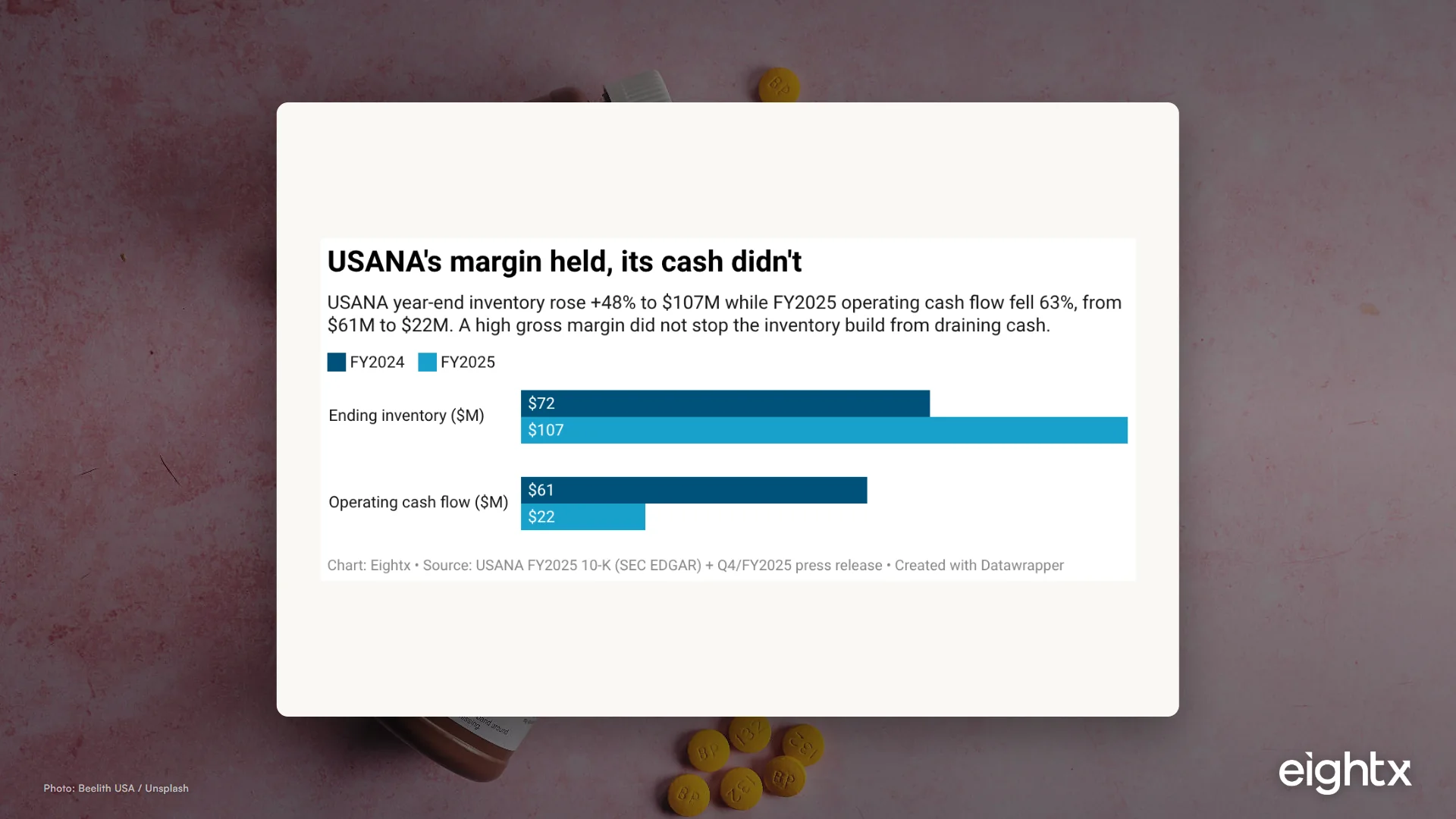
- USANA is the cash trap in one company: inventory rose +48% to $107M while operating cash flow fell 63%, from $61M to $22M. The margin was fine. The inventory build is what drained the cash.
- Set days-on-hand by stage and shelf-life risk, not by a single number: 90-150 days for young brands, 45-90 once demand is visible, and 45-75 for short-dated probiotics, gummies, and liquids.
- Co-packer MOQs of 5,000-10,000 units per SKU are the overstock engine. Sell 800 units a month and a 10,000-unit minimum forces a year of cash into one PO before you've proven the SKU.
- Reorder points must cover an 8-14 week repeat-run lead time (16-26 weeks for a new SKU) plus safety stock. 21 CFR Part 111 then makes lot tracking non-optional, even with a contract manufacturer.
Supplements is the rare consumer category where a 75%-plus gross margin and a permanent cash crunch coexist, and inventory is the reason. You can run a brand that looks gorgeous on the P&L and still sweat payroll, because the cash that margin throws off is sitting in a pallet that won't move for five months. This guide is the CFO read on how to plan supplement inventory: how many days of each SKU to hold, when to reorder against long co-packer lead times, and how to size purchase orders against minimum order quantities (MOQs) and shelf life without burying cash in stock that expires. DIH below means days inventory on hand; FEFO means First Expiry First Out.
Why a 75% gross margin still leaves you short on cash
The fastest way to see the problem is to stop looking at the income statement and look at the balance sheet. USANA Health Sciences, a public supplements brand, closed FY2025 with a perfectly healthy 78% gross margin. And yet its year-end inventory rose roughly 48% to $107M while operating cash flow fell 63%, from $61M in FY2024 to $22M in FY2025. Operating income dropped too, from $66.3M to $37.4M. Nothing was wrong with the margin. The inventory build is what drained the cash.
This is the pattern under almost every supplements brand we look at. When I talk to founders running a brand this size, the thing they keep saying is that they're above 70% gross margin and still can't make payroll comfortably, and nine times out of ten the cash is sitting in a pallet of inventory that won't turn for five months. Gross margin tells you how much cash each sale generates. It tells you nothing about how long that cash is trapped in stock before it converts back to cash. In supplements, that lag is the whole game.
The reason supplements is worse than most CPG categories is structural, not operational. Co-packers impose large minimum runs, lead times stretch across a quarter, and the product has an expiry date that quietly caps how much you can safely hold. Each of those forces you to carry more inventory than your sales velocity alone would justify. So the inventory plan, not the margin, is the thing that decides whether the brand survives a growth year. Why this matters for your business: if you're scaling revenue and your cash keeps tightening, the fix is almost never "raise prices." It's almost always in your days-on-hand and your PO cadence.
How slowly supplements inventory actually turns
Inventory turns measure how many times a year you sell through and replace your stock: COGS divided by average inventory. Days inventory on hand is the same idea expressed in days (365 divided by turns). The two numbers are the heartbeat of an inventory plan, and in supplements that heartbeat is slow.
Across five public supplements brands in their FY2025 10-Ks, inventory turns land between 2.2x and 3.0x a year: LifeVantage 3.0x, USANA 2.9x, Medifast 2.6x, Herbalife 2.3x, and Nature's Sunshine 2.2x. That is roughly 120 to 165 days of stock sitting on hand at any moment. Pooled DTC and CPG inventory runs even heavier, near 178 days (about 2.0x turns). A 75% gross margin on product that turns 2.5 times a year still ties up about five months of cash. That is the benchmark you are planning against.
| Company | Ticker | COGS ($M) | Ending inventory ($M) | Inventory turns (x) | Days on hand |
|---|---|---|---|---|---|
| USANA | USNA | 200.9 | 69.7 | 2.9 | 126 |
| Herbalife | HLF | 1,114.6 | 475.4 | 2.3 | 159 |
| Medifast | MED | 110.6 | 42.4 | 2.6 | 140 |
| Nature's Sunshine | NATR | 132.4 | 59.4 | 2.2 | 166 |
| LifeVantage | LFVN | 44.9 | 15.1 | 3.0 | 122 |
So what does good look like? Set targets by stage and by shelf-life risk, not as one global number. A young brand with long lead times realistically holds 90 to 150 days on hand (2.5 to 4 turns). With better demand visibility, you tighten toward 45 to 90 days (4 to 8 turns). A fast-turn operator on high-velocity hero SKUs can push to 30 to 45 days (8 to 12 turns), but short-dated SKUs like probiotics, gummies, and liquids should sit lower, around 45 to 75 days, to stay clear of the expiry window.
| Stage / SKU type | Days on hand (low) | Days on hand (high) | Turns/yr |
|---|---|---|---|
| Young brand / long lead times | 90 | 150 | 2.5-4 |
| Mature / good demand visibility | 45 | 90 | 4-8 |
| Fast-turn operator | 30 | 45 | 8-12 |
| Short-dated SKUs (probiotic/gummy/liquid) | 45 | 75 | 5-8 |
See your real margin on every order.
Get our Contribution Margin calculator: COGS, shipping, fees, ads, what's left.
Check your inbox. We'll send the Contribution Margin calculator shortly.
Reorder points, safety stock, and MOQ: the math
A reorder point (ROP) is the inventory level that triggers your next PO. The formula is simple: ROP = safety stock + (average daily demand x average lead time in days). Safety stock is the buffer that absorbs demand spikes and supplier delays. A practical version is the Max-Average method: safety stock = (max daily demand x max lead time) minus (average daily demand x average lead time). If you have clean demand history, a Z-score method (Z x demand standard deviation x square root of lead time) sets the buffer to a chosen service level instead.
The catch in supplements is the lead time inside that formula. A repeat production run of capsules, tablets, or powders takes 8 to 14 weeks. Gummies and softgels take 10 to 18 weeks. A brand-new custom SKU is 16 to 26 weeks or more once you add formulation, raw-material qualification, packaging, and QA release. Your reorder point has to cover that entire window plus safety stock, which means you are placing orders months before the shelf runs low.
| Form | Typical MOQ per SKU | Repeat-run lead time | New-SKU lead time |
|---|---|---|---|
| Capsules / tablets (bottles) | 5,000-10,000 bottles | 8-14 weeks | 16-26 weeks |
| Powders (tubs/pouches) | 2,000-5,000 units | 8-14 weeks | 14-24 weeks |
| Gummies | 50,000-300,000 gummies (~5,000-30,000 bottles) | 10-18 weeks | 20-30+ weeks |
| Softgels | 100,000-300,000 softgels (~5,000-15,000 bottles) | 10-18 weeks | 20-30+ weeks |
Then MOQ collides with the reorder math. Your formula might say reorder 1,400 units, but the co-packer's minimum is 10,000. For a SKU selling 800 units a month, that 10,000-unit run is roughly twelve months of supply forced into a single PO before the SKU has proven itself. The MOQ is the silent killer here. A co-packer says 10,000 units, you sell 800 a month, and now you've got a year of cash frozen in one SKU before you've even confirmed it's a winner. The discipline is to treat MOQ as a constraint on which SKUs you launch, not just how much you buy: if velocity can't clear the minimum inside the usable shelf life, the SKU isn't ready.
The expiry cash trap: shelf life, FEFO, and write-offs
Most ecom inventory advice ignores the one variable that defines supplements: the product expires. Shelf life typically runs 18 to 36 months, but probiotics, gummies, and liquids can be far shorter. That single fact rewires the whole plan, because days-on-hand has to be set against remaining shelf life, not in isolation. A 90-day DIH is comfortable on an 18-month powder and reckless on a 6-month probiotic. The same number means a clean sell-through for one SKU and a write-off for another.
FEFO is the operating rule: ship the lot that expires soonest, not the one that arrived first. Best practice is to sell within the first 50 to 70% of shelf life and avoid shipping product inside 6 to 9 months of its expiry date, because retailers and marketplaces reject short-dated stock and customers complain. A 75% gross margin on a probiotic with eight months left on the clock isn't margin, it's a write-off waiting for a date. The pattern we see again and again is brands that plan inventory forward from a demand forecast, when short-dated SKUs need to be planned backward from the expiry date. Shelf life is the real ceiling, not demand.
Practically, that means your PO sizing logic gets an expiry gate bolted on. Before you confirm a run, check whether the days of supply the order represents (PO units divided by average daily demand) exceeds your usable shelf-life window (shelf life on receipt minus your minimum shipment shelf life). If it does, you are knowingly buying product that will expire on the shelf. That single check, run on every SKU, is what separates brands that grow into their cash from brands that grow into a write-off.
Lot tracking and 21 CFR Part 111, even with a co-packer
Here is the part founders assume their co-packer handles: it's yours. Under 21 CFR Part 111, the cGMP rule for dietary supplements, the brand owner (the "own-label distributor") carries lot-tracking and recordkeeping responsibility even when a contract manufacturer makes the product. You must assign a unique lot or batch number, link each finished lot to its master manufacturing record and the component lots that went into it, ship by lot, and keep those records at least one year past the shelf-life date, or two years past last distribution, whichever applies.
The reason this sits in an inventory-planning guide and not a compliance memo is that it shapes your systems. You cannot run FEFO, execute a clean recall, or even compute accurate expiry-adjusted days-on-hand if your 3PL and your ERP don't track inventory at the lot level. So the inventory plan and the compliance floor are the same project. When we've struggled with this, what worked was requiring lot-level data from the co-packer and the 3PL up front, in the contract, then running a mock recall once a year to prove you can trace a lot from PO to customer. If you can't trace it, you can't ship dated product responsibly, and you can't trust your own inventory numbers.
This is also where the long tail of the category matters. There are 19,539 US Shopify stores in Vitamins & Supplements (50,053 globally, about 2,822 on Shopify Plus), a huge fan of sub-scale brands all buying against the same MOQs and all carrying the same Part 111 obligations. The compliance floor is identical whether you do $2M or $80M. The brands that treat lot tracking as infrastructure rather than paperwork are the ones that can actually act on a tight inventory plan.
A simple inventory plan for an 8-figure supplements brand
Put it together and the plan is six moves. First, ABC your SKUs: a small set of hero products usually drives most of the revenue, and they deserve the tightest planning and the most safety stock. Second, set a days-on-hand target per SKU using the stage-and-shelf-life table above, not one blanket number. Third, compute a reorder point per SKU that covers the full 8-to-14-week (or longer) lead time plus safety stock. Fourth, cap every PO by shelf life: run the expiry gate before you confirm a run, and pass on or split any order that would carry product into its expiry window. Fifth, hold MOQ as a launch gate, not just a buy quantity. Sixth, run a mock recall annually so your lot tracking is real, not theoretical.
None of this requires a full-time finance team, though fractional CFO support can own the quarterly reset so it actually happens. It requires deciding the numbers once, per SKU, and revisiting them each quarter as velocity and lead times move. The brands that do this stop being surprised by their own cash position, because the inventory plan and the cash plan finally describe the same reality. For the wider financial picture this sits inside, see the supplements financial benchmark report, the deeper dive on expiry and lot tracking, and how inventory decisions drive supplement brand cash flow.
In supplements, the inventory plan is the cash plan. A 75% gross margin tells you nothing about whether you can make payroll, because the cash is trapped in stock that turns 2.5 times a year and carries an expiry date. Set days-on-hand by SKU and shelf life, build reorder points around 8-to-14-week lead times, gate every PO against expiry, and the cash stops dying on the warehouse floor.
Frequently Asked Questions
why is my supplement brand always short on cash if my gross margin is 75%?
Because the cash is sitting in inventory. Public supplements brands turn stock only 2.2x to 3.0x a year, which is roughly five months of product on the shelf. A 75% gross margin does not help when the cash that margin generated is frozen in a pallet that won't sell for months. USANA's FY2025 is the cleanest example: inventory rose 48% to $107M while operating cash flow fell 63%.
how many days of inventory should a supplements brand hold by sku?
Set it by stage and shelf-life risk, not one global number. Young brands with long lead times realistically run 90 to 150 days on hand. With better demand visibility, tighten to 45 to 90 days. Short-dated SKUs like probiotics, gummies, and liquids should sit lower, around 45 to 75 days, so you don't run into the expiry window.
how many times a year should supplement inventory turn?
The public comps turn 2.2x to 3.0x, so that is the category baseline, not a target to be proud of. A maturing DTC supplement brand should aim for 4 to 8 turns once forecasting is solid. An aggressive fast-turn operator can hit 8 to 12, but only on high-velocity hero SKUs with reliable lead times.
what is the right reorder point and safety stock calculation for a dtc supplement brand?
Reorder point = safety stock + (average daily demand x average lead time in days). The simplest safety stock formula is (max daily demand x max lead time) minus (average daily demand x average lead time). Because repeat runs take 8 to 14 weeks, your reorder point has to cover that whole window plus the buffer, or you stock out mid-production.
how does moq exposure create overstock risk for supplement brands with short shelf lives?
A co-packer minimum of 10,000 units against sales of 800 a month is roughly a year of supply forced into one PO. If that SKU has 18 months of shelf life you'll probably clear it. If it's a probiotic with 9 months left on receipt, a chunk of that run expires before you can sell it. MOQ plus short shelf life is how high-margin brands write off cash.
what is fefo and why does it matter for supplements?
FEFO is First Expiry First Out: you ship the lot that expires soonest, not the one that arrived first. For dated products it matters more than FIFO because two lots received months apart can have very different expiry dates. Best practice is to sell within the first 50 to 70% of shelf life and avoid shipping anything inside 6 to 9 months of expiry.
how long are typical co-packer lead times for a supplement reorder?
A repeat run of capsules, tablets, or powders is usually 8 to 14 weeks. Gummies and softgels run 10 to 18 weeks. A brand-new custom SKU is 16 to 26 weeks or more once you add formulation, raw-material qualification, packaging, and QA release. Your reorder timing has to be built backward from the longest of these, not the shortest.
what records does 21 cfr part 111 require me to keep for each lot?
You assign a unique lot or batch number, link each finished lot to its master manufacturing record and component lots, ship by lot, and keep records at least one year past the shelf-life date or two years past last distribution. You need to be able to run a lot-level recall. The brand owner carries this even when a co-packer makes the product.
how do i size a purchase order against a co-packer moq without overbuying?
Take the days of supply the MOQ represents (PO units divided by average daily demand) and compare it to your usable shelf life on receipt minus your minimum shipment shelf life. If the MOQ is more days than that window, you're buying product that will expire. Either negotiate a lower minimum, split the run across SKUs, or pass on the SKU until velocity supports the buy.
Sources and methodology
Public-company figures come from SEC EDGAR FY2025 annual reports. USANA Health Sciences (USNA, CIK 0000896264), FY2025 (period ending January 3, 2026, 10-K filed March 16, 2026): revenue $925.3M, COGS $200.9M, gross profit $724.4M, operating income $37.4M (down from $66.3M in FY2024), ending inventory $69.7M (the FY2024-tagged balance, the latest in the 10-K), operating cash flow $22.3M versus $61.0M in FY2024. USANA's Q4/FY2025 press release reports year-end inventory of $107M, up roughly $35M (48%) versus year-end 2024. That figure drives the inventory-build and cash-trap chart; it is not used as a turn denominator, which is why the comps table shows $69.7M for USANA.
Inventory turns for the comps table (Herbalife HLF, Medifast MED, Nature's Sunshine NATR, LifeVantage LFVN) are computed as COGS divided by ending inventory from each FY2025 10-K, carried from the supplements financial benchmark research bundle; days on hand is 365 divided by turns. One limitation: inventory denominators use the latest reported balance-sheet inventory, and the USNA FY2025-period inventory was not yet tagged at pull time, so that single turn figure is approximate.
Category sizing comes from Storeleads via the storeleads-mcp search_stores endpoint, category Health/Nutrition/Vitamins & Supplements, platform Shopify, country US (accessed 2026-06-14): 19,539 US stores, 50,053 global, roughly 2,822 on Shopify Plus. Storeleads revenue-band filters do not constrain this category endpoint, so per-store sales bands were not pulled and are not estimated here.
Vertical-specific framing (inventory turns of 2.2x-3.0x, pooled DTC/CPG inventory near 178 days, and the high-gross-margin-but-thin-operating-margin "margin mirage") is drawn from the published supplements financial benchmark pillar, which is the required uplink for this guide. Days-on-hand bands, MOQ and lead-time ranges, safety-stock and reorder-point formulas, and FEFO and expiry best practice were triangulated through Perplexity and Parallel.ai across sources including eightx.co, 3PL and efulfillment guides, ASCM, NetSuite, and a Matsun Nutrition contract-manufacturing reference, plus the eCFR text of 21 CFR Part 111 and the FDA Dietary Supplement Labeling Guide.
The MOQ, lead-time, and fast-turn figures are vendor and industry interpolations, not single audited numbers, so they are presented as ranges. Operator-voice passages in this guide are anonymized, figure-anchored paraphrases of patterns we see across supplements founders, not quotations from any named brand or client.