
Financial Strategy
Supplements Brand Financial Benchmarks 2026
Public supplements brands run 71-80% gross margin but only about 5% operating margin, because acquisition and overhead eat 30-75% of revenue. A healthy 2026 supplement brand targets blended CAC near or below $89, a 3:1+ LTV:CAC, and 2-3 inventory turns a year.
Key Takeaways
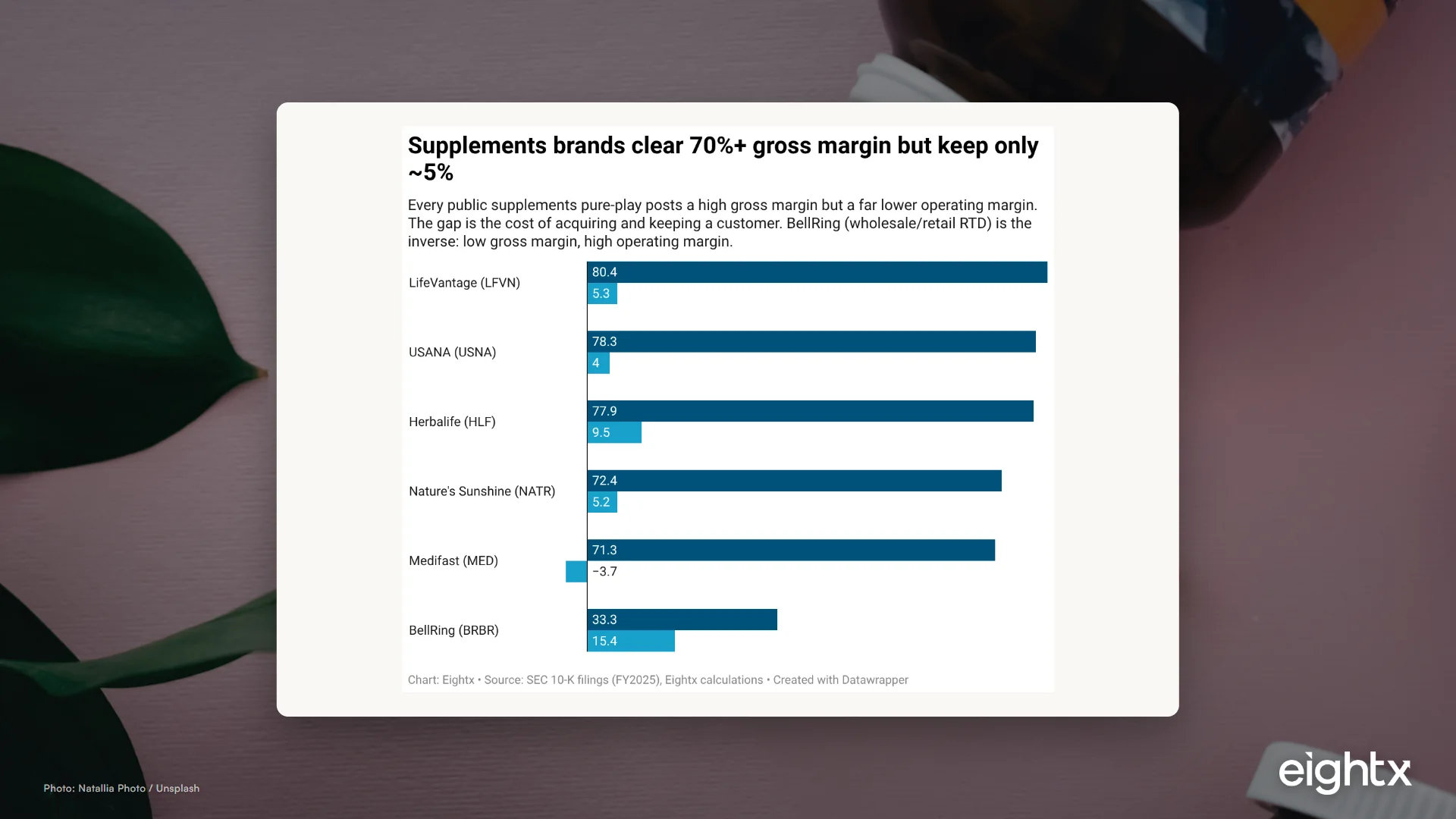
- Public supplements pure-plays run 71-80% gross margin but only 3-5% operating margin. FY2025: LifeVantage 80.4%, USANA 78.3%, Herbalife 77.9%, Nature's Sunshine 72.4%, Medifast 71.3% gross. Median operating margin across the comps is just 5.2%.
- SG&A is the killer line, not COGS. USANA spent 36.5% of revenue on SG&A, Herbalife 37.2%, Nature's Sunshine 37.2%. The gap between a ~78% gross margin and a ~5% operating margin is the cost of getting and keeping a customer.
- Blended CAC for DTC supplements is ~$80-130, median near $89, among the highest of any DTC vertical. The strongest brands with creative and affiliate flywheels run $40-60; anything above ~$90 needs work.
- Healthy LTV:CAC is 3:1 minimum, 4:1+ at maturity, against a 12-month LTV of roughly $180-350 per customer. CAC payback is typically 3-6 months, and subscription mix is the lever that moves it most.
- Inventory turns slowly: ~2-3x per year across the comps. A 75%+ gross margin on stock that turns twice a year still ties up months of cash. The category is huge: 19,400 US Shopify supplement stores, only 2,822 on Shopify Plus.
Supplements is the highest-gross-margin consumer category most operators will ever run, and the one where that margin is most likely to lie to you. If you sell vitamins, powders or capsules direct to consumer, you almost certainly clear 70% gross margin, and that number tells you very little about whether your business is healthy. This is the data pillar the rest of our supplements coverage uplinks to: aggregate margins, customer acquisition cost (CAC), lifetime value (LTV), average order value (AOV), returns and inventory turns, pulled from six public supplements comps and the 19,400 US Shopify stores in the category. Read it as a scorecard for where your own numbers should land.
The margin mirage: 75% gross, 5% operating
Start with the public comps, because they are the only supplements financials you can audit line by line. Across six public supplements and wellness companies (USANA, Herbalife, Medifast, Nature's Sunshine, LifeVantage and BellRing), the branded DTC-style pure-plays cluster at 71-80% gross margin. LifeVantage posts 80.4%, USANA 78.3%, Herbalife 77.9%, Nature's Sunshine 72.4% and Medifast 71.3% on their FY2025 10-K filings.
Then look at what survives. The median operating margin across the comps is just 5.2%. A brand can post a 78% gross margin and keep four cents on the dollar. That gap, from ~75% gross to ~5% operating, is the entire story of this category. Gross margin is table stakes. Everyone clears 70%. The whole game is what survives after you pay to acquire the customer.
When I talk to supplements founders doing $5-20M, almost none of them have a gross-margin problem. They are all above 70%. They have a second-purchase problem, and a CAC problem, and they have usually been told by the headline number that the business is in better shape than it is. The margin mirage is real, and it is expensive, because it delays the hard conversation about acquisition cost by a year or two.
One contrast in the table is deliberate. BellRing Brands (Premier Protein, Dymatize) runs only 33.3% gross margin but a 15.4% operating margin, the inverse of the pure-plays. BellRing is wholesale and retail-led ready-to-drink and powder, so it never carries DTC acquisition cost in the first place. Read BellRing as what the channel does to margin, not as a DTC comp. It is the clearest proof in the dataset that gross margin and operating margin are decided by different things.
Where the money actually goes
If COGS is not eating your margin, what is? SG&A. Across the comps, selling, general and administrative expense runs 30-75% of revenue: USANA at 36.5%, Herbalife 37.2%, Nature's Sunshine 37.2%, LifeVantage 30.3%, and Medifast at a distressed 75.0% after its revenue collapsed from $1.07B in FY2023 to $386M in FY2025. That SG&A line is overwhelmingly customer acquisition and distributor/marketing cost. It is the bill for getting product in front of a buyer and convincing them to purchase.
Take USANA as a clean DTC-style exemplar. On $925.3M of FY2025 revenue, cost of goods sold takes 21.7 cents of every dollar, leaving a 78.3% gross margin. Then SG&A takes 36.5 cents, R&D 1.2, and the remaining operating expense most of the rest, leaving 4.0 cents of operating profit. The chart below walks the income statement down from revenue to operating income.
The lesson for your own P&L: stop celebrating gross margin and start watching the SG&A-to-revenue ratio, because that is where supplements brands quietly bleed out. If your blended CAC is rising faster than your AOV and repeat rate, your version of that 36.5% SG&A line is growing, and your 4% operating margin is heading toward zero no matter how good the gross margin looks.
What healthy unit economics look like
Here is the operator scorecard, triangulated from vendor and agency benchmarks across the category. Blended CAC for DTC supplements runs roughly $80-130, with a frequently-cited median near $89, among the highest of any DTC vertical. The high category CAC is structural: there are tens of thousands of sub-scale brands competing for the same paid impressions, which bids up acquisition cost for everyone.
Against that CAC, healthy 12-month LTV runs $180-350 per customer for mid-market brands, which puts a 3:1 LTV:CAC within reach but not guaranteed. CAC payback is typically 3-6 months. AOV of $60-100 is average, $100-150 is strong. The table below is the full benchmark scorecard. Print it and mark where each of your numbers lands.
| Metric | Strong | Average | Needs work |
|---|---|---|---|
| Blended CAC (USD) | 40-60 | 60-90 | 90+ |
| 12-month LTV (USD) | 300+ | 180-300 | <180 |
| LTV:CAC ratio | 4:1+ | 3:1-4:1 | <2:1 |
| AOV (USD per order) | 100-150 | 60-100 | 40-60 |
| 90-day repeat rate (%) | 30+ | 20-30 | <20 |
| CAC payback (months) | 1-3 | 3-6 | 6+ |
| Gross margin (%) | 70-80 | 60-70 | <60 |
A note on contribution margin, since it is the number that actually gates ad spend. After product cost, fulfillment, payment fees and the cost of returns, a healthy supplement brand should clear 55-65% contribution margin on a first order before any marketing. That is the budget you have to pay back CAC. If your contribution margin is thin and your CAC is $90, you are underwater on the first order and entirely dependent on the second and third purchase to turn a profit. Which brings us to the part of the model that decides everything.
Subscription is the whole ballgame
Supplements are a consumable. People run out and rebuy, or they should. That makes repeat purchase the single most important number in the model, and it is the one most under-instrumented by founders fixated on acquisition. A healthy 90-day repeat rate is 20-30%, with strong subscription cohorts clearing 30% and top consumable performers reaching 40-55% over time. Subscription typically runs 30-45% of revenue at maturity, and subscription-led consumer brands hit roughly 102% aggregate net revenue retention in 2026, meaning their existing customer base grows revenue on its own before a single new customer is acquired.
The pattern we see again and again is that the brands that survive in this category are not the ones with the lowest CAC. They are the ones who got subscription past roughly 40% of revenue, because that is what turns a 5-month payback into a 2-month one and a 2:1 LTV:CAC into a 4:1. When we have watched a brand fix its economics, the fix almost always lived on the retention side, not the acquisition side: a better second-order flow, a subscribe-and-save default, a reason to come back at day 30 instead of day 90.
This is why two supplement brands with identical CAC and identical AOV can have wildly different valuations. One converts 15% of buyers to subscription and bleeds; the other converts 40% and compounds. The acquisition cost is the same. The retention engine is not. If you only have budget to fix one thing this quarter, it is almost never the top of the funnel.
The cash trap nobody models: inventory turns
There is one more way the margin headline lies, and it shows up on the balance sheet, not the P&L. The public comps turn inventory about 2-3 times a year: USANA 2.9x, LifeVantage 3.0x, Medifast 2.6x, Herbalife 2.3x and Nature's Sunshine 2.2x, computed as COGS divided by ending inventory. Independent triangulation puts pooled DTC and CPG inventory at roughly 178 days, or about 2.0x turns, as of May 2026. That is 120-180 days of stock sitting in a warehouse.
A 75% gross margin on inventory that turns twice a year is a cash trap in a nice outfit. The margin tells you the unit is profitable. The turns tell you your cash is locked up for months before that profit is realized. For a growing brand, slow turns plus high CAC is the combination that drains the bank account even while the P&L looks fine, because you are funding both the next inventory buy and the next customer at the same time, months before either pays back.
| Company | Ticker | Revenue ($M) | Gross margin % | Operating margin % | SG&A % of revenue | Inventory turns (x) |
|---|---|---|---|---|---|---|
| USANA | USNA | 925.3 | 78.3 | 4.0 | 36.5 | 2.9 |
| Herbalife | HLF | 5,037.5 | 77.9 | 9.5 | 37.2 | 2.3 |
| Medifast | MED | 385.8 | 71.3 | -3.7 | 75.0 | 2.6 |
| Nature's Sunshine | NATR | 480.1 | 72.4 | 5.2 | 37.2 | 2.2 |
| LifeVantage | LFVN | 228.5 | 80.4 | 5.3 | 30.3 | 3.0 |
| BellRing | BRBR | 2,316.6 | 33.3 | 15.4 | 17.1 | 5.4 |
A healthy supplements brand is not defined by gross margin. Almost everyone clears 70%. It is defined by what survives after CAC and how fast your cash comes back. Watch the SG&A line, the subscription mix and the inventory turns, in that order. The gross margin will take care of itself.
How to use these benchmarks
Run your own numbers against the scorecard table and find the one row where you are furthest from "strong." For most brands at $5-20M, that row is repeat rate or subscription mix, not CAC. Fix that one first, because it moves payback and LTV:CAC at the same time. Then watch your inventory turns, because a 75% margin on slow stock is the quiet cash drain that the P&L never shows you.
If you want the deeper view on the acquisition side, our supplement CAC and payback benchmarks break down payback by channel and subscription mix. For a cross-vertical read on how supplements compares to other high-margin categories, see the beauty brand financial benchmarks. And if you want a second set of eyes on what your own margins, CAC and turns actually say about the health of your business, that is exactly the work our interim CFO services do.
Sources and methodology
SEC EDGAR (primary). FY2025 income-statement and balance-sheet line items were pulled from the 10-K filings of six public supplements and wellness comps: USANA Health Sciences (USNA, CIK 0000896264, filed 2026-03-16), Herbalife (HLF, CIK 0001180262, filed 2026-02-18), Medifast (MED, CIK 0000910329, filed 2026-02-17), Nature's Sunshine (NATR, CIK 0000275053, filed 2026-03-10), LifeVantage (LFVN, CIK 0000849146, filed 2025-09-04) and BellRing Brands (BRBR, CIK 0001772016, filed 2025-11-18). Fiscal year-ends vary, which is noted in the comps table footnote.
Derived metrics (Eightx calculations). Gross margin = gross profit divided by revenue; operating margin = operating income divided by revenue; SG&A percentage = SG&A divided by revenue; inventory turns = COGS divided by ending inventory. The inventory-turn denominator uses the latest reported inventory on the balance sheet, which for USANA reflects the FY2024 period where the FY2025 balance-sheet inventory was not yet tagged. Treat the turn figures as approximate to within a tenth.
Two deliberate caveats on the comps. Herbalife carries negative stockholders' equity (-$801M) from leveraged buybacks, which is a capital-structure artifact and not a going-concern signal, so we read its operating margin, not its balance sheet, for category health. Medifast is the cautionary tale: its weight-management and meal-replacement model took a GLP-1 demand shock that cut revenue by roughly two-thirds and pushed operating margin negative. It is included as one row, not as the story, because the category lesson stands without it.
Storeleads (primary, category aggregates). Shopify store counts for the Health/Nutrition/Vitamins & Supplements category were pulled via Storeleads on 2026-06-11: 50,053 global stores, 19,400 in the US, and 2,822 on Shopify Plus globally. Revenue-band splits were not reliably constrained by the category endpoint's filters, so we report store counts and platform/plan mix only and did not fabricate revenue-band breakdowns.
Triangulation layer (Perplexity and Parallel.ai). CAC, LTV, AOV, repeat rate, subscription mix and payback are synthesized from vendor and agency benchmark reports, including ATTN Agency DTC Profitability Benchmarks 2026 and Eightx CAC-payback-by-vertical work. These figures are interpolated category ranges, not single audited numbers, and are presented as bands throughout. Hims & Hers FY2025 gross margin of 74% is noted as an additional telehealth-adjacent reference point.
Update cadence. This pillar refreshes annually as the comps file new 10-Ks, and on a rolling basis as the category benchmark ranges move. The next scheduled refresh target is the FY2026 10-K cycle in early 2027.
Frequently asked questions
what is a good gross margin for a supplements brand?
70-80% is normal for a DTC supplement brand, and the public pure-plays prove it: LifeVantage runs 80.4%, USANA 78.3%, Herbalife 77.9%. If you are below 60% you likely have a sourcing, packaging or channel problem. But gross margin is table stakes here. It tells you almost nothing about whether the business is healthy.
why is my supplement brand's operating margin so low if gross margin is 75%?
Because acquisition and overhead eat the gap. Across the public comps, SG&A runs 30-75% of revenue, so a ~78% gross margin collapses to a ~5% operating margin. The 70-point drop is the cost of getting and keeping a customer. That is the number that actually decides whether you are profitable.
what is the average cac for a supplement brand in 2026?
Blended CAC for DTC supplements runs roughly $80-130, with a frequently-cited median near $89. That is among the highest of any DTC vertical. Brands with strong creative and affiliate flywheels get to $40-60; anything above $90 is a flag to dig into channel mix and creative.
what is a healthy ltv:cac ratio for a supplement dtc brand?
Aim for 3:1 minimum and 4:1+ at maturity. At a ~$89 CAC and a 12-month LTV of $180-350, many brands sit between 2:1 and 4:1. If you are under 2:1 you are buying revenue at a loss once you load in overhead. Subscription mix is the fastest way to push the ratio up.
how long should cac payback take for a supplement brand?
3-6 months is typical for supplements. That is slower than food and beverage (1-3 months) but faster than fashion or electronics. The single biggest lever is subscription: moving subscription from 20% to 45% of revenue can turn a 5-month payback into roughly a 2-month one.
what aov should a supplement brand aim for?
$60-100 is average, $100-150 is strong, and below $60 makes a ~$89 CAC very hard to pay back on a first order. Bundles, multi-month supply packs and subscription defaults are the usual ways to lift AOV without raising unit price.
what is a good repeat purchase rate for supplements?
A healthy 90-day repeat rate is 20-30%, and strong subscription cohorts clear 30%. Top consumable performers hit 40-55% repeat over time. Supplements are a consumable, so a weak repeat rate is usually a product, onboarding or subscription problem, not an acquisition one.
how does subscription change the unit economics of a supplement brand?
It changes everything. Subscription typically runs 30-45% of revenue at maturity and is what lifts LTV, compresses payback and stabilizes demand planning. The brands that survive in this category are rarely the ones with the lowest CAC. They are the ones who got subscription past ~40% of revenue.
Related Eightx benchmarks: Amazon vs DTC Economics for Supplement Brands (2026) and Supplement CAC and Payback Benchmarks 2026.