
Channels · News React
TikTok Shop Small-Biz Sales Grew 66% in 2025: What Every DTC Brand Should Take From It
TikTok Shop reported that U.S. small-business sellers under $15 million in revenue grew their sales 66 percent in 2025, and the platform now hosts 215,000+ active U.S. small sellers, up 25 percent from 2024. Beauty and personal care led at $2.7 billion, about 19 percent of the platform. The discovery edge is the real story: 67 percent of visitors come specifically to find new brands, versus 57 percent on Amazon.
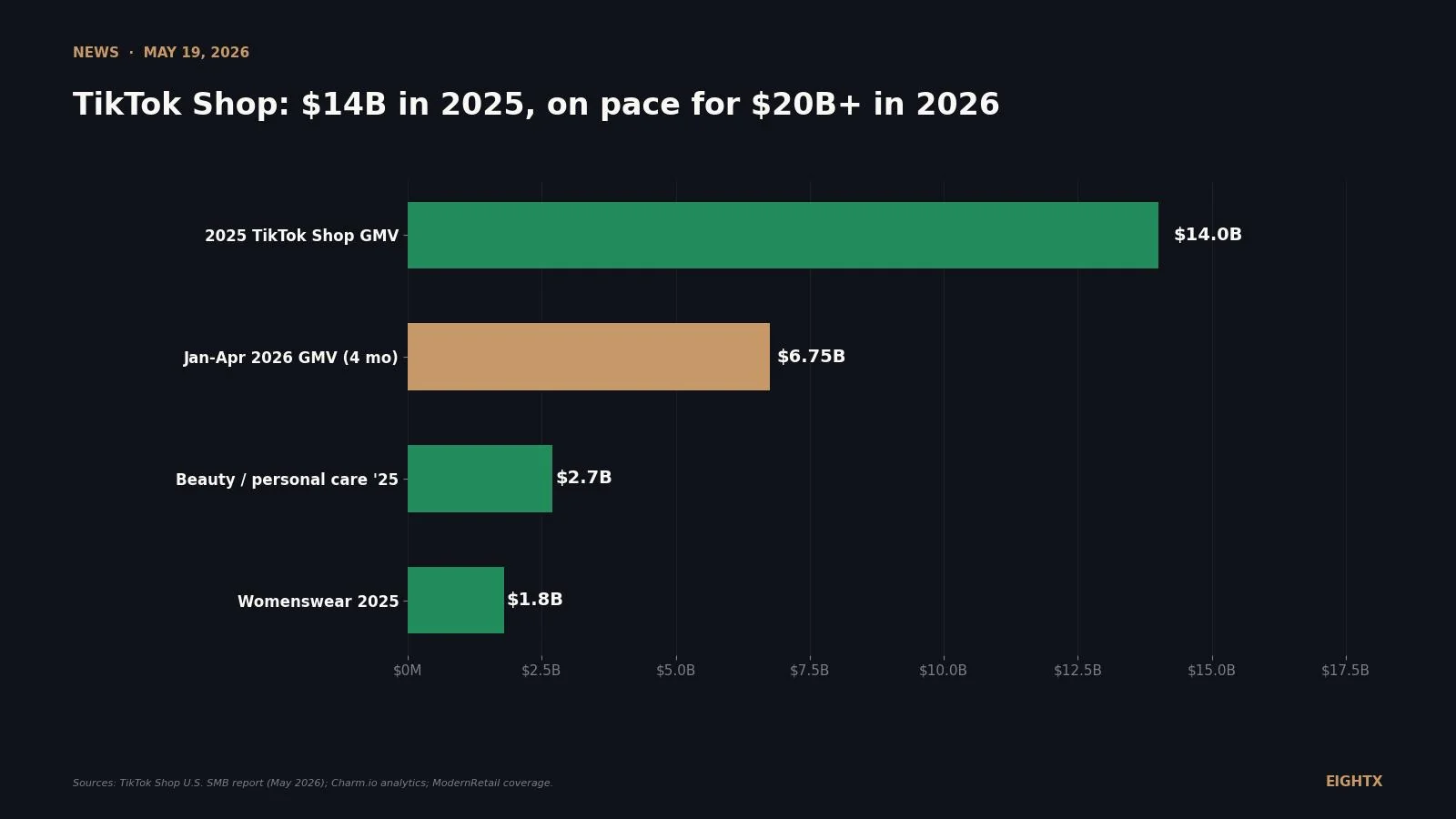
TikTok Shop published a May 2026 report claiming that U.S. small-business sellers (those under $15 million in annual revenue) grew their sales on the platform 66% in 2025. Here's why this matters for DTC operators and what to expect next. Total U.S. TikTok Shop Gross Merchandise Value (GMV) hit $14 billion in 2025 (per Charm.io analytics), making the platform bigger than Wayfair, Etsy, and eBay. The first four months of 2026 alone hit $6.75 billion (roughly 2x the same period in 2025), which puts the annualized run-rate above $20 billion. (1) If your product is visual, sub-$50, and in beauty, apparel, food, or home, you should already be on the platform. (2) The unit economics are different from Meta and Google: 15% to 28% of revenue goes to creator commissions and platform fees before you ship a unit, so 60%+ gross margin is the operator threshold for making it work. (3) Regulatory and platform-dependence risk are real, and the right size of the bet is 5% to 20% of revenue, not 60%. Below: what to do this week, and what we're watching over the next 6 to 12 months.
What happened
TikTok Shop released its U.S. small-business sales report in May 2026, covered by Modern Retail. The headline number is 66% year-over-year growth in sales from sellers under $15 million in annual revenue. The platform now hosts 215,000+ active U.S. small-business sellers, up 25% from 2024. Beauty and personal care led 2025 sales at $2.7 billion (about 19% of the platform). Womenswear came second at $1.8 billion (about 12.5%). TikTok is also pulling major Consumer Packaged Goods (CPG) partners (Frito-Lay, Mars, Coca-Cola) into direct-to-consumer sales on the platform.
The discovery economics are the second story. A GlobalData survey of 6,000 U.S. consumers (April-May 2025) found that 67% of TikTok Shop visitors go to the platform specifically to discover new products and brands (versus 57% on Amazon). 72% of brands U.S. consumers discovered on TikTok had under $15 million in revenue. 58% of consumers who discovered a small brand went on to purchase from that brand on the platform. 70% of TikTok Shop consumers bought a product that was recommended by a creator they follow.
The case studies underline the asymmetry. Mavwicks Fragrances reportedly went from $300,000 to $400,000 in pre-platform annual sales to $32 million in its first year on TikTok Shop. BumpaBuilt, a Connecticut 3D-printed toy seller, went from one printer to seventy and now distributes through 250+ independent retailers. The Mississippi Candle Company grew 600%+ year-over-year after a single viral video, and is building a 20,000 square foot warehouse. Dani Morgan's Boutique generated $100,000 in sales in a single 15-hour livestream using TikTok's countdown bidding feature. The pattern is that small, visually-demonstrable, story-led brands with a real founder on camera are the ones moving real volume.
What TikTok Shop's growth means for your P&L.
The Margin turns channel shifts into operator moves. Free, weekly.
Check your inbox — we'll send The Margin shortly.
Why this matters for your business
The TikTok Shop number that matters is not 66%. It's the 72%.
72% of brands that U.S. consumers discovered on TikTok were under $15 million in revenue. That is not how any other large U.S. ecommerce surface works. On Amazon and Google, the brands the algorithm shows you are mostly the brands that have the biggest ad budget. On TikTok, the algorithm is genuinely re-distributing attention from incumbents to newcomers. For a $5 million to $50 million DTC brand, that is the unlock.
Three implications follow.
Implication 1: the channel has earned a real allocation, but not a primary one. If you're running a DTC brand in beauty, apparel, food, kitchen, or home, plan to put 5% to 20% of revenue through TikTok Shop within 12 months. Below 5% and you're not learning anything actionable. Above 20% and you're carrying platform-dependence risk that is not priced into your business yet. Above 60% (the Mavwicks profile) and you're a TikTok Shop business, not a DTC business - different economics, different valuation multiple, different acquirer pool.
Implication 2: the unit economics are different from Meta or Google, and most operators miss this. Creator-affiliate commissions on TikTok Shop typically run 10% to 20% of order revenue. The platform takes another 5% to 8%. So before you ship a single unit, 15% to 28% of revenue is gone to acquisition. The trade is that this cost is performance-based (you only pay when a creator drives a sale), it scales with revenue (no upfront ad spend), and the creator-economy mechanic does the targeting work that you'd otherwise pay Meta for. For products with 60%+ gross margin, the math works comfortably. For 40% gross margin commodity SKUs, it doesn't. Before you scale, run the math on at least three SKUs with realistic affiliate-commission assumptions, not aspirational ones.
Implication 3: every dollar on TikTok Shop is a rented dollar. The U.S. operational status of TikTok has been an open regulatory question since 2024. A forced sale or a ban would not necessarily zero out TikTok Shop overnight (the U.S. operation could transfer to a new owner), but it would freeze growth, reset every brand's account economics, and likely shake out the creator base. Plus the platform has been historically aggressive about changing the affiliate-commission rules with little notice. Operate on TikTok Shop with the assumption that this is a temporary distribution layer: capture email and Short Message Service (SMS) on the order confirmation, push repeat customers to your direct channel, and never let TikTok Shop pass 25% of revenue.
The fourth implication is competitive. Amazon's Inspire and Shopify's Collabs are both trying to be answers to TikTok Shop. Neither has the attention surface or the creator-economy density. That asymmetry is not stable. Either TikTok consolidates the position (the most likely outcome over 12 to 18 months) or one of the incumbents finally builds a viable copy and the discovery premium fragments. Both outcomes are worse for the brands sitting on the sidelines now.
What to do this week
- Run the SKU triage. Pick the three SKUs from your line that score best on three filters: (a) visual demo in 15 seconds, (b) sub-$50 price point, (c) 60%+ gross margin after creator commission. If you have at least one SKU that hits all three, you have a TikTok Shop business. If you have none, you don't, and you can stop here.
- Open the Seller Center account. Onboarding is 1 to 2 weeks. The bottleneck is usually proving the business is real (bank verification, product compliance for beauty / consumables, the brand registry). Start it today so the account is live when your creative is ready.
- Build a creator-affiliate program at 15% to 20% commission. Seed it with 10 to 20 micro-creators (under 100,000 followers) sourced from the platform's affiliate marketplace. Pay nothing flat-fee in the first 90 days. Affiliate-only keeps the unit economics honest while you learn what works.
- Make creative cheap and high-volume. A TikTok video should cost under $200 fully loaded and you should ship 3 to 5 a week per SKU. The most expensive piece of creative you make on TikTok Shop is the one that doesn't go up.
- Capture email and SMS on every order. Set up the auto-capture in your fulfillment workflow so the customer ends up in your direct flow within 24 hours of purchase. The platform is a discovery layer. The repeat-purchase economics live in your owned channels.
- Set a hard cap on channel concentration. Write it down. 25% of revenue is the upper bound for most DTC brands. Above that, raise the platform-dependence-risk conversation with your board before you raise the revenue.
What we're watching next
Three signals will tell us how durable the channel is.
First, the U.S. regulatory clock on TikTok. Any forced-sale or ban news in the next 6 months immediately freezes the growth math and shakes out the creator base. Operate as if the worst case is real and the upside is gravy.
Second, the first-mover SMB cohort aging out. The brands that broke $32 million on TikTok in 2024 and 2025 are now crossing the $15 million revenue ceiling and aging out of the "small business" definition. Watch how the platform's discovery algorithm treats them at $20M+, $50M+, $100M+. If the algorithm starts down-weighting them in favor of the next cohort of unknowns, that confirms the discovery premium is real and sustainable. If it doesn't, the second wave of brands has less of an advantage than the first did.
Third, the competitive response. Amazon Inspire and Shopify Collabs both ship feature updates roughly quarterly. Watch for either of them launching a real affiliate-commission rail tied to creator content. If one of them does and gets traction, the discovery premium TikTok currently captures starts fragmenting.
The bottom line for founders: TikTok Shop is the rare U.S. ecommerce surface where being small is a real advantage. The brands that win the next 12 months will be the ones that allocated 10% to 20% of their bandwidth to the channel in 2026, treated it as a rented discovery layer rather than a primary business, and built their unit economics around 60%+ gross margin SKUs that can absorb a 20% creator commission.
Frequently Asked Questions
is tiktok shop actually worth my time if i'm a $5m-$50m dtc brand?
Probably yes for a slice of revenue, but no as a primary channel. The platform's discovery economics genuinely favor smaller, unknown brands (72% of brands U.S. consumers discovered on TikTok had under $15M revenue). If your product is visually demonstrable, sub-$50 impulse, and in beauty / apparel / home / food, it belongs on the channel. Plan for 5% to 20% of revenue, not 60%. Anything higher is platform-dependence risk.
what does the unit economics actually look like on tiktok shop?
The CAC math is different from Meta or Google. Creator-affiliate commissions typically run 10% to 20% of the order, plus TikTok's own commission of 5% to 8%. So you're looking at 15% to 28% of revenue going to acquisition before you ship a unit. The trade is that this is performance-based, scales with sales, and doesn't require upfront ad spend. For products with 60%+ gross margin, the math works. For commodity SKUs at 35% gross margin, it doesn't.
is the regulatory risk on tiktok still a real reason to wait?
Yes, but waiting has its own cost. The U.S. operational status of TikTok has been an open question since 2024. A forced sale or ban would not necessarily zero out TikTok Shop overnight (the U.S. operations could transfer to a new owner), but it would freeze growth and reset every brand's account economics. Operate on TikTok Shop with the assumption that it's a temporary distribution layer - meaning capture email and SMS aggressively, get repeat purchases off-platform, and never let the channel exceed roughly 25% of revenue.
what kinds of products are actually winning on the platform?
Three product profiles dominate. (1) Visual demo products where a 15-second video shows the before-and-after better than any photo (beauty, skincare, kitchen gadgets, cleaning). (2) Curiosity-driven novelty under $30 where the impulse-buy threshold is low (food, accessories, home decor). (3) Story-led brands with a real founder presence on camera - Mavwicks Fragrances went from $300K to $32M in a year on this model. If your product fits none of those three, the platform will not save you.
if i'm starting from zero on tiktok shop in 2026, where do i begin?
Pick two or three SKUs from your existing line that pass the visual-demo test. Open the Seller Center account, complete onboarding (1 to 2 weeks). Build a creator-affiliate program at 15% to 20% commission and seed it with 10 to 20 micro-creators (under 100K followers) you find via the platform's marketplace. Do not pay flat-fee influencer deals in the first 90 days - affiliate-only keeps you honest on unit economics. Reinvest the first $50K of revenue into countdown bidding livestreams to test the format. Then re-evaluate at the 90-day mark.