
Insights
TikTok Shop adoption on Shopify: who's actually selling there in 2026
TikTok Shop adoption on Shopify is not uniform. Shopify Plus stores run TikTok Pixel at 28.7% versus 10.4% for standard Shopify stores, and beauty leads all verticals at 20%. Food and drink sits near the baseline. The channel is scaling fastest among higher-GMV operators with visual, impulse-friendly products. If you sell beauty or accessories, your competitors are already testing it.
Key Takeaways
- 28.7% of Shopify Plus stores run TikTok Pixel vs 10.4% of regular Shopify. That's a 2.76x adoption gap. The upmarket already moved; the non-Plus tier is the contested 2026 cohort.
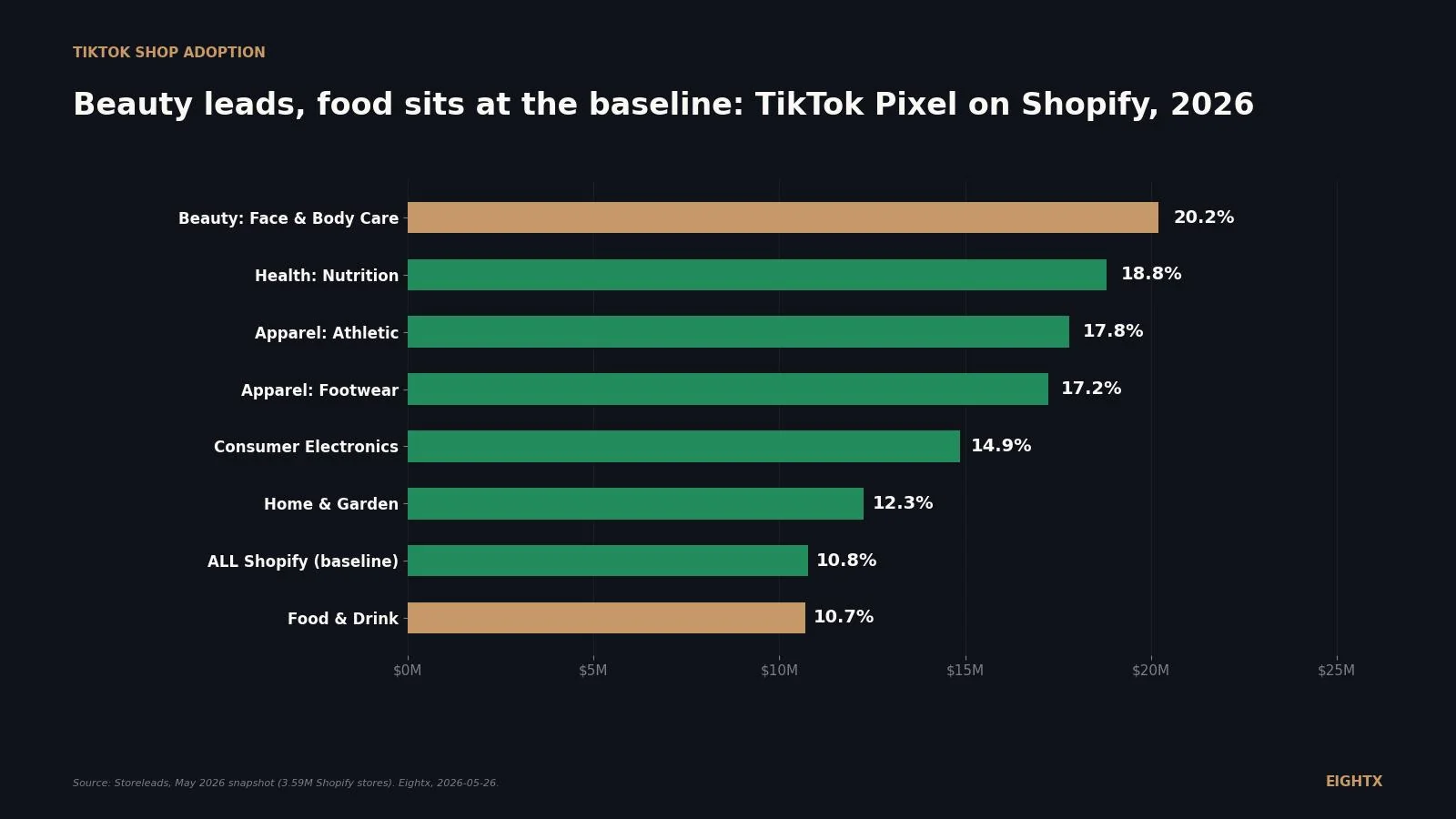
- Beauty (face and body care) leads category adoption at 20.2%, with health/nutrition at 18.8% and athletic apparel at 17.8%. Food and drink, the canonical viral category, sits at 10.7%, right at the all-Shopify baseline.
- TikTok Pixel adoption on Shopify Plus is now 65.6% of Meta Pixel adoption on the same cohort (28.7% vs 43.8%). Five years ago that ratio was effectively zero.
- US TikTok Shop GMV is on pace for ~$23.4B in 2026, up 48% from $15.82B in 2025 (eMarketer-aligned consensus). Seller count is growing slower than GMV, which means average revenue per active seller is rising fast.
- Of ~475,000 registered US TikTok shops, only ~216,000 actually transact (~46% active rate). The headline merchant count overstates competition; the active denominator is what your peer set actually looks like.
We pulled Storeleads in May 2026 to answer a question we kept hearing from operators: "Who is actually selling on TikTok Shop in 2026, and should we be there too?" The headline answer surprised us. The viral category on TikTok (food and drink) adopts the platform at the all-Shopify baseline of 10.77%. The categories that have actually moved hard are beauty, health, athletic apparel, and footwear, and the cohort that moved first is Shopify Plus. If you run a $5-50M direct-to-consumer (DTC) brand on regular Shopify, your competitive peer set on Plus is already past the test phase. This post lays out what we found.
The headline number every Shopify operator should know
387,057 Shopify stores run TikTok Pixel as of May 2026. That's 10.77% of the 3,593,277 stores Storeleads tracks across the platform. TikTok Pixel is now the 22nd most-installed technology in the Shopify universe, ahead of Klaviyo, Mailchimp, and Pinterest Pixel.
The interesting cut isn't the headline 10.77%. It's the plan-tier gap. 28.70% of Shopify Plus stores (21,693 of 75,592) run TikTok Pixel. Only 10.39% of regular Shopify stores (365,364 of 3,517,685) do. That's a 2.76x adoption gap between the upmarket and the non-Plus tier.
A few caveats before we go further. TikTok Pixel install is the closest available proxy for TikTok Shop integration in the Storeleads dataset; the two are correlated but not identical. Some stores have the pixel for ad attribution without an active Shop. Some have an active Shop without driving paid TikTok traffic. We surface the methodology in detail at the bottom of the post. Treat the numbers as directional adoption signal, not a literal Shop-integration count.
Plus tier is two-thirds of the way to Meta-level adoption
Inside Shopify Plus, TikTok Pixel adoption (28.70%) is now 65.6% of Meta Pixel adoption (43.76%) on the same cohort. Five years ago that ratio was effectively zero. TikTok has closed two-thirds of the Meta install gap on the upmarket tier of Shopify in roughly five years.
Cohort Store count TikTok Pixel installs Adoption rate All Shopify (global) 3,593,277 387,057 10.77% Shopify Plus 75,592 21,693 28.70% Regular Shopify (non-Plus) 3,517,685 365,364 10.39% US Shopify (all plans) 1,267,098 147,189 11.62%
Two things drove the Plus tier first. First, agency push. The TikTok Shop partner-agency ecosystem has been pitching the channel as a "2026 land grab" since mid-2024, and Plus brands pay for partners. Second, AOV and SKU mix. Plus brands more often sit in the $30-150 AOV range with the SKU breadth and creator-affiliate budget that TikTok's commission economics actually reward.
Country matters less than plan tier here. The US Shopify base runs slightly above the global average for TikTok adoption (11.62% vs 10.77%) but the gap is one percentage point, not 18 percentage points. Plan tier is the bigger predictor.
Where adoption is highest by category: beauty leads, food trails
Here's the cut that surprised us most. We expected food and drink, the canonical viral category on TikTok, to lead Shopify-side adoption. It doesn't. It sits at 10.71%, almost exactly the all-Shopify baseline of 10.77%.
The categories that actually adopt at above-baseline rates are beauty (20.19%), health and nutrition (18.81%), athletic apparel (17.81%), and footwear (17.23%). These are mid-AOV consumables and softgoods where a creator demo plus a $40-120 checkout lands cleanly. Food and drink, where median AOVs are $15-30, doesn't have the creator-commission math to support the same playbook.
Category TikTok Pixel adoption rate Beauty: Face & Body Care 20.19% Health: Nutrition 18.81% Beauty & Fitness (overall) 18.80% Apparel: Athletic Apparel 17.81% Apparel: Footwear 17.23% Health (overall) 15.83% Consumer Electronics 14.85% Apparel (overall) 14.54% Apparel: Clothing Accessories 14.47% Apparel: Casual Apparel 13.92% Pets & Animals 13.91% Home & Garden 12.26% Sports 11.13% ALL Shopify (baseline) 10.77% Food & Drink 10.71%
The takeaway for operators: don't generalize from "TikTok food trends" to "TikTok Shop food adoption." The platform's content virality and its commerce conversion are different things. TikTok Shop converts on creator demos of mid-AOV consumables with a strong before/after story, not on viral recipe content.
What the platform-level GMV trajectory says
eMarketer's published 2025 figure is $15.82B in US TikTok Shop GMV, up 108% from 2024. The 2026 eMarketer-aligned consensus, which we triangulated against multiple secondary sources citing eMarketer, is about $23.4B (+48% YoY). eMarketer itself describes the 2026 outlook as "another 48.0% increase this year" after the 108% prior year.
Year US TikTok Shop GMV (USD billions) YoY growth 2023 $1.5B n/a (back-solved baseline) 2024 $7.6B +407% (back-solved from published growth rate) 2025 $15.82B +108% (eMarketer published) 2026 $23.4B +48% (eMarketer-aligned consensus)
The seller-side number is what makes this trajectory interesting. Per industry trackers and TikTok Newsroom data, there are about 475,000 registered US TikTok shops as of mid-2025, up from roughly 4,450 in mid-2023 (a 5,000% jump in two years). But only about 216,000 of those registered shops actually transact (December 2024 active count). That's a 46% active rate. The headline "475K-500K US sellers" line is true but overstates the competitive density; the active denominator is half that.
Combine the GMV trajectory ($15.82B to ~$23.4B) with the flat-ish active-seller count and you get a clean read: average revenue per active TikTok Shop seller is rising sharply. The winners are scaling fast and the long tail of registered-but-not-transacting shops is widening. That's consistent with what we see on the Shopify side: Plus tier is leaning in harder than the SMB cohort.
ByteDance's own commentary supports the same read. Overseas commerce revenue grew ~50% in 2025 and now exceeds 30% of total revenue, even as ByteDance's net profit fell 70%+ on AI capex. TikTok Shop is a strategic priority for ByteDance, not an experiment they could shelve.
What this means for your business if you're $5-50M DTC
Three actions to take this quarter if you're a $5-50M DTC brand weighing the channel.
Audit your peer set's adoption rate before you build the case. If your top 20 direct competitors include 5 or more brands already running TikTok Pixel (you can check this in Storeleads or BuiltWith in 30 minutes), you're not pioneering the channel; you're catching up. If 0-2 of them are on, you have more time to validate before committing creator-affiliate budget.
Match your category economics to the data. Beauty, health and nutrition, athletic apparel, and footwear are above-baseline categories with creator-friendly AOVs ($40-150) and visual-demo product types. Food and drink, home and garden, and other low-AOV or hard-to-demo categories are sitting at baseline for a reason: the creator commission math doesn't work as cleanly. Don't run the same playbook across all categories.
Build creator commissions and inventory carry into your channel P&L upfront. Eightx operators report 10-20% standard creator-affiliate take on TikTok Shop. On a $40 AOV beauty SKU at 65% gross margin, a 15% creator fee plus 15% TikTok marketplace commission can compress contribution to 35-40% before fulfillment, the same kind of gap between gross and operating margin we see across public DTC. That's still workable, but only if AOV and unit volume hold, and only if parcel shipping costs don't eat the rest on the way out the door. Multiple operators also flag that TikTok orders show up even before brands actively pursue the channel, which means your inventory model needs a TikTok forecast row whether you've "launched" formally or not.
The CFO read on channel-mix decisions like this one is what we cover in detail in our ad-spend by stage 2026 piece, and the auction-density argument for TikTok-vs-Meta CPM compression is one of the threads we picked up in the DTC layoff and hiring tracker. If you want the full channel-economics analysis applied to your numbers, that's the work our interim CFO services tee up.
The viral category on TikTok adopts TikTok Shop at the platform baseline. The categories that actually move (beauty, health, athletic apparel) are mid-AOV consumables where a creator demo plus a $40-120 checkout lands cleanly. Don't generalize from "TikTok food trends" to "TikTok Shop adoption." They're different things, and the data shows it.
What we're watching next
Two data points will sharpen this picture. First, the H2 2026 Storeleads snapshot, which will tell us whether non-Plus closes the gap (catch-up cycle) or the divergence widens (Plus-only land grab). Second, eMarketer's final-year 2026 GMV print due in Q1 2027, which will confirm or revise the $23.4B consensus.
We'll refresh the post when both land. Also tracking: whether ByteDance discloses a US TikTok Shop seller take rate explicitly (it hasn't yet; industry-reported commission is 5-8% for most categories), and whether the active-vs-registered shop ratio shifts as TikTok rolls out merchant-onboarding changes.
Sources and methodology
Primary data source: Storeleads. All Shopify-side adoption figures are from a live Storeleads pull on 2026-05-25. Method: each cohort count was obtained by running the Storeleads search_stores endpoint with combinations of platform=shopify, technology=TikTok Pixel, plan=Shopify Plus, country=US, and category-path filters. The 14 categories were selected to give wide coverage of DTC verticals while staying within Storeleads' category-path encoding.
TikTok Pixel as proxy for TikTok Shop integration. Storeleads does not have a clean "TikTok Shop" technology tag. The closest available signal is TikTok Pixel (387,057 installs on Shopify). This is a strong-but-imperfect proxy: TikTok Pixel installation means a store is running TikTok ads, which is highly correlated with but not identical to TikTok Shop integration. Stores that sell only on TikTok Shop's marketplace without driving paid TikTok traffic to their Shopify storefront would not show up. Stores running TikTok ads without operating a Shop would. The official Shopify TikTok app (shopify.tiktok, 13,132 reviews) is not surfaceable as a per-store filter in Storeleads.
eMarketer GMV figures. Pulled from the March 2025 eMarketer press release and 2026 commentary. Only the 2025 figure ($15.82B) is directly published. The 2023 and 2024 figures are back-solved from eMarketer's published growth rates of 407% (2024 vs 2023) and 108% (2025 vs 2024) anchored on the $15.82B 2025 print. The 2026 figure ($23.4B, +48% YoY) is the eMarketer-aligned consensus that appears across multiple 2026 social-commerce roundups citing eMarketer. Independent dashboards (Dashboardly) project a higher $37B base case for 2026 on their own model; we cite the eMarketer-aligned consensus as the conservative base case.
US merchant counts. Sourced from industry trackers and TikTok Newsroom. Active-vs-registered split (~216,000 active of ~475,000 registered as of December 2024) is from the same source. ByteDance does not publish an official US merchant time series.
Operator-side commentary. Drawn from anonymized Eightx founder-call corpus (13 matched conversations on TikTok Shop spanning Nov 2023 through Nov 2025). Operator quotes on creator commissions (10-20%), passive order leakage, and inventory-forecast gaps are paraphrased from those calls.
Methodology limitations. First, TikTok Pixel is a proxy for TikTok Shop integration, not a direct measurement. Second, the Storeleads category schema has some category paths that cannot be queried reliably; we used the paths that returned clean counts. Third, no Shopify-side time series was available, so the post tells a snapshot story on the Shopify side and pulls the time-series story from off-platform GMV data. Fourth, the eMarketer 2026 figure is a projection, not an actual print.
Frequently asked questions
is tiktok shop actually worth selling on if i'm under $5m dtc?
Probably yes if you're in beauty, health, athletic apparel, or footwear (the top-adopting categories on Shopify) and no if you're in food and drink or home and garden (where adoption sits at the baseline). The platform-level GMV is growing 48% in 2026 and the integration is reversible, so the cost of testing is mostly your time and creator-affiliate fees of 10-20%.
why are shopify plus stores adopting tiktok shop faster than regular shopify?
Three reasons. Plus stores have the budget to test new channels without it being existential. They have specialist agencies pushing TikTok Shop as a 2026 land grab. And their AOV and SKU breadth match TikTok's best-selling categories (beauty, health, athletic) more often than the median non-Plus store does. The 2.76x adoption gap is upmarket discretionary spend doing what upmarket discretionary spend always does.
does running tiktok pixel mean a store is actually selling on tiktok shop, or just buying tiktok ads?
It means the store is running TikTok ads, which is a strong but imperfect proxy for TikTok Shop integration. Some stores have the pixel for ad attribution without completing the Shop integration (the multi-step Shopify permission grant flow stalls a lot of operators). Some have an active Shop without driving paid TikTok traffic. Read this as a directional adoption signal, not a literal Shop-integration count.
if i'm a food and drink brand, why isn't tiktok shop adoption in my category higher?
TikTok food virality is content-driven, not commerce-driven. People watch a chef video and screenshot the recipe; they don't usually checkout in-app for a $12 snack. The categories that adopt fastest are mid-AOV consumables with a strong creator-review motion: skincare at $30-60, supplements at $40-80, athletic gear at $80-150. Food and drink AOVs run too low for the creator commission math to work.
what's the average gmv per tiktok shop seller in the us right now?
If you use the active denominator (~216,000 shops transacting) and the 2026 GMV projection ($23.4B), that's about $108,000 per active seller per year on average. The distribution is wildly skewed: a small cohort of beauty and apparel scalers do 7-figures-a-month and the long tail of testers does under $10K a year. Plan to enter at the tester end and treat your first year as paid market research.
is meta still bigger than tiktok for paid social in dtc, or has tiktok caught up?
Meta is still bigger but the gap is closing fast. On Shopify Plus, TikTok Pixel adoption is now 65.6% of Meta Pixel adoption (28.7% vs 43.8%). Five years ago that ratio was effectively zero. For the same reasons we tracked in our DTC layoff and hiring tracker, TikTok auction density is climbing while Meta's is softer, which is starting to compress the CPM advantage Meta had through 2023-2024.
should i wait for tiktok shop to mature before integrating, or is the window closing?
The platform is mature enough that the easy wins are gone but immature enough that there's still asymmetric upside. Operators in our call corpus describe a passive revenue stream that shows up even when they aren't actively pursuing TikTok Shop, which suggests baseline organic discovery is real. If your category adoption rate is above the 10.77% Shopify baseline, you're already behind your peer set.
does shopify natively integrate with tiktok shop, or do i need a third-party app?
Shopify has a native TikTok app (the official shopify.tiktok install) plus several third-party connectors. We're not recommending specific apps here. The integration is a five-step permissions and grant flow that stalls a lot of operators; budget half a day with whoever owns your Shopify admin to complete it cleanly. We'll do a separate teardown on integration apps when we have meaningful comparison data.