
Financial Strategy
The UK VAT cliff edge: what £90,000 actually costs a DTC brand in 2026
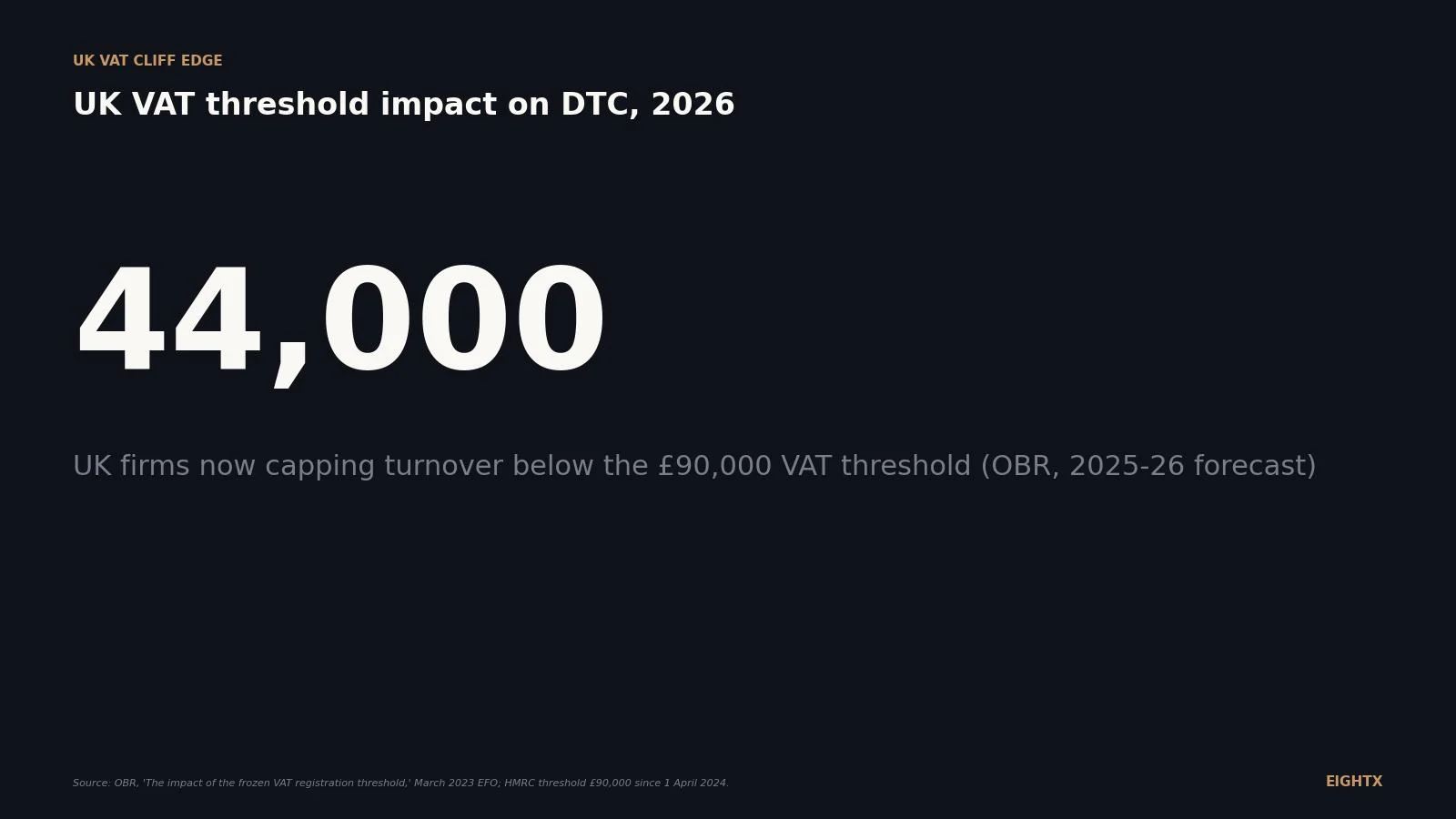
The UK VAT registration threshold is 90,000 pounds of rolling 12-month taxable turnover (raised from 85,000 on 1 April 2024). Crossing it without raising prices drops net revenue per unit by 16.7% on a standard 20% VAT product. The OBR estimates roughly 44,000 UK firms are deliberately capping turnover below the threshold in 2025 to 2026, up from 23,000 in 2017 to 2018, with associated lost turnover rising from 110 million to around 350 million pounds.
Key Takeaways
- The UK VAT registration threshold is £90,000 of taxable turnover on a rolling 12-month basis (raised from £85,000 on 1 April 2024). Deregistration threshold sits at £88,000. Standard VAT rate is 20%.
- The OBR estimates around 44,000 UK firms are now deliberately capping turnover below the threshold in 2025-26, up from about 23,000 in 2017-18. Associated lost turnover has risen from £110m to roughly £350m.
- Absorbing the 20% VAT at a constant £49 sticker drops net revenue per unit to £40.83, a 16.7% per-unit revenue hit and a gross-margin slide from 59.2% to 51.0% (assuming £20 landed COGS).
- UK consumers expect sticker prices to be VAT-inclusive. That convention pushes most brands toward absorbing the VAT instead of raising headline prices, which is why the margin hit lands quietly.
- Liu, Lockwood and Tam (Oxford, 2022) find annual turnover growth slows by up to 2 percentage points near the threshold, with no catch-up after crossing. Costs slow in parallel, so the response is real activity suppression, not under-reporting.
If you sell direct-to-consumer (DTC) into the UK and your rolling 12-month UK turnover is heading toward £90,000, you are about to make the single biggest pricing decision your brand has faced since launch. The £90,000 VAT registration threshold is a cliff edge: cross it and 20% of every sale either disappears from your top line or gets added to your sticker price. The Office for Budget Responsibility (OBR) estimates around 44,000 UK firms are now deliberately capping turnover below the line to avoid that hit, up from roughly 23,000 in 2017-18. This page is a living index of where the threshold actually sits, what crossing costs, and the three pricing strategies you can choose between. We refresh it quarterly as HMRC and the OBR publish new data.
Where the £90,000 line actually sits
The compulsory UK VAT registration threshold is £90,000 of taxable turnover on a rolling 12-month basis. HM Revenue & Customs (HMRC) raised it from £85,000 on 1 April 2024, the first increase since 2017. There is also a forward-looking test: if you expect to exceed £90,000 in the next 30 days alone, you must register immediately, regardless of trailing-12-month sales. The deregistration threshold sits at £88,000, which means once registered you cannot drop out unless your rolling 12-month turnover falls below £88,000 and you can show it will stay there.
HMRC says the £90,000 threshold keeps roughly 3.2 million small UK businesses out of VAT entirely, and that the 2024 rise removed about 28,000 micro-businesses from mandatory VAT in 2024-25 alone, with an average of 14,000 fewer per year through 2028-29. That is about 0.6% of the currently-registered VAT population per year. The threshold is then frozen, which means inflation drags more brands into the cliff zone every year the freeze continues.
The chart below shows how far the nominal threshold has drifted from inflation. Had the £85,000 threshold tracked Office for National Statistics (ONS) CPIH from 2017-18, it would now sit closer to £112,000. The April 2024 nudge to £90,000 closed almost none of that gap.
Item Value Source Compulsory registration threshold £90,000 (rolling 12-month taxable turnover) HMRC Deregistration threshold £88,000 HMRC Standard VAT rate 20% HMRC Forward-looking test Register if you expect to exceed £90k in next 30 days HMRC Date of last threshold change 1 April 2024 (£85,000 to £90,000) HMRC policy note UK businesses kept out of VAT by threshold ~3.2 million HMRC policy note (March 2024) VAT population 2024-25 2,330,400 traders HMRC Annual VAT Statistics 2024-25 New VAT registrations 2024-25 234,000 HMRC Annual VAT Statistics 2024-25 VAT de-registrations 2024-25 218,000 HMRC Annual VAT Statistics 2024-25
44,000 UK brands are capping turnover. The OBR has the receipts.
The OBR's March 2023 Economic & Fiscal Outlook contained a dedicated box on what frozen-threshold bunching has cost the UK economy. The headline figures: roughly 23,000 firms were estimated to be capping turnover just below the threshold in 2017-18; by 2025-26, that count is forecast to be about 44,000. Associated lost turnover (the gap between a smooth turnover distribution and what HMRC actually observes) rose from around £110m to about £350m over the same period.
The OBR only publishes the 2017-18 and 2025-26 endpoints; the years between in the chart above are linearly interpolated for illustration. The direction is what matters: as inflation pushed nominal turnover up while the threshold stayed frozen, more brands ran into the cliff and more chose to stop just short of it.
The academic anchor for this story is Liu, Lockwood and Tam (Oxford Centre for Business Taxation working paper 22-21, 2022). Using variation in the UK VAT threshold between £40,000 and £120,000 over time, they identified how firm growth responds as a brand approaches and crosses the threshold:
- Annual turnover growth slows by up to 2 percentage points within about £20,000 of the threshold (a roughly 25% slowdown on a baseline 8% growth rate).
- There is no compensating catch-up after crossing.
- Costs slow in parallel with revenue, which means the response is real activity suppression, not just under-reporting of sales.
- The long-run firm-size penalty is 0.5% to 1.0%, persistent for about a decade.
An IMF working paper (Liu, Lockwood and Almunia, WP/2019/205) adds a second finding: roughly 43% of UK firms below the threshold voluntarily register anyway, mostly B2B sellers who can reclaim input VAT. Bunching is concentrated in B2C operations with low input costs in competitive markets. That description fits most consumer DTC brands almost exactly.
The £49 sticker problem: what crossing actually costs your margin
UK retail sticker prices are VAT-inclusive by convention. Customers expect the number on the product page to be the number they pay at checkout. That single convention is why crossing the VAT threshold compresses margin for so many DTC operators: the natural path is to hold the sticker constant and absorb the tax.
Here is the math on a £49 hero SKU. Pre-registration, the brand keeps £49 net per unit. Post-registration, three strategies are available:
Strategy Sticker price (£) Net revenue per unit (£) VAT remitted to HMRC (£) Gross margin % (£20 COGS) Revenue change vs pre-VAT Pre-registration baseline 49.00 49.00 0.00 59.2% (baseline) Full pass-through (raise sticker 20%) 58.80 49.00 9.80 59.2% 0% (margin preserved) Absorb VAT (hold sticker at £49) 49.00 40.83 8.17 51.0% -16.7% per unit Split (10% sticker rise + partial absorb) 53.90 44.92 8.98 55.5% -8.3% per unit
The point that always lands hardest on a client call is that there is no neutral option. Full pass-through preserves your margin but moves the £49 hero into £58.80 territory, which is a different psychological price band. Absorb keeps the price familiar but takes 8.2 points of gross margin off the top. Split splits the pain. The right answer depends on your category's price elasticity, your CAC, and how much margin headroom you carry going in.
In the UK, whatever the sticker price is, it includes taxes. Always. That single piece of consumer behaviour is why the absorb path is the default, and why most brands take the margin hit quietly instead of raising prices the day they register.
Shopify and Amazon UK mechanics in 2026
The pricing decision plays out differently on Shopify than on Amazon UK, and both surfaces changed materially in 2024-2025.
Shopify DTC. Shopify lets you configure VAT-inclusive pricing per market. Once you register, you set the VAT rate to 20% on standard-rated goods, and Shopify carves the VAT out of the gross customer price for accounting. The decision is still yours: do you hold the sticker or raise it. The platform does not force either path.
Amazon UK. Two changes hit DTC sellers between 2024 and 2025. First, from August 2024, Amazon started billing most UK seller fees from within the UK, which means 20% VAT is now added to those fees. That VAT is reclaimable as input VAT if you are registered, but it is a cash-flow drag in the meantime. In accounting tools like A2X, those fee lines now need to be mapped as "20% VAT on expenses." Second, the embedded Digital Services Tax pass-through means the effective referral fee on most non-apparel categories is around 15.3% (15% headline plus DST), which compounds with VAT to make Amazon a structurally lower-margin channel than DTC even before considering FBA fulfilment fees.
Non-UK sellers using FBA. If you are a US or Australian DTC brand testing UK Amazon FBA, the £90,000 threshold does not apply to you. Storing inventory in a UK FBA warehouse means you must register for UK VAT before your first sale into the UK. Plan the registration into your launch, not after the fact.
The compliance load: what registration actually costs in time and cash
HMRC does not publish a per-business compliance cost figure, but accountant fee surveys and practitioner ranges point to roughly £500 to £1,500 per year in incremental fees for a brand that just crossed the threshold. That covers quarterly Making Tax Digital (MTD) for VAT filings, the bookkeeping reconciliation work, and the software cost of an MTD-compatible package (Xero, QuickBooks, or A2X if you sell via Amazon). HMRC's own impact estimate for the 2024 threshold change put aggregate annual administrative burden reduction at about £5m across all affected businesses, which is small per business but real at scale.
The bigger cost is operational. Once registered, you owe HMRC quarterly returns, you carry a VAT liability balance on the balance sheet, and your cash-flow timing changes: you collect VAT from customers on day one but remit it to HMRC up to four months later, depending on quarter-end timing. That is a working-capital benefit if managed well and a cash trap if your finance process is not ready.
What we're watching for the next quarterly refresh
We refresh this page when HMRC and the OBR publish new data. The next refresh targets late August 2026, after the next OBR Economic & Fiscal Outlook and the Q2 HMRC VAT update. The watch list for the next 12 months:
- Any threshold change at Autumn Statement 2026 (the FSB and ICAEW have lobbied for a £100k or £150k threshold).
- HMRC Annual VAT Statistics 2025-26 release, expected late 2026, for an updated VAT population count and bunching-adjacent migration data.
- OBR's next bunching update; the 2023 box was the most recent, and the 2025-26 endpoint is now a measured year rather than a forecast.
- Any Making Tax Digital scope changes from HMRC that affect smaller registered traders.
For DTC operators making the registration decision now, two reads:
Model post-VAT pricing before you cross, not after. Build a three-scenario model (raise / absorb / split) at your actual COGS, CAC, and conversion rate. The brands that struggle are the ones that hit £90,000 in a month, register reactively, and discover the margin impact at the next quarterly close.
Reclaim aggressively. The Standard Scheme is structurally better than the Flat Rate Scheme for most brands carrying inventory, because input VAT on inventory, 3PL, software, and marketing services is fully reclaimable. The 7.5% Flat Rate looks cleaner on the surface but throws away most of that recovery.
For the supporting context on UK ecommerce margins and platform economics, see our average ecommerce gross margin benchmark and the AU vs US ecommerce finance comparison. If you want a CFO read on your specific situation, book an interim CFO consult.
Sources and methodology
HMRC primary sources. The £90,000 registration / £88,000 deregistration thresholds are from HMRC's "How VAT works" guidance and VAT Notice 700/1. The 2024 threshold change figures (28,000 fewer mandatory registrations in 2024-25, 14,000 per year on average through 2028-29, 3.2 million businesses kept out, £5m aggregate admin burden reduction) come from the March 2024 HMRC policy paper "Increasing the VAT registration threshold." The 2024-25 VAT population data (2,330,400 traders, 234,000 new registrations, 218,000 de-registrations) is from HMRC's Annual UK VAT Statistics 2024-25 commentary, published 3 December 2025.
OBR primary source. The bunching figures (23,000 firms in 2017-18 forecast rising to about 44,000 by 2025-26; lost turnover from £110m to about £350m) come from the OBR's box "The impact of the frozen VAT registration threshold," published with the March 2023 Economic & Fiscal Outlook. Endpoints are published; interim years in the bunching chart are linearly interpolated for illustration only.
Academic anchors. The growth-suppression figures (2 percentage point slowdown near the threshold, no catch-up, real activity response, 0.5%-1.0% long-run firm-size loss) come from Liu, Lockwood and Tam, "Small Firm Growth and the VAT Threshold" (Oxford CBT WP 22-21, 2022). The 43% voluntary-registration figure and the bunching-by-sector characterisation come from Liu, Lockwood and Almunia, "VAT Notches, Voluntary Registration, and Bunching" (IMF WP/2019/205).
Pricing model. The three-scenario £49-SKU table is an Eightx model using the UK standard VAT rate of 20%. Gross margin assumes £20 landed cost of goods sold and excludes platform fees, payment processing, and marketing spend. Use it as a directional reference, not a substitute for your own unit-economics model.
Limitations. HMRC does not publish a turnover histogram by band, so the bunching count is an OBR/IFS micro-data estimate, not a direct HMRC table. The £500-£1,500/year incremental compliance cost is a practitioner range, not an official HMRC figure. The Chart 3 inflation-adjusted line uses ONS CPIH "All items" indexed from April 2017; a different inflation series (RPI, CPI without housing) would give a slightly different counterfactual.
Update cadence. This page is refreshed quarterly when HMRC releases new VAT statistics commentary and when the OBR refreshes its Economic & Fiscal Outlook. Next target refresh: late August 2026.
Frequently asked questions
should i intentionally cap my uk sales under £90k to avoid registering for vat?
It is legal to cap turnover, and the OBR estimates roughly 44,000 firms now do exactly that. But the academic evidence is clear that capping has real costs: Liu, Lockwood and Tam find no catch-up growth after you eventually cross, and long-run firm size is 0.5% to 1% smaller than counterfactual. If your unit economics survive a 16.7% revenue hit per unit at the same sticker price, register and grow. If they don't, the right answer is usually to fix the unit economics, not throttle the brand.
how much will my margin actually drop the day i register for vat in the uk?
If you hold your sticker prices constant (the most common path), net revenue per unit drops 16.7% because £1 in sticker price becomes 83p net and 17p VAT. On a £20 COGS hero SKU at £49 sticker, gross margin falls from 59.2% to 51.0%. If you raise sticker prices a full 20% (e.g., £49 to £58.80), margin stays flat but you risk conversion drag at the new price point.
is it better to raise my sticker prices 20% or absorb the vat when i register?
There is no universal answer. UK consumers expect VAT-inclusive sticker prices, so a full pass-through can hit conversion. Most brands we work with end up somewhere in the middle: raise the sticker 8% to 12%, absorb the rest, and live with a 4 to 8 point gross-margin compression for 90 days while they retest pricing. The cleaner answer is to model all three scenarios at your actual COGS and CAC before you cross, not after.
what counts as taxable turnover for the £90k vat threshold?
Gross sales of taxable goods and services, including zero-rated supplies (most groceries, kids' clothing, books), excluding VAT-exempt items (insurance, financial services, some healthcare). Returns and refunds net out. For a DTC brand it is essentially gross UK sales of your products, ex-VAT, on a rolling 12-month basis.
how fast do i have to register once i cross £90k in rolling 12-month sales?
You have 30 days from the end of the month in which you exceeded £90,000 to register, and your effective registration date is the first day of the second month after you crossed. There is also a forward-looking test: if you expect to exceed £90,000 in the next 30 days alone, you must register immediately. Late registration triggers penalties and back-dated VAT you may not have collected from customers.
can i deregister if my uk sales drop back below £88k?
Yes. The deregistration threshold sits at £88,000 of rolling 12-month taxable turnover. You can also deregister voluntarily if you can demonstrate you reasonably expect turnover to stay below £88,000 in the next 12 months. Be careful: deregistering means you lose the ability to reclaim input VAT, which often matters more than the VAT charged on sales if you carry significant inventory or 3PL spend.
does the flat rate scheme actually help a uk shopify brand?
Usually no, if you are a brand owning your own inventory. The Flat Rate Scheme caps remitted VAT at a fixed percentage of gross turnover (around 7.5% for ecommerce), but you lose the ability to reclaim input VAT on inventory, 3PL, marketing, and platform fees. For a brand with material reclaimable VAT (most $1M+ DTC operations), the Standard Scheme is structurally better. FRS can work for retail-arbitrage Amazon sellers with little reclaimable input.
how do non-uk amazon fba sellers handle vat differently?
Non-UK sellers storing inventory in UK FBA warehouses have no £90,000 threshold. They must register for UK VAT before their first sale into the UK. Since August 2024, most Amazon UK seller fees also carry 20% VAT (reclaimable as input VAT if you are registered), which means the cash-flow drag from fees is real even if the P&L impact is neutral.