
Financial Strategy
Inside Hain Celestial's Financials: A CFO Teardown
Hain Celestial's FY2025 10-K shows five straight years of falling revenue, down to $1,559.8M, and a $428.9M goodwill write-off that drove a $530.8M net loss. Stockholders' equity fell roughly 80% in under three years, from $1.02B to $215.5M, as serial impairments erased acquisition premium. The operator lesson: diligence margin durability and goodwill-to-equity before the multiple.
Key Takeaways
- Revenue has fallen five years running: $2,053.9M (FY2020) to $1,559.8M (FY2025), a 24% cumulative drop. FY2025 alone was down 10.2%, and the slide continues into FY2026. This is structural, not a one-quarter blip.
- FY2025 booked a $428.9M goodwill impairment, which turned a thin-margin year into a -$461.6M operating loss and a -$530.8M net loss (-$5.89 diluted EPS). Net margin was -34.0%.
- Stockholders' equity collapsed roughly 80% in under three years: $1,017.9M (Jun-2023) to $475.0M (Jun-2025) to $215.5M (Mar-2026). Serial impairments are erasing the book value those acquisitions created.
- Gross margin sits at 21.4%, R&D at 0.3% of sales, and operating cash flow fell 81% to $22.1M in FY2025. This is a business cutting investment to defend cash, not one funding a comeback.
- The operator lesson: goodwill is the price you paid above tangible value. When the brands underperform, the income statement eventually makes you admit it. Diligence margin durability and the goodwill-to-equity ratio before the multiple, not after.
Hain Celestial (Nasdaq: HAIN) is the cautionary teardown every CPG and ecommerce operator should read before they decide to "grow by acquisition." Built into a roughly $2B natural and organic platform through dozens of deals, the company has now printed five straight years of declining revenue and three straight years of GAAP operating losses. FY2025 was the reckoning. Read the way a fractional CFO would diligence it, the 10-K tells a single story: when you pay above tangible value for brands and the brands underperform, the income statement eventually makes you admit it.
This is a teardown of the public financials, not a literal direct-to-consumer channel analysis. Hain is a wholesale and retail CPG business, not a DTC brand. The "DTC" in this teardown is the lens, reading the numbers the way an ecommerce or CPG operator would read their own, not the channel. Every annual figure below comes from SEC EDGAR XBRL filings (CIK 0000910406); quarter-level color comes from the company's investor releases and is labeled as such.
The five-year slide nobody arrested
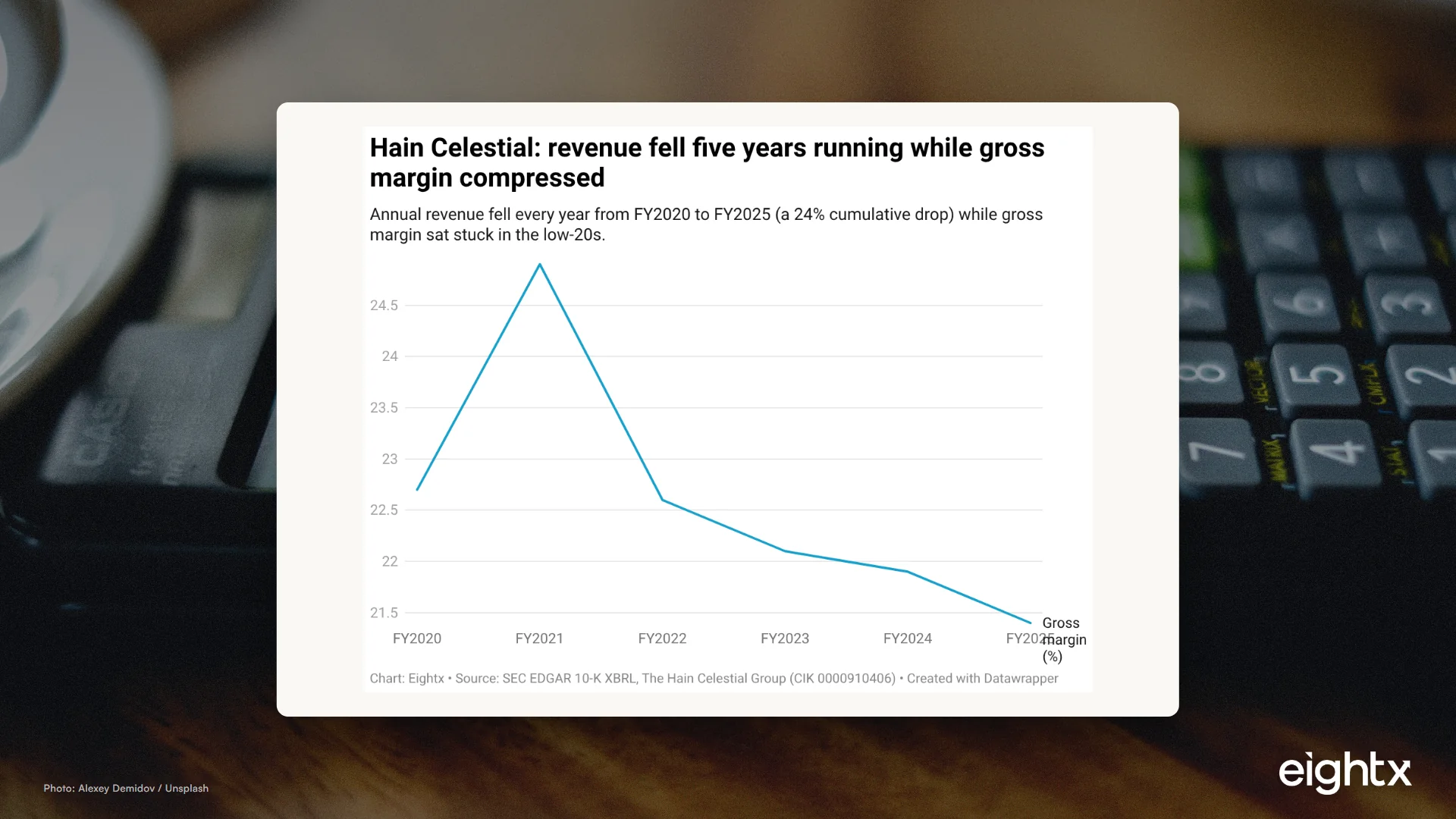
Start with the top line, because everything else follows from it. Revenue fell from $2,053.9M in FY2020 to $1,559.8M in FY2025, a 24% cumulative drop, with FY2025 alone down 10.2% year over year. This is not a single bad quarter that mean-reverts. It is five consecutive years of decline, and it is still going: FY2026 nine-month revenue was $1,090.4M against $1,196.4M a year earlier, down 8.9%.
A roll-up is supposed to compound. You buy brands, you put them on shared infrastructure, you cross-sell, and the whole grows faster than the parts. Hain's chart is the opposite of compounding. The portfolio got bigger by acquisition and smaller by performance at the same time, and the performance won.
When I talk to founders running a brand that wants to acquire its way to scale, the thing I keep flagging is that a roll-up only works if the acquired brands keep growing organically after the deal. The moment organic velocity stalls, you are left carrying the integration cost and the debt without the growth that justified either. Hain is what that looks like at the public-company scale.
The gross-margin line on that chart matters as much as the revenue line. Margin never recovered the FY2021 high of 24.9%; it drifted down to 21.4% by FY2025. A shrinking top line is survivable if margin expands to defend profit. Here both went the wrong way at once.
What a $429M goodwill write-off actually admits
FY2025 booked a $428.9M goodwill impairment. That single charge turned a thin-margin operating year into a -$461.6M operating loss and a -$530.8M net loss, or -$5.89 diluted EPS. Net margin was -34.0%. The net loss was larger than a third of the entire year's revenue.
Goodwill is the price you paid above the tangible, identifiable value of what you bought. When you acquire a brand for $200M and its hard assets and identifiable intangibles are worth $120M, the other $80M sits on your balance sheet as goodwill. It is, in plain terms, the premium. Accounting rules then make you test that premium every year against what the business is actually worth. When the brands underperform, you fail the test, and you write the goodwill down. The charge is non-cash, so it does not drain the bank account, but it is the most honest number in the filing: it is management conceding that the acquisitions are worth far less than what was paid.
And the cycle is not over. A further $150.9M of goodwill impairment hit in the first nine months of FY2026. When you see serial impairments year after year, it is rarely a one-time cleanup. It is the slow admission that the original deal theses did not hold.
Goodwill is the price you paid above tangible value. When the brands underperform, the income statement eventually makes you admit it, and a $429M admission in a single year is the loudest possible signal that a roll-up stopped working.
The pattern we see again and again with acquisitive brands is that the goodwill looks harmless for years, right up until it does not. It sits there as an asset, the multiple looks fine, everyone moves on. Then one soft year forces the test, and the write-off lands all at once.
See your real margin on every order.
Get our Contribution Margin calculator: COGS, shipping, fees, ads, what's left.
Check your inbox. We'll send the Contribution Margin calculator shortly.
Read the margin, not the headline
Strip out the impairment noise and look at the operating economics, because that is where the durability question actually lives. Gross margin of 21.4% is the binding constraint. For a branded natural-foods portfolio, the low-20s leaves very little to fund trade spend, marketing, and the corporate overhead a multi-brand company carries.
Now look at where the remaining margin goes. SG&A ran $271.8M, or 17.4% of sales. R&D was just $5.2M, or 0.3% of sales. That R&D number is the tell. A branded consumer company investing 0.3% of revenue in new product is not funding a comeback; it is defending cash. The portfolio is being managed for survival, not for the next growth cycle.
| Fiscal year (Jun 30) | Revenue ($M) | Gross margin | Operating income ($M) | Net income ($M) | Diluted EPS |
|---|---|---|---|---|---|
| FY2020 | 2,053.9 | 22.7% | 56.0 | -80.4 | -0.77 |
| FY2021 | 1,970.3 | 24.9% | 107.4 | 77.4 | 0.76 |
| FY2022 | 1,891.8 | 22.6% | 104.7 | 77.9 | 0.83 |
| FY2023 | 1,796.6 | 22.1% | -85.6 | -116.5 | -1.30 |
| FY2024 | 1,736.3 | 21.9% | -18.9 | -75.0 | -0.84 |
| FY2025 | 1,559.8 | 21.4% | -461.6 | -530.8 | -5.89 |
Read that table top to bottom and the inflection is FY2023. That is the year operating income went negative and stayed there. The two profitable years (FY2021 and FY2022) were the exception, propped up by the FY2021 margin high. Everything after is the structural margin problem reasserting itself.
When I talk to operators carrying a sprawling SKU base, the conversation I have over and over is that gross margin is the ceiling on everything you can do downstream. If your margin is in the low-20s and your overhead structure was built for a bigger, higher-margin company, you do not have a marketing problem or a sales problem. You have an arithmetic problem, and the only fixes are raising margin or shrinking the cost structure to fit it.
The balance sheet under stress
The income statement explains the damage; the balance sheet shows where it went. Stockholders' equity fell from $1,017.9M in June 2023 to $475.0M in June 2025 to $215.5M by March 2026. That is roughly an 80% reduction in book value in under three years, and the serial goodwill impairments are the mechanism.
Here is the part a lender or an acquirer fixates on. Goodwill plus intangibles stood at about $1.17B at FY2024 ($929.3M goodwill plus $244.8M intangibles), which already exceeded total equity. In other words, most of the "value" on the balance sheet was acquisition premium, not hard assets. When the premium gets written off, equity is what absorbs the hit. That is exactly what the chart below shows: as the intangible book came down, equity came down with it, on a roughly parallel track.
| Period | Stockholders' equity ($M) | Long-term debt ($M) |
|---|---|---|
| Jun-2023 | 1,017.9 | 828.7 |
| Jun-2024 | 942.9 | 745.8 |
| Jun-2025 | 475.0 | 706.7 |
| Mar-2026 (Q3 FY26) | 215.5 | ~549.5 |
Look at the debt against the equity and the problem is the denominator. Debt-to-equity ran about 1.49x at FY2025 ($706.7M of long-term debt against $475.0M of equity), up from well under 1x two years earlier when equity was still above $1B. Debt is coming down in increments while equity is halving and halving again, so the ratio keeps getting worse even as the absolute debt shrinks. That is the tell: a balance sheet whose equity is mostly acquisition premium is fragile by construction, because one stretch of underperformance can cut the equity in half and the debt ratio doubles right along with it.
Cash is the only thing working
The clearest good news in the file is also the narrowest. Operating cash flow cratered to $22.1M in FY2025 from $116.4M in FY2024, an 81% drop. Against $706.7M of long-term debt at the time, $22M of operating cash is not a comfortable engine for deleveraging.
What the company has done instead is sell. By fiscal Q3 2026, total debt had fallen to roughly $549.5M, a single-quarter cut of about $155M, aided by a roughly $115M North American snacks divestiture announced in February 2026. That is a legitimate way to bring debt down quickly. But selling a division to pay down debt is a balance-sheet move, not an earnings move, and the earnings still are not cooperating: Q3 FY2026 net sales fell 13% to $338.4M, with organic sales down around 6%.
So the honest read is split. The deleveraging is real and the team is executing it. The growth is not. Deleveraging by divestiture buys time; it does not fix the velocity problem that caused the impairments in the first place. The open question for the turnaround is simple to state and hard to answer: can they arrest the revenue decline before they run out of divisions to sell.
When we have worked through a stressed balance sheet with operators, the cash-first sequencing Hain is running is the right instinct. You stabilize liquidity, you cut debt, you buy yourself room. But the math only closes if organic sales stop falling, because you cannot divest your way to growth.
The operator's diligence checklist
If you are weighing an acqui-roll-up, or you are a founder being courted to sell into one, here is what a CFO pulls from this 10-K before anyone talks multiples.
First, gross-margin durability. Is the margin holding or drifting? Hain's drift from 24.9% to 21.4% was the quiet signal years before the loud loss. Margin erosion is the earliest tell.
Second, organic velocity. Strip out acquisitions and divestitures and ask whether the underlying brands are growing. A roll-up only compounds if the acquired brands keep selling more after the deal closes.
Third, the goodwill-to-equity ratio. If goodwill and intangibles exceed total equity, most of the book value is premium, and the equity is one impairment cycle away from being cut in half. Hain's $1.17B of intangibles against a shrinking equity base was the structural risk hiding in plain sight.
Fourth, cash conversion. Operating cash flow against debt is the real solvency question. A company generating $22M of operating cash against $700M of debt is relying on asset sales, and asset sales run out.
You can find all four of those signals in a public 10-K, and you could have found them in Hain's filings years before FY2025 made them undeniable. That is the whole point of reading financials like a CFO would diligence them: the warning signs are almost always in the file before they are in the headline.
Sources and methodology
The primary source for every annual figure in this teardown is SEC EDGAR, The Hain Celestial Group, Inc., CIK 0000910406, ticker HAIN (Nasdaq), fiscal year ending June 30, SIC 2000 (Food and Kindred Products). All annual figures were pulled from XBRL company-facts data filed with the SEC.
The FY2025 figures come from the Form 10-K filed 2025-09-15 (accession 0001193125-25-203534). Quarter-level and nine-month FY2026 figures, including the Mar-2026 stockholders' equity of $215.5M, nine-month revenue of $1,090.4M, and the nine-month $150.9M goodwill impairment, come from the Q3 FY2026 Form 10-Q filed 2026-05-11 (accession 0001193125-26-216701).
The XBRL tags used include Revenues, GrossProfit, OperatingIncomeLoss, NetIncomeLoss, EarningsPerShareDiluted, GoodwillImpairmentLoss, StockholdersEquity, Goodwill, IntangibleAssetsNetExcludingGoodwill, LongTermDebt, ResearchAndDevelopmentExpense, SellingGeneralAndAdministrativeExpense, and NetCashProvidedByUsedInOperatingActivities. Where the FY2025 and Q3 FY2026 goodwill and cash balances were not cleanly tagged in the XBRL pull, the equity line is treated as the load-bearing series and the goodwill split is annotated rather than charted.
A reconciliation note matters here. Some secondary web sources cite a "$363M revenue, down 13%" figure for Hain. That is Q4 FY2025 net sales, not full-year revenue. Full-year FY2025 revenue is $1,559.8M per the 10-K, which is the authoritative figure used throughout. We use SEC annual data for all annual claims and reserve investor-relations and 8-K figures for quarter-level color only.
Channel context comes from Storeleads: Hain's branded web storefront is a thin corporate Shopify presence with negligible estimated sales, which confirms Hain is a wholesale and retail CPG business rather than a DTC brand and is why this teardown is framed as an operator-lens read rather than a literal channel analysis. Adjusted EBITDA figures referenced in company releases (FY2025 roughly $10.4M) are company-adjusted, non-GAAP measures and are labeled as such; EBITDA, capex, and free cash flow were not exposed as discrete XBRL tags in the data pull. For a wider view of how clean-and-natural CPG names compare on margin and cash, see our food industry financial benchmarks and the sibling Oatly teardown. If you want this read run against a specific deal, our interim CFO services page explains how we diligence financials across a deal table.
Frequently asked questions
what is hain celestial's gross margin and why is it so low?
Hain Celestial's gross margin was 21.4% in FY2025 ($334.1M gross profit on $1,559.8M revenue), down from roughly 24-25% earlier in the cycle. For a branded natural-foods company, low-20s gross margin leaves almost nothing for trade spend, marketing, and overhead, which is the structural squeeze behind its operating losses.
how much money did hain celestial lose in 2025?
In FY2025 (year ended June 30, 2025) Hain reported a -$461.6M operating loss and a -$530.8M net loss, or -$5.89 diluted EPS. The net loss was bigger than a third of total revenue, mostly because of a $428.9M goodwill impairment.
why did hain celestial take a $429 million goodwill impairment?
Goodwill is the premium a company paid above tangible value in past acquisitions. When the acquired brands underperform, accounting rules force the company to write the goodwill down. Hain's $428.9M FY2025 impairment was an admission that the brands it rolled up are worth far less than it paid.
what is goodwill impairment and what does it tell me about an acquisition?
Goodwill impairment is a non-cash charge that reduces the goodwill on the balance sheet when an acquired business is worth less than its carrying value. It doesn't drain cash, but it's the clearest signal that an acquisition (or a string of them) didn't deliver the value that justified the price.
how much debt does hain celestial have and is it paying it down?
Long-term debt was $706.7M at FY2025. By Q3 FY2026 (Mar-2026) total debt had fallen to roughly $549.5M, a ~$155M single-quarter cut aided by a roughly $115M North American snacks divestiture. So yes, it's deleveraging, but off a base where cash generation is thin.
why has hain celestial revenue declined every year?
Revenue fell from $2,053.9M in FY2020 to $1,559.8M in FY2025, five straight years of decline. The drivers are SKU rationalization, divestitures, and soft organic velocity across a sprawling portfolio of acquired natural and organic brands that stopped compounding.
what happened to hain celestial's stockholders equity?
Equity fell from $1,017.9M in June 2023 to $475.0M in June 2025 to $215.5M by March 2026, a roughly 80% drop in under three years. Serial goodwill impairments are erasing the book value those acquisitions created.
is hain celestial's turnaround working?
It's working on cash and debt, not yet on growth. By Q3 FY2026 total debt was down to ~$549.5M, but quarterly net sales still fell 13% with organic sales down around 6%. Deleveraging is real; arresting the revenue decline is the unsolved problem.
what can ecom and cpg operators learn from hain celestial's financials?
Diligence gross-margin durability, organic velocity, and the goodwill-to-equity ratio before you pay (or accept) a multiple. A portfolio whose book value is mostly acquisition premium is fragile, because one stretch of underperformance forces write-offs that can cut equity in half.