
Financial Strategy
What is the allowance for doubtful accounts? The bad-debt reserve for wholesale and net-terms ecommerce brands
The allowance for doubtful accounts is a contra-asset that reduces gross accounts receivable to the amount you realistically expect to collect. Wholesale and net-terms DTC brands typically reserve 1 to 3 percent of gross receivables. Skipping the reserve overstates assets, inflates working capital, and creates a painful write-off when a retailer goes dark.
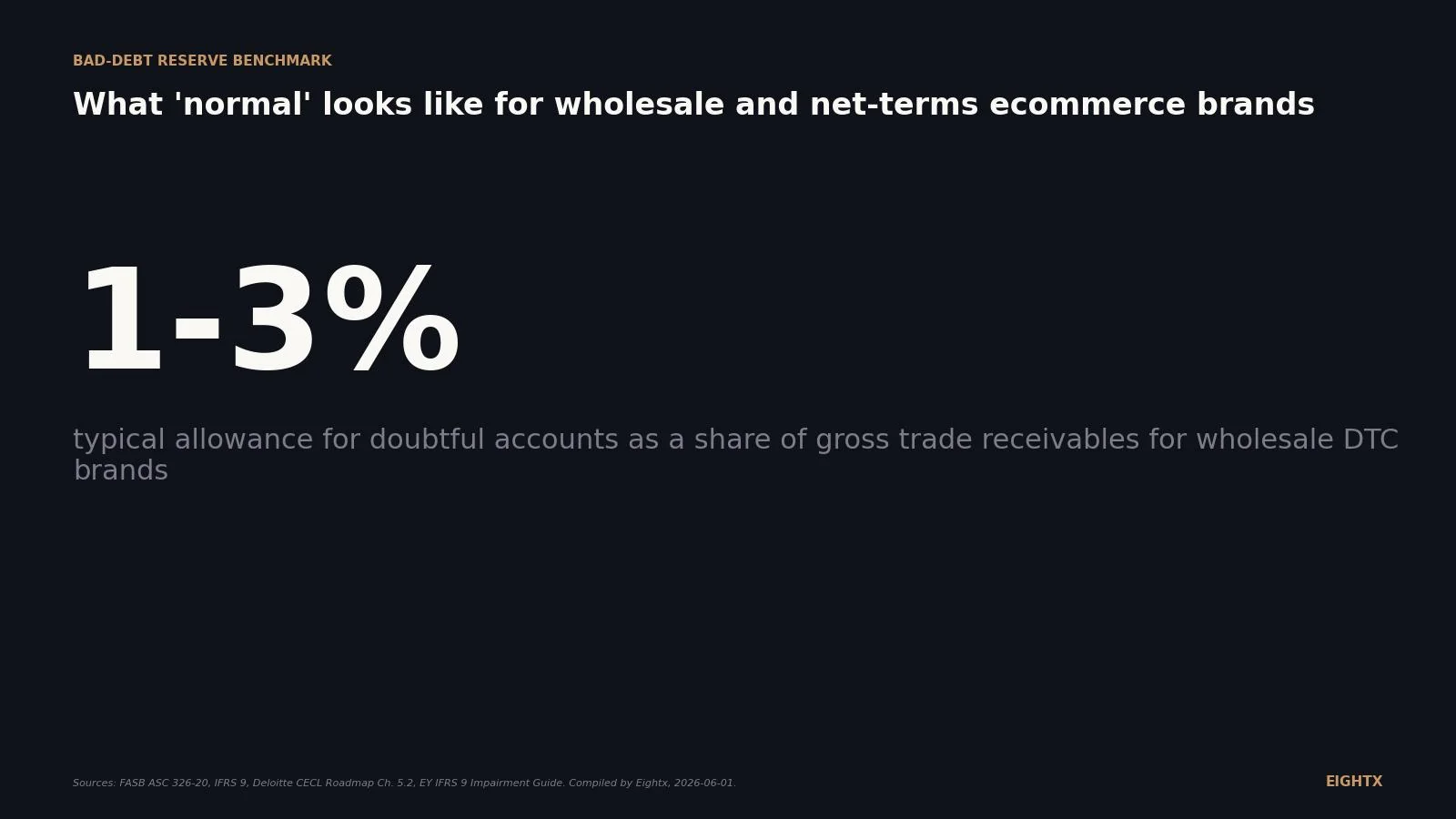
The allowance for doubtful accounts is a contra-asset on your balance sheet that reduces gross accounts receivable (AR) to the amount you actually expect to collect. It is the bad-debt reserve, sitting next to AR with a negative sign. For ecommerce and direct-to-consumer (DTC) brands selling wholesale or extending net-30/60/90 terms (Faire, Joor, boutique retailers, B2B reorders), the typical reserve lands at 1-3% of gross trade receivables when underwriting is tight, with annual write-offs usually under 0.5% of net sales. Under both US GAAP (generally accepted accounting principles, ASC 326 CECL) and IFRS (international financial reporting standards, IFRS 9 simplified approach), the estimate must be forward-looking expected credit losses, not a backward write-off when invoices die.
Pure Shopify revenue rarely needs a meaningful reserve because Stripe and Shop Pay settle in days, not weeks. The moment you add wholesale, Faire, Joor, marketplaces with net-terms, or B2B reorders, your AR balance starts carrying real collection risk. The allowance answers two questions auditors and lenders ask first: what is your AR actually worth, and how exposed are you to a single customer going under. Booking the reserve also smooths your P&L, because the expected loss hits bad-debt expense across the period you earned the revenue, not in the quarter a wholesale account files for bankruptcy.
How it works
Two methods get to the same place. Percentage-of-sales applies a historical loss rate to credit sales for the period and hits bad-debt expense directly. Simpler, coarser, harder to defend under modern accounting standards. Aging-of-receivables (a provision matrix) is what ASC 326 CECL and IFRS 9 effectively require for trade receivables. You bucket AR by aging (current, 1-30, 31-60, 61-90, 90+ days past due), apply a loss rate to each bucket, sum to a target ending allowance, and the bad-debt expense is the plug to get from the prior balance to the new target. Illustrative provision-matrix rates from ASC 326-20-55-37 Example 5: current 0.5%, 1-30 days 2%, 31-60 days 5%, 61-90 days 15%, 90+ days 50%. Worked example: a brand with $800K gross AR split $500K current, $180K 1-30 days, $80K 31-60 days, $30K 61-90 days, $10K 90+ days lands a target allowance of $500K times 0.5% plus $180K times 2% plus $80K times 5% plus $30K times 15% plus $10K times 50% which is $19,600. Net AR on the balance sheet is $780,400. Journal entries: to record the reserve, debit bad-debt expense and credit allowance for doubtful accounts. To write off a specific dead invoice, debit allowance and credit AR (no second P&L hit because the expected loss was already booked). Under CECL the labels often shift to credit-loss expense and allowance for credit losses on trade receivables. Same account, updated naming.
Common triggers
- You are starting to sell wholesale, Faire, Joor, or net-terms B2B and your AR is no longer settling in days.
- Your auditor is asking how you estimate the allowance and whether your method aligns with ASC 326 CECL or IFRS 9.
- A wholesale account stopped paying, you are debating whether to write it off, and you do not have a reserve already booked.
- Your lender is sizing an AR-based credit line and wants to see net realizable value, not gross AR.
- Your accounting close keeps surprising you with bad-debt charges in the quarter an invoice dies instead of smoothing across the period.
The most common mistake
Treating the allowance as a backward write-off and only booking bad-debt expense when an invoice is dead. Under ASC 326 CECL (effective for private companies in fiscal years beginning after December 15, 2022) and IFRS 9, expected credit losses on trade receivables must be recognized at every reporting date using historical loss experience adjusted for current conditions and reasonable forward-looking forecasts. If you only write off when a customer goes bankrupt, your bad-debt expense lumps into one quarter, your gross AR is overstated until that moment, and your auditor flags the methodology. The fix is a provision matrix updated quarterly: bucket AR by aging, apply your own historical loss rates with a forward-looking macro overlay, true up the allowance to the target. Bad-debt expense becomes the plug, not the headline number.
Browse the full ecommerce finance glossary for every metric and money term a DTC operator needs.
Frequently Asked Questions
is the allowance for doubtful accounts an asset, a liability, or something else?
It is a contra-asset. Contra means it sits in the asset section of the balance sheet but with a negative sign, reducing gross accounts receivable to net realizable value. It is not a liability. The matching expense account on the income statement is bad-debt expense (or credit-loss expense under CECL naming).
do i actually have to follow cecl if i am a private shopify brand?
If you report under US GAAP, yes. ASC 326 CECL became effective for private companies in fiscal years beginning after December 15, 2022. The good news for trade receivables is that the provision-matrix approach is explicitly permitted, which is simpler than the full discounted-cash-flow model larger lenders use. If your AR is pure Shopify (settles in days), the practical impact is small. If you carry wholesale AR, you need a documented methodology.
what is a normal bad-debt reserve as a percentage of ar for a wholesale apparel or consumer brand?
Typical range is 1 to 3 percent of gross trade receivables for diversified portfolios with short payment terms and tight underwriting. Riskier customer mixes or longer terms can push to 3 to 5 percent or higher. Annual write-offs usually land under 0.5 percent of net sales when the portfolio is dominated by larger retailers, and 0.5 to 1.5 percent for diversified independent-retailer mixes. These are practice-based ranges, not codified benchmarks. Each entity must derive its own rate from its own loss history.
what is the difference between the direct write-off method and the allowance method?
Direct write-off books bad-debt expense the day you give up on a specific invoice. Simple, but it overstates AR until you write off and it violates the matching principle (revenue and the bad-debt cost of that revenue end up in different periods). The allowance method estimates expected losses in advance and reserves for them, so net AR always reflects what you actually expect to collect. ASC 326 CECL and IFRS 9 effectively require the allowance method for trade receivables.
is bad-debt expense the same as credit-loss expense under cecl?
Functionally yes. Under ASC 326 CECL the financial-statement captions often shift from 'bad-debt expense' to 'credit-loss expense' and from 'allowance for doubtful accounts' to 'allowance for credit losses on trade receivables.' Same account, updated label. Many private companies still use the old captions in management reporting and only switch the formal labels in audited statements.