
Financial Strategy
Bookings vs billings vs revenue: what each number means on a prepaid subscription
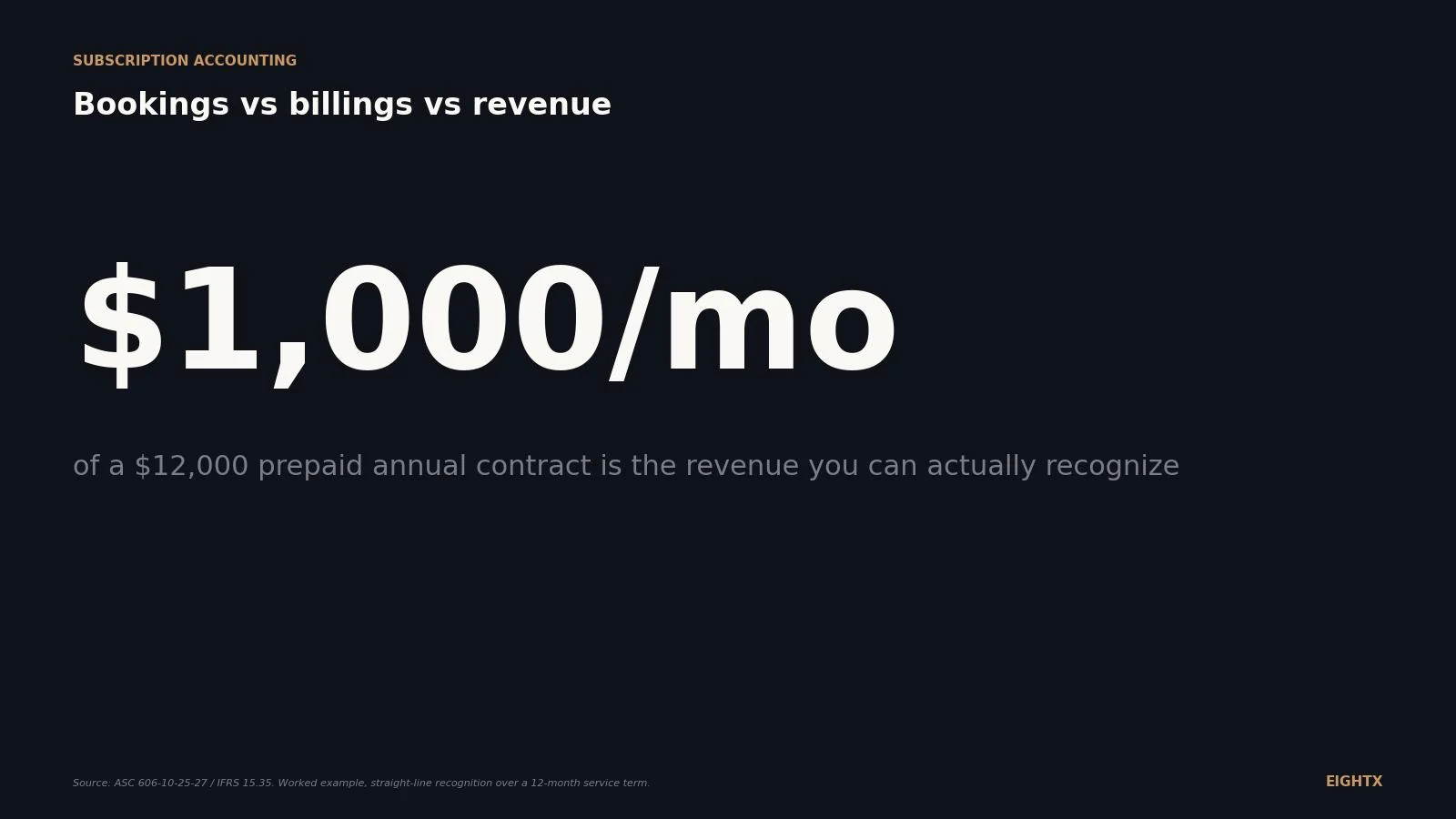
Bookings, billings, and revenue are three different numbers: on a $12,000 prepaid annual subscription, bookings record the full $12,000 at contract signing, billings record the cash invoiced (same $12,000 upfront or quarterly installments), and revenue under ASC 606 recognizes only $1,000 per month as the service is delivered. The distinction matters for ecommerce brands running subscription boxes or annual prepaid programs because deferred revenue on the balance sheet is a liability, not profit, until earned.
Key Takeaways
- Bookings are what the customer signed (Total Contract Value), billings are what you invoiced, and revenue is what ASC 606 lets you recognize as earned. On a $12,000 prepaid annual contract, all three numbers can equal $12,000 (over the full year) and be wildly different in any given month.
- The reconciliation identity is Billings minus Revenue equals the change in Deferred Revenue. If your deferred-revenue balance doesn't move by that exact amount each month, your subledger and your GL are out of sync.
- Prepayment is a contract liability, not revenue. Under ASC 606-10-45-2 (and IFRS 15.106), the $12,000 you collected in January sits on the balance sheet as deferred revenue and unwinds at $1,000 a month.
- ARR and MRR are not revenue and not billings. They are contracted recurring run-rate metrics derived from the recurring portion of bookings. Including a one-time setup fee in ARR is the most common subscription-metric mistake.
- Bookings precede billings precede revenue. A 3-year, $36,000 TCV billed annually books $36,000 on day one, bills $12,000 a year, and recognizes $1,000 a month. Confusing those three numbers is how founders accidentally celebrate growth that hasn't happened yet.
A customer prepays $12,000 in January for a yearly subscription. Your founder-CEO opens Slack and posts, "We just landed $12K of new revenue." Your accountant rolls her eyes. Your bookkeeper books it to deferred revenue. Your sales lead claims credit for $12,000 of bookings. Your board pack three weeks later shows $1,000 of recognized revenue.
All four people are right. They're talking about different numbers.
Bookings, billings, and revenue are three distinct subscription metrics that move at different speeds. On a prepaid annual contract, all three equal $12,000 over the full year. In any given month they can diverge by 12x. The gap between them is where deferred revenue lives, where cash-flow surprises hide, and where founders accidentally celebrate growth that hasn't happened yet. This post defines the three terms, walks the canonical $12,000 worked example through ASC 606 (the US revenue-recognition standard) and IFRS 15 (the global equivalent), shows the journal entries, and connects the metrics to ARR and MRR so you can read your own subscription P&L without guessing.
The three definitions in one minute
Three numbers. Three timings. One income statement line.
Dimension Bookings Billings Revenue Definition Total contract value signed Amount invoiced in period Earned income under ASC 606 / IFRS 15 Timing Contract execution Per payment schedule As performance obligations are satisfied GAAP (Generally Accepted Accounting Principles) line item No (off-GAAP) No (drives AR, cash, deferred revenue) Yes (income statement) What it signals Future revenue potential / sales momentum Near-term cash flow Economic performance delivered Example ($12k annual prepaid) $12,000 in Jan $12,000 in Jan $1,000/mo for 12 months
Bookings is a sales metric. It tells you what your sales team closed. It is not on your income statement. A booking for a 3-year, $36,000 contract is recorded as $36,000 of bookings in the signing month, even if you'll invoice it $12,000 at a time for three years.
Billings is a cash-and-receivables metric. It tells you what your finance team invoiced. Billings drives accounts receivable, cash collection, and the deferred-revenue balance on your balance sheet.
Revenue is a GAAP metric. It tells you what you actually earned this period under the accounting standard. For most subscription businesses that means recognizing the contract value straight-line over the service term, because the customer is consuming the service evenly over time.
The $12,000 prepaid annual contract, walked through month by month
Here's the canonical example every subscription CFO walks new operators through. A customer signs a 12-month subscription on January 1 for a Total Contract Value (TCV) of $12,000, payable upfront. Your sales team records $12,000 of bookings. Your finance team issues a $12,000 invoice and collects payment. Your accountant recognizes $1,000 of revenue.
Then for the next 11 months, sales records zero bookings on this contract, finance records zero billings, and your accountant continues to recognize $1,000 of revenue each month until the deferred-revenue balance hits zero on December 31.
The chart shows bookings and billings spiking together in January at $12,000 and staying flat at zero for the rest of the year, while revenue runs at a steady $1,000 per month. The data table below shows the full schedule including the deferred-revenue balance at each month-end, which is what your CFO will trace back to your subledger.
Month Bookings ($) Billings ($) Revenue Recognized ($) Deferred Revenue End ($) January 12,000 12,000 1,000 11,000 February 0 0 1,000 10,000 March 0 0 1,000 9,000 April 0 0 1,000 8,000 May 0 0 1,000 7,000 June 0 0 1,000 6,000 July 0 0 1,000 5,000 August 0 0 1,000 4,000 September 0 0 1,000 3,000 October 0 0 1,000 2,000 November 0 0 1,000 1,000 December 0 0 1,000 0 Total 12,000 12,000 12,000 n/a
Notice the totals line. Over the full 12-month period, bookings equals billings equals revenue equals $12,000. The three numbers always reconcile at the contract level. They only diverge within a period. That is the entire point.
What changes when billing cadence changes
Same $12,000 contract. Different billing terms. Three cadences any subscription business sees: annual upfront (customer pays all of it on day one), quarterly-in-advance (customer pays $3,000 every three months), and monthly-in-arrears (customer pays $1,000 at month-end after consuming the service).
Bookings and revenue are identical across all three cadences. The customer signed $12,000 of TCV on January 1 (bookings) and consumed $1,000 of service each month (revenue). Only billings move.
The chart shows annual-upfront concentrating all $12,000 of billings in January, quarterly-in-advance generating four $3,000 spikes (January, April, July, October), and monthly-in-arrears running a flat $1,000 per month. Each cadence produces a different deferred-revenue trajectory and a different cash-flow profile, even though the contract value and the recognized revenue are the same.
This is why subscription operators care so much about which cadence their customers pick. Annual upfront maximizes cash flow but generates a large deferred-revenue balance the CFO has to explain on the balance sheet. Monthly-in-arrears generates no deferred revenue but ties up working capital in receivables. Quarterly-in-advance is the middle ground most B2B SaaS lands on by default.
The ASC 606 and IFRS 15 mechanics
Under ASC 606 (US GAAP) and IFRS 15 (global), revenue recognition follows a five-step model: identify the contract, identify the performance obligations, determine the transaction price, allocate the price to the obligations, and recognize revenue as each obligation is satisfied.
For most subscription contracts, the analysis collapses to one performance obligation (provide the service for 12 months) recognized over time on a straight-line basis. That is why a $12,000 annual contract gets recognized at $1,000 a month. The customer is consuming the service evenly and you have a stand-ready obligation to deliver it, so straight-line is the cleanest method under ASC 606-10-25-27.
The prepayment side is governed by ASC 606-10-45-2 (and IFRS 15.106). When you collect cash before you've delivered the service, you record a contract liability (deferred revenue) for the unearned portion. The liability unwinds as you satisfy the performance obligation.
Event Debit Credit Amount ($) Jan 1: Invoice issued and collected Cash Deferred Revenue 12,000 Jan 31: Month-end revenue recognition Deferred Revenue Revenue 1,000 Feb 28: Month-end revenue recognition Deferred Revenue Revenue 1,000 (repeat each month through Nov 30) Deferred Revenue Revenue 1,000 Dec 31: Final entry Deferred Revenue Revenue 1,000
The reconciliation identity falls out of these journal entries: Billings minus Revenue equals the change in Deferred Revenue. In January, billings was $12,000, revenue was $1,000, and deferred revenue grew by $11,000. In February, billings was zero, revenue was $1,000, and deferred revenue shrank by $1,000. The identity holds every period. If it doesn't, your subledger and your general ledger are out of sync and your CFO needs to find the break before close.
How bookings, billings, and revenue connect to ARR and MRR
Annual Recurring Revenue (ARR) and Monthly Recurring Revenue (MRR) are not revenue and not billings. They are contracted recurring run-rate metrics derived from the recurring portion of bookings.
For the worked example, the $12,000 annual contract produces $12,000 of ARR and $1,000 of MRR. Both numbers are constant for the life of the contract regardless of billing cadence and regardless of when revenue is recognized. If the customer renews on December 31 for another year at the same price, ARR stays at $12,000 and the new bookings post in December. If the customer cancels, ARR drops to zero immediately even though revenue keeps running until the service term ends.
The most common ARR mistake is including a one-time setup fee. If the contract is $12,000 of subscription plus a $3,000 implementation fee, ARR is $12,000, not $15,000. The setup fee is non-recurring revenue and gets allocated separately under ASC 606-10-32-28 if it represents a distinct performance obligation. Inflating ARR with one-time fees is how subscription operators end up benchmarking against public-SaaS peers and concluding they're growing faster than they are.
The three numbers always reconcile at the contract level and rarely reconcile within a period. If your board pack shows only one of bookings, billings, or revenue, you're hiding two-thirds of the story. The reconciliation identity (Billings minus Revenue equals change in Deferred Revenue) is the single most useful sanity check a subscription operator can run before sending a finance update.
The five mistakes operators make
Treating bookings as revenue. Sales celebrates the $12,000 contract, the founder posts about $12,000 of new revenue, and the finance team has to walk it back. Bookings is sales momentum, not GAAP revenue. Use the right word in the right Slack channel.
Recognizing prepayment as revenue. A founder sees $12,000 of cash hit the bank account and books it to the revenue account in QuickBooks. By month two the income statement is overstated by $11,000 and the balance sheet is missing the deferred-revenue liability. Fixing this after the fact is painful; preventing it requires a billing system that posts to deferred revenue by default.
Ignoring deferred-revenue movement when reading growth. If your deferred-revenue balance shrinks by $200,000 in a quarter while revenue stays flat, your billings collapsed and your new-contract pipeline is empty. The revenue line alone won't show you that. The deferred-revenue trajectory will.
Conflating ARR with revenue. A board pack that shows "ARR" without showing revenue lets you tell a growth story that the income statement doesn't support. Public SaaS companies disclose both. Private subscription operators should too.
Including one-time fees in ARR. Setup, implementation, onboarding, and migration fees are non-recurring. If they're in your ARR number, your growth rate is overstated and your retention math is wrong.
Sources and methodology
The accounting framework cited throughout this post is FASB ASC 606 "Revenue from Contracts with Customers" (the US GAAP standard) and IFRS 15 "Revenue from Contracts with Customers" (the IASB-issued equivalent, substantively converged with ASC 606). Specific paragraphs referenced: ASC 606-10-25-27 (over-time recognition criteria for stand-ready obligations), ASC 606-10-32-2 (transaction price determination), ASC 606-10-32-28 (allocation of transaction price to distinct performance obligations including non-refundable upfront fees), and ASC 606-10-45-2 (contract liability classification for prepayments). IFRS 15 paragraph 106 covers the parallel contract-liability treatment.
The $12,000 worked example is a teaching case, not a real customer contract. The mechanics (straight-line recognition, deferred-revenue unwind, three-cadence comparison) are consistent with the treatment described in operator-facing explainers from Maxio ("Deferred Revenue in SaaS: Examples and Best Practices"), Chargebee ("Difference Between Bookings, Billings and Revenue In SaaS"), BillingPlatform ("Bookings vs Billings vs Revenue in B2B SaaS"), Lago ("Bookings vs. Billings in SaaS: Complete Guide"), and staxbill ("How to Properly Recognize Revenue in Subscription Business").
The reconciliation identity (Billings = Revenue + change in Deferred Revenue) is a restatement of the deferred-revenue T-account: opening balance plus billings minus revenue equals closing balance. It is implicit in every standard SaaS subledger and stated explicitly in the Maxio and Chargebee references above.
The ARR and MRR distinctions are drawn from Paddle's "SaaS finance: Bookings vs revenue vs collections vs MRR/ARR" and alexanderjarvis.com's definitional posts, which are the closest thing the venture-backed SaaS community has to a shared glossary on these terms.
For related reading on the balance-sheet side, see our explainer on what deferred revenue is and why it's a liability. For the recurring-revenue metrics, see MRR and ARR for subscription ecommerce.
Limitations. This is a definitional glossary post built on a single worked example. It does not address multi-element arrangements (where setup fees, implementation services, and subscription are distinct performance obligations requiring separate allocation), variable consideration (usage-based pricing, refunds, discounts that vary with volume), or contract-modification accounting. Operators with those situations should consult a CPA or revenue-recognition specialist before booking the transactions.
Update cadence. This post is refreshed quarterly when ASC 606 or IFRS 15 implementation guidance materially changes or when the operator-facing references above publish new versions. Next review target: September 2026.
Frequently asked questions
what's the difference between bookings, billings, and revenue on a prepaid subscription?
Bookings is what the customer signed (Total Contract Value), recorded the day the contract is executed. Billings is what you invoiced in the period, which drives accounts receivable and cash. Revenue is what you can recognize as earned under ASC 606 (in the US) or IFRS 15 (globally), which for most subscriptions is straight-line over the service term. On a $12,000 prepaid annual contract, January bookings are $12,000, January billings are $12,000, and January revenue is $1,000.
if my customer pays $12,000 upfront for the year, can i count it all as revenue this month?
No. Under ASC 606-10-45-2 the upfront payment is a contract liability (deferred revenue) until you actually deliver the service. You recognize $1,000 of revenue each month for 12 months as the performance obligation is satisfied. The other $11,000 sits on your balance sheet as deferred revenue at the end of January.
what is deferred revenue and why does it show up as a liability?
Deferred revenue is the dollars you've been paid for but haven't earned yet. It's a liability because you owe the customer the service. The bigger your deferred revenue balance, the more service you owe. It is one of the few cases where a growing liability is good news (more cash collected upfront) and one of the few cases where a shrinking liability is bad news (no new prepayments coming in).
how do i calculate billings from revenue and deferred revenue?
Use the identity Billings = Revenue + change in Deferred Revenue. If you recognized $100,000 of revenue in the quarter and your deferred-revenue balance grew by $40,000, you billed $140,000. If the deferred balance shrank by $20,000, you billed $80,000. Most subscription P&Ls don't show billings as a line item, so you have to derive it from these three GL accounts.
is ARR the same as revenue?
No, and confusing them is the most common subscription-metric mistake. ARR (Annual Recurring Revenue) is a contracted run-rate metric: the annualized value of the recurring revenue you're currently entitled to under signed contracts. Revenue is GAAP earned income on the income statement. A brand can have $1.2M ARR and $300K of recognized revenue in the same quarter if most contracts are recent prepaid annuals.
Browse the full ecommerce finance glossary for every metric and money term a DTC operator needs.