
Tax Strategy
What is GST/HST? Canada CAD $30K and Australia AUD $75K, the two thresholds US ecommerce sellers miss
Canada requires GST/HST registration once a business crosses CAD $30,000 in annual revenue from Canadian customers, while Australia requires GST registration at AUD $75,000 in turnover, and both thresholds catch US ecommerce operators who often miss them when scaling cross-border. Canada's HST rate varies by province from 5% federal-only in Alberta to 15% combined in the Atlantic provinces, and Australia applies GST at 10% plus collects it on imported goods under AUD $1,000.
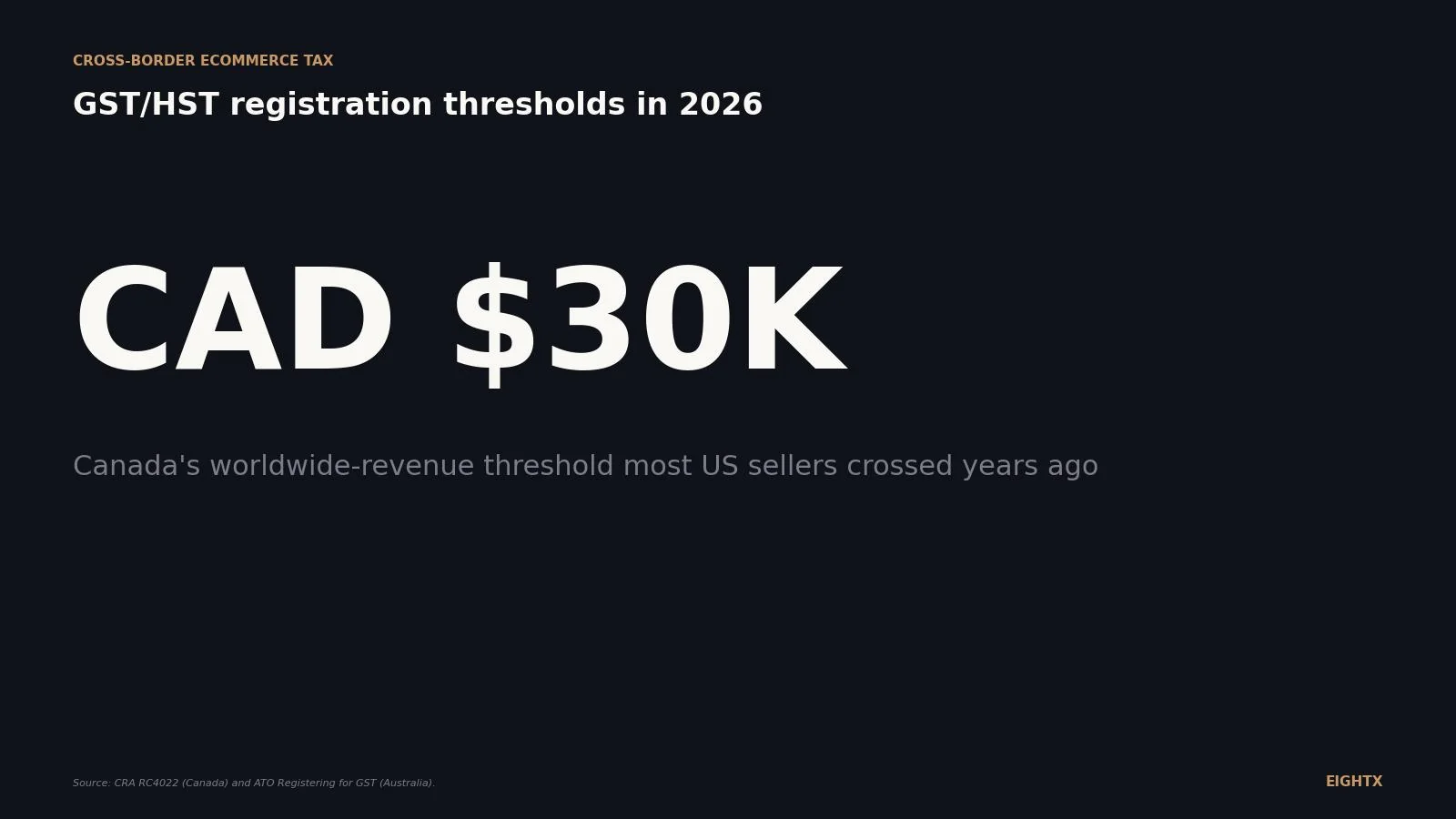
GST/HST are the consumption taxes that play the role in Canada and Australia that state sales tax plays in the US, but with one nationally administered threshold instead of fifty state-by-state rules. GST stands for Goods and Services Tax (the federal layer in both countries). HST stands for Harmonized Sales Tax, which is what five Canadian provinces call GST after they fold their provincial sales tax into it. For a US DTC brand, the two numbers to remember are CAD $30,000 in worldwide taxable supplies (Canada) and AUD $75,000 in Australian-connected turnover (Australia). Cross either, and you have to register, charge tax, and remit.
For an ecom operator selling cross-border out of the US, GST/HST is the line item nobody warned you about. It is not on your Stripe dashboard, not in your Shopify checkout by default for non-residents, and not part of your US economic-nexus reporting. The Canada Revenue Agency (CRA) treats your worldwide taxable supplies in the threshold math, not just Canadian sales, which means a healthy US brand often crossed the CAD $30,000 line years before it noticed. Once over, the tax due is 5% in most provinces, 13% in Ontario, or 15% in the Atlantic provinces (Nova Scotia, New Brunswick, Newfoundland and Labrador, PEI), based on the customer's shipping address. Australia is simpler: one threshold, one rate. AUD $75,000 of rolling-12-month Australian turnover, and you charge 10% GST on every taxable supply. Both countries offer "simplified" registration paths designed for offshore sellers (no Australian Business Number required in Australia, no input tax credits available under either simplified regime). Numbers below are 2026 CRA and ATO published guidance.
How it works
Canada works in two layers. The federal GST is 5% and applies everywhere. Five provinces (Ontario plus the four Atlantic provinces) gave up running their own sales tax and let Ottawa collect a combined rate on their behalf, which is called HST. In Ontario the HST is 13% (5% federal + 8% provincial). In Nova Scotia, New Brunswick, Newfoundland and Labrador, and Prince Edward Island it is 15% (5% + 10%). British Columbia, Saskatchewan, Manitoba, and Quebec keep their provincial sales taxes separate (PST, RST, and QST respectively), which is why a non-resident seller registers federally for GST/HST with the CRA and then, if they cross threshold in Quebec, separately for QST with Revenu Québec. The place-of-supply rule that determines which rate to charge is the customer's shipping destination for tangible goods, so a single order to Toronto pays 13% HST while an order to Calgary pays 5% GST. Once you cross CAD $30,000 in worldwide taxable supplies over a single calendar quarter or four consecutive quarters, you have 30 days to register (CRA RC4022). Non-residents selling B2C digital goods or using a Canadian fulfillment warehouse since July 1, 2021 can use the simplified GST/HST account, file quarterly, and skip input tax credits.
Australia is one layer. The federal GST is 10% on every taxable supply connected with Australia. The threshold is AUD $75,000 of GST turnover over a rolling 12 months, and it applies identically to residents and non-residents. Since July 1, 2018, non-resident sellers and electronic distribution platforms (EDPs, things like Shopify, eBay, and Amazon) must charge GST on imported goods with a customs value of AUD $1,000 or less sold to Australian consumers, once you cross threshold. The AUD $1,000 ceiling is per shipment, not per order: a buyer who orders three AUD $400 items shipped together hits AUD $1,200 of customs value, which means Australian customs taxes it at the border instead of you. Split shipments stay under the ceiling and stay your problem at checkout. The ATO's simplified GST registration is online-only, takes no ABN, files quarterly, and like Canada's simplified regime gives up the right to claim input tax credits on Australian expenses. The full registration with an ABN is the path if you have material Australian costs (3PL, marketing agency, contractor) and want to recover GST on those. One nuance both regimes share: when you sell via a marketplace (Amazon CA, eBay AU), the marketplace is typically the deemed supplier under CRA digital-economy rules and ATO EDP rules, so those sales may not count toward your own threshold. Your direct-to-consumer Shopify or BigCommerce store does, every time. See FAQ #5 for how to split the math.
Common triggers
- Crossing CAD $30,000 of worldwide taxable supplies in one quarter or any four consecutive quarters: CRA's small-supplier rule kicks in, you have 30 days to register, and every subsequent Canadian sale needs GST or HST charged at the customer's destination rate.
- Crossing AUD $75,000 of Australian-connected turnover on a rolling 12-month basis: you register with the ATO, charge 10% GST on every Australian sale (digital products, low-value imported goods, and any other taxable supply).
- Storing inventory in a Canadian fulfillment warehouse (Amazon FBA Canada, ShipBob Canada): this can move you from the simplified non-resident regime to the standard one, with carrying-on-business-in-Canada exposure for income tax and possibly Quebec QST registration on top.
- Selling digital products or low-value imported goods (LVIG, AUD $1,000 or less customs value) into Australia above threshold: the ATO requires you, not the customer, to collect and remit the 10% GST on the order.
- Selling into Quebec above threshold: Quebec administers its own QST (9.975%) via Revenu Québec, separate from the federal GST/HST registration. You can be CRA-registered and still owe a Quebec registration if you ship to QC customers.
- Stacking PST in British Columbia, Saskatchewan, or Manitoba: these provincial sales taxes (PST in BC and SK, RST in MB) run separately from GST and have their own non-resident registration rules. Provincial thresholds vary by province. Check each province's revenue ministry rules directly (not your CRA account), because the CRA does not administer them.
The most common mistake
The most expensive mistake is leaving Canada or Australia GST as a "we'll deal with it later" item until you hit a registration audit or a buyer flags it in due diligence. The CRA's small-supplier threshold is CAD $30,000 of worldwide taxable supplies, not Canadian sales, which means a US brand doing $500,000 a year is years past the line even if Canada is only 5% of revenue. The penalty math compounds: unpaid GST/HST plus CRA prescribed interest (which floats quarterly, check the current rate on the CRA "prescribed interest rates" page) plus failure-to-file penalties, multiplied by every quarter you missed. In Australia, the same trap on a smaller threshold: most operators cross AUD $75,000 of Australian turnover on the first Black Friday push into the AU market without noticing, because the threshold counts every channel, including marketplace-deemed sales for which you may not be the supplier. Pre-launch operators get a pass (your action is to monitor, not register), but the moment Canadian or Australian revenue starts trending toward the threshold, set a calendar reminder. The fix is monitoring rolling-12-month revenue per country quarterly (not annually), registering before you cross (simplified regime in both countries takes about a week online), and configuring your Shopify or BigCommerce tax engine to charge the right rate by destination. Cross-link to /blog/state-by-state-sales-tax-exposure-2026 for the US-side comparison, /blog/au-vs-us-ecommerce-finance for AU operator context, and the glossary siblings /blog/what-is-chargeback-ecommerce and /blog/what-is-interchange-fee-ecommerce for the rest of the payments-and-tax stack. Put this on the quarterly close checklist, not the year-end scramble.
Browse the full ecommerce finance glossary for every metric and money term a DTC operator needs.
Frequently Asked Questions
what is the difference between gst and hst?
GST is the 5% federal Goods and Services Tax that applies everywhere in Canada. HST is the Harmonized Sales Tax that five provinces use (Ontario at 13%, Nova Scotia at 15%, New Brunswick at 15%, Newfoundland and Labrador at 15%, Prince Edward Island at 15%) where the provincial sales tax has been folded into the federal GST and the CRA collects both at once. As a seller, you charge either GST or HST based on the customer's shipping destination, never both.
when do i actually have to register for canadian gst/hst as a us seller?
Once your worldwide taxable supplies cross CAD $30,000 in a single calendar quarter or over any four consecutive calendar quarters. The threshold counts your total taxable revenue globally, not just Canadian sales, so most US brands above USD $500K a year are already over the line. Once you cross, you have 30 days to register with the CRA. The simplified GST/HST account for non-residents is the fastest path: online registration, quarterly returns, no input tax credits.
what is the gst threshold in australia and how do i know if i'm over it?
AUD $75,000 of GST turnover on a rolling 12-month basis. That is your Australian-connected sales (digital products, low-value imported goods under AUD $1,000 customs value, and any other taxable supply to Australian consumers), not your worldwide revenue. The ATO requires you to register promptly once you cross or expect to cross the threshold (their guidance, not a fixed number you can quote me on). The simplified GST system is online-only, takes no Australian Business Number (ABN), and files quarterly. Use full GST registration if you want to claim input tax credits on Australian expenses (3PL, agency, contractor).
do i charge gst on digital products sold to australia?
Yes, if your Australian-connected turnover crosses AUD $75,000 in a rolling 12 months. Since July 1, 2018, non-resident sellers of digital products and services to Australian consumers must charge 10% GST. The ATO determines residency by billing address, IP address, or payment-card country. B2B sales are exempt if the buyer provides their ABN and confirms they are GST-registered, otherwise treat as B2C and charge GST.
does selling on amazon canada or ebay australia trigger my own gst registration?
Often not. Under both the CRA digital-economy rules and the ATO electronic distribution platform (EDP) rules, the marketplace is typically the deemed supplier and collects GST/HST itself. Your own threshold may not be triggered for marketplace sales. The threshold trigger is your own direct-to-consumer store (Shopify on your domain, BigCommerce, headless). If you sell through both, count marketplace sales separately from direct sales in your threshold math, and check Amazon Seller Central or Shopify's tax settings to confirm whether the platform or you is collecting.