
Tax Strategy
State-by-state sales tax exposure for DTC brands in 2026: which states you likely owe in
Economic nexus thresholds vary by state, and most DTC brands hit them in more states than they realize once sales scale past seven figures. This post maps the 2026 thresholds, transaction minimums, and enforcement activity by state so you can identify where you likely owe before a notice arrives.
Key Takeaways
- 45 US jurisdictions enforce economic nexus in 2026 (49 states + DC, minus the 4 no-sales-tax states: New Hampshire, Oregon, Montana, Delaware). Alaska is local-only via the Remote Seller Commission.
- 17 states have dropped the 200-transaction trip-wire. Most recently Illinois (Jan 2026), Kentucky (Aug 2026), Utah (Jul 2025), Wyoming (Jul 2024). 15 states + DC still use the dual $100K-or-200-tx test, which is brutal for low-AOV brands.
- 6 high-threshold states buy you breathing room. California, Texas, Tennessee at $500K. New York at $500K AND 100 transactions (the only true AND test). Alabama and Mississippi at $250K.
- Marketplace facilitator rules are split, not blanket. California, Louisiana, and the Alaska commission INCLUDE Amazon/Walmart sales in your seller threshold. Alabama, Arizona, Arkansas, Colorado, Illinois, and a longer list EXCLUDE them. Don't assume.
- Amazon FBA warehouse storage creates physical nexus regardless of revenue. If FBA stored a single pallet of your product in a state, you have nexus there even at $1K of sales. The economic-nexus threshold is irrelevant for physical nexus.
If you sell direct to consumer in the US in 2026, you have an economic nexus problem you may not realize. Seven years after the Supreme Court's Wayfair v South Dakota decision opened the door, 45 US jurisdictions enforce economic sales tax nexus on remote sellers. The threshold in most of them is $100,000 of in-state sales, and 17 states now use a dollar-only test (no 200-transaction trip-wire). The post below shows where you owe at $5M, $10M, $25M, and $50M of US revenue, and the calculator at the bottom does the math on your actual number.
This is not legal advice. It is the operator-level map your accountant will assume you already have when you bring them the question.
The 2026 nexus map: where you owe once you cross $100K
Forty-five US jurisdictions enforce economic sales tax nexus on remote sellers in 2026. That is the 49 sales-tax states plus DC, minus the 4 NOMAD states with no state sales tax: New Hampshire, Oregon, Montana, and Delaware. Alaska is its own beast. There is no state sales tax, but the Alaska Remote Seller Sales Tax Commission administers a $100,000 threshold for participating local jurisdictions (the commission dropped its 200-transaction test January 1, 2025).
The choropleth below sorts every state into four tiers based on its 2026 threshold.
Three things to take from the map. First, the green bloc (17 states with a $100K dollar-only threshold) is now larger than the orange bloc (15 states still using $100K or 200 transactions). The 200-transaction test is dying. Second, the high-threshold states (California, Texas, Tennessee at $500K; New York at $500K AND 100 transactions; Alabama and Mississippi at $250K) buy you significant breathing room if your revenue skews to non-population-proportional markets. Third, the four no-tax states are the only places where the question is genuinely moot.
The Wayfair decision in June 2018 set the stage. The 2026 picture is the result of seven years of states racing to maximize sales-tax revenue from out-of-state sellers.
The 17 states that dropped the 200-transaction trip-wire
The 200-transaction test was the harshest part of the original Wayfair-era threshold for low-AOV brands. A brand selling $8 socks could hit 200 transactions at $1,600 of revenue and trip nexus, the same as a brand selling $500 jackets that hit it at $100,000. States gradually recognized the math was punitive for small remote sellers and started dropping the transaction test.
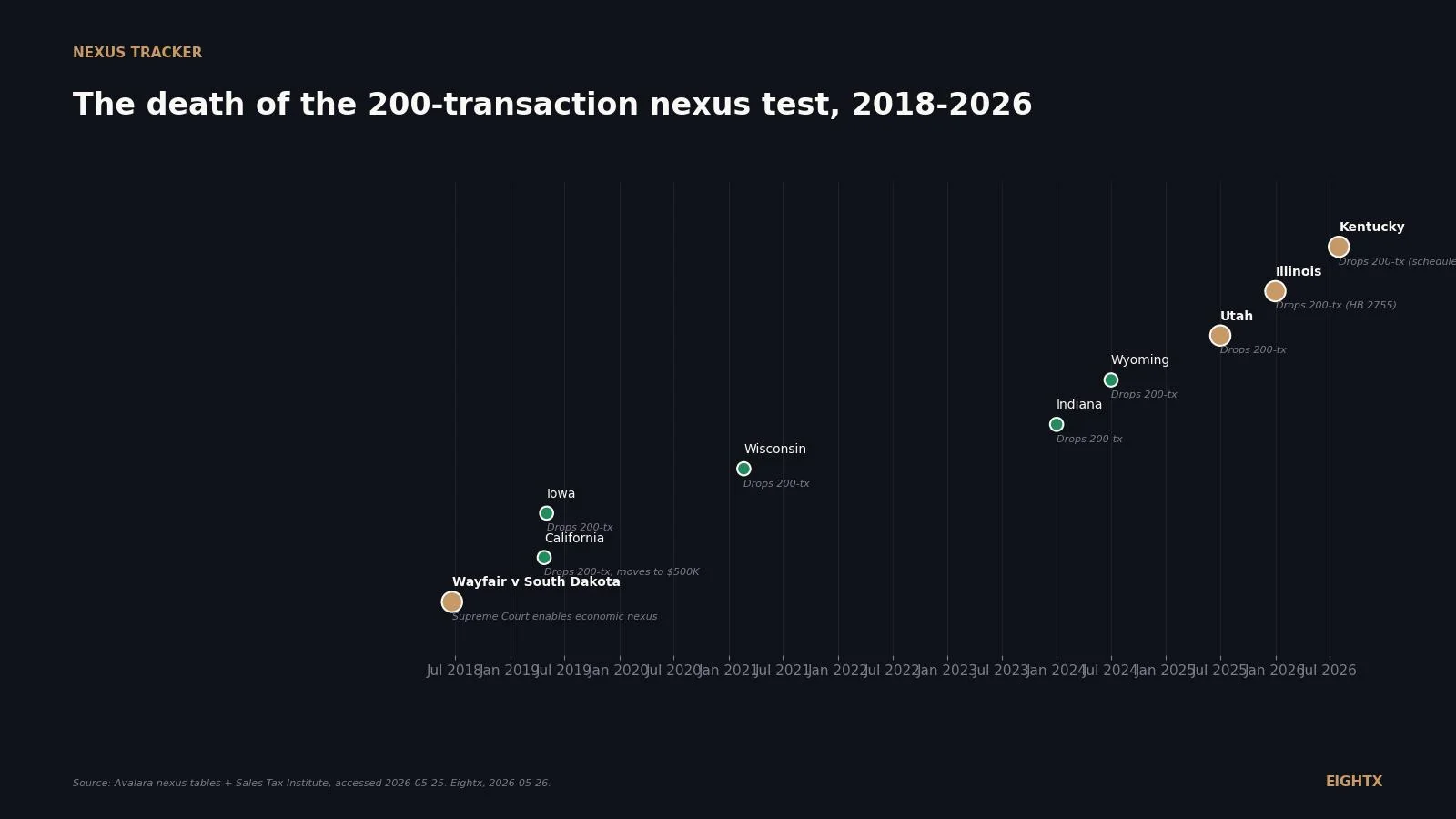
The cadence has accelerated. California led in April 2019. Iowa followed in May 2019. Colorado in April 2019. Then a slow stretch through 2021-2023, then a sprint: Wyoming July 2024, Alaska commission January 2025, Utah July 2025, Illinois January 2026, Kentucky August 2026. New Jersey has bills pending (A2702 and S2466) but no enacted date.
Effective dates for the cleanest recent eliminations, from Parallel.ai primary-source confirmation: Colorado Apr 14 2019, Iowa May 3 2019, Wisconsin Feb 20 2021, Indiana Jan 1 2024, Wyoming Jul 1 2024, Alaska commission Jan 1 2025, Utah Jul 1 2025, Illinois Jan 1 2026, Kentucky Aug 1 2026.
The 15 states (plus DC) that still use $100K or 200 transactions in 2026 are: Arkansas, DC, Georgia, Hawaii, Maryland, Michigan, Minnesota, Nebraska, Nevada, New Jersey, Ohio, Rhode Island, Vermont, Virginia, and West Virginia. Connecticut runs an AND test instead of an OR test ($100K AND 200 tx), which is functionally protective.
The 6 high-threshold states that buy you breathing room
California, Texas, and Tennessee sit at $500,000 of in-state sales. New York is the rare AND test: $500,000 of gross receipts AND 100 separate sales transactions in the immediately preceding four sales tax quarters. Alabama and Mississippi sit at $250,000.
This matters. A $10M DTC brand selling proportional to US population would do roughly $1.18M into California (12% of US population), $913K into Texas, $585K into New York, and $210K into Tennessee. The brand triggers nexus in California, Texas, and New York at $10M but NOT in Tennessee. At $5M, California is the only high-threshold state that triggers (the brand does $592K into California, over the $500K threshold; Texas drops to $456K at 9.13% of population, just below its $500K threshold). Smaller states with $100K thresholds cross easily long before the high-threshold band lights up.
The practical implication for a $5-10M brand: do not assume California is "always on." Run the math. If your California sales are below $500K combined direct plus marketplace, you do not have to register, you do not have to collect, and you do not have to file in California. (Per CDTFA's Marketplace Facilitator Act guide, marketplace sales count toward your California threshold.)
Where exposure triggers at $5M, $10M, $25M, $50M GMV
We modeled a population-proportional DTC brand against every state's 2026 threshold. The calculation: state_revenue = total_revenue × state_population_share, and state_transactions = total_transactions × state_population_share (assuming $80 AOV). Triggers count if the brand crosses either the dollar or transaction prong, depending on which the state uses.
At $5M of US revenue, a population-proportional brand crosses the dollar threshold in 14 states. The 200-transaction test (where it still exists) adds another 27 states for a low-AOV brand, totalling 41 of 47 enforcing jurisdictions. That is the trap for $5M brands selling sub-$30 AOV: dollar exposure feels safe, but transaction count has already tripped nexus everywhere a state still uses the OR test.
At $10M, dollar exposure jumps to 27 states. By $25M, it is 39. By $50M, it is 45. Above $50M of US revenue, you owe in essentially every state with a sales tax.
One important caveat. The population-proportional model is a baseline, not a forecast. Real DTC brands over-index to higher-income coastal metros: California, New York, Massachusetts, Washington, Colorado, and Texas all run hotter than population share suggests, and West Virginia, Mississippi, Arkansas, and Wyoming run cooler. Use the calculator at the bottom of this post to override population shares with your actual state revenue mix.
The 51-row threshold table
For reference, the full 2026 picture as a sortable table.
State Dollar threshold Transaction threshold Test type Note Alabama $250,000 None Sales only Alaska $100,000 None Local commission Dropped 200-tx Jan 1 2025 Arizona $100,000 None Sales only Arkansas $100,000 200 $100K or 200 tx California $500,000 None Sales only Marketplace sales INCLUDED in threshold Colorado $100,000 None Sales only Dropped 200-tx Apr 14 2019 Connecticut $100,000 200 $100K AND 200 tx AND test, not OR Delaware None None No state tax District of Columbia $100,000 200 $100K or 200 tx Florida $100,000 None Sales only Georgia $100,000 200 $100K or 200 tx Hawaii $100,000 200 $100K or 200 tx Idaho $100,000 None Sales only Illinois $100,000 None Sales only Dropped 200-tx Jan 1 2026 Indiana $100,000 None Sales only Dropped 200-tx Jan 1 2024 Iowa $100,000 None Sales only Dropped 200-tx May 3 2019 Kansas $100,000 None Sales only Kentucky $100,000 200 (through Jul 31 2026) Sales only from Aug 1 2026 Drops 200-tx Aug 1 2026 Louisiana $100,000 None Sales only Marketplace sales INCLUDED in threshold Maine $100,000 None Sales only Maryland $100,000 200 $100K or 200 tx Massachusetts $100,000 None Sales only Michigan $100,000 200 $100K or 200 tx Minnesota $100,000 200 $100K or 200 tx Mississippi $250,000 None Sales only Missouri $100,000 None Sales only Montana None None No state tax Nebraska $100,000 200 $100K or 200 tx Nevada $100,000 200 $100K or 200 tx New Hampshire None None No state tax New Jersey $100,000 200 $100K or 200 tx Bills A2702, S2466 pending New Mexico $100,000 None Sales only New York $500,000 100 $500K AND 100 tx Only true AND test North Carolina $100,000 None Sales only North Dakota $100,000 None Sales only Ohio $100,000 200 $100K or 200 tx Oklahoma $100,000 None Sales only Oregon None None No state tax Pennsylvania $100,000 None Sales only Rhode Island $100,000 200 $100K or 200 tx South Carolina $100,000 None Sales only South Dakota $100,000 None Sales only Original Wayfair state Tennessee $500,000 None Sales only Texas $500,000 None Sales only Utah $100,000 None Sales only Dropped 200-tx Jul 1 2025 Vermont $100,000 200 $100K or 200 tx Virginia $100,000 200 $100K or 200 tx Washington $100,000 None Sales only VDA expanded Jul 1 2025 West Virginia $100,000 200 $100K or 200 tx Wisconsin $100,000 None Sales only Dropped 200-tx Feb 20 2021 Wyoming $100,000 None Sales only Dropped 200-tx Jul 1 2024
The marketplace facilitator question: include or exclude?
Most states have marketplace facilitator laws (Amazon, Walmart, eBay, Etsy collect and remit on third-party seller sales). The question that confuses operators is: do those marketplace-facilitated sales count toward YOUR seller threshold for purposes of registering on your own direct sales?
The answer is split, and the original draft of this post had it wrong. After primary-source review against the Sales Tax Institute chart and California CDTFA guidance, here is the corrected picture.
States that INCLUDE marketplace sales in your seller threshold (count Amazon toward your nexus math):
- California ($500K threshold). CDTFA: "you must include all sales of tangible merchandise for delivery in this state, including sales made on your own behalf and ... your sales facilitated through a marketplace facilitator's marketplace."
- Louisiana ($100K threshold). Sales Tax Institute: "Gross sales (Remote Sellers) - Marketplace sales are included towards the threshold for individual sellers."
- Alaska Remote Seller Sales Tax Commission ($100K, local jurisdictions). Sales Tax Institute: "Marketplace sales included towards the threshold for individual sellers."
States that EXCLUDE marketplace sales from your seller threshold (Amazon does not count toward nexus math):
- Alabama ($250K threshold)
- Arizona ($100K)
- Arkansas ($100K)
- Colorado ($100K)
- Illinois ($100K)
- And a longer list of states the Sales Tax Institute chart flags "Marketplace sales excluded from the threshold for individual sellers."
For every state not on either explicit list, read the state's "gross receipts" or "taxable sales" definition. When the language is ambiguous, default to INCLUDING marketplace sales in your nexus calculation (it is the conservative answer; you can back it out later once you have a clear DOR ruling). The downside of excluding when you should include is a registration assessment 18 months later. The downside of including when you should exclude is filing a return for a state where you do not yet owe.
The physical-nexus blind spot: Amazon FBA warehouse storage
Everything in this post is about ECONOMIC nexus, the revenue-triggered version. There is a second kind: PHYSICAL nexus. Storing inventory in a state creates physical nexus regardless of revenue.
Amazon FBA is the classic gotcha. If FBA stores even one pallet of your product in a California, Texas, Pennsylvania, or Florida fulfillment center, you have physical nexus in that state. The economic threshold is irrelevant. A $500K brand can have physical nexus in 12 states because FBA decided to distribute inventory there for faster delivery.
Two things to do this week if you are FBA-heavy. First, pull Amazon's FBA Inventory Event Detail report (it shows which warehouses your inventory passed through). Second, treat any state where FBA stored inventory as a state you should be registered in, regardless of your revenue. The economic-nexus calculator below does NOT model physical nexus. Your accountant has to add it.
A client of ours surfaced US sales tax questions specifically because of a warehouse relocation. Inventory location is the trigger that catches Amazon-heavy and 3PL-using brands flat-footed.
What's next: NJ legislation and the 2027 pipeline
Two near-term changes worth tracking.
New Jersey A2702 / S2466. Both bills would drop the 200-transaction prong from New Jersey's nexus test, leaving the $100,000 sales threshold. As of May 2026, no enacted effective date. The Sales Tax Institute chart still shows NJ as $100K or 200 tx. If either bill passes in 2026 or early 2027, the dollar-only bloc grows from 17 to 18 states (or 19, if Kentucky's August 2026 elimination has already taken effect).
Washington VDA program for non-US sellers. Effective July 1, 2025, Washington expanded its Voluntary Disclosure Program specifically for non-US remote sellers, with reduced lookback periods and penalty relief for a limited time. It is one of the freshest enforcement-posture signals: states are getting more sophisticated about identifying unregistered remote sellers (data analytics on Shopify storefronts, FBA warehouse manifests, marketplace seller IDs) and they are simultaneously offering carrots for sellers who self-register.
2025-2026 audit hot topics. Tax authorities have flagged nexus, digital goods, and marketplace facilitator compliance as priority audit areas for 2025-2026. Resale and exemption certificate misuse audits are rising. The window to self-register via a VDA before a state sends a nexus questionnaire is closing.
Your exposure calculator
Plug in your numbers. The calculator below uses the 51-row threshold table and Census ACS 2023 population shares to estimate which states you have likely crossed.
The 200-transaction trip-wire is dying. Marketplace facilitator rules are split, not blanket. Physical nexus from FBA warehouse storage trumps every economic threshold. Run the math on YOUR revenue distribution, not the population-proportional default, before you decide where you are registered or where you are not.
How to think about VDAs, registration, and back-exposure
If the calculator flagged states where you have crossed the threshold and you are not registered, you have three options. Pick one before a state sends you a nexus questionnaire.
Option 1: Register prospectively and ignore the back-exposure. Cheapest in the short term. You sign up with the state, start collecting, and hope they never look backwards. The risk: states are running data-matching against Shopify storefronts, FBA warehouse manifests, and marketplace seller IDs. If they find you, the back-exposure is full lookback (typically 5-7 years), full penalties, full interest, no negotiation room. Bad bet at $5M+ revenue.
Option 2: File a Voluntary Disclosure Agreement (VDA) in each state. A VDA is a negotiated settlement where you self-disclose past non-compliance and the state agrees to a capped lookback (usually 3-4 years), waived penalties, and a structured payment plan. Washington's expanded VDA program for non-US sellers (effective July 1, 2025) is the current gold standard: reduced lookback, penalty relief, time-limited window. Most other states have permanent VDA programs with similar terms. Bring a SALT attorney or specialty firm; do not file VDAs solo, the lookback negotiation matters.
Option 3: Engage an automated compliance vendor (Avalara, TaxJar, Anrok, Numeral) AND a SALT advisor. Vendors handle registration, collection, and filing. The SALT advisor handles back-exposure cleanup via VDAs. Most $5-50M brands need both: the vendor for ongoing compliance, the advisor for the historical fix.
One operational note from a client experience: switching sales-tax vendors mid-year is a high-risk window. A client cut over from Avalara to Numeral and missed a return because both vendors assumed the other was filing for August. Reconcile the handoff month explicitly. Get a written list from each vendor of which states they are filing for, in which month, and which state portals you control directly.
Sources and methodology
Threshold data. Compiled primarily from Avalara's economic nexus tables (accessed 2026-05-25), including the April 21, 2026 update confirming 16 states plus the Alaska Remote Seller Commission have eliminated the 200-transaction prong. Cross-checked against the Sales Tax Institute's economic nexus state guide, which is the most granular public source on marketplace facilitator inclusion vs exclusion at the seller-threshold level.
Effective-date confirmations. Parallel.ai primary-source research surfaced the specific elimination dates: Colorado April 14 2019, Iowa May 3 2019, Wisconsin February 20 2021, Indiana January 1 2024, Wyoming July 1 2024, Alaska commission January 1 2025, Utah July 1 2025, Illinois January 1 2026, Kentucky August 1 2026. New York's $500K AND 100 transactions test was confirmed via the NY State Department of Taxation publication on nexus registration.
Marketplace facilitator split. California's include treatment was confirmed via CDTFA's Marketplace Facilitator Act guide. Louisiana and Alaska commission include treatment confirmed via Sales Tax Institute chart. Exclude treatment for Alabama, Arizona, Arkansas, Colorado, Illinois confirmed via the same chart. For the remaining ~30 states, treat as "ambiguous" and read the state's "gross receipts" definition; default to inclusion when unclear.
Population-proportional revenue model. Census ACS 2023 1-year state population estimates (B01001_001E). The model assumes revenue distributes pro-rata to state population, which is a baseline only. Real DTC brands over-index high-income coastal metros (CA, NY, MA, WA, CO, TX); under-index West Virginia, Mississippi, Arkansas, Wyoming. Population-share refresh planned for September 2026 when 2024 ACS 1-year data releases.
Limitations. This post and the calculator model ECONOMIC nexus only. Physical nexus (employees, contractors, inventory storage including Amazon FBA fulfillment centers) is a separate test that trumps economic thresholds. The calculator does not model state-by-state marketplace facilitator inclusion/exclusion at the row level; it applies the simplified "include all sales toward threshold" by default. Product-level taxability variation (food, clothing, supplements vary by state) is not modeled. This is research, not legal or tax advice.
Update cadence. Threshold tables refreshed when Avalara or Sales Tax Institute publishes a state change. Population shares refresh September 2026 when 2024 ACS 1-year releases. New Jersey A2702/S2466 status monitored quarterly.
For a deeper read on the operating side, see our notes on interim CFO services and the working capital drag calculator that pairs with the same revenue-distribution model.
Frequently asked questions
do i owe sales tax in every state i ship to once i hit $100k revenue?
No. You owe in every state where your sales into that state cross the state's threshold. At $5M of US revenue distributed pro-rata to population, you trigger the dollar test in roughly 14 states. Add the 200-transaction test and a low-AOV brand can hit 30+ states at the same revenue. The choropleth map above shows which states use which test.
if i sell on amazon does that count toward my own shopify nexus threshold?
It depends on the state, and the rules are split. California, Louisiana, and the Alaska Remote Seller Commission say yes: count your Amazon FBA sales toward your seller threshold. Alabama, Arizona, Arkansas, Colorado, Illinois and others say no: only your direct (non-marketplace) sales count. The Sales Tax Institute chart is the canonical reference. Default to including marketplace sales if the state language is ambiguous, then back it out once you have a clear DOR answer.
what's the difference between physical nexus and economic nexus?
Physical nexus is triggered by a presence in the state: an employee, an office, contractor activity, or inventory stored in a 3PL. Economic nexus is triggered by sales volume. Amazon FBA is the classic gotcha here. If FBA stores even one pallet of your product in a California fulfillment center, you have physical nexus in California regardless of how little revenue you do there. Economic-nexus thresholds protect you from low-revenue states; physical nexus blows through them.
i passed the threshold in a state three months ago. am i already in trouble?
You are non-compliant, not necessarily in trouble. Most states give you 30 to 90 days from when you cross the threshold to register and start collecting. After that, every uncollected sale becomes a liability you may owe out of pocket. The Washington VDA program (expanded July 2025 for non-US sellers) is one signal that states are getting more aggressive about audits, but a voluntary disclosure agreement filed before you get a letter typically caps your back-exposure to 3-4 years and waives penalties.
do i have to register in california at $100k or $500k of california sales?
$500,000 of California sales in the preceding or current calendar year, per CDTFA. California is one of the highest-threshold states. The catch: California EXPLICITLY includes marketplace-facilitated sales (Amazon, Walmart) in that $500K total per CDTFA's Marketplace Facilitator Act guide. So if you do $300K direct + $250K Amazon into California, you have hit the threshold.
when did illinois and kentucky drop the 200-transaction test and what does it change for me?
Illinois dropped it January 1, 2026 (IDOR bulletin FY 2026-12). Kentucky drops it August 1, 2026. Both kept the $100,000 sales test. If you are a low-AOV brand selling $15 supplements or $20 socks, those two states no longer pull you in on volume alone. You only owe once you cross $100K of in-state sales.
what about new jersey's 200-transaction test, is that going away?
Bills A2702 and S2466 have been introduced to drop New Jersey's 200-transaction test. As of May 2026, no enacted effective date. The Sales Tax Institute chart still shows NJ as $100K or 200 transactions. Treat NJ as a 200-tx state for now and watch the bills.
what happens if a state finds out i passed the threshold but didn't register?
Three things in sequence. First, a nexus questionnaire from the state asking you to confirm your sales volume. Second, an assessment for back taxes plus penalties and interest, typically 5-7 years back (no statute of limitations until you register). Third, the option to fight it or settle. The cleaner path is a voluntary disclosure agreement BEFORE a letter arrives: lookback usually caps at 3-4 years, penalties are waived, and you negotiate the assessment. Washington's expanded VDA program (Jul 2025) is the most generous current example.
if i switched my sales-tax filing from avalara to numeral mid-year, am i covered?
Not automatically. Reconcile the handoff month carefully. One of our clients cut over from Avalara to Numeral and missed a return because both vendors assumed the other was filing. Get a written list from each vendor of which states they are filing for, in which month, and which state portals you control directly. The cutover month is where returns slip.