
Financial Strategy
What are prepaid expenses in ecommerce accounting? ASC 340-10, the $2,500 threshold, and the journal entries every DTC CFO uses
Prepaid expenses are payments made now for benefits received over future periods, classified as current assets and expensed ratably as the benefit is consumed. Under ASC 340-10, most DTC brands apply a $2,500 per-item capitalization threshold, meaning anything below that hits the P and L immediately. Common examples include annual SaaS contracts, platform fees, and inventory insurance.
A prepaid expense is cash you have already paid for a benefit your business will receive over multiple future months. Annual Shopify Plus, annual D&O insurance, and 12-month commercial leases are the classic examples for ecommerce and direct-to-consumer (DTC) brands. Under US GAAP (Generally Accepted Accounting Principles), the controlling guidance is FASB ASC 340-10 (Other Assets and Deferred Costs). The payment lands on the balance sheet as a current asset, then moves into the P&L on a straight-line basis over the period the benefit is consumed. This post covers US GAAP and US tax. Canadian and Australian brands have analogous rules (ASPE, IFRS for SMEs, AASB) but the citations and the 12-month rule are US-specific.
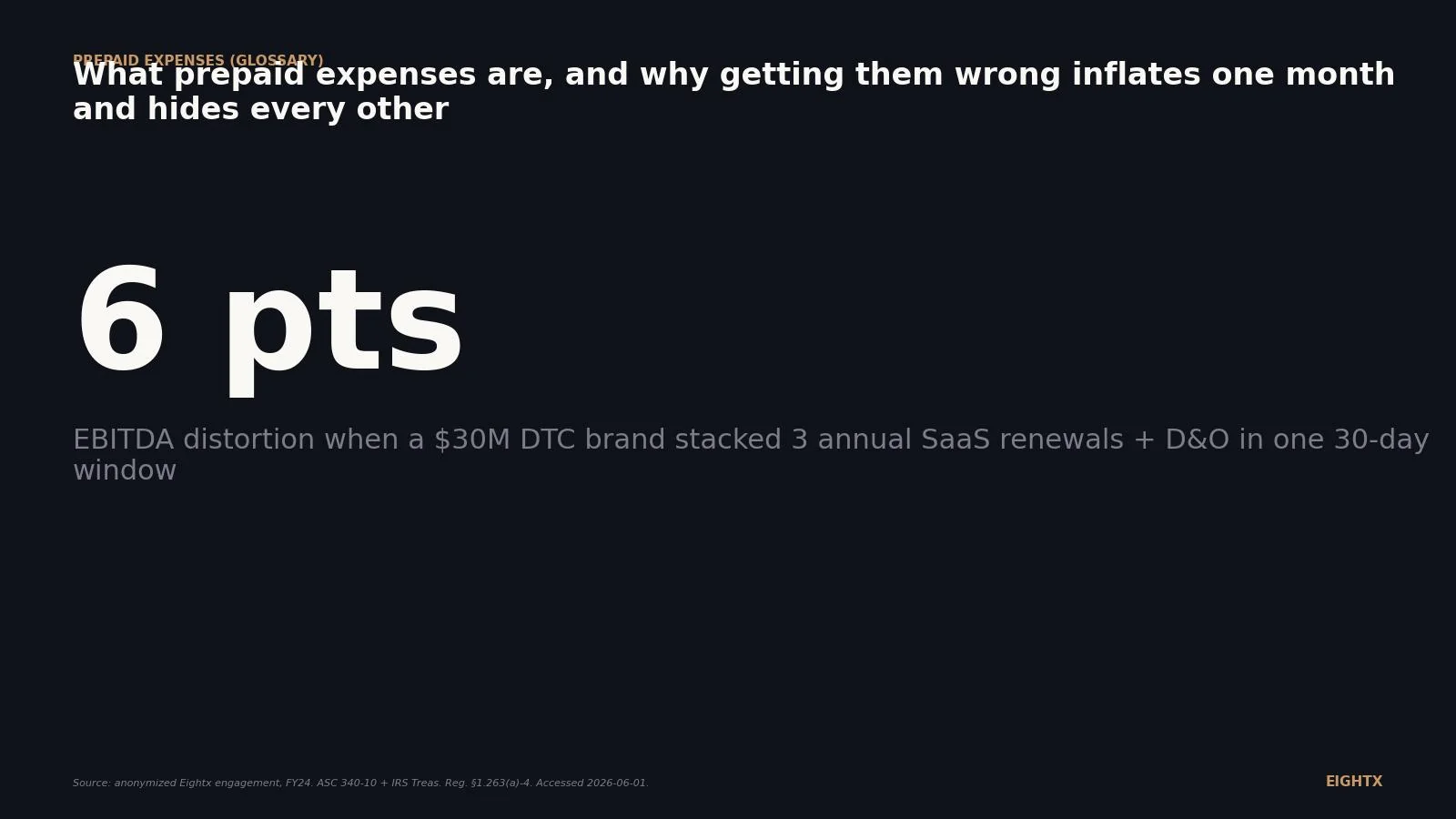
Most growth-stage DTC operators we meet expense the entire annual Shopify Plus invoice, the annual Klaviyo renewal, and the annual D&O premium in the month they pay them. That makes one month of the P&L look catastrophic and every other month look artificially profitable. The fix is mechanical and codified, but most $3M-$50M brands never set it up because the first-hire bookkeeper inherited a cash-in, cash-out P&L. The reclassification entry to move stacked annual payments into prepaids typically restores several hundred basis points of EBITDA in the spike month (we have seen single-month swings of 100 to 300 bps at growth-stage brands, and as high as ~600 bps at one $30M apparel client). Audited and audit-ready brands get this right because their auditor will book the entry themselves if the brand does not, and force a restatement of comparatives if the misstatement is material.
How it works
Three things have to be true for an item to be a prepaid expense. First, the cash has already left the bank. Second, the benefit you bought extends past the end of the current accounting period. Third, the amount is above the materiality threshold your business has set for capitalizing prepayments (your fractional CFO or auditor can sanity-check the number). ASC 340-10 leaves the dollar threshold to management judgment; in practice every audit-ready DTC brand sets one in a one-page Accounting Policies memo. Typical bands: brands under $10M revenue use $500 to $1,000, brands $10M to $50M use $1,000 to $2,500, brands over $50M use $2,500 to $5,000. Revisit the threshold annually as the brand grows across revenue bands.
The mechanics are the same for every prepaid. Worked example: a $24,000 illustrative annual SaaS renewal (e.g. a Shopify Plus contract at the lower end of the published floor, or a mid-stack Klaviyo or Gorgias annual) paid 15 January. At payment, debit Prepaid SaaS $24,000, credit Cash $24,000. At the end of each month from January through December, debit Software Expense $2,000, credit Prepaid SaaS $2,000. The Prepaid SaaS balance walks from $24,000 down to zero over 12 months; the Software Expense line shows a steady $2,000 per month instead of a $24,000 January spike followed by eleven months of zero. Insurance works identically. A $120,000 D&O premium for a 12-month policy amortizes at $10,000 per month over the policy period (typically 12 months running from the binder or effective date, which rarely aligns to the fiscal calendar).
The boundary that most operators miss: a deposit you wire to your overseas manufacturer for next quarter's production run is NOT a prepaid expense. It is an advance to supplier (other current asset) under ASC 330. It sits in advances to suppliers, reclassifies to inventory when the agreed incoterm transfers risk and title (FOB origin at the manufacturer's port, CIF on the vessel, or arrival at your 3PL per your PO), then to COGS (Cost of Goods Sold) when the units sell. Same boundary holds for event deposits and design fees that buy a one-time deliverable rather than a multi-period service.
Annual SaaS, annual insurance, and 12-month rent prepayments are all ASC 340-10 prepaid assets. Shopify, Klaviyo, NetSuite, and Gorgias are hosting arrangements that do not convey a software license under ASC 350-40, so the annual fee is a service prepayment under ASC 340-10 only. ASC 350-40 still applies separately for implementation and setup costs, but the hosting fee itself does not sit under that subtopic.
Common triggers
- Three or more annual SaaS renewals (Shopify Plus, NetSuite, Klaviyo, Gorgias) hit the bank in the same 30-day window and the operator runs the P&L as cash.
- Your annual D&O, cyber, or commercial general liability premium has just been wired and someone is debating which month to expense it.
- An auditor or fractional CFO is asking for your Accounting Policies memo and the capitalization threshold has never been written down.
- You have wired a $50K-$200K deposit to an overseas manufacturer and the bookkeeper is about to book it to operating expense.
- You crossed from $9M to $15M revenue and your $500 capitalization threshold no longer fits. The prepaids schedule is collecting noise from $400 domain renewals while a $60K D&O premium hits OpEx.
The most common mistake
Expensing annual SaaS and annual insurance on the payment date for both books and tax. The books version inflates the payment month's loss, understates EBITDA in that month by the full invoice, and overstates every other month's profit by the missing amortization. The auditor catches it during fieldwork and proposes a reclassification entry that moves the unconsumed portion off the P&L and onto the balance sheet; if the misstatement is material, the auditor may require a restatement of comparative periods. The cleanest fix is to build a prepaids schedule before audit season, post the catch-up entry yourself, and document the new policy in a one-page Accounting Policies memo with an effective date. Adjacent mistake: classifying an overseas manufacturer deposit as a prepaid expense and amortizing it through OpEx. That understates inventory and overstates operating expense. The deposit should sit in advances to suppliers, reclassify to inventory at title transfer, and only hit the P&L through COGS when the units sell.
Browse the full ecommerce finance glossary for every metric and money term a DTC operator needs.
Frequently Asked Questions
should i capitalize my annual shopify plus invoice?
Yes, if the invoice is above your capitalization threshold. Most ecommerce brands set that at $1,000 to $2,500. Annual Shopify Plus on the published floor runs $2,300+ per month with revenue-share kickers above $1M GMV per month, so most $10M to $50M brands prepay $30,000 to $50,000 a year, well above any reasonable threshold. Record it as a prepaid asset, then amortize 1/12th per month into the P&L over the 12-month contract. Same logic for annual Klaviyo, NetSuite, Gorgias, Recharge, Yotpo, and Attentive.
is a deposit to my china manufacturer a prepaid expense?
No. A deposit to an overseas manufacturer is an advance to supplier under ASC 330, not a prepaid expense under ASC 340-10. It sits as other current asset on the balance sheet, reclassifies to inventory when the agreed incoterm transfers risk and title (FOB origin at the manufacturer's port, CIF on the vessel, or arrival at your 3PL per your PO), then to COGS when the units sell. Misclassifying it as a prepaid expense inflates operating expense and understates inventory. This is the single most common DTC misclassification we see.
can i deduct annual saas upfront for tax even if i capitalize it on the books?
Often yes, under the IRS 12-month rule (Treas. Reg. §1.263(a)-4(f)). If the benefit does not extend more than 12 months past the date the right begins, AND it does not extend past the close of the following tax year, you can deduct the full amount upfront for tax. Books still amortize. In a tax-paying year that creates a deferred tax liability your tax preparer tracks on the M-1 schedule; brands in an NOL position will see the difference offset by valuation allowance movement instead. If you have never elected the 12-month rule, switching is an accounting method change and requires IRS Form 3115 under Rev. Proc. 2015-13 with a Section 481(a) adjustment.
what threshold do most dtc cfos use for prepaids?
Brands under $10M revenue typically use $500 to $1,000. Brands $10M to $50M use $1,000 to $2,500. Brands over $50M use $2,500 to $5,000. Audited or public brands often go to $5,000 or higher because their overall financial-statement materiality is higher. There is no GAAP-mandated number. Pick one, write it into a one-page Accounting Policies memo, apply it consistently, and revisit annually as you cross revenue bands.
what happens at audit if i expensed all my saas on payment?
Your auditor will propose a reclassification entry that moves the unconsumed portion off the P&L and onto the balance sheet, and your EBITDA will move. If the amounts are material to the year you are auditing, the auditor may also require a restatement of comparative periods. The cleanest fix is to build a prepaids schedule before audit season, post the catch-up entry yourself, and document the new policy. We see this fix add or subtract several hundred basis points of EBITDA at growth-stage DTC brands every audit cycle (typically 100 to 300 bps, occasionally more at brands with heavily stacked annual renewals).