
Financial Strategy
What is SDE (Seller's Discretionary Earnings)? The sub-$5M valuation base every ecom founder should understand
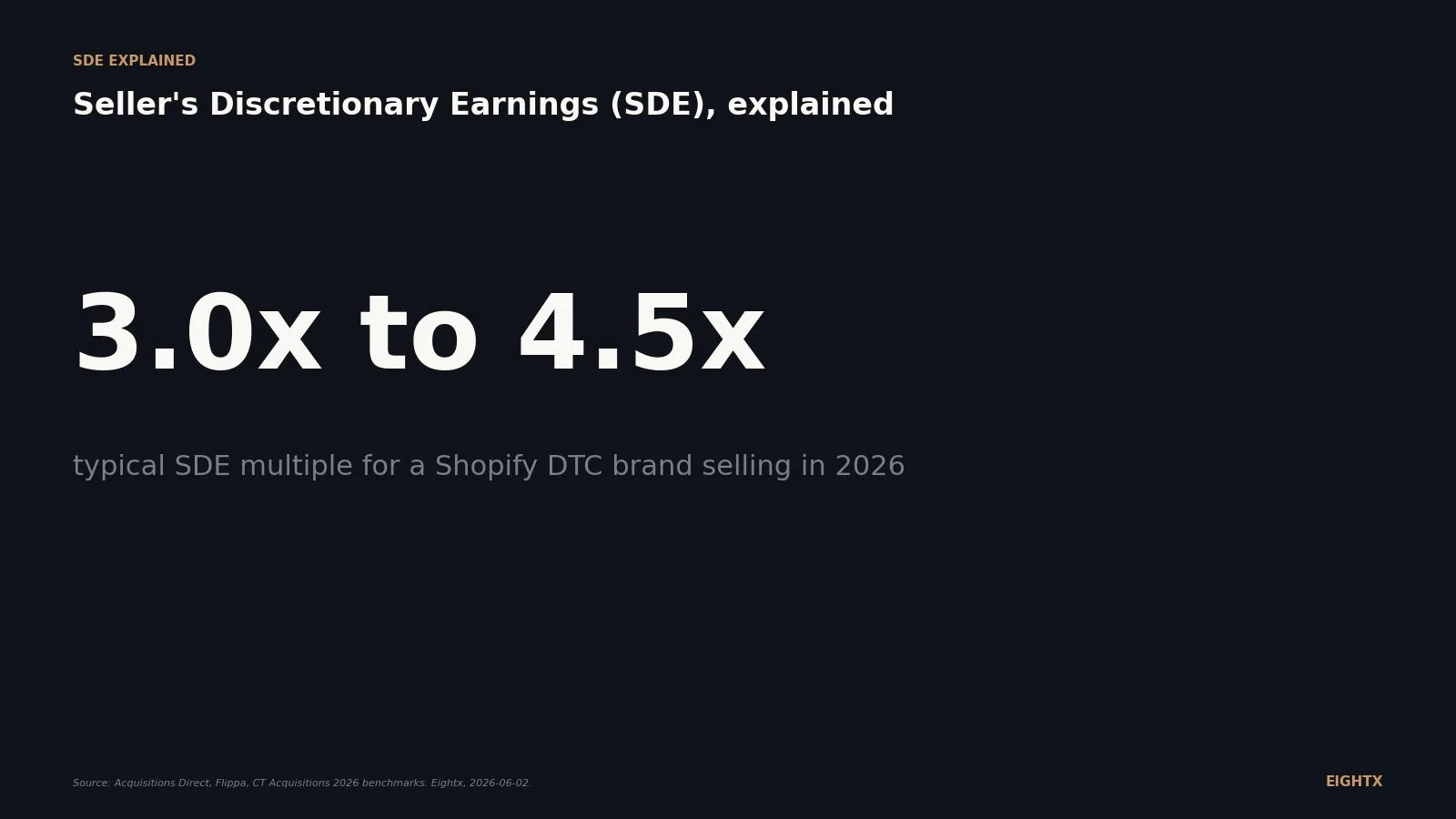
SDE (Seller's Discretionary Earnings) is EBITDA plus owner pay plus documented add-backs, and it is how brokers price ecommerce brands under roughly $5M revenue. A general Shopify DTC brand trades at 3.0 to 4.5 times SDE in 2026, while repeat-purchase niches like beauty and pet reach 3.5 to 4.8 times. Amazon FBA brands take a 0.3 to 0.5 times discount versus multi-channel brands because of platform-concentration risk.
Key Takeaways
- SDE = pre-tax profit + owner compensation + interest + depreciation + amortization + non-recurring + discretionary personal expenses. Effectively EBITDA plus owner pay and add-backs. The cash a single owner-operator buyer keeps before debt service.
- Brokers price you on SDE under ~$5M revenue or ~$1M EBITDA. Above that, buyers shift to adjusted EBITDA because they assume a hired GM replaces the owner. Quoting the wrong metric misses broker pricing by 30 to 50 percent.
- 2026 SDE multiples: Amazon FBA 2.8x to 4.2x, Shopify DTC 3.0x to 4.5x, beauty and pet DTC 3.5x to 4.8x, apparel 2.25x to 3.75x, content sites 2.5x to 3.75x, small SaaS 3.0x to 6.0x. Category matters more than absolute dollars.
- Bigger SDE earns a bigger multiple. Flippa data shows the same dollar of profit earns 1.68x in a sub-$100K deal and 2.43x in a $1M+ deal. Scale lifts the multiple before any operating improvements.
- The four levers that move your multiple: growth rate (15%+ YoY adds 0.5x to 1.0x), channel diversification (+0.75x), 3+ years of clean financials (+0.5x), and lack of customer concentration. Start fixing these 12 months before you list.
Seller's Discretionary Earnings (SDE) is the cash-flow metric your business broker will use to price your store if you sell for under about $5M in 2026. It matters because the gap between SDE and EBITDA, and the multiple a buyer applies to each, is the single most common reason founder valuation expectations miss broker pricing by 30 to 50 percent. This explainer covers the formula, the SDE-versus-EBITDA threshold, the 2026 multiple bands by category, the add-backs you can and cannot defend, and what to fix in the 12 months before you list. Watch the apparel and content-site bands, which compressed in 2025 and look likely to stay compressed through Q4 2026.
The one-line definition
SDE is pre-tax profit plus owner compensation, interest, depreciation, amortization, non-recurring expenses, and discretionary personal expenses. In shorthand:
SDE = EBITDA + owner pay + discretionary add-backs.
The intuition: SDE approximates what a single owner-operator buyer can put in their pocket after paying the bank. EBITDA leaves owner salary as a cost; SDE adds it back, because the buyer expects to do that work themselves and keep the pay.
Worked example. A $1.2M revenue Shopify brand with $360K in reported net income. The owner pays themselves a $120K salary plus $18K in health and retirement. They ran a $22K trademark dispute through legal that year, $14K of personal travel and meals through the business, and have $8K of depreciation on warehouse racking. SDE is $360K + $120K + $18K + $22K + $14K + $8K = $542K. At a mid-band 3.75x Shopify DTC multiple, indicative enterprise value is $2.03M. Move to a low-band 3.0x and it is $1.63M. Same business, $400K of value depending on where the buyer anchors.
SDE vs EBITDA: where the line actually sits
The market convention is straightforward. Below about $5M revenue or about $1M EBITDA, deals are priced on SDE multiples. Above that threshold, buyers shift to adjusted EBITDA. Note that the threshold is a rule of thumb, not a statutory cutoff. Empire Flippers, Quiet Light, and FE International all use SDE as the default for online-business deals in the under-$5M range; private equity and strategic acquirers use adjusted EBITDA for deals above $1M EBITDA.
Why the switch happens. Below $1M EBITDA, the buyer is almost always an individual operator or small acquirer who will run the business themselves. They want to know what they will keep, which is SDE. Above $1M EBITDA, the buyer pool shifts to PE and strategics who will hire a general manager at market rate. They normalize owner pay to a hired replacement and price on the adjusted EBITDA that results.
Why this matters for your business. If your broker is using a 3.5x SDE multiple and you are quoting a 6x EBITDA multiple at a discovery call, you are quoting two different numbers that happen to share the word "multiple." On $500K of SDE that includes $120K of owner pay, you are talking about a $1.75M valuation versus a $2.28M valuation on the EBITDA side. The buyer hears confusion and discounts accordingly.
What you can, and cannot, add back
The legitimate add-back list is shorter than most founders think and longer than most accountants will tell you.
Add-back category Usually accepted Typically rejected Owner salary + payroll taxes Yes (full) Owner health insurance + retirement Yes Personal travel / meals run through biz Yes (if documented) If recurring and operational One-off legal / consulting Yes If used annually Family-member payroll (non-operating) Yes If they actually work in the business Marketing "tests" Sometimes If running 6+ months / part of normal ad mix Replacement-cost normalization No (SDE) / Yes (EBITDA) Founder's unpaid time Always rejected
The two failure modes we see most. First, founders add back working ad spend by calling it "testing." Buyers know the difference between $30K of one-shot creative testing and $30K of ongoing Meta spend that has been running for 14 months. Reclassifying the latter as a one-off gets caught on the first day of due diligence and torches credibility on every other add-back you have proposed. Second, founders try to normalize their own time at zero, arguing the business runs itself. No buyer believes this. If you are the head of marketing, the head of brand, and the customer service email replier, your replacement cost is a real number. Buyers want SDE that reflects the cash they keep after hiring that work back out.
2026 SDE multiples by category
Bands below reflect typical low-to-high SDE multiples in 2025-26 deal flow. Top of the band assumes 15%+ YoY growth, multi-channel revenue, 3+ years of clean financials, and no customer concentration. Bottom of the band assumes the opposite.
Category Low Typical High Source Amazon FBA (private label) 2.8x 3.5x 4.2x Acquisitions Direct 2026 Shopify / DTC (general) 3.0x 3.75x 4.5x Acquisitions Direct 2026 Beauty / pet / health DTC 3.5x 4.2x 4.8x Acquisitions Direct 2026 Apparel / fashion DTC 2.25x 3.0x 3.75x Acquisitions Direct 2026 Content / affiliate site 2.5x 3.0x 3.75x Flippa 2024 Small SaaS (sub-$1M ARR) 3.0x 4.5x 6.0x CT Acquisitions / Flippa 2026
Scale matters too. Flippa's published deal-size data shows the same dollar of profit earns a 1.68x median multiple in a $10K to $100K deal, 2.10x in a $100K to $1M deal, and 2.43x in a $1M+ deal. Bigger SDE earns a bigger multiple before any operating improvements, because the buyer pool widens (more PE search funds, more strategic acquirers) and the deal de-risks (more diligence headroom, more financing options).
The four levers that move your multiple
The category band sets your starting point. Four levers move you within the band, and the math compounds.
Growth rate. 15%+ YoY top-line growth typically adds 0.5x to 1.0x SDE. Declining businesses (-5% YoY or worse) lose 0.5x to 1.5x. On $800K of SDE, the difference between 3.0x and 4.5x is $1.2M of exit value. Twelve months of YoY growth is enough; you do not need a multi-year track record, but you do need the chart to be pointing up at LOI.
Channel diversification. Multi-channel revenue mix (Amazon, Shopify, retail, wholesale, marketplaces) adds about 0.75x. Single-channel concentration (you are 100% Amazon FBA or 100% DTC with one acquisition channel) subtracts about 0.75x. The fix is not equal channels; it is the existence of a second meaningful channel doing 15%+ of revenue.
Financial cleanliness. 3+ years of clean books (QuickBooks tied out to bank, no commingled personal expenses without paper trail, monthly close current) adds about 0.5x. Sub-12-month operating history or messy financials that need a quality-of-earnings rebuild subtract 1.0x or more. The QofE (Quality of Earnings) process is where buyer-friendly add-backs survive or die.
Customer concentration. No formal multiplier, but customer concentration above ~25% of revenue from a single customer typically caps the multiple at the low end of the band regardless of growth or cleanliness. This shows up most often in DTC subscription brands with a heavy enterprise account or wholesale brands with a single retailer.
The difference between 3.0x SDE and 4.5x SDE on $800K of SDE is $1.2M of exit value. Same business. Same year. The gap is whether you have growth, channel proof, clean books, and no customer concentration on the day you list. Twelve months of operator focus moves you across this gap. The day-of-LOI scramble does not.
What to do 12 months before you list
Six things to start now if you are thinking about a 2027 exit.
Clean QuickBooks against the bank. Every month. Tie out cash, AR, AP, inventory, and intercompany. If you are still on cash basis, a buyer's accountant will rebuild your P&L on accrual during diligence and the gap between the two is where deal value leaks. Move to monthly accrual close now.
Separate personal and business. New credit card, new bank account if you have to. From here forward, every personal expense runs on the personal card. Anything you intend to claim as an add-back gets a paper trail and a written note in the GL.
Document SOPs to de-risk owner dependency. Three to five SOPs covering the work only you do today: ad account management, product launch process, supplier negotiation, customer-service escalation. A buyer pays a higher multiple for a business they can operate without you. They do not need perfect SOPs. They need to see that the work is documentable.
Decide whether to switch to a market-rate owner salary 12 months out. This is the underrated move. If you pay yourself $40K now and intend to add back a $120K market-rate salary at sale, the buyer's accountant will normalize it back down to your actual paid amount. If you switch to a $120K salary 12 months before you list, the historical financials show the salary you actually paid, and the add-back is unambiguous.
Get a second channel to 15%+ of revenue. If you are 100% Amazon, launch DTC. If you are 100% Shopify, launch on Amazon (yes, even at thinner margin). The 0.75x channel-diversification premium pays for itself on most $500K+ SDE businesses.
Lock down customer concentration. If a single retailer, marketplace account, or subscriber cohort is more than 25% of revenue, broaden the base. This is the slowest of the six fixes and the one most likely to be a multi-quarter project. Start it first.
Sources and methodology
We triangulated SDE multiple bands across four broker and marketplace sources to reflect actual 2025-26 transaction pricing, not theoretical valuation models. Acquisitions Direct publishes annual ecommerce SDE multiples by sub-category (FBA, Shopify DTC, beauty, apparel) based on their own deal flow; their 2026 bands are the primary source for category-specific multiples. Flippa's Business Valuation Multiples report (late 2024, refreshed quarterly) provides cross-category median profit multiples and the deal-size-by-multiple data we used for the scale premium. CT Acquisitions' 2026 SDE framework supplied the growth premium and multi-channel adjustment math. Peak Business Valuation's general ecommerce SDE range corroborated the Acquisitions Direct band.
The Flippa profit-multiple-by-deal-size data is published by Flippa from their marketplace transaction database and reflects open-marketplace pricing, which typically clears 70 to 85 percent of asking. Empire Flippers' ~88 percent sold-to-asking ratio comes from a 2026 third-party SaaS marketplace comparison and is directional, not audited. Empire Flippers itself publishes deal statistics quarterly but does not break them out by SDE band.
The $5M revenue / $1M EBITDA SDE-to-EBITDA threshold is a widely-used market convention rather than a statutorily defined cutoff. Brokers we have worked with use it consistently, but individual deals deviate: a $7M revenue brand with a single-owner-operator buyer pool may still price on SDE, and a $4M revenue brand with strong PE interest may price on adjusted EBITDA. Use the threshold as a starting point, not a hard line.
Limitations. Live SEC filings do not yield ecommerce-broker-relevant SDE comps because SDE is by definition a private, owner-operator metric. Public-comp SDE multiples do not exist. All multiples in this post therefore rely on broker-published benchmarks, which are the actual market signal anyway. Multiples can move 0.5x or more inside a quarter when buyer demand or cost-of-capital shifts; treat 2026 bands as the current read, not a permanent fixture.
What we are watching next. Two things. First, whether the apparel and content-site bands stay compressed through Q4 2026 (they have been at the low end since mid-2024 on weak buyer demand). Second, whether the FBA platform-concentration discount widens as Amazon fee changes hit, or narrows as multi-channel FBA brands prove out. We will refresh this post in February 2027 with updated multiple bands.
For more on the M&A pricing stack, see our pieces on EBITDA add-backs, what an exit multiple actually means, the holdback in an M&A deal, and the letter of intent stage. If you are 12 months out from listing, our DTC brand exit financial readiness guide and interim CFO for M&A due diligence walk the full prep sequence.
Frequently asked questions
what is seller's discretionary earnings in plain english?
SDE is the cash a single owner-operator buyer keeps after running the business. It starts with reported pre-tax profit, then adds back the owner's salary and benefits, depreciation, amortization, interest, and any one-off or personal expenses the business paid for. The result is the number a broker uses to price your business if you sell for under about $5M.
what's the difference between sde and ebitda?
EBITDA adds back interest, taxes, depreciation, and amortization but leaves owner pay in the cost stack. SDE adds owner pay back on top. So SDE is always higher than EBITDA for an owner-operated business. Brokers use SDE for deals under ~$5M revenue because a single buyer will replace the owner; they switch to adjusted EBITDA above ~$1M EBITDA because the buyer is hiring a GM.
what add-backs can i legitimately include in sde?
Owner salary plus payroll taxes, owner health insurance and retirement contributions, personal travel and meals run through the business (if documented), one-off legal or consulting fees, family-member payroll for people who do not work in the business, and the business's interest expense. What brokers reject: working ad spend reclassified as "tests," real software the business needs, and your own unpaid time normalized to zero.
what's a typical sde multiple for a shopify store in 2026?
3.0x to 4.5x SDE for a general Shopify DTC brand, 3.5x to 4.8x for repeat-purchase niches like beauty, pet, or health, and 2.25x to 3.75x for apparel and fashion. Higher growth, multi-channel revenue, and 3-plus years of clean financials push you to the top of the band. Single-channel concentration and a sub-12-month operating history push you below the baseline.
when does a buyer stop caring about sde and start using ebitda?
Around $1M EBITDA or $5M revenue, give or take. Below that, the buyer pool is individual operators and small acquirers who will run the business themselves, so they care about SDE. Above that, the buyer pool is private equity and strategic acquirers who will hire a GM at market rate, so they price on adjusted EBITDA with owner comp normalized to a hired replacement.
Browse the full ecommerce finance glossary for every metric and money term a DTC operator needs.