
Financial Strategy
What is TTM (trailing twelve months)? How DTC buyers normalize a seasonal P&L in 2026
TTM (trailing twelve months) is the sum of the last 12 months of actual revenue, and it is the primary anchor acquirers, banks, and quality-of-earnings providers use to price DTC brands because it captures one full seasonality cycle. Run-rate multiples typically trade at a half-turn to full-turn discount versus TTM multiples. To bridge TTM EBITDA to the SDE a broker will quote, add back above-market owner comp, one-time costs, and documented personal expenses.
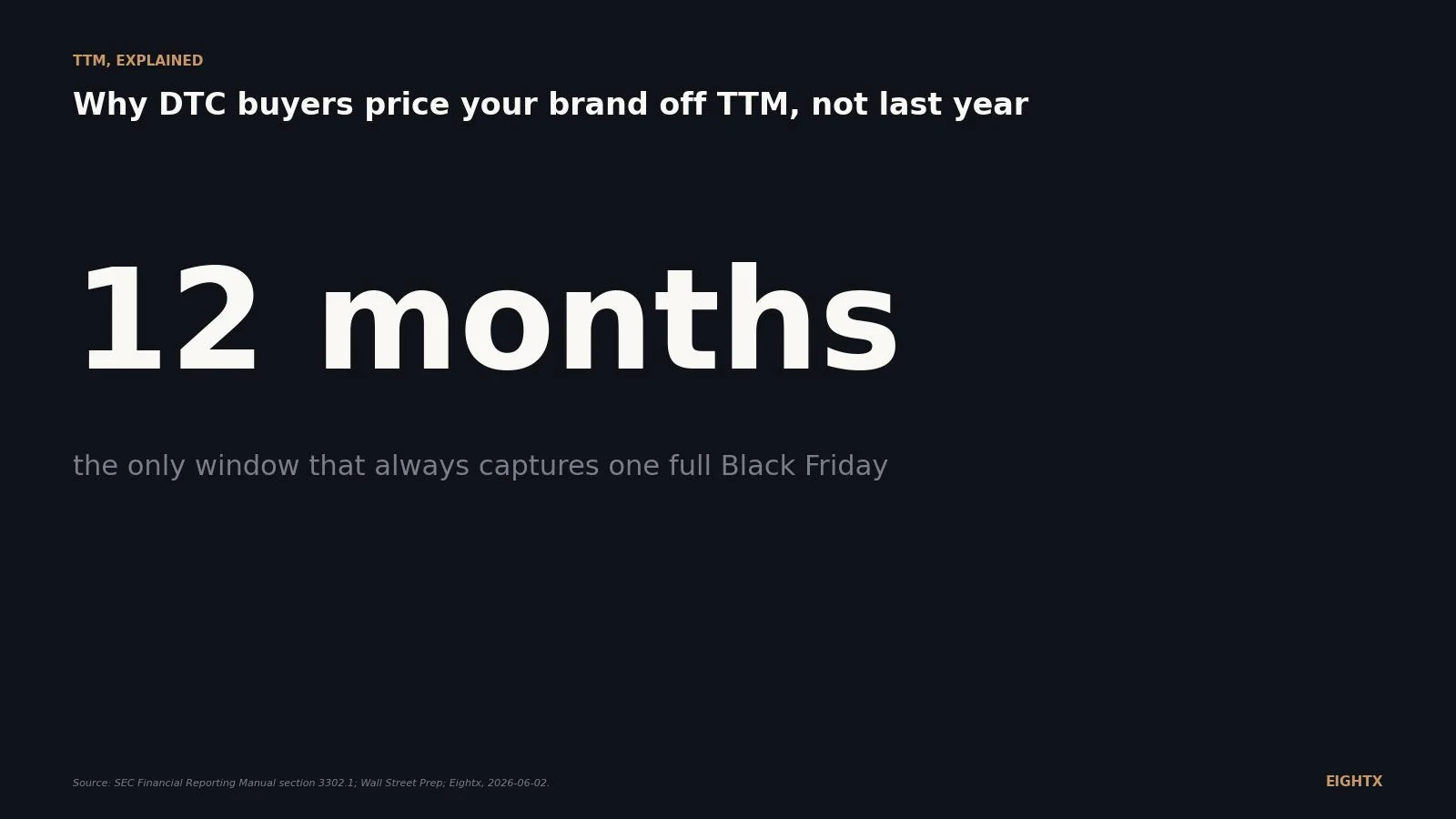
TTM (trailing twelve months) is the rolling 12-month window of revenue, EBITDA, or SDE (seller's discretionary earnings) that buyers and intermediaries use to price your DTC brand. It is the same thing as LTM (last twelve months). Investment banks tend to say LTM, brokers and aggregators tend to say TTM. The window rolls forward each month: the most recent month rolls in, the oldest month rolls out. A buyer opening an LOI in June 2026 is not pricing off your 2025 calendar-year results. They are pricing off whatever the last 12 months look like the day they sign. Calendar year can be 11 months stale by close. TTM cannot.
Apparel, beauty, gifting, and home DTC brands typically concentrate a heavy share of annual revenue into Q4. Across the Eightx operator-call library between 2024 and 2026 that share consistently lands somewhere between 30 and 50 percent of full-year revenue. Any non-12-month read distorts the brand. A calendar-year read can be 11 months stale by close. A partial-year read misses Black Friday. TTM solves it by always containing exactly one Black Friday, one Cyber Monday, and one post-holiday quitter cycle (the January-February wave of subscription cancels and product returns that follows the gift-buying spike). The SEC does not codify TTM as a generally accepted accounting principles (GAAP) metric. It is a presentation and valuation construct. The closest the SEC comes to formally blessing rolling-12 thinking is language in the SEC Financial Reporting Manual permitting a pro-forma 12-month presentation when the most recent fiscal year is unrepresentative of normal operations. We have paraphrased the FRM here rather than citing a specific section verbatim; operators preparing SEC filings should verify the exact section against the SEC.gov PDF.
How it works
Two formulas, same answer when the periods line up. Method A: sum the last four quarters (Q_current + Q_-1 + Q_-2 + Q_-3). Pull the last four closed quarters from your Shopify reports or QBO P&L and add them. Method A dominates BizBuySell, IBBA, and Axial deals because the inputs are management accounts. Method B: rolling LTM subtraction (Latest Full Fiscal Year + Current YTD - Prior-Year YTD). Method B is standard in public-comp and 10-Q work because the inputs are public quarterly filings. Worked example, same DTC brand, both methods. Method A inputs: Q1 2026 $2.4M + Q4 2025 $5.1M + Q3 2025 $2.5M + Q2 2025 $2.3M = $12.3M TTM revenue. Method B inputs: FY2025 $12.0M + current YTD (Q1 2026) $2.4M - prior-year YTD (Q1 2025) $2.1M = $12.3M TTM revenue. Same window ending 2026-Q1. Same answer. When TTM breaks down. TTM is a poor read in three cases: (1) the business is under 12 months old so there is no full trailing window to roll, (2) a category shift happened inside the window (wholesale-to-DTC pivot, channel relaunch, brand repositioning) and the older months no longer describe the business the buyer is acquiring, (3) the trailing 12 months contain a one-off revenue event (viral TikTok, Costco test order, PR spike that did not repeat) that inflates the window past sustainable run-rate. In each, the buyer will still anchor on TTM but discount it or rebuild a normalized 12-month view alongside it. For sub-$10M DTC deals the multiple gets applied to TTM SDE, not TTM EBITDA. Accepted add-backs are bounded: above-market owner comp, one-time launch or rebrand costs, sale-related professional fees, personal expenses run through the business, and sometimes unsustainable marketing spikes. Hypothetical future savings, structural OPEX, and foregone owner comp do not clear. Strategic buyers may credit shared cost savings tied to the buyer's existing operations; financial sponsors generally do not.
Common triggers
- You are 6 to 18 months from selling and need a number to put on the cover of the CIM.
- A banker or broker has asked for LTM EBITDA or LTM SDE and you are not sure if that is the same as TTM (it is).
- Your fiscal year ended several months ago and the calendar-year read no longer matches what the business looks like today.
- A buyer is trying to reframe your DTC deal off NTM (next twelve months) revenue and you need to defend the TTM window.
- You are trying to time a listing and want to know which quarter to close the data room around to maximize TTM revenue and TTM EBITDA.
The most common mistake
Treating TTM as a calendar-year proxy and refreshing it once a quarter instead of monthly. The window rolls every single month (the most recent month rolls in, the 13th-prior month rolls out) and a buyer will price off whatever the last 12 months look like the day they sign the LOI, not the day you last updated the workbook. Sellers who refresh quarterly carry a stale TTM number in their data room for roughly half the month after each quarter close, and the gap between the stale number and the live number is exactly the opening a buyer uses to retrade in diligence. The fix is a recurring monthly task: pull the last 12 closed months from QBO, rebuild the TTM EBITDA-to-TTM SDE bridge with every add-back documented (GL reference, dollar amount, one-line rationale), and date-stamp the snapshot. By the time a buyer opens an LOI conversation the number in the room is the number a buyer can defend.
Browse the full ecommerce finance glossary for every metric and money term a DTC operator needs.
Frequently Asked Questions
is ttm the same as ltm?
Yes. LTM (last twelve months) and TTM are the same thing. Investment banks tend to say LTM, brokers and aggregators tend to say TTM, aggregators say either. If a banker asks for LTM EBITDA and a broker asks for TTM EBITDA in the same week, they want the same number.
how do i calculate ttm revenue for my shopify brand?
Easiest way is Method A. Add up the last four closed quarters of revenue from your Shopify reports or your QBO P&L. If you are mid-quarter, use the last 12 closed months. Method B (Latest Full Fiscal Year + Current YTD - Prior-Year YTD) lands the same answer through a different door, but Method A is what almost every DTC seller actually uses.
how do buyers normalize my q4 holiday spike when they look at ttm?
Three ways, usually together. They compare Q4 this year to Q4 last year to see if the spike is growth or steady-state. They weight the most recent 6 months more heavily if growth has been accelerating. And they haircut Q4 revenue if the contribution margin was destroyed by deep discounting. You will hear the phrase seasonally adjusted LTM or normalized TTM in diligence.
whats the difference between ttm and run rate?
TTM is the last 12 months of actuals. Run rate annualizes a shorter window, usually the last 3 months times 4. Sellers love run rate when growth is steep because it makes the number bigger. Buyers discount run-rate-based multiples relative to TTM multiples because the proof window is shorter. Across the Eightx operator-call library 2024 to 2026 that discount has typically landed somewhere in the half-turn to full-turn of EBITDA range, though it is a deal-book pattern, not a published benchmark.
what add-backs are buyers actually going to accept on my ttm ebitda?
Bounded list. Above-market owner comp (replace with market manager comp and document the rate). One-time launch or rebrand costs (must be invoiced and dated). Sale-related legal and advisory fees. Personal expenses run through the business (itemize them). And sometimes unsustainable marketing spikes if the buyer agrees the spend was discretionary. Hypothetical future savings, structural OPEX, and foregone owner comp do not clear. Strategic buyers may credit shared cost savings tied to their existing operations; financial buyers generally do not.