
Insights
Amazon vs DTC margin gap: 10 public 10-Ks disclose the channel split but none disclose the margin
None of 10 public DTC brands break out Amazon channel gross margin in their FY2025 10-Ks; only ELF names Amazon, at 11% of net sales. Gross margin is roughly equal across channels if booked cleanly. The real gap is contribution margin: a well-run Amazon FBA SKU lands at 15 to 25% versus 20 to 40% on owned DTC.
Key Takeaways
- Zero of 10 public DTC and consumer brands disclose Amazon channel gross profit margin separately in their FY2025 10-Ks. The structural disclosure (where Amazon shows up in the P&L) is the data point, not the number itself.
- ELF puts Amazon in wholesale at 11% of FY26 net sales (down from 12% in FY25). YETI, Olaplex, and Crocs bury Amazon inside their DTC channel. FIGS, Revolve, and Hims do not sell on Amazon at all.
- The disclosed gross-margin spread across 8 reporting units runs 71.6% (ELF) to 44.8% (HEYDUDE). HEYDUDE inside the same accounting policy as Crocs Brand at 61.3% shows how brand-strength collapse blows out gross margin independent of channel mix.
- The Amazon tax for most brands runs 40-60% of topline (referral 15% + FBA 15-25% + ads 10-25%). Operator-estimated Amazon channel contribution profit: 15-25%. Owned DTC website contribution margin on the same brand: 20-40%.
- Fix your chart of accounts before you fix your channel strategy. If you book Amazon referral, FBA, and PPC into COGS, your gross margin looks the same across channels and you cannot see the leak. Move marketplace fees into variable selling costs, then compare.
You will not find Amazon channel gross margin in any public DTC company's 10-K. We checked. Ten of them. The structural disclosures are useful (where Amazon shows up in the P&L, what percent of sales it represents at a given brand, whether it sits in wholesale or DTC) but the number every operator actually wants, the gross margin split between Amazon and owned-website sales, is not on a single page in EDGAR.
This post walks through what the 10-Ks do say, where Amazon shows up in each brand's reporting, and how a private operator should triangulate to their own Amazon channel margin from public-company comps plus the Amazon fee schedule.
Why no public brand discloses Amazon channel gross margin
The disclosure rules do not require it. U.S. GAAP segment reporting requires brands to break out reportable segments (typically by product line or geography), not by retail channel within a segment. A brand can voluntarily disclose channel margin, but doing so hands Amazon a negotiation weapon. If Olaplex publishes that its Amazon channel runs at 55% gross margin while its Olaplex.com channel runs at 75%, Amazon's vendor manager opens the next category review with that number on the table.
So the silence is rational. What you can read instead is the disclosure shape: how each brand classifies Amazon, how it discusses channel-mix shifts in MD&A, and what offsetting commentary it provides on SG&A or cost-of-sales when Amazon-driven revenue grows. That tells you which P&L line absorbs the marketplace-fee drag, and you can back into a range for the channel margin from there.
The other thing the 10-Ks tell you, which is harder to get from any other public source, is the size of the Amazon line. ELF discloses Amazon at 11% of FY26 net sales (down a tick from 12% in FY25, customer-mix noise rather than a retreat). Crocs discloses DTC including third-party marketplaces at 52.1% of revenue. Olaplex discloses DTC including Amazon at $139.3M of $423M total. Those numbers anchor the operator math in the back half of this post.
The three places Amazon shows up in a public DTC P&L
Amazon lands in one of three buckets across the 10 brands we reviewed.
Bucket 1: named wholesale customer. ELF discloses Amazon at 11% of FY26 net sales, sitting alongside Target (18%), Walmart (13%), and Sephora (10%) in the Concentrations of Credit Risk footnote. This means ELF sells to Amazon at a wholesale ASP, ships in pallet quantities, and Amazon handles the listing and the end-customer relationship. The marketplace fee is absorbed into the wholesale discount, not a separate line. The benefit: cleaner accounting and lower customer-acquisition cost on Amazon side. The cost: lower revenue per unit and zero direct customer relationship.
Bucket 2: Amazon inside DTC. YETI, Olaplex, and Crocs all classify Amazon Marketplace inside their DTC channel. YETI's 10-K explicitly names Amazon Marketplace as one of three drivers of its 4% DTC channel growth in 2025 (alongside corporate sales and YETI retail stores). The cost: SG&A rose 130 bps as a percent of sales partly due to "higher online marketplace fees associated with higher Amazon Marketplace net sales." Olaplex describes DTC as "comprised of Olaplex.com and sales through third-party e-commerce platforms, including Amazon." Crocs flags DTC SG&A expansion of 310 bps tied to channel investment. All three put marketplace fees in SG&A, not cost-of-sales.
Bucket 3: not a channel at all. FIGS, Revolve, and Hims are pure-play owned-DTC. They do not sell on Amazon, and the 10-K does not mention Amazon as a channel (Hims mentions Amazon only as the AWS infrastructure provider). These three are the anti-Amazon comp set. Their consolidated gross margins (FIGS 67.7%, Revolve 52.4%) reflect what owned-DTC looks like with no marketplace fee drag in either gross margin or SG&A.
Brand Ticker Amazon classification in 10-K Amazon disclosure level Consolidated GM e.l.f. Beauty ELF Wholesale customer 11% of FY26 net sales 71.6% Olaplex OLPX DTC (third-party e-commerce) Inside DTC channel ($139.3M) 69.4% YETI YETI DTC (Amazon Marketplace) Inside DTC channel ($1.13B) 57.4% Crocs CROX DTC (third-party marketplaces) Inside DTC channel (52.1%) 58.3% FIGS FIGS Not a channel Pure-play owned DTC 67.7% Revolve RVLV Not a channel Owned websites only 52.4% Hims & Hers HIMS Not a channel (AWS only) Pure-play telehealth subscription n/a Kenvue KVUE Not separately disclosed Embedded in e-commerce / retail n/a Coty COTY Not separately disclosed Embedded in e-commerce n/a Solo Brands DTC DTC / wholesale (mixed) Embedded in DTC channel n/a
What the disclosed gross margins do and do not tell you
Ranking the eight reporting units by consolidated gross margin gets you a 27-point spread.
Read this carefully. The spread is not Amazon doing the work. ELF at 71.6% is a beauty brand with COGS leverage from China sourcing and a high-volume distribution model. Revolve at 52.4% is fashion with markdown and inventory risk baked into cost-of-sales. The Amazon-versus-owned signal in this chart is buried.
The cleanest read is at the bottom. HEYDUDE Brand sits at 44.8% gross margin (down 290 bps year-over-year) while Crocs Brand sits at 61.3% (down only 30 bps). Same parent, same accounting policy, same disclosure conventions, very different brand health. HEYDUDE has been in a publicly disclosed brand reset since 2024 (the channel mix actually differs too: HEYDUDE skews more wholesale-heavy than Crocs Brand, which carries a stronger DTC mix). The 290-bps GM melt is brand strength, not marketplace fees. Channel classification does not save you if the brand is not working.
YETI's 57.4% is the most useful single number for an operator triangulating Amazon channel margin. One caveat before reading too much into the 70-bps YoY decline: YETI's own MD&A attributes roughly 230 bps of gross-margin drag in 2025 to tariffs, partially offset by lower inbound freight and product-cost favorability. Most of the YoY GM erosion is a tariff story, not a marketplace-fee story. The marketplace-fee drag shows up below the line in SG&A, which is where the Amazon channel signal actually lives. YETI explicitly states two things in its MD&A: DTC gross margin runs higher than wholesale gross margin (differentiated pricing), and DTC variable SG&A runs higher than wholesale SG&A (marketplace fees, 3PL, credit card processing). The gross margin uplift on DTC gets partially clawed back below the line. That is the structural pattern every Amazon-on-DTC brand exhibits.
The other thing the public disclosures tell you: DTC share keeps climbing. YETI 58% to 60% over three years. Crocs 48.0% to 52.1%. Olaplex 31% (2023) to 32% (2024) to 33% (2025). As DTC grows, an increasing share of "DTC" is actually Amazon-sourced. The marketplace-fee drag in SG&A grows with it. YETI flagged 70 bps of SG&A expansion in 2025 partly attributable to higher Amazon Marketplace net sales. That is the cost of the channel-mix shift surfacing in real numbers.
What private operators should infer about their own Amazon margin
No 10-K is going to give you this number, so here is the operator math, triangulated from the fee schedule, industry research, and what we see on founder calls every week.
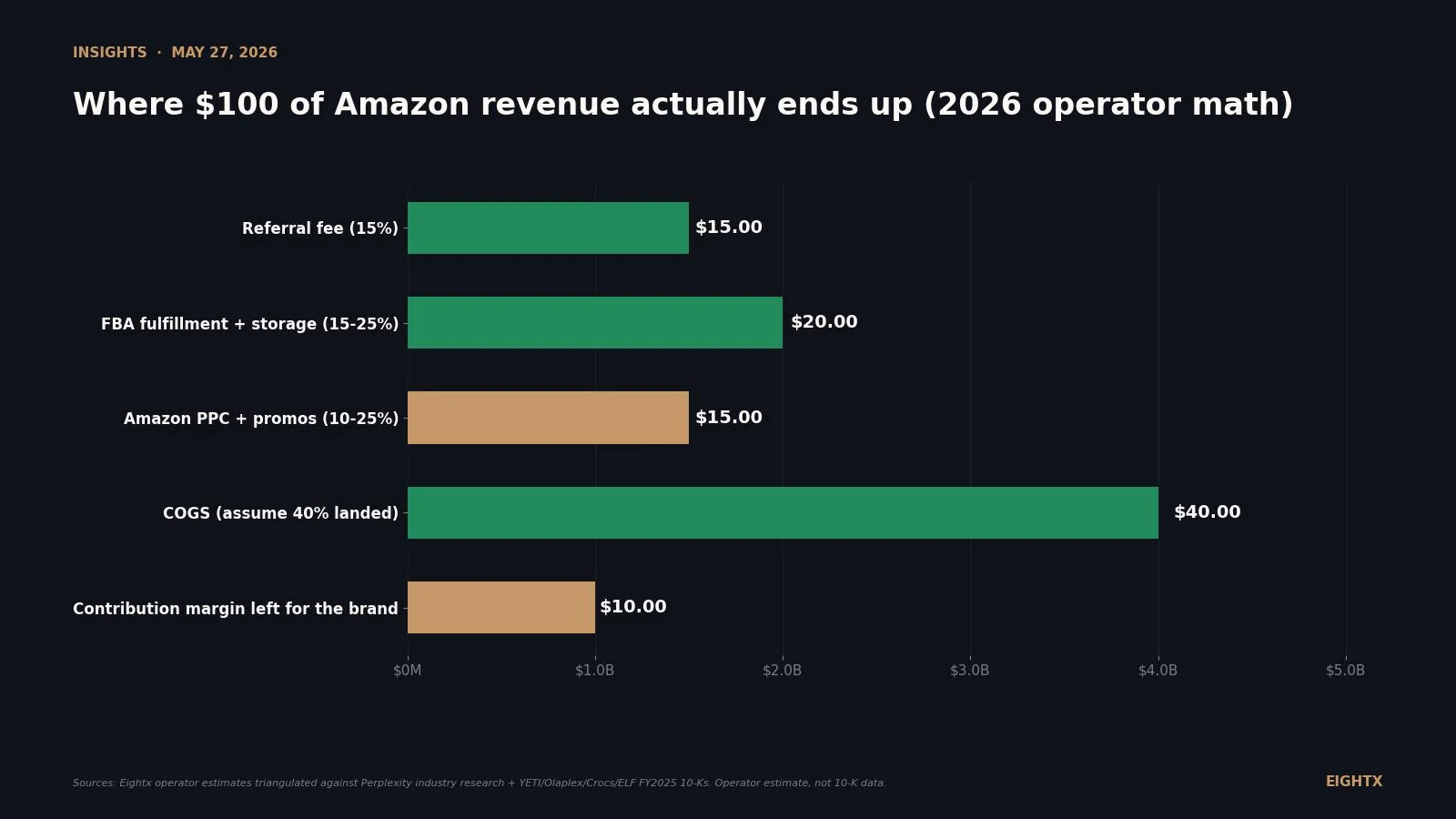
Sidebar: what your Amazon margin should look like (operator estimate, not 10-K data). Stack the fees against a $100 sale. Referral fee: $15. FBA fulfillment plus storage: $15 to $25 depending on packaging and turn velocity. Amazon PPC: $10 to $25 depending on category competitiveness and whether you are defending rank or trying to gain it. Total Amazon tax: 40-60% of topline. Subtract COGS at 35-45% of sales (which is where most operators land). That leaves 15-25% contribution margin in a well-run Amazon channel. The same brand selling on its Shopify store with healthy email and organic mix usually runs 20-40% contribution margin on the same SKU. The gap is 10-25 points and it sits below gross profit, not at the gross margin line.
The industry research and our own client data converge on the same range. Operators in our network and in public Seller Central forums describe a similar shape: roughly 40-50% of revenue going to Amazon-related selling costs once you stack referral, FBA, ads, and the surcharge creep that has been compounding since 2024. Amazon held headline referral and FBA fee rates flat for two years in a row, but the storage utilization surcharge expanded in 2024, FBA fulfillment fees rose by $0.08 per unit on standard-size $10-$50 items starting January 15, 2026, and a 3.5% fuel and logistics surcharge applied to all U.S. FBA fulfillment fees starting April 17, 2026. The margin compression is happening in the variable surcharges, not the headline rates.
The fix that matters more than any of this: pull marketplace fees out of COGS in your own books. Most operators we work with classify Amazon referral, FBA, and PPC inside cost-of-sales. That obscures the channel comparison from themselves. Your gross margin looks similar across Amazon and Shopify (because the selling price and product cost are the same) and you cannot see the contribution leak. Move referral and FBA into variable selling costs (where YETI, Olaplex, and Crocs put them), keep PPC in marketing, and your contribution margin per channel finally shows the truth.
Concretely, in QuickBooks or Xero, this means: create a new "Variable Selling Costs" section in the chart of accounts that sits below Gross Profit and above operating SG&A. Reclassify Amazon Referral Fees, FBA Fulfillment Fees, FBA Storage Fees, and FBA Long-Term Storage out of COGS and into that new section, each as its own GL account. Tag every Amazon transaction with a "Channel: Amazon" class or tracking category (Xero) or class (QuickBooks) and code the matching Shopify, wholesale, and retail revenue the same way. Code by SKU consistently so you can roll up channel P&Ls in one click. Then re-run the trailing 12 months. The first time you see channel-level gross margin and contribution margin side-by-side in your own books, the leak is obvious.
Fix the chart of accounts before you fix the channel strategy. That is the order of operations.
What to ask your finance team this quarter
Three diagnostic questions tied directly to how each public brand classifies Amazon.
Where does the referral fee hit, COGS or SG&A? If it hits COGS, your channel gross margin comparison is structurally broken. Reclassify to variable selling costs, restate the prior 12 months, and re-run the channel P&L. Olaplex, YETI, and Crocs all put marketplace fees in SG&A. If you are not doing the same, you are the only one in the room without the right number.
Where does Amazon PPC hit, and is it fully loaded? Amazon Sponsored Products, Sponsored Brands, coupons, deals, and Subscribe and Save discounts all hit your Amazon contribution margin. If you book Sponsored Products in your marketing budget but coupons and S&S discounts as price concessions inside net revenue, you are double-counting the discipline. Pick a treatment, document it, and apply it consistently.
What is the all-in payback on an Amazon SKU vs a website-only SKU? Payback period is the cleanest channel comparison most brands can run. If your Amazon SKU pays back in 1.4 orders and your owned-DTC SKU pays back in 2.8 orders, Amazon is the cash-flow channel and you should fund it accordingly. If they are within 0.3 orders of each other, the LTV math (which favors owned DTC because you keep the customer relationship) usually tilts the call back to website.
One last thing worth a single sentence: Amazon-heavy brands trade at a valuation multiple discount to DTC-heavy brands. Buy-side data published by Centurica / CTA Acquisitions for 2026 shows DTC at $5M+ EBITDA trading at 4.0-8.0x EBITDA while Amazon-heavy FBA brands typically clear 2.0-4.0x SDE (ctacquisitions.com). The spread reflects platform dependency and the limited customer file. Worth knowing if you are running the business for an eventual exit.
For more on the contribution-margin discipline that drives this analysis, see our interim CFO services overview and our breakdown of how to calculate contribution margin in ecommerce for the underlying definitions.
Sources and methodology
SEC EDGAR 10-K filings reviewed. e.l.f. Beauty (ELF) 10-K filed 2026-05-21 for fiscal year ended March 31, 2026; YETI Holdings (YETI) 10-K filed 2026-02-27 for fiscal year ended January 3, 2026; Olaplex (OLPX) 10-K filed 2026-03-05 for fiscal year ended December 31, 2025; Crocs (CROX) 10-K filed 2026-02-12 for fiscal year ended December 31, 2025; FIGS (FIGS) 10-K filed 2026-02-26; Revolve Group (RVLV) 10-K filed 2026-02-25; Hims & Hers Health (HIMS) 10-K filed 2026-02-23. Kenvue, Coty, and Solo Brands were reviewed for Amazon disclosure but excluded from the detailed margin table because none discloses Amazon at the channel-margin level.
Financial metrics pulled via SEC XBRL. Gross profit and revenue values came from the GrossProfit and Revenues / RevenuesFromContractWithCustomerExcludingAssessedTax tags for each ticker. Gross margin computed as GrossProfit divided by Net Sales using the values reported in each 10-K's MD&A table, not adjusted for non-recurring items beyond what each company disclosed.
Amazon fee schedule. Referral, FBA, storage, surcharge, and 2026 fee-change data pulled from Amazon Selling Partners primary publications (the 2026 fee update page and the FBA fulfillment fee help reference). The 3.5% fuel and logistics surcharge effective April 17, 2026 is from Amazon's own announcement. Operator-estimated channel contribution margin ranges (15-25% Amazon vs 20-40% owned DTC) come from Perplexity industry research synthesizing 2025-26 published practitioner data, cross-referenced against the founder-call corpus from our own client base.
Limitations. Zero public consumer brands in the comp set disclose Amazon channel gross margin numerically; the data finding is the absence of disclosure plus the structural classification choices. ELF reports on a March fiscal year; the others are calendar-year. Gross margin comparisons are FY-aligned, not strictly synchronous. Olaplex DTC includes Amazon, Olaplex.com, and other beauty / wellness e-commerce partners; the Amazon-only portion is not separable from the disclosure. Crocs DTC includes company-operated retail stores in addition to e-commerce, so the channel mix percentages overstate the digital-only share. The "what your Amazon margin should look like" sidebar is an operator estimate built from triangulated industry data, not a 10-K number.
Update cadence. Refreshed annually after Q4 10-K filings land (February-May each year), with mid-year update if Amazon publishes a material fee change. Next update target: May 2027.
Frequently asked questions
does any public dtc brand actually disclose amazon channel gross margin separately?
No. We reviewed 10 public DTC and consumer brand 10-Ks for fiscal 2025 (ELF, YETI, Olaplex, Crocs, FIGS, Revolve, Hims, Kenvue, Coty, Solo Brands) and zero of them break out Amazon channel gross margin as a separate line. The closest disclosure is ELF naming Amazon as 11% of net sales in its customer-concentration footnote. The silence is structural: 10-K rules do not require it, and the brands have a competitive reason not to publish it because Amazon would use the number in negotiations.
where does amazon show up in a public dtc 10-k, is it wholesale or dtc?
Depends on the brand. ELF classifies Amazon as a wholesale customer (alongside Target and Walmart). YETI, Olaplex, and Crocs classify Amazon Marketplace inside their DTC channel. FIGS, Revolve, and Hims do not sell on Amazon at all. The classification choice determines where the marketplace fee hits: wholesale brands take a lower ASP into cost-of-sales, marketplace-classified brands take the referral and FBA fee into SG&A.
why does yeti put amazon marketplace inside its dtc channel?
Because YETI controls the relationship with the end customer (price, listing, returns, brand) rather than selling at a wholesale ASP into Amazon's inventory. The 10-K spells this out and flags higher online marketplace fees as the SG&A cost of that DTC-share growth. Putting Amazon inside DTC also lets YETI report a larger DTC growth number, which the market rewards with a higher multiple.
what is the real gross margin difference between selling on amazon and selling on shopify?
Gross margin is roughly the same across channels if you book it cleanly. Contribution margin is what differs. A well-run Amazon FBA SKU lands at 15-25% contribution margin in 2026 once you stack referral, FBA, and PPC. The same product on a Shopify store with healthy email and organic mix runs 20-40%. The gap is 10-25 points, and it shows up below gross profit in the P&L, not at the gross margin line.
if elf is 11% amazon and grossing 71.6%, what is amazon's gross margin probably doing to the consolidated number?
Slightly dilutive but not by much. ELF books Amazon as a wholesale customer, which means it takes a lower wholesale ASP into revenue. The cost-of-sales hit lands in gross margin, not SG&A. Our read: ELF consolidated GM would probably be 50-150 bps higher without the Amazon line, and the trade-off is volume and shelf presence. The 12% to 11% drop year-over-year is small enough to be customer mix noise, not a strategic retreat.
what should i benchmark my own amazon channel margin against if no one discloses it?
Use the operator math, not the 10-K math. Assume your Amazon channel contribution margin should land 10-15 points below your owned-DTC contribution margin after referral, FBA, and PPC. If the gap is larger than 15 points, you are overspending on ads, underpricing, or both. If the gap is under 8 points, your owned DTC is leaking somewhere (probably paid media). Track it separately in your own books before you optimize either channel.
do brands hide amazon's contribution margin drag in sg&a instead of cost-of-sales?
Yes, and it is the right accounting under U.S. GAAP for marketplace sales. YETI, Olaplex, and Crocs all do this. The 10-K MD&A flags the SG&A drag (YETI cites higher online marketplace fees explicitly) but the reader has to know to look for it. Operators reading peer 10-Ks should normalize: pull marketplace fees and PPC out of SG&A in your peer model before comparing gross margin to gross margin.
should i be selling on amazon if my consolidated margin is below 60% already?
Depends on whether your product is consumable. If you sell a high-repeat consumable (supplements, beauty refills, pet food) you almost have to be on Amazon because customers will re-buy where it is fastest. If you sell a considered-purchase or premium item where the brand experience matters, you can hold the line on owned DTC. A 55% consolidated gross margin business can support a healthy Amazon channel if FBA is dialed in and PPC sits at single digits as a percent of sales. Below 50% consolidated, it gets tight fast.