
M&A
Apparel Brand Exit Multiples and Acquirers 2026
Most apparel and footwear brands sell for 1.0x to 1.8x revenue or 8x to 11x EBITDA in 2026. Mass and distressed DTC clear under 1x revenue, while high-growth, high-DTC performance brands push 2x to 3x revenue and low-teens EBITDA. Gildan bought HanesBrands at 8.9x EBITDA.
Key Takeaways
- Mainstream apparel and footwear brands transact around 8x to 11x EV/EBITDA and 1.0x to 1.8x EV/revenue in 2026, per banker fairness-opinion ranges in SEC proxies and live public comps.
- Gildan agreed to buy HanesBrands at about $4.4B enterprise value, an 8.9x LTM adjusted EBITDA multiple, or 6.3x after $200M of planned synergies.
- Brand heat clears a premium and decays: VF bought Supreme at ~4.2x revenue in 2020 but sold it for about 2.3x in 2024 once the heat cooled.
- Mass and distressed DTC apparel sells cheap. Walmart sold Bonobos for about $75M, roughly 0.4x revenue, the textbook DTC down-round.
- Operating margin runs from 23% (Deckers) to under 1% (Capri) in one vertical, so DTC mix and margin quality, not the category label, set your multiple.
Every apparel founder I talk to at $5M to $50M has seen the headlines. VF paid two billion for Supreme. Gildan is buying HanesBrands for billions. Then they look at their own brand and ask the only question that matters: what would someone actually pay for this, and what makes that number go up?
Here is the honest answer. Apparel and footwear are structurally lower-multiple than beauty, because the gross margins are thinner and the inventory is heavier. When I talk to founders who have run both, the line I hear is blunt: in beauty you can pull off 80 to 85 gross margin, but in apparel, by the time you have done wholesale, you are at 50 at best. That margin gap is why the category sits lower. But the spread inside the category is enormous. Brand heat, DTC mix and growth can move a brand from a 0.4x revenue fire sale to a 3x revenue premium. Below is who is buying, what they are paying with real sourced deals, the live public comps that prove the spread, and the specific levers that separate the floor from the premium.
Who is actually buying apparel and footwear brands
The 2025 and 2026 buyer pool splits into three camps, and which one buys you sets your multiple.
Strategics write the biggest checks. Gildan buying HanesBrands, VF rolling brands in and out of its portfolio, Capri buying Versace. They buy for portfolio gaps and for cost savings a financial buyer cannot underwrite. Gildan, for example, justified its HanesBrands price partly on $200M of planned cost reductions. Strategics set the headline multiples.
Private equity underwrites to EBITDA and cash flow. That usually means a lower revenue multiple than a strategic will pay for the same brand, because PE is modeling your free cash flow, not buying distribution overlap. In a soft fashion market, PE is the disciplined buyer that anchors the floor.
Brand aggregators and licensing platforms like Authentic Brands Group and WHP Global are the third camp, and they are uniquely important in apparel. They buy the brand IP, often out of distress, and license it back to operators and manufacturers. Authentic Brands bought Reebok from Adidas; WHP Global and Express bought Bonobos from Walmart. Aggregators are why a tired mass brand still has a floor value: someone will always pay for the trademark even when the operating business is broken.
When founders ask me what a buyer is actually looking at, the answer is almost always the same. Right now they are looking at EBITDA or seller's discretionary earnings, which just means profit. You do not get a revenue-based valuation unless you are raising venture capital. Revenue velocity matters, but it shows up as a multiple on profit, not as the headline number itself.
What multiples apparel and footwear brands command
For scaled, profitable brands, banker fairness opinions filed with the SEC point to a consistent picture in 2026: roughly 8x to 11x EV/EBITDA and 1.0x to 1.8x EV/revenue for mainstream apparel and footwear. Challenged or turnaround brands clear 5x to 7x EBITDA, often under 1x sales. Only high-growth, high-DTC performance brands push into the low-teens EBITDA and 2x to 3x revenue.
That band lines up with what I tell founders weighing whether to scale before they sell. If you can get to $25M a year at a 20% EBITDA margin, that is $5M of profit, and in this industry you would likely exit for 8 to 10x EBITDA. To pull that off you want roughly 20% EBITDA with 40% year-on-year growth. Hit both and you are squarely in the band. Miss the growth and you drift toward the floor.
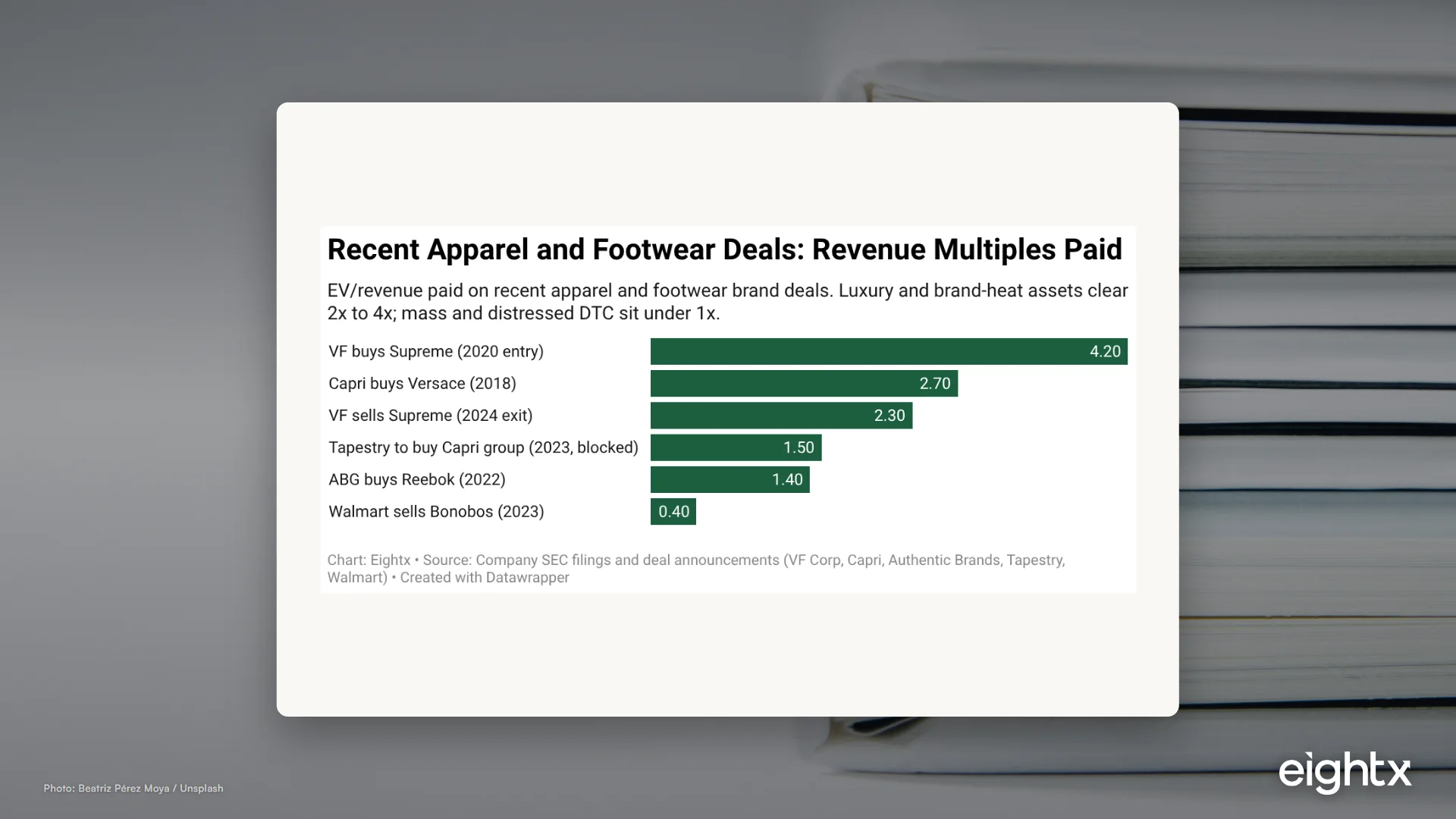
The recent deal record shows the revenue-multiple spread clearly.
The deals that tell the story:
- Gildan / HanesBrands (2025): about $4.4B enterprise value at an implied 8.9x LTM adjusted EBITDA, or 6.3x including $200M of expected cost savings, per Gildan's announcement filing. That is the disclosed adjusted-LTM basis; on a reported pre-synergy basis a third-party deal monitor backs into closer to 7x EBITDA, so treat 8.9x as the headline and expect reported math to read lower. Either way it is the textbook scaled, wholesale-led basics multiple: sub-10x EBITDA on a low-growth utility apparel platform where the value is cost savings, not momentum.
- VF / Supreme (2020 in, 2024 out): VF paid roughly 4.2x revenue to buy Supreme in 2020 at the peak of streetwear heat, then sold it in 2024 for $1.486B in net proceeds, an implied ~2.3x revenue on roughly $650M of trailing sales. Same brand, roughly half the multiple, four years apart. Brand heat is a real and perishable input.
- Authentic Brands / Reebok (2022): about 1.4x revenue on roughly $1.7B of run-rate sales. A scaled athletic brand bought by an aggregator to license, not to operate.
- Walmart / Bonobos (2023): sold for $75M total ($50M for the brand to WHP Global, $25M for operations to Express) on roughly $200M of revenue, an implied ~0.4x revenue. The textbook DTC down-round: a sub-scale, loss-making menswear brand sold for a fraction of what strategic buyers paid for DTC at the 2015 to 2019 peak.
- Capri / Versace (2018) and Tapestry / Capri (announced 2023, blocked 2024): Versace sold at an estimated 2x to 3x revenue as a standalone luxury house; the later Tapestry bid for the whole Capri group implied about 1.5x revenue and roughly 8x to 9x forward EBITDA before antitrust regulators blocked it. Mono-brand luxury clears a higher multiple than a diversified group.
| Deal | Year | Acquirer type | Enterprise value | Implied EV/revenue | Implied EV/EBITDA |
|---|---|---|---|---|---|
| Gildan / HanesBrands | 2025 | Strategic | ~$4.4B | ~1.3x | 8.9x LTM adj (6.3x post synergies) |
| VF / Supreme (buy) | 2020 | Strategic | ~$2.1B | ~4.2x | low-to-mid teens (est) |
| VF / Supreme (sell) | 2024 | Strategic divest | ~$1.5B proceeds | ~2.3x | n/a |
| Capri / Versace | 2018 | Strategic | ~$2.12B (EUR1.83B) | ~2x-3x (est) | not disclosed |
| Tapestry / Capri (blocked) | announced 2023, blocked 2024 | Strategic | ~$8.5B | ~1.5x | ~8x-9x fwd (est) |
| Authentic Brands / Reebok | 2022 | Brand aggregator | ~$2.5B (est) | ~1.4x (est, ~$1.7B rev) | ~8x-10x (est) |
| Walmart / Bonobos (sell) | 2023 | Aggregator + strategic | ~$75M | ~0.4x | n/m (loss-making) |
The public comps prove the spread
The cleanest proof that an apparel multiple is meaningless without the detail is the live public comp set. Pull the most recent annual SEC filing for nine public apparel and footwear brands and the reported operating margins range from 23.1% at Deckers down to 0.7% at Capri. That is a more than 22-point spread inside one vertical.
Footwear is the bright spot. Deckers runs a 23.1% operating margin on 9.8% growth, and Crocs carries a 58.3% gross margin even with a thin operating line. Higher gross margin, repeat purchase and technical differentiation are exactly why performance footwear clears a premium to apparel. At the other end, Capri and Crocs show how quickly the operating line compresses when growth stalls or markdowns climb.
| Company | Revenue | Operating margin | Revenue growth YoY | Gross margin |
|---|---|---|---|---|
| Nike | $46.3B | 7.1% | -9.8% | 42.7% |
| Lululemon | $11.1B | 19.9% | 4.9% | 56.6% |
| VF Corp | $9.6B | 6.0% | 1.1% | n/d |
| Ralph Lauren | $8.1B | 14.5% | 14.6% | 69.9% |
| Levi Strauss | $6.3B | 10.8% | 4.1% | 61.7% |
| Deckers | $5.5B | 23.1% | 9.8% | 57.7% |
| Crocs | $4.0B | 3.7% | -1.5% | 58.3% |
| Columbia | $3.4B | 6.1% | 0.9% | 50.5% |
| Capri Holdings | $3.5B | 0.7% | -4.1% | 62.3% |
The same lesson shows up in trading multiples, which is where premiums prove they are perishable. Lululemon, a historic DTC premium name, now trades at roughly 1.3x revenue and about 5.4x EV/EBITDA in mid-2026 (third-party tracker estimates, which move) after soft guidance and a tariff hit to gross margin. Nike and Ralph Lauren still carry mid-to-high-teens EBITDA multiples, and most of the rest cluster near 11x. A premium multiple is a bet on growth; when growth slows, the bet gets repriced fast.
What actually drives the multiple up
A multiple is a proxy for risk and growth an acquirer can underwrite. In apparel and footwear, four levers move it.
DTC mix is the biggest single lever. The way I'd stratify it: a brand with under 30% DTC and a wholesale-led model clears low-to-mid single-digit EBITDA multiples unless the brand is exceptional. At 30% to 60% DTC you are in the 8x to 11x sweet spot. Over 60% to 70% DTC, the strongest vertical brands command low-teens EBITDA, because owned channel means higher gross margin, better customer data and pricing control.
Growth rate moves the revenue multiple. Sustained double-digit top-line growth is what gets a brand from 1x revenue to 2x or 3x. Buyers pay for next year's revenue, not last year's. The pattern we see again and again: if you are pulling off high-velocity, profitable revenue, someone's payback period is faster, and a faster payback is worth a higher multiple. A slow grower in a soft category gets the floor regardless of how clean the books are.
Brand heat is real and it decays. Supreme is the cleanest proof: 4.2x revenue at the peak, 2.3x once the cultural moment passed. Heat is unprompted awareness, low promotional dependency and pricing power. It earns a premium, but a buyer prices the risk that it fades.
Margin quality and the cash tied up in inventory determine whether the multiple holds. The public comps above show the polarization: durable, defensible margin earns the high end, and margin that depends on one channel or a discount habit earns the low end. Inventory is the quiet drag. The first thing I notice on a lot of apparel books is an inventory balance sitting near 250 days, which makes the cash conversion cycle very long. We would point most brands toward three to four months of inventory at the outside; getting there frees up real liquidity, and a buyer prices a clean working-capital position. The wholesale terms behind that working capital are their own discipline, covered in apparel wholesale net terms and cash.
A multiple is not a number you negotiate at the closing table. It is the price of the risk you removed in the 18 months before. DTC mix, durable margin, controlled inventory and books that tie out are the four things that move a brand from the 0.4x floor to the 3x premium, and every one of them is built, not pitched.
What to do about it
If you are building toward an exit or a raise, here is the work, in order.
- Lift gross margin and prove it is durable. In apparel that means moving from trading-company sourcing toward direct factory relationships and getting markdowns under control. It is the single highest-impact move at your revenue band and it takes 12 to 18 months.
- Push DTC mix up, but only profitable DTC. Buyers reward DTC because of margin and data, not vanity revenue. Show contribution margin after CAC by channel so a buyer can see the DTC is actually profitable, not bought.
- Get inventory days under control. Apparel is slow inventory and a bloated working-capital position is a cash drag a buyer discounts. Target three to four months of inventory at the outside and free up the liquidity.
- Reduce founder and single-channel dependency. A brand that only grows because the founder posts, or only sells through one retailer, is a concentration risk that caps the multiple. Build a team, a system and a diversified channel mix the acquirer can run.
- Get your books diligence-ready early. The deal-killer is not a low number, it is a surprise in the data room. Move to accrual books that reflect what actually happened in the period, and prep the standard contents: a shareholder register, tax returns, AR and AP, and the investment memo. Clean books that tie out save you real points on the multiple.
This is exactly the pre-deal work the Eightx team runs: tightening the margin story, building the DTC and inventory narrative, and making sure the number an acquirer arrives at reflects the business you actually built.
Sources and methodology
Deal figures are drawn from SEC filings and company announcements. Gildan / HanesBrands: about $4.4B enterprise value at 8.9x LTM adjusted EBITDA, 6.3x after planned cost savings, per Gildan's combination filing; a third-party deal monitor reports closer to 7x on a reported pre-synergy basis, which is why we flag the basis difference rather than presenting both as one number. VF / Supreme: $1.486B net proceeds in 2024 per VF's fiscal 2025 filing, against a ~$2.1B EV at the 2020 entry. Capri / Versace: enterprise value of about US$2.12B (EUR1.83B) per Capri's 2018 8-K exhibit.
Revenue multiples on deals are implied: enterprise value divided by the most recent disclosed or reported revenue, and they are approximations where exact enterprise value or revenue timing is not fully disclosed. The Supreme entry and exit multiples are estimated against reported and segment revenue. Authentic Brands / Reebok, Walmart / Bonobos and Tapestry / Capri figures are from deal announcements and proxies; Tapestry / Capri was announced in 2023 and blocked by regulators in 2024, and is shown as a bid, not a close.
The public comp table and operating-margin chart come from US SEC EDGAR annual report filings, pulled for the most recent annual filing of each of the nine companies (fiscal years ending Nov 2025 to Mar 2026). Margins are reported operating income divided by revenue, not adjusted. EBITDA was not available in the XBRL facts for this filer set, so EBITDA-margin figures are not asserted from SEC.
Trading multiples (EV/EBITDA, EV/revenue) referenced for Lululemon, Nike and Ralph Lauren are market-price-derived from third-party trackers as of June 2026, not from filings, and should be read as approximate. Providers disagree by date and EBITDA definition, so we present them as a band, not a point estimate.
The 2026 market ranges (8x to 11x EBITDA, 1.0x to 1.8x revenue mainstream; low-teens and 2x to 3x for high-DTC performance brands) reflect banker fairness-opinion comp ranges in recent SEC merger proxies and published segment benchmarks. Operator framing throughout reflects patterns across many founder conversations and is anonymized; no client is named.
Frequently Asked Questions
what multiple do apparel brands sell for in 2026?
Most scaled, profitable apparel and footwear brands trade around 8x to 11x EV/EBITDA and 1.0x to 1.8x EV/revenue in 2026. High-growth, high-DTC performance brands reach 2x to 3x revenue and low-teens EBITDA. Distressed or mass brands sell under 1x revenue.
who is buying apparel and footwear brands right now?
Three buyer types: strategics like Gildan and VF, private equity firms underwriting to EBITDA, and brand aggregators like Authentic Brands and WHP Global that buy the IP and license it. The aggregators set the floor on tired mass brands; strategics pay the premiums.
what is a good ebitda multiple for an apparel brand?
8x to 11x is the healthy mainstream band. Gildan bought HanesBrands at 8.9x LTM adjusted EBITDA. Challenged or turnaround brands clear 5x to 7x. Only high-growth, high-DTC performance brands push into the low-teens, and you have to prove the growth is durable.
why do footwear brands get higher multiples than apparel?
Footwear typically has higher repeat purchase, more room for technical differentiation and higher gross margin, so buyers pay a premium. Deckers runs a 23% operating margin and Crocs a 58% gross margin, which is exactly why performance footwear sits at the top of the range.
do buyers value my apparel brand on revenue or ebitda?
On profit. Right now buyers look at EBITDA or seller's discretionary earnings, not revenue, unless you are raising venture capital. Revenue velocity still matters because fast, profitable growth lifts the multiple they will pay on that profit.
why did supreme sell for half what vf paid for it?
Brand heat is real and perishable. VF paid about 4.2x revenue at the streetwear peak in 2020 and sold it for about 2.3x in 2024 once the cultural moment passed. The brand was the same; the growth a buyer could underwrite was not.
how do i prepare my apparel brand to sell for a strong multiple?
Lift gross margin and prove it holds, push DTC mix up with profitable contribution margin, get inventory days under control, reduce founder dependency, and have accrual books an acquirer can diligence. That work takes 12 to 18 months, not 12 weeks.