
Cash Flow
Wholesale Net-60 Terms and the Cash Drag: What Receivables Really Cost Apparel Brands in 2026
Selling apparel wholesale on net-60 means you fund production and ship goods, then wait roughly 72 days to collect while financing the next season. At a 12 percent cost of capital that drag runs about $23,700 a year per $1M of receivables, and far more if you borrow at 11 to 22 percent like most $5M to $50M brands do.
Key Takeaways
- Net-60 apparel receivables typically collect closer to 72 days, costing about $23,700 a year per $1M carried at a 12 percent cost of capital.
- Wholesale is the norm in apparel at scale: On Holding ran 59.3 percent wholesale in FY2024, and Birkenstock and Levi's are majority wholesale too, so the cash drag is structural, not optional.
- Factoring advances 70 to 90 percent of invoices for roughly 1 to 5 percent per 30 days; PO financing funds production earlier but costs more, often 1.5 to 6 percent per 30 days.
- US bank prime sat at 6.75 percent in May 2026, but most $5M to $50M DTC and apparel operators actually borrow at 11 to 22 percent, so headline rates understate your real carry.
- Price wholesale to cover carry: bake 2 to 5 points of receivables cost into the wholesale price or your terms, do not absorb it in margin.
You sell wholesale, so the order looks like a win: a retailer commits to a season, you book the revenue, and your factory gets paid to produce it. Then reality arrives. You fund the production, you ship the goods, and you wait. Net-30, net-60, sometimes net-90. Meanwhile the next season's fabric deposit is already due. The profit is real, but the cash is somewhere between your warehouse and a retailer's accounts payable team, and it is not coming back for months.
This is the wholesale cash drag, and it is the single most under-priced cost in apparel. Founders treat net terms as a relationship courtesy. They are actually a loan you make to your customer, interest-free, while you pay 11 to 22 percent to borrow the money to keep producing. Here is what that loan costs, what factoring and PO financing actually price at in 2026, and how to put the cost back into your wholesale price where it belongs.
Wholesale is not optional at apparel scale
First, the uncomfortable part: you usually cannot just walk away from wholesale. Across public consumer brands, wholesale share of net revenue spans the full range from near-zero to roughly 90 percent, and the apparel and footwear cluster tends to live in the middle and high end, per Eightx's wholesale revenue share benchmark. On Holding ran 59.3 percent wholesale in FY2024 (CHF 1,375.5M of CHF 2,318.3M net sales, per its 20-F), and brands like Birkenstock and Levi's are majority wholesale too. Mostly-DTC apparel players tend to be the exception, not the rule.
So for most apparel brands above a few million in revenue, wholesale is how you scale. That means the receivables drag is structural. You do not get to opt out of it. You get to price it and finance it intelligently, or you get to fund it out of your own margin by accident. When I talk to founders running a brand this size, the thing they keep saying is that wholesale felt like free growth until the second season, when production deposits and unpaid invoices landed in the same month and the bank balance went sideways. This is exactly the kind of structural cash problem a fractional CFO for apparel brands is built to catch before it strangles a season. If you want context on what "normal" margins look like before you start giving cash away, our 9-company apparel benchmark puts median operating margin in the mid-single digits. There is not a lot of room to donate working capital.
What net terms actually cost you
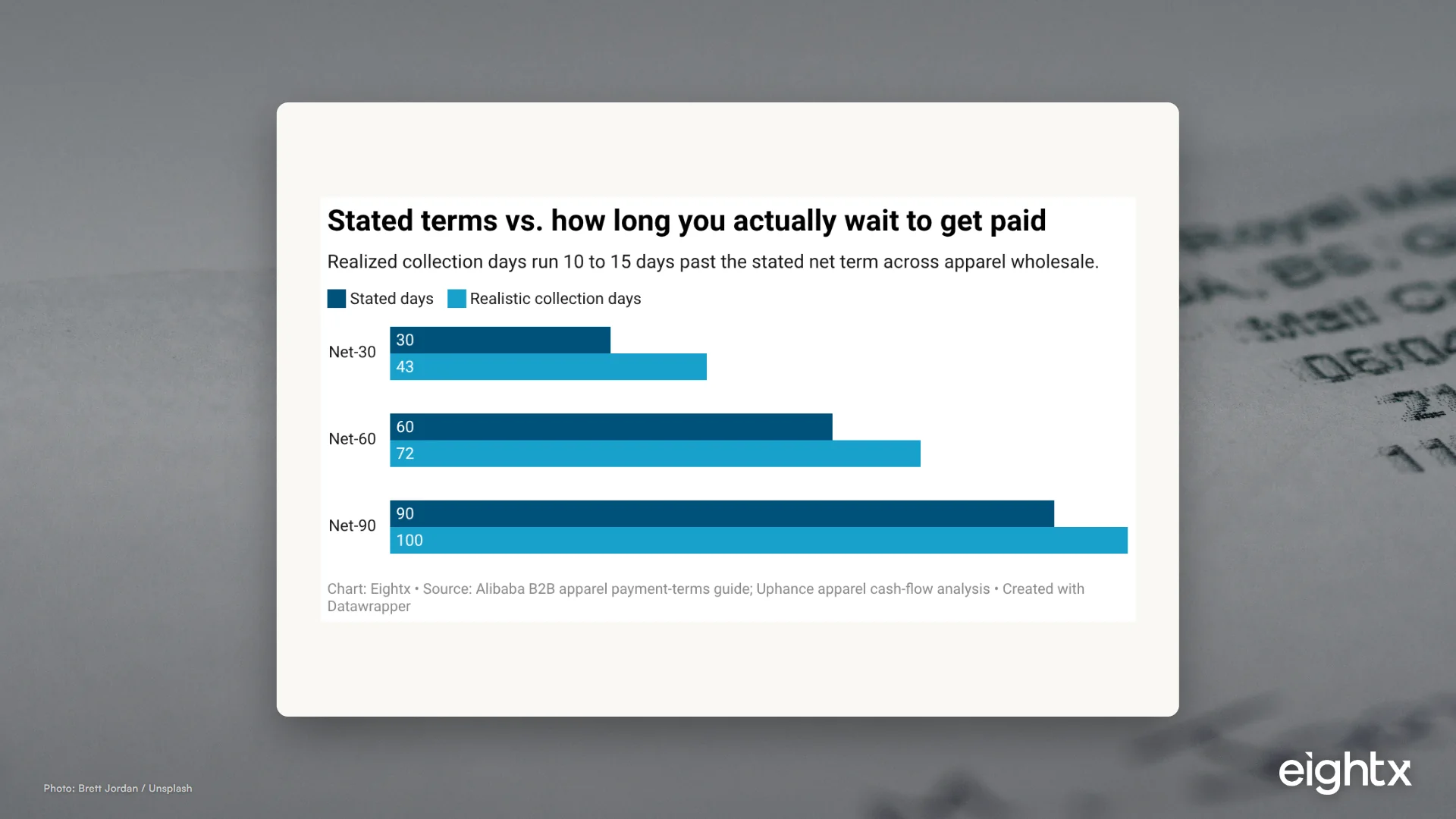
Stated terms understate the drag, because retailers pay late. Net-30 in apparel typically collects in 40 to 45 days, and net-60 stretches to about 70 to 75 days if you are not chasing it hard. When you model receivables, use actual collection days, not the number on the invoice.
The math is simple. Carry cost equals (days outstanding divided by 365) times the dollars tied up times your cost of capital. At a 12 percent cost of capital, here is what each terms tier costs per $1M of wholesale receivables.
Net-60, collected at a realistic 72 days, costs about $23,700 a year for every $1M you have out on the street. Scale that. A brand doing $10M of wholesale at net-60 is carrying roughly $2M of receivables at any moment and paying close to $47,000 a year just to wait for money it has already earned. And that is at 12 percent. Most $5M to $50M apparel and DTC operators do not borrow at prime. US bank prime sat at 6.75 percent in May 2026 (the Fed Funds rate was 3.63 percent), but real borrowing for brands this size runs 11 to 22 percent, per our working capital drag calculator. At 22 percent, that net-60 carry roughly doubles to about $43,400 a year per $1M.
This is the same disease as inventory drag, just on the other side of the balance sheet. It compounds with it. The apparel cohort runs well over a hundred inventory days; stack 72 days of receivables on top and you are financing five-plus months of cash conversion before a dollar comes home. That is the structural reason apparel sits among the most cash-hungry verticals in DTC, and it is closely related to the seasonal cash swings every apparel founder already feels in their bones.
You collect slower than Levi's does
Here is the part that stings: the same big-box buyer pays a small supplier slower than it pays a giant one. Large public apparel brands post low blended DSO because they have buyer leverage and strong-credit accounts. Levi Strauss ran a DSO of roughly 45 days in FY2025 ($774.7M of receivables on $6,282M of revenue), Crocs about 23 days in FY2024, and Deckers about 21 days for its year ended March 2026, all derived from SEC 10-K filings. A small wholesale brand selling into the same retailers waits 70 to 75 days on net-60. Note that the public-brand figures are blended numbers that include their own DTC revenue, which pulls DSO down, so treat the small-brand band as the wholesale-only reality, not an apples-to-apples comparison.
The pattern we see again and again is that the big-box buyer everyone wants on their line sheet is also the slowest payer. Operators at this stage tell us the major retailer will push net-60 or net-90 on a small supplier while paying a Levi's-sized vendor on time, because the small brand has no power to enforce its own terms. One brand we worked with had a single account at roughly 40 percent of receivables sitting on net-90; that one relationship was effectively a quarter-million-dollar interest-free loan they had never agreed to make. The lesson is not to drop the account. It is to know exactly what that account costs you and to price or finance it accordingly.
Net terms are not a courtesy. They are a loan you make to your customer, interest-free, while you borrow at 11 to 22 percent to fund the next season. Price the loan, or it prices your margin for you.
Factoring versus PO financing
Two tools attack two different gaps. Know which gap you have.
| Tool | What it funds | When you get cash | Advance rate | Typical cost |
|---|---|---|---|---|
| Invoice factoring | Invoices you already issued | After you ship | 70% to 90% (up to 96%) | ~1% to 5% per 30 days |
| PO financing | Production against a confirmed order | Before you ship | Up to ~100% of supplier cost | ~1.5% to 6%+ per 30 days |
| Bank line / ABL | Inventory + receivables | Revolving | Varies | Cheapest, but slowest to approve |
Factoring solves the back-end gap: you shipped, the invoice is sitting in net-60 limbo, and you need the cash now to buy next season's goods. A factor advances 70 to 90 percent of the invoice immediately and pays the rest, minus the fee, when the retailer pays. The fee, roughly 1 to 5 percent per 30 days depending on buyer quality and concentration, is the price of not waiting. It is more expensive than a bank line, so the logic is simple: factor when the cost of the fee is less than the cost of the growth you give up by waiting.
PO financing solves the front-end gap: a retailer placed a big order, but you cannot afford to produce it. PO finance pays your supplier against the confirmed PO so you can fill the order at all. Because the lender is funding production before an invoice even exists, it carries more risk and costs more, often 1.5 to 6 percent per 30 days, and is frequently blended with back-end factoring once you ship. Use it to say yes to an order you would otherwise have to decline. Neither tool is free, and neither is a substitute for pricing the terms correctly in the first place.
Price wholesale to cover the carry
This is the part founders skip. If a retailer wants net-60 and your real cost of capital is 18 percent, those 72 days cost you about 3.5 percent of the invoice. If your wholesale margin assumed you got paid on ship date, you just gave away 3.5 points you did not budget for. On a mid-single-digit operating margin business, that is more than half your profit on the order.
Here is the full grid, so you can read off your own number. Find your actual collection days, then your real borrowing rate, and that is the annual carry on every $1M you have out.
| Terms (actual collection) | Carry per $1M at 12% | Carry per $1M at 18% | Carry per $1M at 22% |
|---|---|---|---|
| Net-30 (~42 days) | $13,808 | $20,712 | $25,315 |
| Net-60 (~72 days) | $23,671 | $35,507 | $43,397 |
| Net-90 (~100 days) | $32,877 | $49,315 | $60,274 |
When we have struggled to get a founder to take this seriously, what worked was running their actual top account through this grid live. Seeing $40,000-plus a year evaporate on terms they granted for free, on one buyer, tends to end the debate about whether carry belongs in the price. So put it back in the price. There are three clean ways to do it, and you can use them together: build the points into the wholesale price, charge more for terms longer than net-30, or offer an early-pay discount that is cheaper than your real cost of capital.
What to do about it
- Calculate your actual carry rate first. Take your real cost of capital (not prime, the rate you actually borrow at) times your actual DSO over 365. That is the percentage every wholesale invoice costs you to carry. Until you know this number, you are pricing blind.
- Build it into the wholesale price. Add 2 to 5 points to wholesale pricing to cover receivables carry, the same way you would cover freight. This is the cleanest fix because it requires no per-deal negotiation.
- Charge for extended terms. Offer net-30 as standard and price net-60 or net-90 higher. Terms are a product feature; sell them. Retailers who insist on long terms are asking you to lend them money, so make the loan show up in the price.
- Offer an early-pay discount, but only if it is cheaper than your cost of capital. A 2/10 net-60 discount (2 percent off if they pay in 10 days) is a great deal if your real carry rate is higher than that. Run the math before you offer it.
- Match the financing tool to the gap. Factor the back-end wait, use PO financing to say yes to orders you could not otherwise fund, and push the cheapest capital (a bank line or ABL) as far as it will stretch before reaching for either.
- Tighten collections. The cheapest financing is getting paid on time. Invoice on ship date, not month-end. Put someone on AR weekly. Cutting DSO from 75 days to 60 on $2M of receivables saves real money at any rate.
- Watch concentration. One retailer at 40 percent of your AR on net-90 is a cash and credit risk, not just a drag. Factor or insure those receivables, and price that risk in. This is the same lens that drives how apparel businesses get valued: predictable, well-collected cash is worth more than lumpy revenue.
Sources and methodology
Carry cost figures use the formula (days outstanding / 365) x dollars outstanding x cost of capital, with 12 percent as the base cost of capital and a sensitivity range up to 22 percent, consistent with Eightx's working capital drag calculator. Actual collection days (about 42 for net-30, 72 for net-60, 100 for net-90) reflect typical apparel wholesale drift of 10 to 15 days past stated terms, drawn from the Alibaba B2B apparel payment-terms guide and Uphance's apparel cash-flow analysis.
On Holding's wholesale share (59.3 percent in FY2024, CHF 1,375.5M of CHF 2,318.3M net sales) is from its FY2024 20-F results press release. Birkenstock and Levi's are majority wholesale, as compiled in Eightx's wholesale share benchmark; Birkenstock does not disclose a numeric FY2025 channel split, so treat that as qualitative and confirm the latest splits in the benchmark before relying on a single figure.
Public-brand DSO is derived from SEC 10-K filings as period-end accounts receivable divided by trailing-twelve-month revenue, times 365: Levi Strauss (CIK 94845) at roughly 45 days for FY2025, Crocs (CIK 1334036) at about 23 days for FY2024, and Deckers (CIK 910521) at about 21 days for the year ended March 2026. These are blended figures that include each brand's own DTC revenue, which lowers DSO versus a pure-wholesale small brand, so they are a directional contrast, not a like-for-like comparison.
Bank prime (6.75 percent, May 2026) and the Fed Funds rate (3.63 percent, May 2026) are from FRED series MPRIME and FEDFUNDS. Factoring and PO financing cost and advance-rate ranges are market norms compiled from Business Factors, FundThrough, Uphance, and Resolve; treat them as directional ranges, not quotes, since pricing depends on buyer quality, concentration, and volume. Operator examples are anonymized composites from Eightx's founder-call corpus, with figures preserved and identifying details removed.
Frequently Asked Questions
what does net-60 mean for an apparel wholesale brand?
Net-60 means the retailer owes you the full invoice 60 days after you ship. You have already paid to produce and deliver the goods, so you are financing those units for two months plus collection drift, often 72 days in practice, before any cash comes back.
how much does the cash drag on wholesale receivables actually cost?
At a 12 percent cost of capital, net-60 receivables collected in about 72 days cost roughly $23,700 a year per $1M outstanding. Net-30 costs about $13,800 and net-90 about $32,900. If you borrow at 22 percent the figures nearly double.
why do retailers pay later than the stated net terms?
Big buyers manage their own cash and know a small supplier rarely enforces late fees, so net-30 commonly collects in 40 to 45 days and net-60 in 70 to 75 days. The bigger the retailer, the slower it tends to pay a small brand, so always model DSO above the stated term.
is invoice factoring worth it for apparel wholesale?
Factoring can be worth it if the carry cost or growth constraint is larger than the fee. Factors advance 70 to 90 percent of invoices for roughly 1 to 5 percent per 30 days. It frees cash to fund the next season, but it is more expensive than a bank line, so use it where the receivable is strong and the alternative is stalled growth.
what is the difference between factoring and PO financing?
Factoring advances cash against invoices you have already issued, after you ship. PO financing funds production against a confirmed purchase order, before you ship. PO financing solves the earlier gap, so you can fill the order at all, but it usually costs more, often 1.5 to 6 percent per 30 days.
how should I price wholesale to cover net terms?
Treat receivables carry as a line of cost, not a rounding error. Build 2 to 5 points into the wholesale price, or charge for extended terms beyond net-30, or offer an early-pay discount that is cheaper than your real cost of capital. The goal is that the terms you grant do not quietly eat your margin.
is it bad to have one retailer be 40 percent of my receivables?
Yes. One account at 40 percent of your AR is a cash and credit risk, not just a drag, because a single slow or missed payment can stall your next production run. Tighten terms on that account, consider credit insurance or factoring on it, and price the concentration risk into the deal.