
Cash Flow
Pre-Order and Made-to-Order Cash Models for Apparel Brands 2026
Pre-order and made-to-order collect customer cash before you pay the factory, flipping the apparel cash cycle. Buy-to-stock pays the supplier first and waits roughly 120 inventory days, the general-DTC benchmark, to recover cash, and the public apparel cohort runs higher still at 128.8 days. Pre-order can push the cash conversion cycle negative, cutting working capital need and markdown risk, but it costs conversion, adds fulfillment delay, and raises refund exposure.
Key Takeaways
- Buy-to-stock ties up cash for roughly 120 inventory days plus a few days of DTC collection before you see a dollar back, and the apparel public cohort actually runs higher at 128.8 days. Pre-order can flip that cash cycle negative.
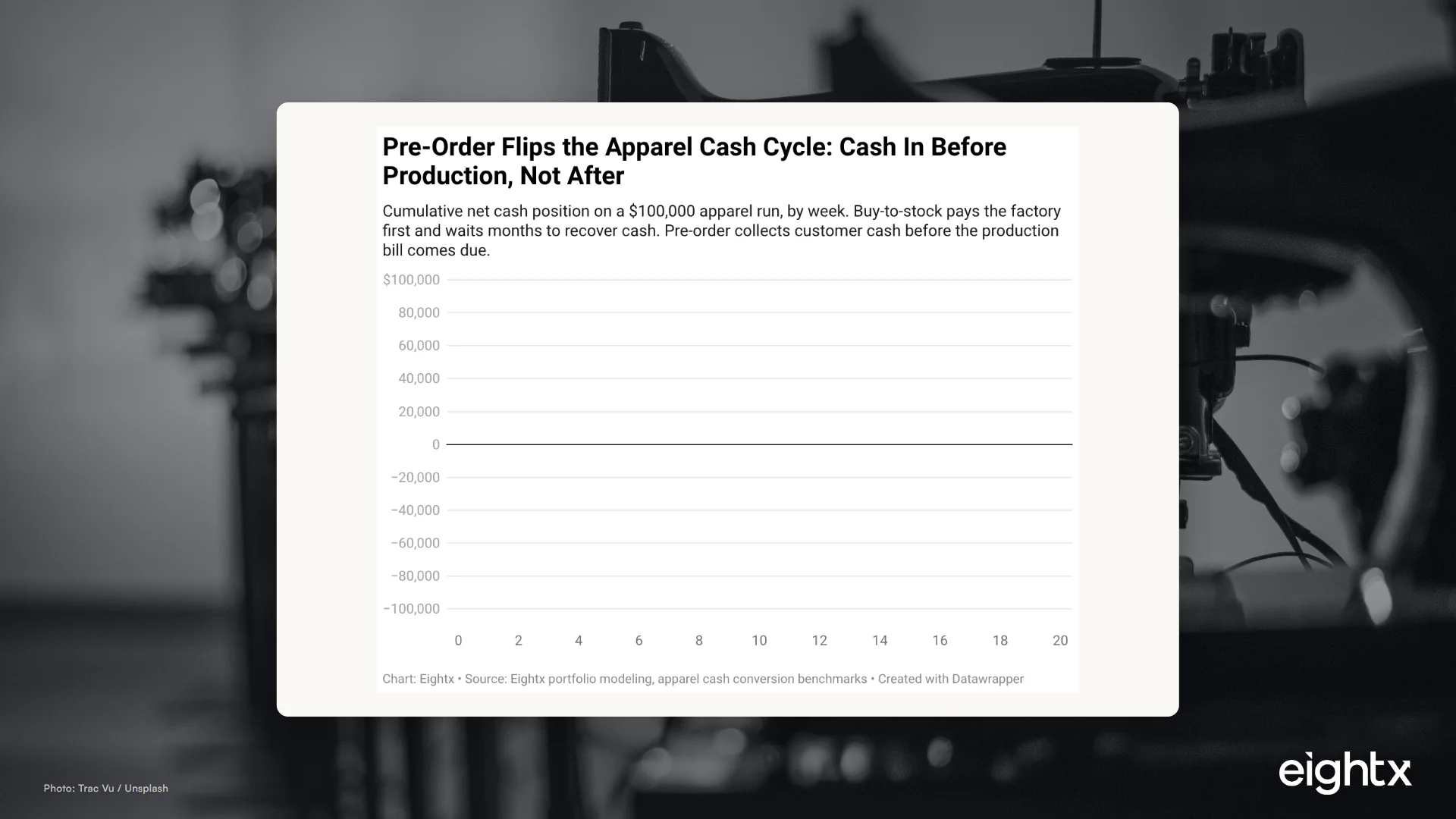
- On a $100,000 run, buy-to-stock sits around $100,000 in the hole for two to three months. Pre-order never drops that far because customer cash lands first.
- Pre-order and made-to-order cut markdown and overstock risk to near zero because you make what is already sold, protecting full-price selling.
- The tradeoffs are real: conversion drag from shipping delay, longer fulfillment, and higher refund and cancellation exposure on cash you have already collected.
- The right answer for most apparel brands is hybrid: stock evergreen core, pre-order new drops, sizes, and limited runs.
A $22M apparel brand I looked at was growing 40% a year with solid margins and still could not make payroll in Q4. The P&L was fine. The problem was the cash cycle: they paid the factory upfront, then waited four months for the inventory to land and sell. Every dollar of growth needed cash they had already shipped to a supplier overseas and had not gotten back yet.
Pre-order and made-to-order break that trap by changing one thing: when the customer's cash arrives relative to when you pay the factory. Buy-to-stock pays the supplier first and waits. Pre-order collects the customer's money first and uses it to fund production. That single reorder of the timeline is the most powerful working capital lever in apparel, and it comes with real tradeoffs that most founders underweight.
The apparel cash cycle is the actual problem
Apparel is slow inventory, and that is true even for the best operator in the category. Nike, in its FY2025 10-K filed with the SEC, carried $7,489M of finished goods against $26,519M of cost of goods sold, which works out to roughly 103 days of inventory, or about 3.5 turns a year. If the category leader sits near 100 days, a smaller brand's cash is parked even longer. Across the 9-company public apparel cohort we track from SEC 10-K filings, median inventory days are 128.8, which is roughly four months of stock sitting on the shelf. Apparel is just slow.
Now layer on the cash conversion cycle math. CCC = DIO + DSO - DPO:
- DIO (days inventory outstanding): around 120 days is the general-DTC benchmark, but the public apparel cohort actually runs higher at 128.8 days, so apparel sits at the upper end. Your cash is parked in product.
- DSO (days sales outstanding): 0 to 5 days on the DTC channel (processor payout timing), longer if you sell into retail or wholesale at 30 to 60 days.
- DPO (days payable outstanding): 30 to 45 days if you have negotiated terms. Most small apparel brands paying factories upfront have a DPO close to zero.
Put together, an early-stage DTC apparel brand runs a cash conversion cycle of 60 to 110 days, and a scaling one runs 90 to 160. That is the number of days your own cash is locked up in every production cycle. Grow faster and the hole gets deeper, because each cycle needs more cash than the last one returned. That is why working capital, not profit, is what actually constrains apparel growth.
When I talk to founders running a brand this size, the first thing I usually find is exactly this. One founder I worked with was carrying roughly 250 days of inventory, which meant their cash conversion cycle was enormous and every reorder made the squeeze worse. The diagnosis is almost always the same: the cash is not gone, it is just sitting in product. Here is what each component looks like under buy-to-stock versus pre-order or made-to-order.
| Component | Buy-to-stock (typical apparel) | Under pre-order / made-to-order |
|---|---|---|
| DIO (days inventory outstanding) | ~100 to 130 days | near zero (produce to demand) |
| DSO (days sales outstanding) | 0 to 5 days DTC; 30 to 60 wholesale | negative (cash collected before delivery) |
| DPO (days payable outstanding) | 0 if paying upfront; 30 to 60 with terms | 30 to 60 with terms |
| Cash conversion cycle | ~90 to 160 days | can go negative |
How pre-order flips the timeline
Pre-order and made-to-order attack the cash cycle from the front. Instead of paying the factory and waiting, you collect customer cash first and pay production out of it. The clearest way to see it is to model a single $100,000 run both ways.
Under buy-to-stock, you wire the factory roughly $100,000 at week 0. You are about $100,000 in the hole and you stay there for two to three months while goods are produced, shipped, and land in the warehouse around week 8. Then sell-through grinds across the next 120-ish inventory days before cumulative cash crosses back into positive territory near week 16. You financed the entire cycle.
Under pre-order, you launch at week 0 and customer cash arrives as orders come in, weeks 0 to 6. You pay the factory at production start, so the line dips briefly, then recovers as the rest of the orders and fulfillment settle. The cash position never falls anywhere near the buy-to-stock trough. In a clean pre-order, the customer finances your inventory, and your net working capital requirement on that run can approach zero or go negative.
The operators who have lived this describe it the same way. One founder put it to me as: cash conversion cycle is almost negative, meaning customers are paying us before we pay our suppliers, so even as we exit a cash crunch, how do we keep it this way? That is the right question, because once the customer is funding production, the whole growth math changes.
Buy-to-stock makes you the bank. Pre-order makes the customer the bank. Reorder one thing, when the cash arrives relative to when you pay the factory, and the working capital that used to cap your growth stops being your problem.
The second win: markdown and overstock risk goes to near zero
The cash-timing benefit gets the attention, but the markdown benefit may be worth more over a full season. When you buy to stock, you are forecasting demand and eating the gap. Forecast high and you carry dead inventory you eventually clear at successive markdowns, often 30, 40, then 50% off, which is margin you will never get back. Forecast low and you stock out on your best sellers.
Pre-order and made-to-order remove that bet. You produce what is already sold, so:
- Overstock waste is near zero. You are not guessing the size curve or color split; the orders tell you.
- Full-price selling discipline holds. No clearance pressure means no markdown spiral, which protects the gross margin that funds everything else.
- No capital sits in product that never sells. The most expensive inventory is the kind you discount to move and the kind you write off.
In a vertical where markdowns and high return rates are a structural margin headwind (Coresight put the online apparel return rate at 24.4% for the 12 months ended March 2023, and footwear runs higher at roughly 27%), producing only against committed demand is a quiet margin upgrade on top of the cash win.
The tradeoffs, because they are real
I am not going to pretend this is free. Pre-order and made-to-order cost you in three places, and brands that ignore them get burned.
- Conversion drag. There is no clean universal number for how much pre-order hurts conversion, and you should distrust anyone who quotes you one. But the direction is reliable: a shipping delay loses the shoppers who want it now. The offset is scarcity and exclusivity on a limited drop, which can lift conversion. The pattern I see again and again is that pre-order works best when the product justifies the wait. One founder I talked through this had a product that sold extremely well on pre-order, but it was an expensive utility item, not a fashion piece, so the customer was happy to wait. Net effect depends on your audience and how clearly you communicate the ship date.
- Fulfillment delay and execution risk. Made-to-order starts production after the sale, so delivery is slower by definition. Worse, you are now sitting on customer cash for product that has not shipped. If the factory slips, that delay becomes a trust and refund problem fast.
- Refund and cancellation exposure. You already have the customer's money, which means they can ask for it back. Long lead times, quality misses, and vague timelines all push cancellations up. That cash was never fully yours until the product shipped and stuck.
The fix for all three is the same: transparent, specific ship dates, regular updates, and a production timeline you can actually hit. Pre-order rewards operational discipline and punishes sloppiness harder than buy-to-stock does.
What to do about it
Here is how I would approach this with a $5M to $50M apparel brand.
- Calculate your real cash conversion cycle first. DIO + DSO - DPO, by channel, not blended. If you are over 90 to 100 days, you have a working capital problem worth fixing this quarter regardless of model.
- Segment your catalog. Evergreen core sellers where fast shipping wins the sale stay buy-to-stock. New drops, extended sizes and colors, collabs, and limited editions move to pre-order or made-to-order.
- Use pre-order to test demand before you commit production cash. A pre-order window is the cheapest demand forecast you will ever run. Hit a minimum order threshold, then produce. Miss it, refund, and you risked nothing.
- Set and hold the ship date. Pick a date you can beat, then beat it. Under-promise on the timeline the way you would never under-promise on the product.
- Negotiate supplier terms in parallel. Pre-order helps your DPO problem indirectly, but real net-30 or net-60 factory terms attack the same cash cycle from the other side. Operators at this stage tell us they have pushed factories to net-45 and negotiated standing order caps, and that DPO win stacks on top of the pre-order cash win. Use both levers, not one.
- Model the conversion tradeoff in dollars, not vibes. A lower conversion rate on a pre-order that needs zero working capital and carries zero markdown risk can still beat a higher-converting buy-to-stock run that ties up cash for four months. Do the math per launch.
Sources and methodology
The inventory anchor is primary-source verified. Nike's Form 10-K for the fiscal year ended May 31, 2025 (SEC EDGAR, CIK 0000320187) reports finished-goods inventory of $7,489M against cost of goods sold of $26,519M, which gives roughly 103 days inventory outstanding (7,489 / 26,519 x 365) and about 3.5 turns. The same filing states supplier payables are generally due 60 days after shipment, which is the source for the 60-day DPO ceiling cited above. This is finished-goods inventory only, so it slightly understates total-inventory days, which makes it a conservative "even the best operator sits near 100 days" benchmark.
The general cash cycle figures (DIO around 120 days, DPO 30 to 45 days, cash conversion cycle 60 to 160 days by stage) come from the Eightx cash conversion cycle benchmark for ecommerce brands; the 120-day DIO is the general-DTC anchor, and the apparel-specific public cohort actually runs higher at 128.8 days. DTC apparel DSO is near zero (0 to 5 days, set by processor payout timing) rather than the higher general-ecommerce figure. A 2026 vertical dataset puts the median apparel cash conversion cycle around 112 days, in the same band. These vendor benchmarks (the 112-day apparel CCC and the Eightx DIO/DSO/DPO and CCC ranges) are directional, not audited, and should be treated as ranges. Apparel inventory days (median 128.8 across nine public brands) come from our apparel public benchmarks, sourced from SEC 10-K filings via EDGAR.
The return-rate figure (24.4% of online apparel orders) is from Coresight Research, covering the 12 months ended March 2023. It is the freshest credible apparel-specific return benchmark we found, so we cite it with the date attached rather than implying it is a current-year number.
The $100,000 cash-timeline chart is illustrative and directional, built on those benchmark assumptions (factory paid upfront, goods landing around week 8, roughly 120-day sell-through, pre-order cash arriving weeks 0 to 6), not a guarantee for any specific brand.
The qualitative points on conversion drag, markdown reduction, and refund risk are drawn from industry reporting on pre-order and made-to-order models plus anonymized founder calls. There is no reliable universal percentage for pre-order conversion impact or apparel cancellation rates, so those are framed as direction and ranges rather than hard figures. The McKinsey State of Fashion 2026 finding that working capital is under pressure from overstock supports the markdown argument but is directional, not a measured input.
Frequently Asked Questions
do pre-orders convert worse than in-stock products?
Usually a little, yes, for the shoppers who want it now. There is no clean universal benchmark, but a delivery delay reliably costs some conversion because immediacy buyers drop off. The offset is urgency, scarcity, and exclusivity, which can lift conversion on a limited drop. Net effect depends on your audience and how clearly you set the ship date.
how does made-to-order improve cash flow?
Made-to-order collects the customer payment before or near the moment you commit production cash, so you fund the factory with the customer's money instead of your own. That shortens or reverses the cash conversion cycle and removes capital tied up in unsold stock, warehousing, and clearance. It is the single biggest working capital lever in apparel.
what is the difference between pre-order and made-to-order?
Pre-order sells a defined run before it lands, then you produce in a batch against committed demand. Made-to-order produces each unit only after it is sold, often customized. Both collect cash early. Made-to-order goes furthest on inventory risk because nothing is built speculatively, but it carries the longest lead time and the most per-unit production friction.
what are the risks of selling apparel on pre-order?
Three main ones. Conversion drag from the shipping delay. Fulfillment risk if the factory slips and you are sitting on cash for product that has not shipped. And refund or cancellation exposure, because you have already collected money customers can ask back. Transparent ship dates and tight production timelines are what keep all three contained.
should an apparel brand use pre-order or buy-to-stock?
Most should use both. Stock your evergreen core where fast shipping wins the sale, and run pre-order or made-to-order for new drops, extended sizes and colors, and limited editions. Hybrid lets you protect conversion on proven sellers while using pre-order to test demand and fund production on everything unproven.
can pre-order give an apparel brand a negative cash conversion cycle?
Yes. If customer cash arrives before you pay the factory and before goods ship, the cash conversion cycle can go negative, meaning customers finance your inventory. Buy-to-stock does the opposite: you pay first and wait roughly 120 inventory days plus collection time to recover cash. The swing between the two is the whole point.
For more on the apparel cash picture, see how a fractional CFO for apparel brands thinks about it, and read our companion pieces on apparel seasonal cash flow and apparel drop model economics.